Nevada: Parking rules — Part 2 Practice Test
Questions in this part include: “After parallel parking an automatic transmission car, to what position do you shift when correctly positioned?” · “How close to a fire hydrant may you not park in a place where parallel parking is permitted?”
Independent educational site · not affiliated with any government agency or DMV
Ready? Test yourself
- Instant feedback with an explanation
- Every answer cites its source in the manual
- Your best score is saved on this device
- Keyboard: press 1 to 4 to answer and Enter for the next question
Questions are original and based on the official manual "Nevada Driver's Handbook" (March 2024 (DMV 700)), Nevada Department of Motor Vehicles.
All 17 questions in this practice test
Take the test above first, then use this list to study. Tap “Show answer” to see the correct answer and explanation.
Show the questions and answersHide the questions
-
While parallel parking on the right side, what should you do when the back of your front seat is in line with the rear bumper of the car you are parking behind?
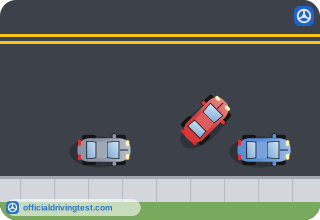
- Stop and turn the steering wheel all the way to the right again
- Shift to drive and pull forward to straighten the car out
- Keep turning the wheel to the right while you keep backing up
- Straighten the wheels by steering smoothly and quickly to the left
Show answer
Correct answer: Straighten the wheels by steering smoothly and quickly to the left
At that point you straighten the wheels by steering smoothly and quickly to the left, keeping your speed slow.
Source: Nevada Driver's Handbook (March 2024 (DMV 700)), page 49 · Open this page in the manual (Manual page 49)
-
When parallel parking on the right side, what happens if you do not straighten your front wheels at the right time?
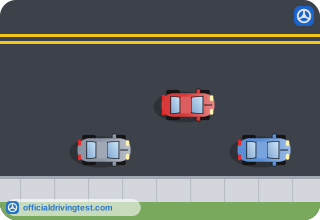
- Your left front fender will hit the car ahead
- Your car will stop 5 feet from the curb
- Your right rear wheel will hit the curb
- Your engine will stall
Show answer
Correct answer: Your right rear wheel will hit the curb
The handbook says that if you do not straighten your front wheels, your right rear wheel will hit the curb.
Source: Nevada Driver's Handbook (March 2024 (DMV 700)), page 49 · Open this page in the manual (Manual page 49)
-
When parallel parking on the right side, what may happen if you turn your steering wheel too far to the left?
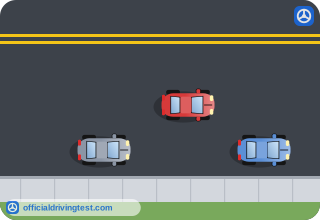
- Your right front fender may hit the car you are parking behind
- Your right rear wheel will hit the curb and the steering will lock
- Your rear bumper will hit the car behind the space
- Your car will stop 5 feet from the curb
Show answer
Correct answer: Your right front fender may hit the car you are parking behind
If you turn your steering wheel too far to the left, your right front fender may hit the car you are parking behind.
Source: Nevada Driver's Handbook (March 2024 (DMV 700)), page 49 · Open this page in the manual (Manual page 49)
-
While parallel parking on the right side, how far do you continue to back up slowly after straightening the wheels?
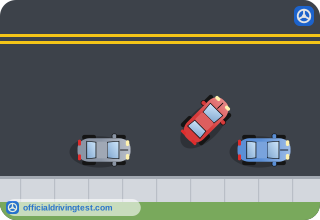
- Until your front bumper touches the other car's rear bumper
- Until your car is 5 feet from the curb
- Until your front fender just clears the other car's left bumper
- Until your rear wheel touches the curb
Show answer
Correct answer: Until your front fender just clears the other car's left bumper
You continue to back up slowly until your front fender just clears the other car’s left bumper.
Source: Nevada Driver's Handbook (March 2024 (DMV 700)), page 49 · Open this page in the manual (Manual page 49)
-
While backing into the last part of a parallel parking space on the right, which way do you look and steer?
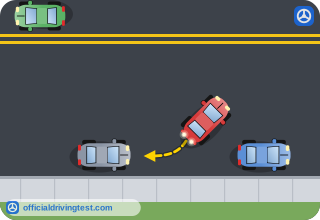
- Over your right shoulder, steering the wheel to the left
- Over your left shoulder, steering the wheel to the right
- Over your right shoulder, steering the wheel to the right
- Into the rearview mirror only, with the wheel straight
Show answer
Correct answer: Over your right shoulder, steering the wheel to the left
You look over your right shoulder and back slowly, turning the steering wheel to the left and stopping before your car touches the vehicle behind you.
Source: Nevada Driver's Handbook (March 2024 (DMV 700)), page 49 · Open this page in the manual (Manual page 49)
-
After backing into the parallel parking space, what do you do next?
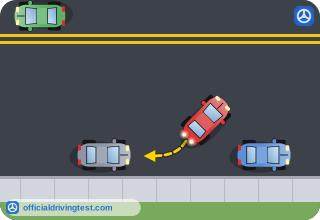
- Shift to park and leave the car where it is
- Shift to reverse and back up until you touch the curb
- Turn off the engine and walk back to check the space
- Shift to drive and center your car in the space
Show answer
Correct answer: Shift to drive and center your car in the space
You shift to drive, move slowly forward, turn the steering wheel to the right to straighten the wheels, and center your car in the space.
Source: Nevada Driver's Handbook (March 2024 (DMV 700)), page 49 · Open this page in the manual (Manual page 49)
-
After parallel parking an automatic transmission car, to what position do you shift when correctly positioned?
- Neutral
- Park
- Drive
- Reverse
Show answer
Correct answer: Park
When you are correctly positioned, you stop and shift to park in an automatic transmission car, then set the parking brake.
Source: Nevada Driver's Handbook (March 2024 (DMV 700)), page 49 · Open this page in the manual (Manual page 49)
-
After parallel parking a manual transmission car, which gear do you use when correctly positioned, in addition to setting the parking brake?
- First gear or reverse
- Second gear or neutral
- Neutral
- Third gear
Show answer
Correct answer: First gear or reverse
In a manual transmission car you shift to first gear or reverse and set the parking brake.
Source: Nevada Driver's Handbook (March 2024 (DMV 700)), page 49 · Open this page in the manual (Manual page 49)
-
As you approach a parallel parking space, what should you check first?
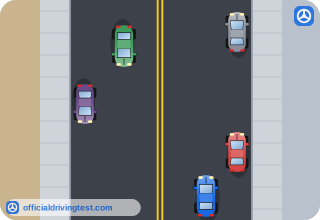
- The traffic in front of the car ahead
- Whether your wheels are straight
- The traffic beside and behind you
- The distance to the curb ahead
Show answer
Correct answer: The traffic beside and behind you
As you approach the space, you check the traffic beside and behind you before using your turn signal.
Source: Nevada Driver's Handbook (March 2024 (DMV 700)), page 49 · Open this page in the manual (Manual page 49)
-
As you approach a parallel parking space, what do you use to show you are preparing to park?
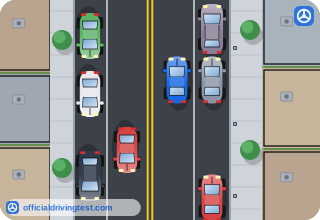
- Your four-way flashers
- Your turn signal
- Your horn
- Your parking lights
Show answer
Correct answer: Your turn signal
If the driver behind you is far enough away to stop or move around you safely, you use your turn signal to show you are preparing to park.
Source: Nevada Driver's Handbook (March 2024 (DMV 700)), page 49 · Open this page in the manual (Manual page 49)
-
The handbook's parallel parking steps are for parking on the right side of the road. What do you do to park on the left side?
- Use the same actions without any change
- Back in with the wheels turned all the way to the right
- Enter the space nose first
- Use the opposite actions
Show answer
Correct answer: Use the opposite actions
The guide is for the right side of the road, and you use the opposite actions for parking on the left side.
Source: Nevada Driver's Handbook (March 2024 (DMV 700)), page 49 · Open this page in the manual (Manual page 49)
-
When parking on a hill, why do you turn your front tires?
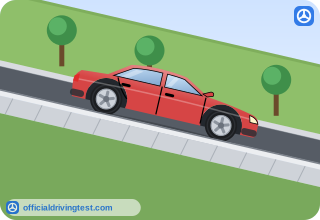
- So the vehicle can pull out faster when traffic clears
- So the parking brake does not have to be set
- So the wheels do not touch the curb or the shoulder
- So a rolling vehicle moves away from traffic or into the curb
Show answer
Correct answer: So a rolling vehicle moves away from traffic or into the curb
You turn your front tires so that if your vehicle should start to roll, it will move away from traffic or into the curb.
Source: Nevada Driver's Handbook (March 2024 (DMV 700)), page 49 · Open this page in the manual (Manual page 49)
-
When your vehicle is parked headed downhill, which way should you turn your front tires?
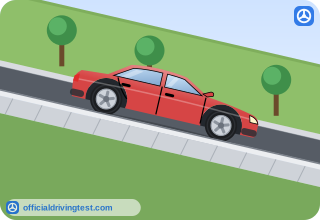
- Away from the curb or road shoulder
- Toward or into the curb or road shoulder
- Straight ahead, parallel to the road
- Toward the center of the road
Show answer
Correct answer: Toward or into the curb or road shoulder
When headed downhill, you turn your front tires toward or into the curb or road shoulder.
Source: Nevada Driver's Handbook (March 2024 (DMV 700)), page 49 · Open this page in the manual (Manual page 49)
-
When your vehicle is parked headed uphill and there is a curb, which way should you turn your front tires?
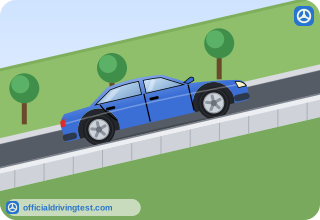
- Away from the curb
- Toward the curb
- Straight ahead
- Any direction, once the parking brake is set
Show answer
Correct answer: Away from the curb
When headed uphill and there is a curb, you turn your front tires away from the curb.
Source: Nevada Driver's Handbook (March 2024 (DMV 700)), page 49 · Open this page in the manual (Manual page 49)
-
When your vehicle is parked headed uphill and there is no curb, which way should you turn your front tires?
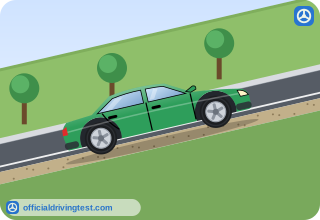
- Away from the road shoulder
- Straight ahead
- Toward the road shoulder
- Toward the center of the road
Show answer
Correct answer: Toward the road shoulder
When headed uphill with no curb, you turn your front tires toward the road shoulder, and you always set the parking brake.
Source: Nevada Driver's Handbook (March 2024 (DMV 700)), page 49 · Open this page in the manual (Manual page 49)
-
How close to a fire hydrant may you not park in a place where parallel parking is permitted?
- Within 5 feet
- Within 15 feet
- Within 10 feet
- Within 30 feet
Show answer
Correct answer: Within 15 feet
You may not park within 15 feet of a fire hydrant in a place where parallel parking is permitted.
Source: Nevada Driver's Handbook (March 2024 (DMV 700)), page 50 · Open this page in the manual (Manual page 50)
-
How close to a fire hydrant may you not park in a place where angle parking is permitted?
- Within 5 feet
- Within 10 feet
- Within 15 feet
- Within 20 feet
Show answer
Correct answer: Within 20 feet
Where angle parking is permitted, you may not park within 20 feet of a fire hydrant.
Source: Nevada Driver's Handbook (March 2024 (DMV 700)), page 50 · Open this page in the manual (Manual page 50)