Nevada: Parking rules — Part 1 Practice Test
Questions in this part include: “Whenever you park and leave your vehicle, what should you do?” · “When a roadway has no curb or other barrier and no signs or markings give instruction, how should you park?”
Independent educational site · not affiliated with any government agency or DMV
Ready? Test yourself
- Instant feedback with an explanation
- Every answer cites its source in the manual
- Your best score is saved on this device
- Keyboard: press 1 to 4 to answer and Enter for the next question
Questions are original and based on the official manual "Nevada Driver's Handbook" (March 2024 (DMV 700)), Nevada Department of Motor Vehicles.
All 17 questions in this practice test
Take the test above first, then use this list to study. Tap “Show answer” to see the correct answer and explanation.
Show the questions and answersHide the questions
-
Whenever you park and leave your vehicle, what should you do?
- Leave the engine idling and set the hazard flashers
- Turn off the engine and leave the front wheels straight
- Turn off the engine and set the parking brake
- Shift to neutral and leave the parking brake off
Show answer
Correct answer: Turn off the engine and set the parking brake
The handbook says that whenever you park and leave your vehicle you turn off the engine and set the parking (emergency) brake.
Source: Nevada Driver's Handbook (March 2024 (DMV 700)), page 48 · Open this page in the manual (Manual page 48)
-
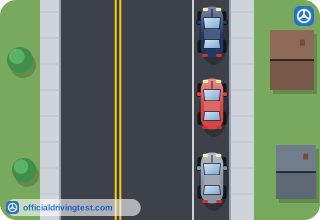
Before opening your door to get out of a parked vehicle, what should you do?
- Sound the horn once to warn others
- Look carefully for bicycles and other vehicles
- Turn on your four-way flashers
- Open the door halfway and step out quickly
Show answer
Correct answer: Look carefully for bicycles and other vehicles
Before opening your door to get out, you should look carefully for bicycles and other vehicles.
Source: Nevada Driver's Handbook (March 2024 (DMV 700)), page 48 · Open this page in the manual (Manual page 48)
-
Which way should your parked vehicle face?
- Toward oncoming traffic so you can see it
- At an angle to the road
- Away from the direction of traffic
- In the direction that normal traffic flows
Show answer
Correct answer: In the direction that normal traffic flows
The handbook says a parked vehicle should face in the direction that normal traffic flows.
Source: Nevada Driver's Handbook (March 2024 (DMV 700)), page 48 · Open this page in the manual (Manual page 48)
-
What is the legal parking position in relation to the curb?
- Front and rear wheels within 6 inches of the curb
- Front and rear wheels within 36 inches of the curb
- Front and rear wheels within 18 inches of the curb
- Front and rear wheels within 5 feet of the curb
Show answer
Correct answer: Front and rear wheels within 18 inches of the curb
The legal parking position is with the front and rear wheels within 18 inches of the curb.
Source: Nevada Driver's Handbook (March 2024 (DMV 700)), page 48 · Open this page in the manual (Manual page 48)
-
How far in each direction should your parked vehicle be visible?
- 200 feet
- 50 feet
- 100 feet
- 500 feet
Show answer
Correct answer: 200 feet
The handbook says your parked vehicle should be visible for 200 feet (about 20 car lengths) in each direction.
Source: Nevada Driver's Handbook (March 2024 (DMV 700)), page 48 · Open this page in the manual (Manual page 48)
-
When a roadway has no curb or other barrier and no signs or markings give instruction, how should you park?
- At an angle to the road
- Facing the road at a right angle
- Parallel to the road
- Backed in toward the road
Show answer
Correct answer: Parallel to the road
With no curb or barrier and no signs or markings, you should park parallel to the road.
Source: Nevada Driver's Handbook (March 2024 (DMV 700)), page 48 · Open this page in the manual (Manual page 48)
-
If you must stop on a highway, where should you park if possible?
- With all four wheels well off the pavement
- With two wheels on the pavement and two off
- In the right lane, close to the curb
- Just past the crest of a hill so others see you
Show answer
Correct answer: With all four wheels well off the pavement
If you must stop on a highway, park with all four wheels well off the pavement, if possible, leaving enough space for other vehicles to pass safely.
Source: Nevada Driver's Handbook (March 2024 (DMV 700)), page 48 · Open this page in the manual (Manual page 48)
-
If you must stop on a highway, when should you use your parking lights or four-way flashers?
- Only if you stay inside the vehicle
- Only if you are stopped for more than 10 minutes
- Only between midnight and sunrise
- If visibility is poor, or between sunset and sunrise
Show answer
Correct answer: If visibility is poor, or between sunset and sunrise
The handbook says to use your parking lights or four-way flashers if visibility is poor, or if it is between sunset and sunrise.
Source: Nevada Driver's Handbook (March 2024 (DMV 700)), page 48 · Open this page in the manual (Manual page 48)
-
What should you always use when you have to use emergency parking areas on highways and freeways?
- Your high-beam headlights and horn
- Four-way flashers or parking lights
- Your left turn signal and wipers
- Your horn every few seconds
Show answer
Correct answer: Four-way flashers or parking lights
When you use emergency parking areas on highways and freeways, you should always use your four-way flashers or parking lights.
Source: Nevada Driver's Handbook (March 2024 (DMV 700)), page 48 · Open this page in the manual (Manual page 48)
-
Which curb color usually indicates a very short stop only, to take on or let off passengers or to drop mail in a mailbox?
- Green
- Yellow
- White
- Blue
Show answer
Correct answer: White
A white curb usually indicates you are allowed a very short stop only to take on or let off passengers, or to drop mail in a mailbox.
Source: Nevada Driver's Handbook (March 2024 (DMV 700)), page 48 · Open this page in the manual (Manual page 48)
-
Which curb color allows you to park for a limited time, usually shown on a sign?
- White
- Green
- Red
- Yellow
Show answer
Correct answer: Green
A green curb allows you to park for a limited time, and the amount of time is usually shown on a sign.
Source: Nevada Driver's Handbook (March 2024 (DMV 700)), page 48 · Open this page in the manual (Manual page 48)
-
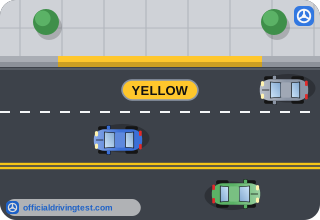
What does a yellow curb mean?
- Parking for a limited time shown on a sign
- No stopping, standing or parking
- A very short stop to drop mail only
- A loading zone; rules depend on local laws
Show answer
Correct answer: A loading zone; rules depend on local laws
A yellow curb means a loading zone, and the rules depend on local laws.
Source: Nevada Driver's Handbook (March 2024 (DMV 700)), page 48 · Open this page in the manual (Manual page 48)
-
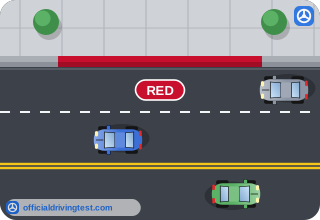
What does a red curb mean?
- A loading zone where rules depend on local laws
- Parking for a limited time shown on a sign
- Handicapped parking only
- No stopping, standing or parking; local laws apply
Show answer
Correct answer: No stopping, standing or parking; local laws apply
A red curb means no stopping, standing or parking, and local laws apply.
Source: Nevada Driver's Handbook (March 2024 (DMV 700)), page 48 · Open this page in the manual (Manual page 48)
-
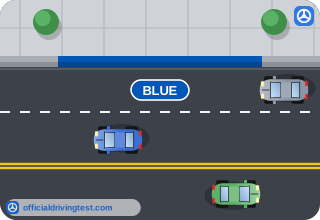
What does a blue curb designate?
- A loading zone
- Handicapped parking areas
- Parking for a limited time
- A very short stop only
Show answer
Correct answer: Handicapped parking areas
A blue curb designates handicapped parking areas.
Source: Nevada Driver's Handbook (March 2024 (DMV 700)), page 48 · Open this page in the manual (Manual page 48)
-
When parallel parking, the open space between two cars should be about how much longer than your car?
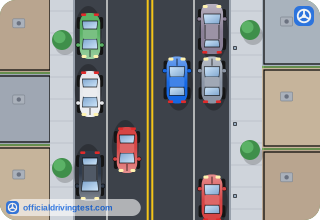
- About 5 feet
- About 1 foot
- About 10 feet
- About 15 feet
Show answer
Correct answer: About 5 feet
The space should be big enough for your vehicle, about 5 feet longer than your car.
Source: Nevada Driver's Handbook (March 2024 (DMV 700)), page 49 · Open this page in the manual (Manual page 49)
-
When starting to parallel park, how far from the car beside you should your car be as you line up the rear bumpers?
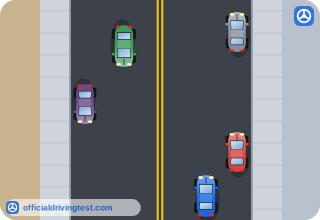
- About 6 inches
- About 10 feet
- About 2 or 3 feet
- About 15 feet
Show answer
Correct answer: About 2 or 3 feet
Your car should be about 2 or 3 feet away from the car beside you, with your rear bumpers lined up across from each other.
Source: Nevada Driver's Handbook (March 2024 (DMV 700)), page 49 · Open this page in the manual (Manual page 49)
-
When parallel parking on the right side of the road, how do you turn the steering wheel as you first slowly back up into the space?
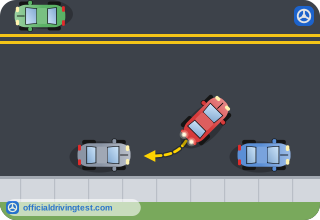
- All the way to the left
- All the way to the right
- Halfway to the left
- Keep the wheels straight
Show answer
Correct answer: All the way to the right
You slowly back up with the steering wheel turned all the way to the right.
Source: Nevada Driver's Handbook (March 2024 (DMV 700)), page 49 · Open this page in the manual (Manual page 49)