Nevada: Emergency vehicles, work zones and police stops — Part 2 Practice Test
Questions in this part include: “What is often used to control traffic in highway work zones?” · “When may visibility in a work zone be reduced especially?”
Independent educational site · not affiliated with any government agency or DMV
Ready? Test yourself
- Instant feedback with an explanation
- Every answer cites its source in the manual
- Your best score is saved on this device
- Keyboard: press 1 to 4 to answer and Enter for the next question
Questions are original and based on the official manual "Nevada Driver's Handbook" (March 2024 (DMV 700)), Nevada Department of Motor Vehicles.
All 18 questions in this practice test
Take the test above first, then use this list to study. Tap “Show answer” to see the correct answer and explanation.
Show the questions and answersHide the questions
-
What is often used to control traffic in highway work zones?
- Traffic circles and metered ramps
- Toll gates and weigh stations
- Flaggers and pilot cars
- Photo radar vans only
Show answer
Correct answer: Flaggers and pilot cars
Flaggers and pilot cars are often used to control traffic in work zones.
Source: Nevada Driver's Handbook (March 2024 (DMV 700)), page 60 · Open this page in the manual (Manual page 60)
-
What happens if you move any barriers or signs to cross over a road that is closed to traffic?
- It is allowed when no workers are working nearby and the road looks clear
- It is illegal and you are subject to double penalties for work-zone violations
- It is allowed if you drive slowly
- It brings only a written warning
Show answer
Correct answer: It is illegal and you are subject to double penalties for work-zone violations
Moving barriers or signs to cross a closed road is illegal and brings double penalties for work-zone violations.
Source: Nevada Driver's Handbook (March 2024 (DMV 700)), page 60 · Open this page in the manual (Manual page 60)
-
What happens to fines for speeding in work zones?
- They triple
- They stay the same
- They increase by half
- They double
Show answer
Correct answer: They double
Fines for speeding double in work zones.
Source: Nevada Driver's Handbook (March 2024 (DMV 700)), page 60 · Open this page in the manual (Manual page 60)
-
Which speed limit signs in a work zone are regulatory?
- Black and white
- Orange
- Yellow
- Green
Show answer
Correct answer: Black and white
Black and white speed limit signs are regulatory, while orange speed limit signs are advisory.
Source: Nevada Driver's Handbook (March 2024 (DMV 700)), page 60 · Open this page in the manual (Manual page 60)
-
What do orange speed limit signs in a work zone indicate?
- Regulatory limits enforced by law
- The end of the work zone
- Advisory slower, safer speeds
- The minimum speed allowed
Show answer
Correct answer: Advisory slower, safer speeds
Orange speed limit signs are advisory and indicate slower, safer speeds.
Source: Nevada Driver's Handbook (March 2024 (DMV 700)), page 60 · Open this page in the manual (Manual page 60)
-
If time is a concern when a work zone is ahead, what does the handbook suggest?
- Speed up in the work zone to make up time
- Consider another route or start your trip earlier
- Drive on the shoulder to pass slow traffic
- Follow the vehicle ahead more closely
Show answer
Correct answer: Consider another route or start your trip earlier
The handbook says that if time is a concern, you should consider another route or start your trip earlier.
Source: Nevada Driver's Handbook (March 2024 (DMV 700)), page 60 · Open this page in the manual (Manual page 60)
-
When may visibility in a work zone be reduced especially?
- At noon
- On dry days
- On weekends
- At night
Show answer
Correct answer: At night
Visibility in a work zone may be reduced, especially at night.
Source: Nevada Driver's Handbook (March 2024 (DMV 700)), page 60 · Open this page in the manual (Manual page 60)
-
What should you do whenever you see orange signs on the road?
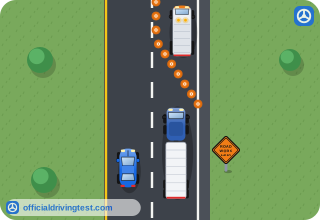
- Slow down and watch for equipment and people working on the road
- Speed up to clear the area before traffic backs up behind you
- Move to the far left lane
- Turn on your high beams
Show answer
Correct answer: Slow down and watch for equipment and people working on the road
Orange signs mean you should slow down and watch for equipment and people working on the road.
Source: Nevada Driver's Handbook (March 2024 (DMV 700)), page 60 · Open this page in the manual (Manual page 60)
-
What should you do when flaggers are directing traffic in a work zone?
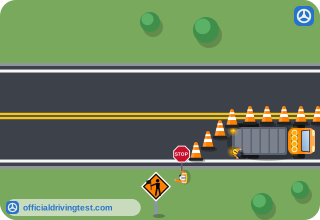
- Ignore them if no workers are close
- Follow the signs only
- Follow their instructions
- Follow the vehicle ahead only
Show answer
Correct answer: Follow their instructions
Be aware of flaggers working to direct traffic and follow their instructions for everyone’s safety.
Source: Nevada Driver's Handbook (March 2024 (DMV 700)), page 60 · Open this page in the manual (Manual page 60)
-
How should you merge in a work zone?
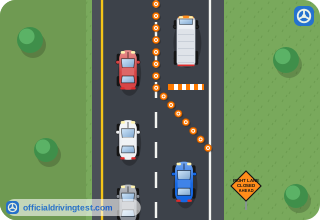
- Quickly, ahead of other traffic
- Carefully and cooperatively
- Only after stopping completely
- At the very last moment
Show answer
Correct answer: Carefully and cooperatively
The handbook says to merge carefully and cooperatively in a work zone.
Source: Nevada Driver's Handbook (March 2024 (DMV 700)), page 60 · Open this page in the manual (Manual page 60)
-
Which of these stopped vehicles does the handbook name among those drivers have certain duties when approaching?
- A taxicab
- A rental truck
- A passenger van
- A garbage truck
Show answer
Correct answer: A garbage truck
Garbage trucks are among the stopped emergency, utility or service vehicles drivers must approach with certain duties.
Source: Nevada Driver's Handbook (March 2024 (DMV 700)), page 61 · Open this page in the manual (Manual page 61)
-
The duties for approaching a stopped emergency, utility or service vehicle also apply to whom?
- Anyone attending to a repair of a vehicle
- Only officers writing a report
- Only drivers parked on the shoulder
- Only road crews at work zones
Show answer
Correct answer: Anyone attending to a repair of a vehicle
The rules for approaching stopped emergency, utility or service vehicles also apply to anyone attending to a repair of a vehicle.
Source: Nevada Driver's Handbook (March 2024 (DMV 700)), page 61 · Open this page in the manual (Manual page 61)
-
How must you adjust your speed when approaching a stopped emergency, utility or service vehicle?
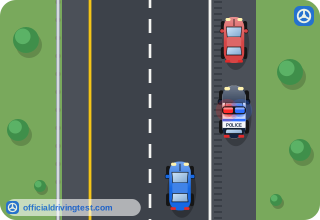
- Keep to the posted speed limit exactly
- Increase speed to pass it quickly before it pulls back into traffic
- Decrease to a reasonable and proper speed less than the posted limit
- Stop completely until it leaves
Show answer
Correct answer: Decrease to a reasonable and proper speed less than the posted limit
Drivers must decrease speed to a speed that is reasonable and proper and less than the posted speed limit.
Source: Nevada Driver's Handbook (March 2024 (DMV 700)), page 61 · Open this page in the manual (Manual page 61)
-
Besides decreasing speed, what must you do when approaching a stopped emergency, utility or service vehicle?
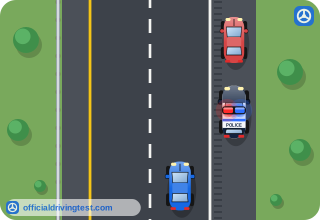
- Sound your horn and flash your headlights as you pass
- Proceed with caution and be prepared to stop
- Flash your headlights at it
- Stop until it moves
Show answer
Correct answer: Proceed with caution and be prepared to stop
Drivers must proceed with caution and be prepared to stop.
Source: Nevada Driver's Handbook (March 2024 (DMV 700)), page 61 · Open this page in the manual (Manual page 61)
-
When approaching a stopped emergency vehicle, which lane should you use if possible?
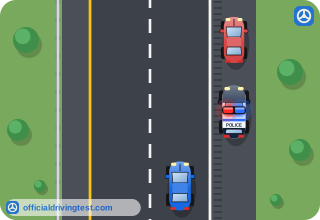
- The lane right next to the stopped vehicle, at a reduced speed
- Any lane, stopping beside the vehicle
- The lane farthest to the right only
- A lane that is not adjacent to the lane in which the vehicle is stopped
Show answer
Correct answer: A lane that is not adjacent to the lane in which the vehicle is stopped
If possible, drive in a lane that is not adjacent to the lane in which the emergency vehicle is stopped, unless conditions make it unsafe or impossible.
Source: Nevada Driver's Handbook (March 2024 (DMV 700)), page 61 · Open this page in the manual (Manual page 61)
-
Under what condition may certain emergency vehicles drive on the paved shoulder of a highway?
- If signage placed along the highway authorizes its use
- If the traffic lanes are empty and no other vehicles are near
- Whenever traffic is heavy
- At any time of day or night
Show answer
Correct answer: If signage placed along the highway authorizes its use
Certain emergency vehicles may drive on the paved shoulder of a highway if signage placed along the highway authorizes its use.
Source: Nevada Driver's Handbook (March 2024 (DMV 700)), page 61 · Open this page in the manual (Manual page 61)
-
What is true of a highway shoulder that is marked to allow emergency use?
- Any driver may stop on it for up to five minutes
- Drivers may stop on it if their hazard lights are on
- Drivers of non-emergency vehicles may not stop on it
- Drivers may stop on it only during daylight hours
Show answer
Correct answer: Drivers of non-emergency vehicles may not stop on it
Drivers of non-emergency vehicles may not stop on a shoulder marked to allow emergency use.
Source: Nevada Driver's Handbook (March 2024 (DMV 700)), page 61 · Open this page in the manual (Manual page 61)
-
Which of these may use a paved shoulder where signage authorizes its use?
- Taxicabs
- Public transit buses
- Delivery trucks
- Motorcycles
Show answer
Correct answer: Public transit buses
The listed vehicles that may use a paved shoulder include public transit buses.
Source: Nevada Driver's Handbook (March 2024 (DMV 700)), page 61 · Open this page in the manual (Manual page 61)