Nevada: Emergency vehicles, work zones and police stops
Yielding to emergency vehicles, approaching stopped emergency and service vehicles, work zones and being stopped by law enforcement. Split into 2 shorter tests so you're not stuck in one long quiz.
Independent educational site · not affiliated with any government agency or DMV
Choose a part
Emergency vehicles, work zones and police stops — Part 1
Questions in this part include: “What shape are most signs used in highway and street work areas?”
StartEmergency vehicles, work zones and police stops — Part 2
Questions in this part include: “What is often used to control traffic in highway work zones?”
StartAll 37 Emergency vehicles, work zones and police stops questions with answers
Choose a part above to take a practice test, or study every question and answer here.
Show the questions and answersHide the questions
-
An emergency vehicle using a siren and red lights is approaching. What must you do?
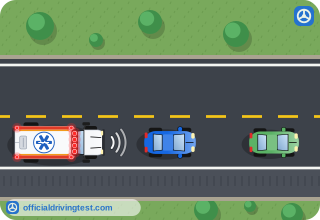
- Speed up and clear the intersection before it arrives
- Stop in the lane you are in and wait for it to pass
- Drive to the right edge of the road and stop until it has passed
- Pull onto the left edge of the road and keep moving slowly
Show answer
Correct answer: Drive to the right edge of the road and stop until it has passed
You must yield to an emergency vehicle using a siren and red lights by driving to the right edge of the road and stopping until it has passed.
Source: Nevada Driver's Handbook (March 2024 (DMV 700)), page 29 · Open this page in the manual (Manual page 29)
-
When yielding to an emergency vehicle using a siren and red lights, where must you never stop?
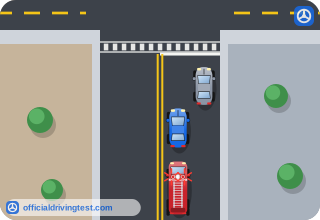
- In an intersection
- At the right edge of the road
- Beside the curb on your right
- Behind a parked vehicle
Show answer
Correct answer: In an intersection
When yielding to an emergency vehicle, never stop in an intersection.
Source: Nevada Driver's Handbook (March 2024 (DMV 700)), page 29 · Open this page in the manual (Manual page 29)
-
What shape are most signs used in highway and street work areas?
- Diamond-shaped
- Octagonal
- Round
- Pentagon-shaped
Show answer
Correct answer: Diamond-shaped
Construction and maintenance signs warn drivers of possible danger in or near work areas, and most of them are diamond-shaped.
Source: Nevada Driver's Handbook (March 2024 (DMV 700)), page 30 · Open this page in the manual (Manual page 30)
-
What are cones, drums, and barricades used for in work areas?
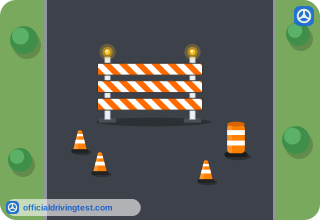
- To mark where work crews are allowed to park their vehicles
- To show drivers the permanent speed limit of the road
- To alert drivers and guide them safely through work areas
- To tell drivers that the work area has already ended
Show answer
Correct answer: To alert drivers and guide them safely through work areas
Cones, drums, and barricades alert drivers and guide them safely through work areas.
Source: Nevada Driver's Handbook (March 2024 (DMV 700)), page 30 · Open this page in the manual (Manual page 30)
-
For night work, what may cones, drums, and barricades be equipped with?
- Speed radar displays
- Warning lights
- Loudspeakers
- Pedestrian signals
Show answer
Correct answer: Warning lights
For night work, cones, drums, and barricades may be equipped with warning lights.
Source: Nevada Driver's Handbook (March 2024 (DMV 700)), page 30 · Open this page in the manual (Manual page 30)
-
When cones, drums, posted signs, or construction flaggers are in a work area, what must drivers do?
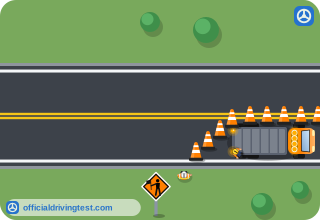
- Follow the posted signs but ignore any flaggers who are present
- Maintain normal speed unless a police officer is present
- Stop completely and wait for the cones to be removed
- Slow down and follow the direction of the posted signs and any flaggers
Show answer
Correct answer: Slow down and follow the direction of the posted signs and any flaggers
Drivers must slow down and follow the direction of the posted signs and any construction flaggers who may be present.
Source: Nevada Driver's Handbook (March 2024 (DMV 700)), page 30 · Open this page in the manual (Manual page 30)
-
What happens to traffic fines for violations in work zones?
- They are increased
- They are waived for a first violation
- They stay the same as elsewhere
- They apply only at night
Show answer
Correct answer: They are increased
Violations in work zones result in increased traffic fines.
Source: Nevada Driver's Handbook (March 2024 (DMV 700)), page 30 · Open this page in the manual (Manual page 30)
-
An emergency vehicle is approaching with its siren sounding and its lights flashing. What must you immediately do?
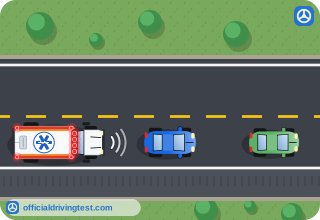
- Slow down and keep driving in your lane until it has passed
- Stop where you are, even if you are inside an intersection
- Drive to the right side of the road, clear of any intersection, and stop
- Pull to the left side of the road and wait with your emergency flashers on
Show answer
Correct answer: Drive to the right side of the road, clear of any intersection, and stop
You must immediately drive to the right side of the road, clear of any intersection, and stop until the emergency vehicle has passed.
Source: Nevada Driver's Handbook (March 2024 (DMV 700)), page 34 · Open this page in the manual (Manual page 34)
-
What should you do when you see red lights flashing in your rearview mirror?
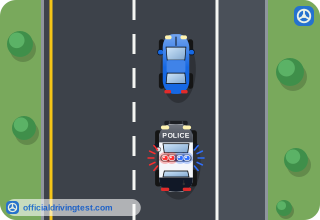
- Slow down and keep driving to the next exit
- Speed up to reach a safe place first
- Stop in the lane you are in and wait
- Pull over and stop
Show answer
Correct answer: Pull over and stop
When you see red lights flashing in the rearview mirror, you should pull over and stop.
Source: Nevada Driver's Handbook (March 2024 (DMV 700)), page 43 · Open this page in the manual (Manual page 43)
-
When stopped by law enforcement, where should you stop your vehicle?
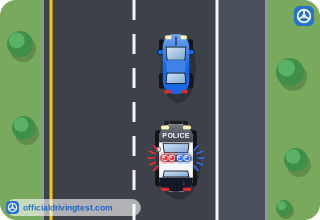
- As far out of the lane of traffic as possible
- In your lane, with your flashers turned on
- On the nearest cross street, out of view
- Beside the officer's vehicle in the next lane
Show answer
Correct answer: As far out of the lane of traffic as possible
Drivers who are stopped are encouraged to stop as far out of the lane of traffic as possible.
Source: Nevada Driver's Handbook (March 2024 (DMV 700)), page 43 · Open this page in the manual (Manual page 43)
-
What may happen if you leave your vehicle when stopped by law enforcement?
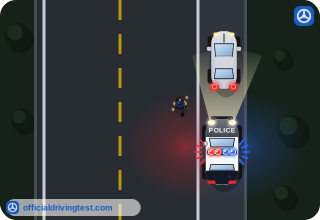
- You will automatically lose your driving privilege
- The officer will be required to give you a warning
- You and the officer are put in danger from nearby traffic
- Your vehicle will be towed from the roadside
Show answer
Correct answer: You and the officer are put in danger from nearby traffic
If you leave the vehicle, you subject yourself and the officer to danger from nearby traffic, so you should stay in your vehicle.
Source: Nevada Driver's Handbook (March 2024 (DMV 700)), page 43 · Open this page in the manual (Manual page 43)
-
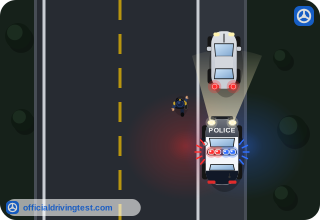
If you are stopped by law enforcement at night, what are you encouraged to do?
- Turn off your headlights and engine
- Turn on the interior light
- Turn on your high beams
- Get out and wave a flashlight
Show answer
Correct answer: Turn on the interior light
If stopped at night, turn on the interior light, because good lighting assists good communication.
Source: Nevada Driver's Handbook (March 2024 (DMV 700)), page 43 · Open this page in the manual (Manual page 43)
-
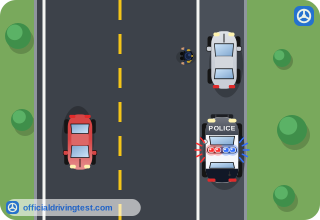
While stopped by law enforcement, where should you keep your hands?
- In your lap, out of the officer's sight
- Near the glove box so you can reach your papers
- Reaching in the glove box for your documents
- In plain view, preferably on the steering wheel
Show answer
Correct answer: In plain view, preferably on the steering wheel
Keep your hands in plain view at all times, preferably on the steering wheel, and avoid sudden movements.
Source: Nevada Driver's Handbook (March 2024 (DMV 700)), page 43 · Open this page in the manual (Manual page 43)
-
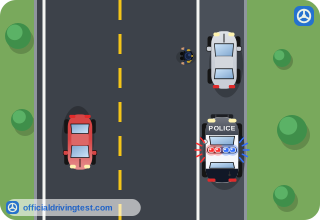
What should you do before reaching for your license, registration and proof of insurance when stopped by an officer?
- Wait for the officer to ask for them
- Hand them out the window as soon as you stop
- Place them on the dashboard right away
- Reach for them while the officer walks up
Show answer
Correct answer: Wait for the officer to ask for them
You should wait for the officer to request your license, registration and evidence of insurance.
Source: Nevada Driver's Handbook (March 2024 (DMV 700)), page 43 · Open this page in the manual (Manual page 43)
-
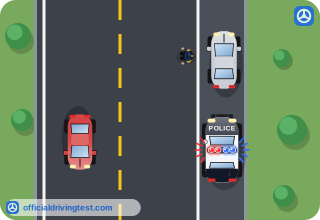
What are officers trained to do first when they stop a driver?
- Explain why the driver was stopped
- Ask where the driver is going
- Ask for identification
- Ask the driver to step out
Show answer
Correct answer: Ask for identification
Officers are trained to ask for identification first and explain why the driver was stopped second.
Source: Nevada Driver's Handbook (March 2024 (DMV 700)), page 43 · Open this page in the manual (Manual page 43)
-
How should you present the paperwork an officer requests?
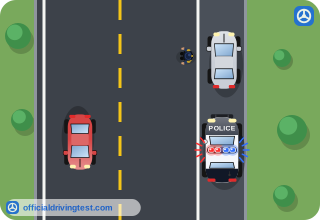
- Only after the officer tells you the reason
- Promptly and without an argument
- After you ask to see the officer's badge
- Only after you have explained your driving
Show answer
Correct answer: Promptly and without an argument
You should extend the courtesy by presenting the requested paperwork promptly and without an argument.
Source: Nevada Driver's Handbook (March 2024 (DMV 700)), page 43 · Open this page in the manual (Manual page 43)
-
If you think a citation was wrongly issued, what is the proper procedure?
- Argue the citation with the officer at the roadside
- Ask the DMV to cancel it at your next office visit
- Ignore it and wait for the officer to call you
- Request a hearing through the court system
Show answer
Correct answer: Request a hearing through the court system
Don't argue the citation with the officer; the proper procedure is to request a hearing through the court system or attend the hearing for which you received notification.
Source: Nevada Driver's Handbook (March 2024 (DMV 700)), page 43 · Open this page in the manual (Manual page 43)
-
How are highway work zones identified?
- With blue signs and white cones
- With green signs and red flares
- With yellow signs and red lights
- With orange signs, cones and barrels
Show answer
Correct answer: With orange signs, cones and barrels
Work zones are identified with orange signs, cones and barrels.
Source: Nevada Driver's Handbook (March 2024 (DMV 700)), page 60 · Open this page in the manual (Manual page 60)
-
Why should you use extra caution when approaching cars ahead of you in a work zone?
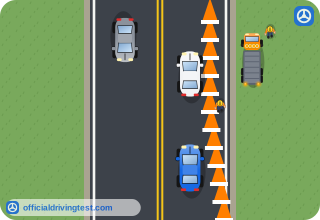
- They may be stopped
- They may be speeding up
- They may be turning around
- They may be passing you
Show answer
Correct answer: They may be stopped
Cars in a work zone sometimes must come to a complete stop, so cars ahead may be stopped.
Source: Nevada Driver's Handbook (March 2024 (DMV 700)), page 60 · Open this page in the manual (Manual page 60)
-
What is often used to control traffic in highway work zones?
- Traffic circles and metered ramps
- Toll gates and weigh stations
- Flaggers and pilot cars
- Photo radar vans only
Show answer
Correct answer: Flaggers and pilot cars
Flaggers and pilot cars are often used to control traffic in work zones.
Source: Nevada Driver's Handbook (March 2024 (DMV 700)), page 60 · Open this page in the manual (Manual page 60)
-
What happens if you move any barriers or signs to cross over a road that is closed to traffic?
- It is allowed when no workers are working nearby and the road looks clear
- It is illegal and you are subject to double penalties for work-zone violations
- It is allowed if you drive slowly
- It brings only a written warning
Show answer
Correct answer: It is illegal and you are subject to double penalties for work-zone violations
Moving barriers or signs to cross a closed road is illegal and brings double penalties for work-zone violations.
Source: Nevada Driver's Handbook (March 2024 (DMV 700)), page 60 · Open this page in the manual (Manual page 60)
-
What happens to fines for speeding in work zones?
- They triple
- They stay the same
- They increase by half
- They double
Show answer
Correct answer: They double
Fines for speeding double in work zones.
Source: Nevada Driver's Handbook (March 2024 (DMV 700)), page 60 · Open this page in the manual (Manual page 60)
-
Which speed limit signs in a work zone are regulatory?
- Black and white
- Orange
- Yellow
- Green
Show answer
Correct answer: Black and white
Black and white speed limit signs are regulatory, while orange speed limit signs are advisory.
Source: Nevada Driver's Handbook (March 2024 (DMV 700)), page 60 · Open this page in the manual (Manual page 60)
-
What do orange speed limit signs in a work zone indicate?
- Regulatory limits enforced by law
- The end of the work zone
- Advisory slower, safer speeds
- The minimum speed allowed
Show answer
Correct answer: Advisory slower, safer speeds
Orange speed limit signs are advisory and indicate slower, safer speeds.
Source: Nevada Driver's Handbook (March 2024 (DMV 700)), page 60 · Open this page in the manual (Manual page 60)
-
If time is a concern when a work zone is ahead, what does the handbook suggest?
- Speed up in the work zone to make up time
- Consider another route or start your trip earlier
- Drive on the shoulder to pass slow traffic
- Follow the vehicle ahead more closely
Show answer
Correct answer: Consider another route or start your trip earlier
The handbook says that if time is a concern, you should consider another route or start your trip earlier.
Source: Nevada Driver's Handbook (March 2024 (DMV 700)), page 60 · Open this page in the manual (Manual page 60)
-
When may visibility in a work zone be reduced especially?
- At noon
- On dry days
- On weekends
- At night
Show answer
Correct answer: At night
Visibility in a work zone may be reduced, especially at night.
Source: Nevada Driver's Handbook (March 2024 (DMV 700)), page 60 · Open this page in the manual (Manual page 60)
-
What should you do whenever you see orange signs on the road?
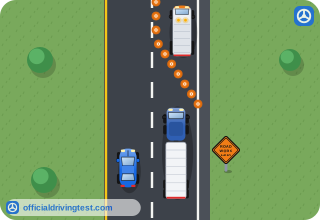
- Slow down and watch for equipment and people working on the road
- Speed up to clear the area before traffic backs up behind you
- Move to the far left lane
- Turn on your high beams
Show answer
Correct answer: Slow down and watch for equipment and people working on the road
Orange signs mean you should slow down and watch for equipment and people working on the road.
Source: Nevada Driver's Handbook (March 2024 (DMV 700)), page 60 · Open this page in the manual (Manual page 60)
-
What should you do when flaggers are directing traffic in a work zone?
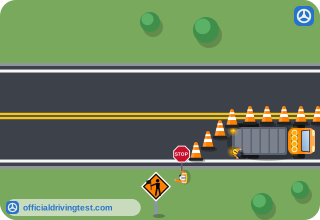
- Ignore them if no workers are close
- Follow the signs only
- Follow their instructions
- Follow the vehicle ahead only
Show answer
Correct answer: Follow their instructions
Be aware of flaggers working to direct traffic and follow their instructions for everyone’s safety.
Source: Nevada Driver's Handbook (March 2024 (DMV 700)), page 60 · Open this page in the manual (Manual page 60)
-
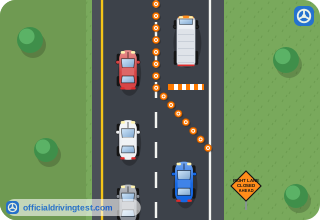
How should you merge in a work zone?
- Quickly, ahead of other traffic
- Carefully and cooperatively
- Only after stopping completely
- At the very last moment
Show answer
Correct answer: Carefully and cooperatively
The handbook says to merge carefully and cooperatively in a work zone.
Source: Nevada Driver's Handbook (March 2024 (DMV 700)), page 60 · Open this page in the manual (Manual page 60)
-
Which of these stopped vehicles does the handbook name among those drivers have certain duties when approaching?
- A taxicab
- A rental truck
- A passenger van
- A garbage truck
Show answer
Correct answer: A garbage truck
Garbage trucks are among the stopped emergency, utility or service vehicles drivers must approach with certain duties.
Source: Nevada Driver's Handbook (March 2024 (DMV 700)), page 61 · Open this page in the manual (Manual page 61)
-
The duties for approaching a stopped emergency, utility or service vehicle also apply to whom?
- Anyone attending to a repair of a vehicle
- Only officers writing a report
- Only drivers parked on the shoulder
- Only road crews at work zones
Show answer
Correct answer: Anyone attending to a repair of a vehicle
The rules for approaching stopped emergency, utility or service vehicles also apply to anyone attending to a repair of a vehicle.
Source: Nevada Driver's Handbook (March 2024 (DMV 700)), page 61 · Open this page in the manual (Manual page 61)
-
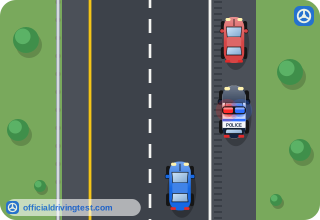
How must you adjust your speed when approaching a stopped emergency, utility or service vehicle?
- Keep to the posted speed limit exactly
- Increase speed to pass it quickly before it pulls back into traffic
- Decrease to a reasonable and proper speed less than the posted limit
- Stop completely until it leaves
Show answer
Correct answer: Decrease to a reasonable and proper speed less than the posted limit
Drivers must decrease speed to a speed that is reasonable and proper and less than the posted speed limit.
Source: Nevada Driver's Handbook (March 2024 (DMV 700)), page 61 · Open this page in the manual (Manual page 61)
-
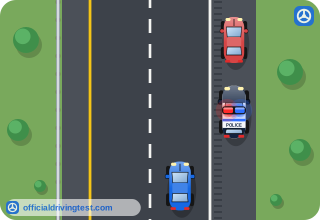
Besides decreasing speed, what must you do when approaching a stopped emergency, utility or service vehicle?
- Sound your horn and flash your headlights as you pass
- Proceed with caution and be prepared to stop
- Flash your headlights at it
- Stop until it moves
Show answer
Correct answer: Proceed with caution and be prepared to stop
Drivers must proceed with caution and be prepared to stop.
Source: Nevada Driver's Handbook (March 2024 (DMV 700)), page 61 · Open this page in the manual (Manual page 61)
-
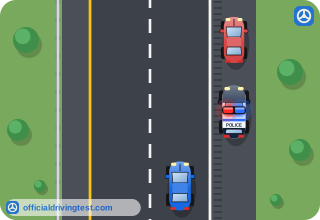
When approaching a stopped emergency vehicle, which lane should you use if possible?
- The lane right next to the stopped vehicle, at a reduced speed
- Any lane, stopping beside the vehicle
- The lane farthest to the right only
- A lane that is not adjacent to the lane in which the vehicle is stopped
Show answer
Correct answer: A lane that is not adjacent to the lane in which the vehicle is stopped
If possible, drive in a lane that is not adjacent to the lane in which the emergency vehicle is stopped, unless conditions make it unsafe or impossible.
Source: Nevada Driver's Handbook (March 2024 (DMV 700)), page 61 · Open this page in the manual (Manual page 61)
-
Under what condition may certain emergency vehicles drive on the paved shoulder of a highway?
- If signage placed along the highway authorizes its use
- If the traffic lanes are empty and no other vehicles are near
- Whenever traffic is heavy
- At any time of day or night
Show answer
Correct answer: If signage placed along the highway authorizes its use
Certain emergency vehicles may drive on the paved shoulder of a highway if signage placed along the highway authorizes its use.
Source: Nevada Driver's Handbook (March 2024 (DMV 700)), page 61 · Open this page in the manual (Manual page 61)
-
What is true of a highway shoulder that is marked to allow emergency use?
- Any driver may stop on it for up to five minutes
- Drivers may stop on it if their hazard lights are on
- Drivers of non-emergency vehicles may not stop on it
- Drivers may stop on it only during daylight hours
Show answer
Correct answer: Drivers of non-emergency vehicles may not stop on it
Drivers of non-emergency vehicles may not stop on a shoulder marked to allow emergency use.
Source: Nevada Driver's Handbook (March 2024 (DMV 700)), page 61 · Open this page in the manual (Manual page 61)
-
Which of these may use a paved shoulder where signage authorizes its use?
- Taxicabs
- Public transit buses
- Delivery trucks
- Motorcycles
Show answer
Correct answer: Public transit buses
The listed vehicles that may use a paved shoulder include public transit buses.
Source: Nevada Driver's Handbook (March 2024 (DMV 700)), page 61 · Open this page in the manual (Manual page 61)