Nebraska: Signals and vehicle controls — Part 3 Practice Test
Questions in this part include: “Which statement about driving with parking lights only is correct?” · “When are studded tires lawful?”
Independent educational site · not affiliated with any government agency or DMV
Ready? Test yourself
- Instant feedback with an explanation
- Every answer cites its source in the manual
- Your best score is saved on this device
- Keyboard: press 1 to 4 to answer and Enter for the next question
Questions are original and based on the official manual "Nebraska Driver's Manual" (January 2025), Nebraska Department of Motor Vehicles.
All 17 questions in this practice test
Take the test above first, then use this list to study. Tap “Show answer” to see the correct answer and explanation.
Show the questions and answersHide the questions
-
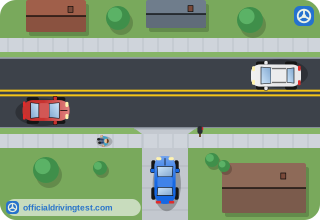
What should you do before pulling into traffic from a parking area or alley?
- Sound your horn twice
- Signal your intention
- Flash your high beams
- Turn on your hazard flashers
Show answer
Correct answer: Signal your intention
The manual lists pulling into traffic from a parking area or alley as a time to always signal.
Source: Nebraska Driver's Manual (January 2025), page 54 · Open this page in the manual (Manual page 54)
-
During which hours must headlights be used?
- From one hour after sunset to one hour before sunrise
- From sunset to sunrise
- Only when it is completely dark
- Only when other drivers have their lights on
Show answer
Correct answer: From sunset to sunrise
The manual says headlights must be used from sunset to sunrise.
Source: Nebraska Driver's Manual (January 2025), page 61 · Open this page in the manual (Manual page 61)
-
What should you do when daylight begins to fade?
- Turn on low beams to help others see you
- Wait until it is fully dark to turn on lights
- Turn on your high beams
- Use your parking lights only
Show answer
Correct answer: Turn on low beams to help others see you
Turning on low beams as daylight fades helps other drivers see you.
Source: Nebraska Driver's Manual (January 2025), page 61 · Open this page in the manual (Manual page 61)
-
Which statement about driving with parking lights only is correct?
- It is lawful on streets with street lights
- It is lawful in fog
- It is unlawful
- It is lawful just after sunset
Show answer
Correct answer: It is unlawful
The manual states that driving with parking lights only is unlawful.
Source: Nebraska Driver's Manual (January 2025), page 61 · Open this page in the manual (Manual page 61)
-
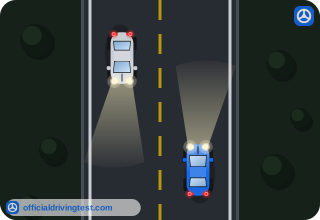
When approaching another vehicle from the front or rear, when should auxiliary driving lights be turned off?
- Only after you have passed the other vehicle completely
- At the same time the headlights are required to be dimmed
- Only when you are within 500 feet of the other vehicle
- Never, because only the headlights have to be dimmed
Show answer
Correct answer: At the same time the headlights are required to be dimmed
Auxiliary driving lights go off at the same moment the headlights are required to be dimmed.
Source: Nebraska Driver's Manual (January 2025), page 61 · Open this page in the manual (Manual page 61)
-
Which headlight setting does the manual say to use on open highways?
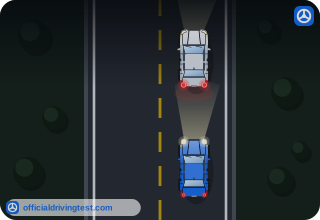
- Low beams only
- Parking lights
- High beams
- Auxiliary driving lights only
Show answer
Correct answer: High beams
The manual says to use high beams on open highways, dimming when following or meeting other vehicles.
Source: Nebraska Driver's Manual (January 2025), page 61 · Open this page in the manual (Manual page 61)
-
You are following another vehicle at night. Within what distance should you dim your headlights?
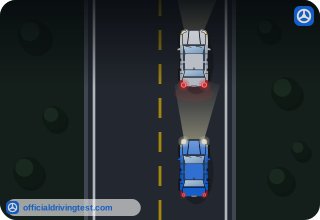
- 200 feet
- 100 feet
- 300 feet
- 500 feet
Show answer
Correct answer: 200 feet
Headlights should be dimmed when following within 200 feet of another vehicle.
Source: Nebraska Driver's Manual (January 2025), page 61 · Open this page in the manual (Manual page 61)
-
At night, the lights of an oncoming vehicle are blinding. Where should you look?
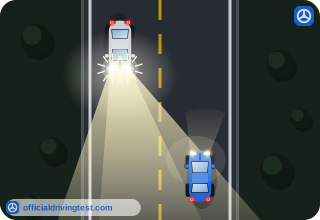
- Directly at the oncoming vehicle
- At the center line of the road
- Toward the left edge of the road
- Toward the right edge of the road
Show answer
Correct answer: Toward the right edge of the road
If oncoming lights are blinding, you do not look directly at the vehicle but toward the right edge of the road.
Source: Nebraska Driver's Manual (January 2025), page 61 · Open this page in the manual (Manual page 61)
-
What helps reduce the glare from oncoming vehicles at night?
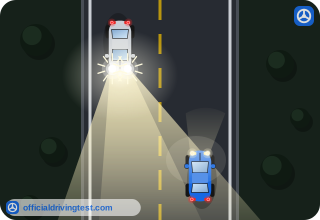
- Keeping your high beams on
- A clean windshield, inside and out
- Driving closer to the center line
- Turning up the brightness of the dashboard lights
Show answer
Correct answer: A clean windshield, inside and out
A windshield that is clean inside and out helps reduce glare from oncoming vehicles.
Source: Nebraska Driver's Manual (January 2025), page 61 · Open this page in the manual (Manual page 61)
-
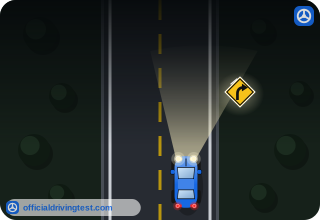
At night, what should you do to avoid eye strain, fatigue and lack of concentration?
- Keep your eyes moving
- Fix your eyes on the spot lit by the headlights
- Focus on the taillights of the vehicle ahead
- Look only at the road just in front of the hood
Show answer
Correct answer: Keep your eyes moving
Staring at the spot created by the headlights can cause eye strain, fatigue and lack of concentration, so you keep your eyes moving.
Source: Nebraska Driver's Manual (January 2025), page 61 · Open this page in the manual (Manual page 61)
-
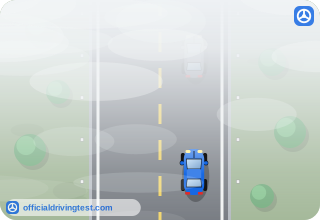
In fog, which headlights does the manual say to use?
- Headlights switched off
- Parking lights only
- Low beam headlights
- Auxiliary driving lights only
Show answer
Correct answer: Low beam headlights
The manual tells you to use low beam headlights in fog.
Source: Nebraska Driver's Manual (January 2025), page 62 · Open this page in the manual (Manual page 62)
-
When are studded tires lawful?
- From October 1 to March 1
- From December 1 to March 31
- From November 15 to April 15
- From November 1 to April 1
Show answer
Correct answer: From November 1 to April 1
Studded tires are lawful only from November 1 to April 1.
Source: Nebraska Driver's Manual (January 2025), page 63 · Open this page in the manual (Manual page 63)
-
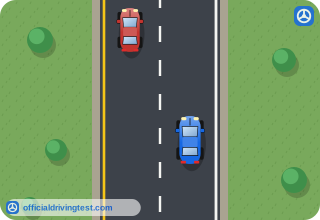
What is the "blind spot"?
- The area right behind your rear bumper when backing
- The area ahead that lies beyond your headlights at night
- The area hidden from view behind a large truck ahead
- The area to the side of a vehicle that cannot be seen in mirrors
Show answer
Correct answer: The area to the side of a vehicle that cannot be seen in mirrors
The blind spot is the area to the side of a vehicle which cannot be seen in mirrors.
Source: Nebraska Driver's Manual (January 2025), page 66 · Open this page in the manual (Manual page 66)
-
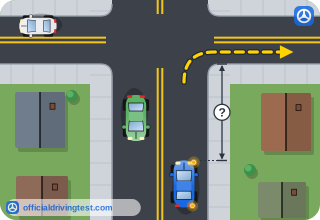
Under the defensive driving tips, at least how far ahead of a change of direction should you signal?
- At least 30 feet
- At least 75 feet
- At least 100 feet
- At least 150 feet
Show answer
Correct answer: At least 100 feet
You should signal your intentions at least 100 feet before planning to change direction.
Source: Nebraska Driver's Manual (January 2025), page 66 · Open this page in the manual (Manual page 66)
-
Besides when you have difficulty seeing other vehicles, when should you use headlights?
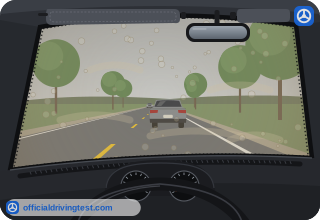
- Whenever you are using windshield wipers
- Only after sunset
- Only when driving faster than 40 MPH
- Only when towing a trailer
Show answer
Correct answer: Whenever you are using windshield wipers
The manual says to use headlights any time you have difficulty seeing other vehicles and whenever you use windshield wipers.
Source: Nebraska Driver's Manual (January 2025), page 66 · Open this page in the manual (Manual page 66)
-
When should you sound a sharp blast on the horn?
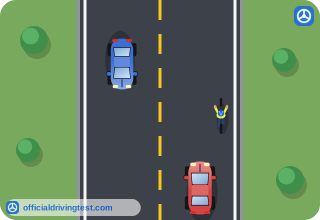
- To tell a slower driver to move over
- To greet a driver you know
- To warn drivers behind you that you are slowing down
- To alert another driver of an immediate danger of a collision
Show answer
Correct answer: To alert another driver of an immediate danger of a collision
A sharp blast on the horn alerts another driver of an immediate danger of a collision.
Source: Nebraska Driver's Manual (January 2025), page 66 · Open this page in the manual (Manual page 66)
-
What should you do to warn drivers behind you when slowing down?
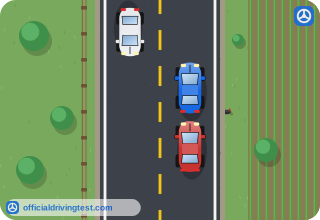
- Sound a sharp blast on the horn
- Quickly tap the brakes several times
- Flash your high beams
- Turn on your parking lights
Show answer
Correct answer: Quickly tap the brakes several times
You quickly tap the brakes several times when slowing down to warn drivers behind you.
Source: Nebraska Driver's Manual (January 2025), page 66 · Open this page in the manual (Manual page 66)