Nebraska: Signals and vehicle controls — Part 2 Practice Test
Questions in this part include: “What does Nebraska law say about sunscreening material below the AS-1 line on a vehicle windshield?” · “Nebraska law restricts the rear or back windows from having light transmission of less than what?”
Independent educational site · not affiliated with any government agency or DMV
Ready? Test yourself
- Instant feedback with an explanation
- Every answer cites its source in the manual
- Your best score is saved on this device
- Keyboard: press 1 to 4 to answer and Enter for the next question
Questions are original and based on the official manual "Nebraska Driver's Manual" (January 2025), Nebraska Department of Motor Vehicles.
All 17 questions in this practice test
Take the test above first, then use this list to study. Tap “Show answer” to see the correct answer and explanation.
Show the questions and answersHide the questions
-
What does Nebraska law say about sunscreening material below the AS-1 line on a vehicle windshield?
- It may be as dark as the driver prefers
- It is unlawful unless it is clear and transparent
- It may be tinted if light transmission is at least 35%
- It is allowed if the driver is over 21
Show answer
Correct answer: It is unlawful unless it is clear and transparent
The manual says it is unlawful to have any sunscreening material that is not clear and transparent below the AS-1 line on a windshield.
Source: Nebraska Driver's Manual (January 2025), page 29 · Open this page in the manual (Manual page 29)
-
Nebraska law restricts front side windows from having light transmission of less than what?
- 20%
- 25%
- 50%
- 35%
Show answer
Correct answer: 35%
The manual says front side windows may not have light transmission of less than 35%.
Source: Nebraska Driver's Manual (January 2025), page 29 · Open this page in the manual (Manual page 29)
-
Nebraska law restricts front side windows from having luminous reflectance of more than what?
- 20%
- 25%
- 35%
- 50%
Show answer
Correct answer: 35%
The manual says front side windows may not have luminous reflectance of more than 35%.
Source: Nebraska Driver's Manual (January 2025), page 29 · Open this page in the manual (Manual page 29)
-
Nebraska law restricts the rear or back windows from having light transmission of less than what?
- 20%
- 10%
- 30%
- 35%
Show answer
Correct answer: 20%
The manual says rear or back windows may not have light transmission of less than 20%.
Source: Nebraska Driver's Manual (January 2025), page 29 · Open this page in the manual (Manual page 29)
-
Nebraska law restricts the rear or back windows from having luminous reflectance of more than what?
- 10%
- 20%
- 50%
- 35%
Show answer
Correct answer: 35%
The manual says rear or back windows may not have luminous reflectance of more than 35%.
Source: Nebraska Driver's Manual (January 2025), page 29 · Open this page in the manual (Manual page 29)
-
What is a person who owns or operates a motor vehicle in violation of Nebraska's window tinting restrictions guilty of?
- A Class I misdemeanor
- A Class III misdemeanor
- A traffic infraction with no points
- A Class II felony
Show answer
Correct answer: A Class III misdemeanor
The manual says violating the sunscreening and tinting restrictions makes the person guilty of a Class III misdemeanor.
Source: Nebraska Driver's Manual (January 2025), page 29 · Open this page in the manual (Manual page 29)
-
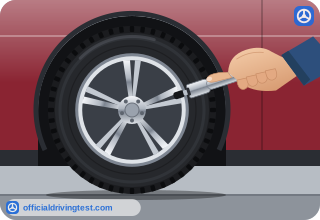
How much air pressure can tires lose in a month, according to the manual?
- Up to 1 psi
- Up to 10 psi
- Up to 5 psi
- Up to 20 psi
Show answer
Correct answer: Up to 1 psi
The manual says tires have been known to lose up to 1 psi every month.
Source: Nebraska Driver's Manual (January 2025), page 30 · Open this page in the manual (Manual page 30)
-
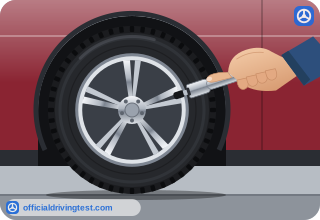
How often does the manual say to check all tires, including your spare?
- Once a year, at inspection time
- Only when a tire looks low
- Once a month or before a long trip
- Only when you buy new tires
Show answer
Correct answer: Once a month or before a long trip
The manual says to check all tires, including the spare, once a month or before a long trip.
Source: Nebraska Driver's Manual (January 2025), page 30 · Open this page in the manual (Manual page 30)
-
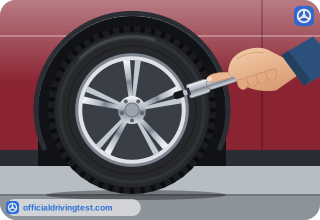
Where does the manual say to find your vehicle's recommended tire pressure (PSI)?
- On the sidewall of the tire itself
- On a sticker inside the driver's door
- On the valve stem cap
- Printed on the gas cap door
Show answer
Correct answer: On a sticker inside the driver's door
The manual says to compare to the PSI on the sticker inside the driver's door or in the owner's manual, and not to the PSI on the tire's sidewall.
Source: Nebraska Driver's Manual (January 2025), page 30 · Open this page in the manual (Manual page 30)
-
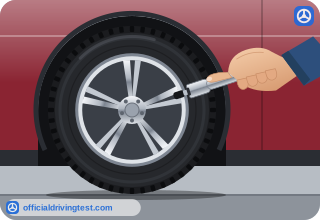
The manual says to check your tires "cold". When is a tire cold?
- Right after you finish a short drive
- At least thirty minutes after driving
- At least one hour after you have driven
- Before driving, or at least three hours after
Show answer
Correct answer: Before driving, or at least three hours after
The manual says to check tires cold, before you've driven or at least three hours after you've driven.
Source: Nebraska Driver's Manual (January 2025), page 30 · Open this page in the manual (Manual page 30)
-
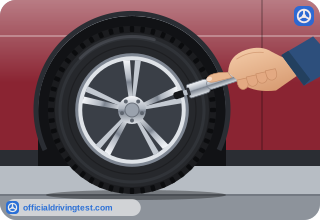
If your measured tire pressure is below the recommended number, what should you do?
- Let air out until it matches the number
- Leave it as it is until the next month
- Add air until it reaches the proper number
- Drive until the tire warms up first
Show answer
Correct answer: Add air until it reaches the proper number
The manual says that if the PSI is below the number, add air until it reaches the proper number.
Source: Nebraska Driver's Manual (January 2025), page 30 · Open this page in the manual (Manual page 30)
-
In the penny test for tread depth, where do you select a point on the tire?
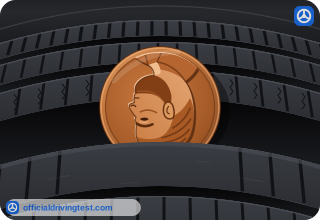
- Where the tread appears to be the lowest
- Where the tread appears to be the highest
- On the tire's sidewall
- At the center of the tire only
Show answer
Correct answer: Where the tread appears to be the lowest
The manual says to select a point on your tire where the tread appears to be the lowest.
Source: Nebraska Driver's Manual (January 2025), page 30 · Open this page in the manual (Manual page 30)
-
In the penny test for tread depth, how do you know you have a safe amount of tread?
- All of Lincoln's head stays visible above the tread
- The tread covers only Lincoln's body
- The penny does not fit into any groove
- Some part of Lincoln's head is covered by the tread
Show answer
Correct answer: Some part of Lincoln's head is covered by the tread
The manual says that if any part of Lincoln's head is covered by the tread, you are driving with a safe amount of tread.
Source: Nebraska Driver's Manual (January 2025), page 30 · Open this page in the manual (Manual page 30)
-
According to the manual, what happens when your tire tread gets below the safe amount?
- Your car's fuel economy improves a little
- Its grip in adverse conditions is greatly reduced
- Your tires will lose air pressure much faster
- Your steering wheel lock stops working
Show answer
Correct answer: Its grip in adverse conditions is greatly reduced
The manual says that if tread gets below the safe amount, the car's ability to grip the road in adverse conditions is greatly reduced.
Source: Nebraska Driver's Manual (January 2025), page 30 · Open this page in the manual (Manual page 30)
-
A "T" intersection sign warns that the roadway ends ahead. What does the manual say you must do before turning right or left there?
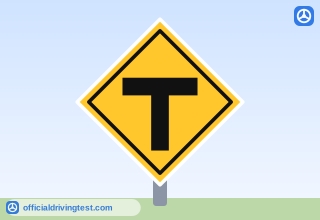
- Stop for at least three seconds
- Signal
- Turn on your headlights
- Sound your horn
Show answer
Correct answer: Signal
The "T" Intersection sign tells you that the roadway ends ahead and that you must signal before turning right or left.
Source: Nebraska Driver's Manual (January 2025), page 41 · Open this page in the manual (Manual page 41)
-
In which of these situations does the manual say you should always signal?
- Pulling in or out of a parking space
- Driving straight through an intersection
- Continuing in your lane on a straight road
- Driving on a straight road with no one nearby
Show answer
Correct answer: Pulling in or out of a parking space
You should always signal when pulling in or out of a parking space, as well as when changing lanes or pulling into traffic.
Source: Nebraska Driver's Manual (January 2025), page 54 · Open this page in the manual (Manual page 54)
-
At least how far before turning, or moving right or left, should you signal?
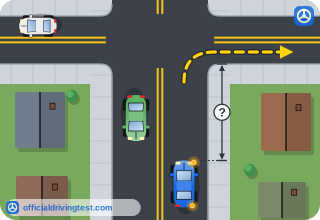
- 50 feet
- 200 feet
- 100 feet
- 300 feet
Show answer
Correct answer: 100 feet
The manual says to signal at least 100 feet before turning, or moving right or left.
Source: Nebraska Driver's Manual (January 2025), page 54 · Open this page in the manual (Manual page 54)