Nebraska: Pavement markings Practice Test
Yellow and white lines, edge lines, shared left turn lanes, crosswalks, stop lines and bike lanes.
Independent educational site · not affiliated with any government agency or DMV
Ready? Test yourself
- Instant feedback with an explanation
- Every answer cites its source in the manual
- Your best score is saved on this device
- Keyboard: press 1 to 4 to answer and Enter for the next question
Questions are original and based on the official manual "Nebraska Driver's Manual" (January 2025), Nebraska Department of Motor Vehicles.
All 20 questions in this practice test
Take the test above first, then use this list to study. Tap “Show answer” to see the correct answer and explanation.
Show the questions and answersHide the questions
-
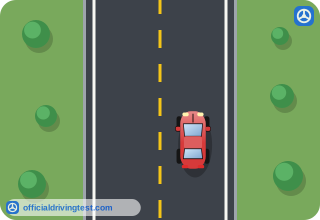
What do yellow center lines indicate?
- Traffic that is flowing in the same direction
- A lane reserved for buses
- Two-way traffic flowing in opposite directions
- The edge of the road
Show answer
Correct answer: Two-way traffic flowing in opposite directions
Yellow center lines indicate that there is two-way traffic flowing in opposite directions.
Source: Nebraska Driver's Manual (January 2025), page 44 · Open this page in the manual (Manual page 44)
-
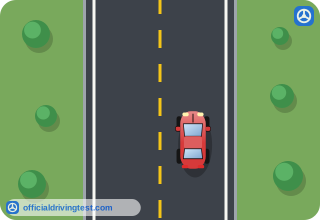
What does a single broken yellow center line indicate?
- Passing is never allowed in either direction of travel
- Passing on the left is permitted when the way ahead is clear
- Passing is permitted only on the right
- The lane is reserved for left turns
Show answer
Correct answer: Passing on the left is permitted when the way ahead is clear
A broken yellow line indicates that passing on the left is permitted when the way ahead is clear.
Source: Nebraska Driver's Manual (January 2025), page 44 · Open this page in the manual (Manual page 44)
-
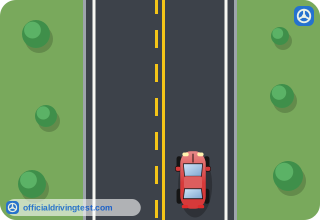
A broken yellow line runs alongside a solid yellow line in the center of the road. When may you pass?
- Only if the solid line is on your side
- From either side of the road
- From neither side of the road
- Only if the broken line is on your side
Show answer
Correct answer: Only if the broken line is on your side
Passing is permitted on the side of the broken line, but not on the side of the solid line.
Source: Nebraska Driver's Manual (January 2025), page 44 · Open this page in the manual (Manual page 44)
-
Double solid yellow lines mark the center of the road. What does the manual say about passing?
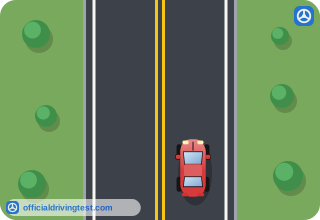
- Passing is not allowed in either direction.
- Passing is allowed in both directions if the way is clear.
- Passing is allowed only for slow vehicles.
- Passing is allowed only during daylight.
Show answer
Correct answer: Passing is not allowed in either direction.
Double solid yellow lines separate oncoming traffic, and passing is not allowed in either direction.
Source: Nebraska Driver's Manual (January 2025), page 44 · Open this page in the manual (Manual page 44)
-
Which is one of the only lawful crossings allowed over double yellow lines?
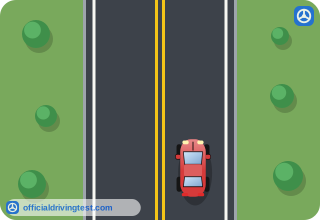
- Passing a slow-moving vehicle
- Making a U-turn at any place
- Avoiding an obstruction
- Moving over to let a faster vehicle pass
Show answer
Correct answer: Avoiding an obstruction
Passing is not allowed across double solid yellow lines; making a left turn (into or from an alley, private road or driveway, unless signs prohibit it) or avoiding an obstruction are the only lawful crossings.
Source: Nebraska Driver's Manual (January 2025), page 44 · Open this page in the manual (Manual page 44)
-
A center lane has a solid and a broken yellow line on each side. What is it reserved for?
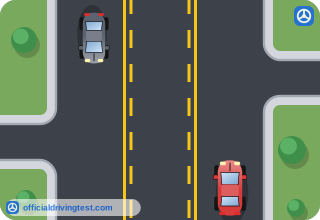
- A lane for passing slower vehicles on the left
- A lane for left turns shared with traffic from the opposite direction
- A lane for traffic going in one direction only, at all times
- A lane for bicyclists only
Show answer
Correct answer: A lane for left turns shared with traffic from the opposite direction
A center lane separated with solid and broken yellow lines reserves a lane for left turns shared with traffic from the opposite direction.
Source: Nebraska Driver's Manual (January 2025), page 45 · Open this page in the manual (Manual page 45)
-
What may motorists entering a shared left turn lane do?
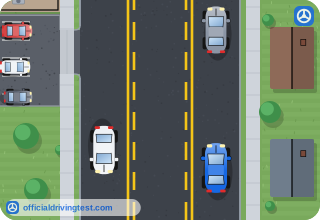
- Turn left or go straight
- Turn right or left
- Use it as a regular travel lane
- Only turn left
Show answer
Correct answer: Only turn left
Motorists entering a shared left turn lane should use caution and may only turn left.
Source: Nebraska Driver's Manual (January 2025), page 45 · Open this page in the manual (Manual page 45)
-
What does the manual say about using a shared left turn lane to pass?
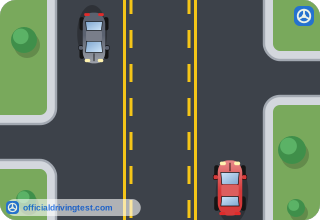
- It is prohibited.
- It is allowed when the way ahead is clear.
- It is allowed only for slow-moving vehicles.
- It is allowed for passing on the right only.
Show answer
Correct answer: It is prohibited.
The manual says using the shared left turn lane to pass is prohibited.
Source: Nebraska Driver's Manual (January 2025), page 45 · Open this page in the manual (Manual page 45)
-
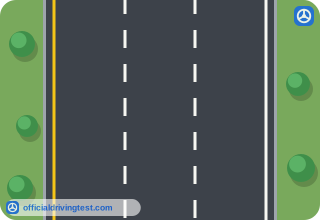
What do white lane lines separate?
- Lanes of traffic going in opposite directions
- The roadway from the shoulder only
- Lanes of traffic going in the same direction
- Bicycle lanes from sidewalks
Show answer
Correct answer: Lanes of traffic going in the same direction
White lines separate lanes of traffic going in the same direction.
Source: Nebraska Driver's Manual (January 2025), page 45 · Open this page in the manual (Manual page 45)
-
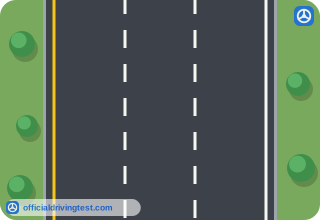
What does the manual say about crossing a broken white line?
- It may never be crossed.
- It may be crossed with care.
- It may be crossed only to turn right.
- It may be crossed only when no other traffic is in sight.
Show answer
Correct answer: It may be crossed with care.
Broken white lines separate lanes of traffic going in the same direction and may be crossed with care.
Source: Nebraska Driver's Manual (January 2025), page 45 · Open this page in the manual (Manual page 45)
-
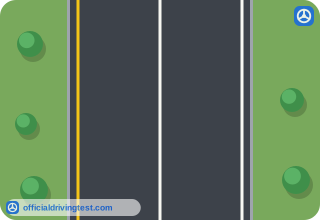
For what are solid white lines used?
- Marking the center of a two-way road with no passing
- Marking zones where passing is allowed on a highway
- Separating oncoming traffic from the bike lane
- Turn lanes and discouraging lane changes near intersections
Show answer
Correct answer: Turn lanes and discouraging lane changes near intersections
Solid white lines are used for turn lanes and to discourage lane changes near intersections.
Source: Nebraska Driver's Manual (January 2025), page 45 · Open this page in the manual (Manual page 45)
-
A lane is marked with a curved arrow and the word ONLY. What must you do?
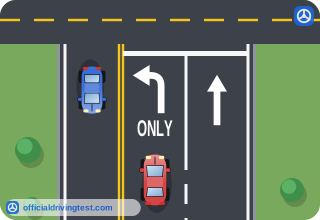
- Turn in the direction of the arrow
- Go straight ahead
- Turn in either direction
- Change lanes before the intersection
Show answer
Correct answer: Turn in the direction of the arrow
When a lane is marked with a curved arrow and the word ONLY, you must turn in the direction of the arrow.
Source: Nebraska Driver's Manual (January 2025), page 45 · Open this page in the manual (Manual page 45)
-
A lane is marked with both a curved arrow and a straight arrow. What is allowed?
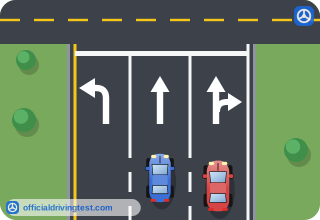
- Turning only
- Proceeding straight ahead only
- Turning or proceeding straight ahead
- Changing lanes only
Show answer
Correct answer: Turning or proceeding straight ahead
When a lane is marked with both a curved and straight arrow, turning or proceeding straight ahead is allowed.
Source: Nebraska Driver's Manual (January 2025), page 45 · Open this page in the manual (Manual page 45)
-
In urban areas, about how far before a crosswalk is a stop line usually located?
- Two feet
- Ten feet
- Twenty feet
- Four feet
Show answer
Correct answer: Four feet
In urban areas, the stop line is usually located about four feet before a crosswalk.
Source: Nebraska Driver's Manual (January 2025), page 46 · Open this page in the manual (Manual page 46)
-
What are rumble strips intended to do?
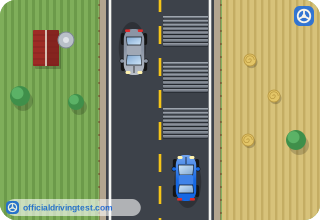
- Slow traffic down by making a bump in the road surface
- Mark a lane for turning vehicles
- Alert drowsy or inattentive drivers through vibration and sound
- Warn drivers that a school zone begins
Show answer
Correct answer: Alert drowsy or inattentive drivers through vibration and sound
Rumble strips are intended to alert drowsy or inattentive drivers through vibration and sound that their vehicles have left the travel lane or are approaching a stop sign or signal.
Source: Nebraska Driver's Manual (January 2025), page 46 · Open this page in the manual (Manual page 46)
-
Where may rumble strips be installed?
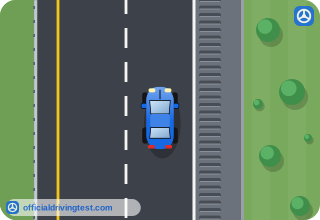
- Across the full width of every crosswalk
- In the lane of traffic approaching a stop sign or signal
- On sidewalks next to school crossings
- Only on freeways, in the lane next to the exit ramp
Show answer
Correct answer: In the lane of traffic approaching a stop sign or signal
Rumble strips may be installed on a paved shoulder, near the center line of a two-lane roadway, or in the lane approaching a stop sign or signal.
Source: Nebraska Driver's Manual (January 2025), page 46 · Open this page in the manual (Manual page 46)
-
Why should you use caution when entering a two-way left turn lane?
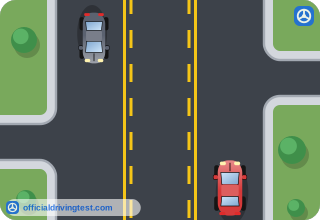
- Vehicles in the lane may be passing at very high speed
- Bicyclists ride in the lane
- The lane may end without warning
- Left-turning vehicles from the opposite direction may use it
Show answer
Correct answer: Left-turning vehicles from the opposite direction may use it
Caution should be used because left-turning vehicles from the opposite direction may also be using the center lane.
Source: Nebraska Driver's Manual (January 2025), page 46 · Open this page in the manual (Manual page 46)
-
Which markings indicate a reversible lane?
- A single solid white line
- Double solid yellow lines
- A broken white line with arrows
- Double-dashed broken yellow lines
Show answer
Correct answer: Double-dashed broken yellow lines
Reversible lanes are marked with double-dashed broken yellow lines.
Source: Nebraska Driver's Manual (January 2025), page 54 · Open this page in the manual (Manual page 54)
-
What indicates which direction of traffic flow a reversible lane is being used for?
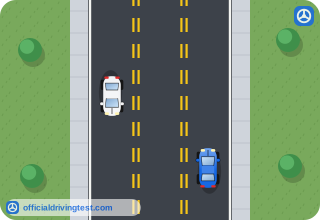
- Traffic signs or signals
- The speed limit posted for the lane
- The direction the car ahead is traveling
- The time of day on a clock
Show answer
Correct answer: Traffic signs or signals
In a reversible lane, the direction of traffic flow changes as indicated by traffic signs or signals.
Source: Nebraska Driver's Manual (January 2025), page 54 · Open this page in the manual (Manual page 54)
-
On an entrance ramp, what does the solid white line to your left separate?
- Lanes of traffic going in opposite directions
- Lanes of traffic going in the same direction
- The ramp from the road's shoulder
- A bicycle lane from the travel lane
Show answer
Correct answer: Lanes of traffic going in the same direction
On an entrance ramp, the solid white line to the left separates lanes of traffic going in the same direction.
Source: Nebraska Driver's Manual (January 2025), page 60 · Open this page in the manual (Manual page 60)