Nebraska: Signals and vehicle controls
Required equipment, window tinting, tires and tread depth, headlights at night, turn signals and safety recalls. Split into 3 shorter tests so you're not stuck in one long quiz.
Independent educational site · not affiliated with any government agency or DMV
Choose a part
Signals and vehicle controls — Part 1
Questions in this part include: “What does Nebraska law say about using nitrous oxide in a motor vehicle?”
StartSignals and vehicle controls — Part 2
Questions in this part include: “What does Nebraska law say about sunscreening material below the AS-1 line on a vehicle windshield?”
StartSignals and vehicle controls — Part 3
Questions in this part include: “Which statement about driving with parking lights only is correct?”
StartAll 51 Signals and vehicle controls questions with answers
Choose a part above to take a practice test, or study every question and answer here.
Show the questions and answersHide the questions
-
What does Nebraska law say about using nitrous oxide in a motor vehicle?
- It is allowed for drivers who are 21 or older
- It is allowed on interstate highways only
- It is unlawful in any motor vehicle on a public roadway
- It is allowed if the system came from the manufacturer
Show answer
Correct answer: It is unlawful in any motor vehicle on a public roadway
The manual says it is unlawful to use nitrous oxide in any motor vehicle operated on any public roadway in Nebraska.
Source: Nebraska Driver's Manual (January 2025), page 27 · Open this page in the manual (Manual page 27)
-
Which U.S. agency gathers information about safety problems in motor vehicles and equipment such as tires and child safety seats?
- The Federal Highway Administration
- National Highway Traffic Safety Administration
- The Environmental Protection Agency
- The Federal Motor Carrier Safety Administration
Show answer
Correct answer: National Highway Traffic Safety Administration
The manual says the NHTSA gathers information about safety problems in motor vehicles and equipment such as tires and child safety seats.
Source: Nebraska Driver's Manual (January 2025), page 29 · Open this page in the manual (Manual page 29)
-
What can reporting a vehicle safety problem sometimes lead to?
- New driver licensing rules
- Fines for the manufacturer
- Lower insurance rates
- Recalls
Show answer
Correct answer: Recalls
The manual says reporting a problem is your chance to help identify potential problems which sometimes lead to recalls.
Source: Nebraska Driver's Manual (January 2025), page 29 · Open this page in the manual (Manual page 29)
-
Which of these is required on vehicles by Nebraska law?
- Fog lights
- A rear spoiler
- A muffler
- Cruise control
Show answer
Correct answer: A muffler
The manual's list of required equipment includes a muffler.
Source: Nebraska Driver's Manual (January 2025), page 29 · Open this page in the manual (Manual page 29)
-
Which of these is required on vehicles by Nebraska law?
- A horn
- A backup camera
- Fog lights
- A radio
Show answer
Correct answer: A horn
The manual's list of required equipment includes a horn.
Source: Nebraska Driver's Manual (January 2025), page 29 · Open this page in the manual (Manual page 29)
-
Which of these is required on vehicles by Nebraska law?
- Air conditioning
- A sunroof
- A navigation system
- Windshield wipers
Show answer
Correct answer: Windshield wipers
The manual's list of required equipment includes windshield wipers.
Source: Nebraska Driver's Manual (January 2025), page 29 · Open this page in the manual (Manual page 29)
-
Which lights does the manual list as required equipment on vehicles?
- Headlights and tail lights, but not brake lights
- Headlights, tail lights, and brake lights
- Headlights and brake lights, but not tail lights
- Tail lights and brake lights, but not headlights
Show answer
Correct answer: Headlights, tail lights, and brake lights
The manual's required equipment list includes headlights, tail lights, and brake lights.
Source: Nebraska Driver's Manual (January 2025), page 29 · Open this page in the manual (Manual page 29)
-
What two systems of brakes must a vehicle have under Nebraska law?
- A service brake and a parking brake
- A service brake and an emergency air brake
- A parking brake and an anti-lock brake
- A foot brake and a trailer brake
Show answer
Correct answer: A service brake and a parking brake
The manual lists two systems of brakes: the service brake and parking brake.
Source: Nebraska Driver's Manual (January 2025), page 29 · Open this page in the manual (Manual page 29)
-
Which windows must have safety glass under Nebraska law?
- Only the windshield
- Only the windshield and the rear window
- All windows
- Only the front windows
Show answer
Correct answer: All windows
The manual lists safety glass in all windows as required equipment.
Source: Nebraska Driver's Manual (January 2025), page 29 · Open this page in the manual (Manual page 29)
-
What tread depth must the pneumatic tires on a vehicle have, at least?
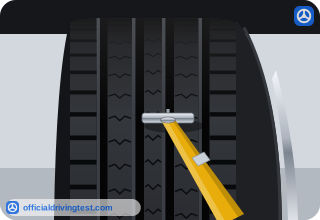
- 1/32 inch
- 2/32 inch
- 4/32 inch
- 6/32 inch
Show answer
Correct answer: 2/32 inch
The manual lists pneumatic tires with at least 2/32" tread as required equipment.
Source: Nebraska Driver's Manual (January 2025), page 29 · Open this page in the manual (Manual page 29)
-
What does the manual say about objects hanging or posted in a vehicle's windows?
- They are allowed if they are smaller than a sheet of paper
- They are allowed on the rear window only
- They are allowed if the vehicle has a rear-view camera
- There must be none that obstruct vision
Show answer
Correct answer: There must be none that obstruct vision
The manual lists as required equipment that there be no objects hanging or posted in windows which obstruct vision.
Source: Nebraska Driver's Manual (January 2025), page 29 · Open this page in the manual (Manual page 29)
-
What does the manual say about seat belts as required equipment?
- They must be three-point belts in every vehicle
- They are required only in the front seats
- Appropriate to the year manufactured
- They are required only on vehicles made after 1990
Show answer
Correct answer: Appropriate to the year manufactured
The manual lists seat belts appropriate to year manufactured as required equipment.
Source: Nebraska Driver's Manual (January 2025), page 29 · Open this page in the manual (Manual page 29)
-
What do you need to check whether your vehicle may have been the subject of a safety recall?
- Your vehicle identification number
- Your driver's license number
- Your insurance policy number
- Your registration receipt number
Show answer
Correct answer: Your vehicle identification number
The manual says you will need your vehicle identification number (VIN) to check for a safety recall.
Source: Nebraska Driver's Manual (January 2025), page 29 · Open this page in the manual (Manual page 29)
-
Where is the vehicle identification number (VIN) usually located?
- On the inside of the glove compartment lid
- On the rear bumper near the license plate
- On the radiator support under the hood
- On the lower corner below the windshield
Show answer
Correct answer: On the lower corner below the windshield
The manual says the VIN is usually located on the lower corner below the windshield.
Source: Nebraska Driver's Manual (January 2025), page 29 · Open this page in the manual (Manual page 29)
-
What does a steering wheel locking device do when the key is turned to the lock position?
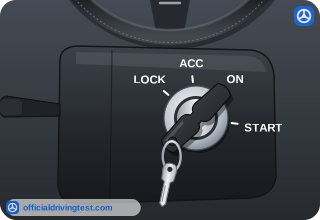
- It locks only the vehicle's doors
- It locks the steering wheel
- It turns off the headlights
- It sets the parking brake
Show answer
Correct answer: It locks the steering wheel
The manual says a spring loaded steering wheel lock device engages and locks the steering wheel when the key is turned to the lock position.
Source: Nebraska Driver's Manual (January 2025), page 29 · Open this page in the manual (Manual page 29)
-
Why should you never turn the ignition to the "lock" position while the vehicle is in motion?
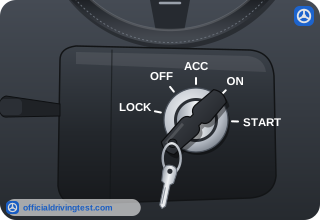
- You will be unable to control the vehicle
- The brakes will stop working entirely
- The battery will quickly drain
- The engine will overheat
Show answer
Correct answer: You will be unable to control the vehicle
The manual says never to turn the ignition to the lock position when the vehicle is in motion because you will be unable to control the vehicle.
Source: Nebraska Driver's Manual (January 2025), page 29 · Open this page in the manual (Manual page 29)
-
What does the manual recommend as part of your vehicle's routine maintenance regarding the steering wheel lock?
- Replacing the lock every year
- Lubricating the lock with oil each month
- An inspection of the steering wheel lock
- Removing the lock
Show answer
Correct answer: An inspection of the steering wheel lock
The manual says an inspection of the steering wheel lock is recommended as part of routine maintenance.
Source: Nebraska Driver's Manual (January 2025), page 29 · Open this page in the manual (Manual page 29)
-
What does Nebraska law say about sunscreening material below the AS-1 line on a vehicle windshield?
- It may be as dark as the driver prefers
- It is unlawful unless it is clear and transparent
- It may be tinted if light transmission is at least 35%
- It is allowed if the driver is over 21
Show answer
Correct answer: It is unlawful unless it is clear and transparent
The manual says it is unlawful to have any sunscreening material that is not clear and transparent below the AS-1 line on a windshield.
Source: Nebraska Driver's Manual (January 2025), page 29 · Open this page in the manual (Manual page 29)
-
Nebraska law restricts front side windows from having light transmission of less than what?
- 20%
- 25%
- 50%
- 35%
Show answer
Correct answer: 35%
The manual says front side windows may not have light transmission of less than 35%.
Source: Nebraska Driver's Manual (January 2025), page 29 · Open this page in the manual (Manual page 29)
-
Nebraska law restricts front side windows from having luminous reflectance of more than what?
- 20%
- 25%
- 35%
- 50%
Show answer
Correct answer: 35%
The manual says front side windows may not have luminous reflectance of more than 35%.
Source: Nebraska Driver's Manual (January 2025), page 29 · Open this page in the manual (Manual page 29)
-
Nebraska law restricts the rear or back windows from having light transmission of less than what?
- 20%
- 10%
- 30%
- 35%
Show answer
Correct answer: 20%
The manual says rear or back windows may not have light transmission of less than 20%.
Source: Nebraska Driver's Manual (January 2025), page 29 · Open this page in the manual (Manual page 29)
-
Nebraska law restricts the rear or back windows from having luminous reflectance of more than what?
- 10%
- 20%
- 50%
- 35%
Show answer
Correct answer: 35%
The manual says rear or back windows may not have luminous reflectance of more than 35%.
Source: Nebraska Driver's Manual (January 2025), page 29 · Open this page in the manual (Manual page 29)
-
What is a person who owns or operates a motor vehicle in violation of Nebraska's window tinting restrictions guilty of?
- A Class I misdemeanor
- A Class III misdemeanor
- A traffic infraction with no points
- A Class II felony
Show answer
Correct answer: A Class III misdemeanor
The manual says violating the sunscreening and tinting restrictions makes the person guilty of a Class III misdemeanor.
Source: Nebraska Driver's Manual (January 2025), page 29 · Open this page in the manual (Manual page 29)
-
How much air pressure can tires lose in a month, according to the manual?
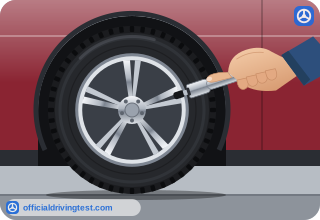
- Up to 1 psi
- Up to 10 psi
- Up to 5 psi
- Up to 20 psi
Show answer
Correct answer: Up to 1 psi
The manual says tires have been known to lose up to 1 psi every month.
Source: Nebraska Driver's Manual (January 2025), page 30 · Open this page in the manual (Manual page 30)
-
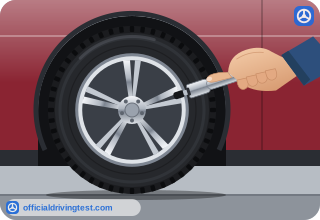
How often does the manual say to check all tires, including your spare?
- Once a year, at inspection time
- Only when a tire looks low
- Once a month or before a long trip
- Only when you buy new tires
Show answer
Correct answer: Once a month or before a long trip
The manual says to check all tires, including the spare, once a month or before a long trip.
Source: Nebraska Driver's Manual (January 2025), page 30 · Open this page in the manual (Manual page 30)
-
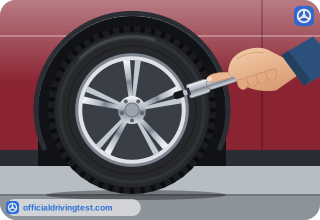
Where does the manual say to find your vehicle's recommended tire pressure (PSI)?
- On the sidewall of the tire itself
- On a sticker inside the driver's door
- On the valve stem cap
- Printed on the gas cap door
Show answer
Correct answer: On a sticker inside the driver's door
The manual says to compare to the PSI on the sticker inside the driver's door or in the owner's manual, and not to the PSI on the tire's sidewall.
Source: Nebraska Driver's Manual (January 2025), page 30 · Open this page in the manual (Manual page 30)
-
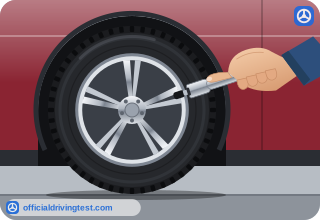
The manual says to check your tires "cold". When is a tire cold?
- Right after you finish a short drive
- At least thirty minutes after driving
- At least one hour after you have driven
- Before driving, or at least three hours after
Show answer
Correct answer: Before driving, or at least three hours after
The manual says to check tires cold, before you've driven or at least three hours after you've driven.
Source: Nebraska Driver's Manual (January 2025), page 30 · Open this page in the manual (Manual page 30)
-
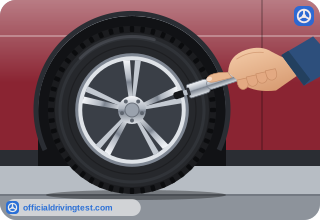
If your measured tire pressure is below the recommended number, what should you do?
- Let air out until it matches the number
- Leave it as it is until the next month
- Add air until it reaches the proper number
- Drive until the tire warms up first
Show answer
Correct answer: Add air until it reaches the proper number
The manual says that if the PSI is below the number, add air until it reaches the proper number.
Source: Nebraska Driver's Manual (January 2025), page 30 · Open this page in the manual (Manual page 30)
-
In the penny test for tread depth, where do you select a point on the tire?
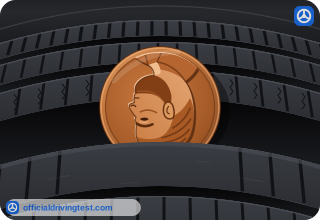
- Where the tread appears to be the lowest
- Where the tread appears to be the highest
- On the tire's sidewall
- At the center of the tire only
Show answer
Correct answer: Where the tread appears to be the lowest
The manual says to select a point on your tire where the tread appears to be the lowest.
Source: Nebraska Driver's Manual (January 2025), page 30 · Open this page in the manual (Manual page 30)
-
In the penny test for tread depth, how do you know you have a safe amount of tread?
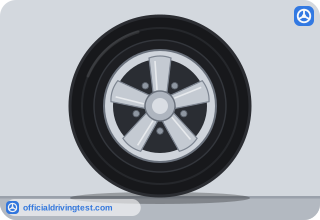
- All of Lincoln's head stays visible above the tread
- The tread covers only Lincoln's body
- The penny does not fit into any groove
- Some part of Lincoln's head is covered by the tread
Show answer
Correct answer: Some part of Lincoln's head is covered by the tread
The manual says that if any part of Lincoln's head is covered by the tread, you are driving with a safe amount of tread.
Source: Nebraska Driver's Manual (January 2025), page 30 · Open this page in the manual (Manual page 30)
-
According to the manual, what happens when your tire tread gets below the safe amount?
- Your car's fuel economy improves a little
- Its grip in adverse conditions is greatly reduced
- Your tires will lose air pressure much faster
- Your steering wheel lock stops working
Show answer
Correct answer: Its grip in adverse conditions is greatly reduced
The manual says that if tread gets below the safe amount, the car's ability to grip the road in adverse conditions is greatly reduced.
Source: Nebraska Driver's Manual (January 2025), page 30 · Open this page in the manual (Manual page 30)
-
A "T" intersection sign warns that the roadway ends ahead. What does the manual say you must do before turning right or left there?
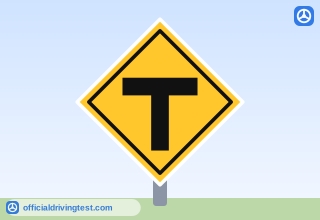
- Stop for at least three seconds
- Signal
- Turn on your headlights
- Sound your horn
Show answer
Correct answer: Signal
The "T" Intersection sign tells you that the roadway ends ahead and that you must signal before turning right or left.
Source: Nebraska Driver's Manual (January 2025), page 41 · Open this page in the manual (Manual page 41)
-
In which of these situations does the manual say you should always signal?
- Pulling in or out of a parking space
- Driving straight through an intersection
- Continuing in your lane on a straight road
- Driving on a straight road with no one nearby
Show answer
Correct answer: Pulling in or out of a parking space
You should always signal when pulling in or out of a parking space, as well as when changing lanes or pulling into traffic.
Source: Nebraska Driver's Manual (January 2025), page 54 · Open this page in the manual (Manual page 54)
-
At least how far before turning, or moving right or left, should you signal?
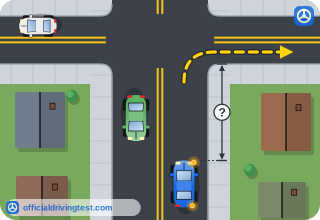
- 50 feet
- 200 feet
- 100 feet
- 300 feet
Show answer
Correct answer: 100 feet
The manual says to signal at least 100 feet before turning, or moving right or left.
Source: Nebraska Driver's Manual (January 2025), page 54 · Open this page in the manual (Manual page 54)
-
What should you do before pulling into traffic from a parking area or alley?
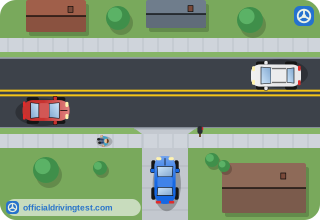
- Sound your horn twice
- Signal your intention
- Flash your high beams
- Turn on your hazard flashers
Show answer
Correct answer: Signal your intention
The manual lists pulling into traffic from a parking area or alley as a time to always signal.
Source: Nebraska Driver's Manual (January 2025), page 54 · Open this page in the manual (Manual page 54)
-
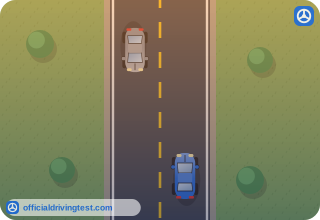
During which hours must headlights be used?
- From one hour after sunset to one hour before sunrise
- From sunset to sunrise
- Only when it is completely dark
- Only when other drivers have their lights on
Show answer
Correct answer: From sunset to sunrise
The manual says headlights must be used from sunset to sunrise.
Source: Nebraska Driver's Manual (January 2025), page 61 · Open this page in the manual (Manual page 61)
-
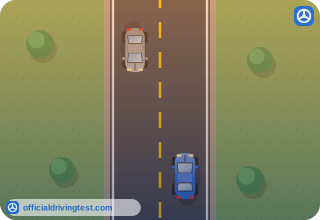
What should you do when daylight begins to fade?
- Turn on low beams to help others see you
- Wait until it is fully dark to turn on lights
- Turn on your high beams
- Use your parking lights only
Show answer
Correct answer: Turn on low beams to help others see you
Turning on low beams as daylight fades helps other drivers see you.
Source: Nebraska Driver's Manual (January 2025), page 61 · Open this page in the manual (Manual page 61)
-
Which statement about driving with parking lights only is correct?
- It is lawful on streets with street lights
- It is lawful in fog
- It is unlawful
- It is lawful just after sunset
Show answer
Correct answer: It is unlawful
The manual states that driving with parking lights only is unlawful.
Source: Nebraska Driver's Manual (January 2025), page 61 · Open this page in the manual (Manual page 61)
-
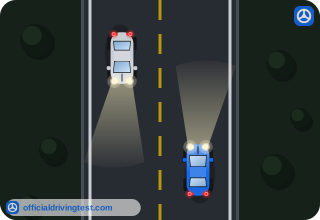
When approaching another vehicle from the front or rear, when should auxiliary driving lights be turned off?
- Only after you have passed the other vehicle completely
- At the same time the headlights are required to be dimmed
- Only when you are within 500 feet of the other vehicle
- Never, because only the headlights have to be dimmed
Show answer
Correct answer: At the same time the headlights are required to be dimmed
Auxiliary driving lights go off at the same moment the headlights are required to be dimmed.
Source: Nebraska Driver's Manual (January 2025), page 61 · Open this page in the manual (Manual page 61)
-
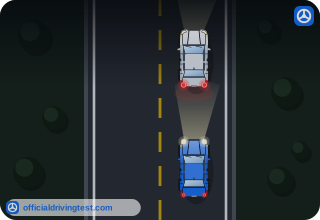
Which headlight setting does the manual say to use on open highways?
- Low beams only
- Parking lights
- High beams
- Auxiliary driving lights only
Show answer
Correct answer: High beams
The manual says to use high beams on open highways, dimming when following or meeting other vehicles.
Source: Nebraska Driver's Manual (January 2025), page 61 · Open this page in the manual (Manual page 61)
-
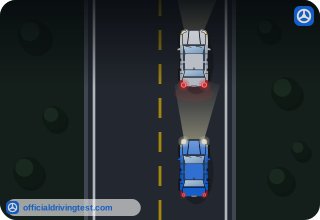
You are following another vehicle at night. Within what distance should you dim your headlights?
- 200 feet
- 100 feet
- 300 feet
- 500 feet
Show answer
Correct answer: 200 feet
Headlights should be dimmed when following within 200 feet of another vehicle.
Source: Nebraska Driver's Manual (January 2025), page 61 · Open this page in the manual (Manual page 61)
-
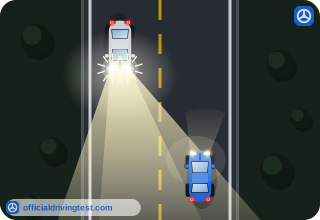
At night, the lights of an oncoming vehicle are blinding. Where should you look?
- Directly at the oncoming vehicle
- At the center line of the road
- Toward the left edge of the road
- Toward the right edge of the road
Show answer
Correct answer: Toward the right edge of the road
If oncoming lights are blinding, you do not look directly at the vehicle but toward the right edge of the road.
Source: Nebraska Driver's Manual (January 2025), page 61 · Open this page in the manual (Manual page 61)
-
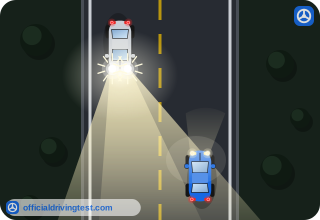
What helps reduce the glare from oncoming vehicles at night?
- Keeping your high beams on
- A clean windshield, inside and out
- Driving closer to the center line
- Turning up the brightness of the dashboard lights
Show answer
Correct answer: A clean windshield, inside and out
A windshield that is clean inside and out helps reduce glare from oncoming vehicles.
Source: Nebraska Driver's Manual (January 2025), page 61 · Open this page in the manual (Manual page 61)
-
At night, what should you do to avoid eye strain, fatigue and lack of concentration?
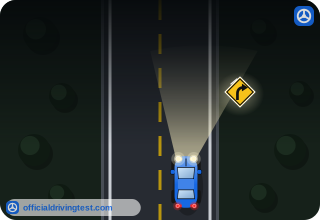
- Keep your eyes moving
- Fix your eyes on the spot lit by the headlights
- Focus on the taillights of the vehicle ahead
- Look only at the road just in front of the hood
Show answer
Correct answer: Keep your eyes moving
Staring at the spot created by the headlights can cause eye strain, fatigue and lack of concentration, so you keep your eyes moving.
Source: Nebraska Driver's Manual (January 2025), page 61 · Open this page in the manual (Manual page 61)
-
In fog, which headlights does the manual say to use?

- Headlights switched off
- Parking lights only
- Low beam headlights
- Auxiliary driving lights only
Show answer
Correct answer: Low beam headlights
The manual tells you to use low beam headlights in fog.
Source: Nebraska Driver's Manual (January 2025), page 62 · Open this page in the manual (Manual page 62)
-
When are studded tires lawful?
- From October 1 to March 1
- From December 1 to March 31
- From November 15 to April 15
- From November 1 to April 1
Show answer
Correct answer: From November 1 to April 1
Studded tires are lawful only from November 1 to April 1.
Source: Nebraska Driver's Manual (January 2025), page 63 · Open this page in the manual (Manual page 63)
-
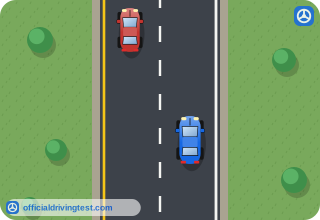
What is the "blind spot"?
- The area right behind your rear bumper when backing
- The area ahead that lies beyond your headlights at night
- The area hidden from view behind a large truck ahead
- The area to the side of a vehicle that cannot be seen in mirrors
Show answer
Correct answer: The area to the side of a vehicle that cannot be seen in mirrors
The blind spot is the area to the side of a vehicle which cannot be seen in mirrors.
Source: Nebraska Driver's Manual (January 2025), page 66 · Open this page in the manual (Manual page 66)
-
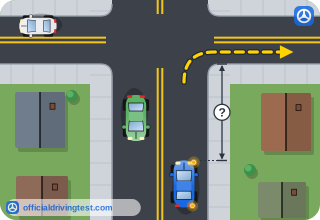
Under the defensive driving tips, at least how far ahead of a change of direction should you signal?
- At least 30 feet
- At least 75 feet
- At least 100 feet
- At least 150 feet
Show answer
Correct answer: At least 100 feet
You should signal your intentions at least 100 feet before planning to change direction.
Source: Nebraska Driver's Manual (January 2025), page 66 · Open this page in the manual (Manual page 66)
-
Besides when you have difficulty seeing other vehicles, when should you use headlights?
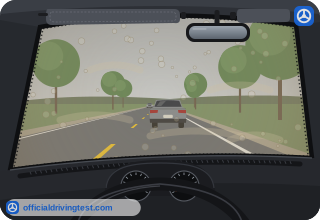
- Whenever you are using windshield wipers
- Only after sunset
- Only when driving faster than 40 MPH
- Only when towing a trailer
Show answer
Correct answer: Whenever you are using windshield wipers
The manual says to use headlights any time you have difficulty seeing other vehicles and whenever you use windshield wipers.
Source: Nebraska Driver's Manual (January 2025), page 66 · Open this page in the manual (Manual page 66)
-
When should you sound a sharp blast on the horn?
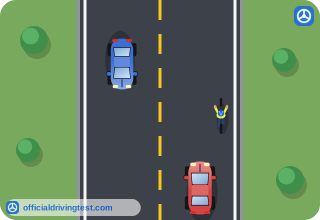
- To tell a slower driver to move over
- To greet a driver you know
- To warn drivers behind you that you are slowing down
- To alert another driver of an immediate danger of a collision
Show answer
Correct answer: To alert another driver of an immediate danger of a collision
A sharp blast on the horn alerts another driver of an immediate danger of a collision.
Source: Nebraska Driver's Manual (January 2025), page 66 · Open this page in the manual (Manual page 66)
-
What should you do to warn drivers behind you when slowing down?
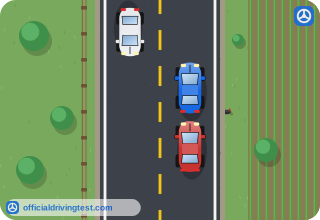
- Sound a sharp blast on the horn
- Quickly tap the brakes several times
- Flash your high beams
- Turn on your parking lights
Show answer
Correct answer: Quickly tap the brakes several times
You quickly tap the brakes several times when slowing down to warn drivers behind you.
Source: Nebraska Driver's Manual (January 2025), page 66 · Open this page in the manual (Manual page 66)