Nebraska: Emergency vehicles, work zones and police stops — Part 3 Practice Test
Questions in this part include: “How are funeral procession escort vehicles classified?” · “Which of these are traffic control devices used in work zones to guide and direct drivers safely through?”
Independent educational site · not affiliated with any government agency or DMV
Ready? Test yourself
- Instant feedback with an explanation
- Every answer cites its source in the manual
- Your best score is saved on this device
- Keyboard: press 1 to 4 to answer and Enter for the next question
Questions are original and based on the official manual "Nebraska Driver's Manual" (January 2025), Nebraska Department of Motor Vehicles.
All 16 questions in this practice test
Take the test above first, then use this list to study. Tap “Show answer” to see the correct answer and explanation.
Show the questions and answersHide the questions
-
After pulling over for an authorized emergency vehicle, how long must you remain stopped?
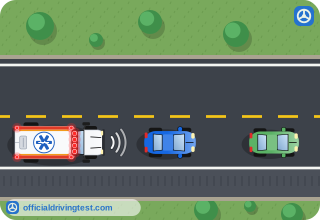
- Until the emergency vehicle has passed
- For 30 seconds after the siren stops
- Until you can no longer hear the siren
- Until the flashing lights are out of sight
Show answer
Correct answer: Until the emergency vehicle has passed
You remain stopped until the emergency vehicle has passed.
Source: Nebraska Driver's Manual (January 2025), page 51 · Open this page in the manual (Manual page 51)
-
After an emergency vehicle has passed and before you proceed, what should you do?
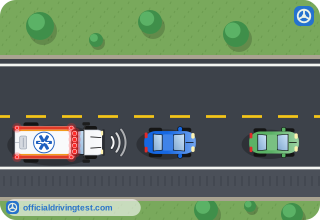
- Turn on your hazard flashers and pull out immediately
- Sound your horn to signal that you are ready
- Watch for other emergency vehicles
- Follow the emergency vehicle closely to clear the way
Show answer
Correct answer: Watch for other emergency vehicles
Before proceeding you watch for other emergency vehicles.
Source: Nebraska Driver's Manual (January 2025), page 51 · Open this page in the manual (Manual page 51)
-
When an emergency vehicle approaches on a roadway divided by a median, what applies to traffic going the opposite direction?
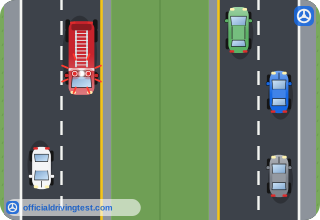
- It must stop at the median
- It is not required to stop
- It must move to the left edge of the roadway
- It must slow to 25 MPH
Show answer
Correct answer: It is not required to stop
On a roadway divided by a median, traffic going the opposite direction is not required to stop.
Source: Nebraska Driver's Manual (January 2025), page 52 · Open this page in the manual (Manual page 52)
-
What is the closest that a vehicle may follow a fire apparatus traveling in an emergency status?
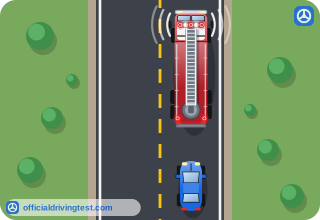
- No closer than 100 feet
- No closer than 300 feet
- No closer than 1,000 feet
- No closer than 500 feet
Show answer
Correct answer: No closer than 500 feet
No vehicle may follow a fire apparatus traveling in an emergency status closer than 500 feet.
Source: Nebraska Driver's Manual (January 2025), page 52 · Open this page in the manual (Manual page 52)
-
Where may no vehicle drive onto or park when a fire apparatus has stopped to answer an emergency?
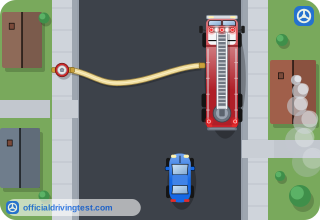
- Within the block the fire apparatus has stopped in
- Within 100 feet of the fire apparatus at the scene
- Within 500 feet of the fire apparatus at the scene
- Only on the same side of the street as the apparatus
Show answer
Correct answer: Within the block the fire apparatus has stopped in
No vehicle may drive onto or park within the block where a fire apparatus has stopped to answer an emergency.
Source: Nebraska Driver's Manual (January 2025), page 52 · Open this page in the manual (Manual page 52)
-
How are funeral procession escort vehicles classified?
- As ordinary vehicles with no special right-of-way
- As road assistance vehicles
- As emergency vehicles
- As highway maintenance vehicles
Show answer
Correct answer: As emergency vehicles
Funeral procession escort vehicles are classified as emergency vehicles, and drivers must yield to them when they display proper audio or visual signals.
Source: Nebraska Driver's Manual (January 2025), page 52 · Open this page in the manual (Manual page 52)
-
What is a major cause of rear-end crashes in work zones?
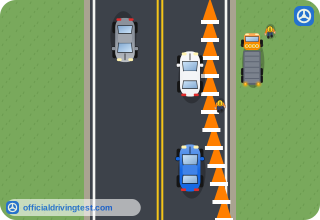
- Driving in the right lane through the work zone area
- Driving with the headlights on in the work zone
- Driving slower or faster than the surrounding traffic
- Obeying the posted signs in the work zone
Show answer
Correct answer: Driving slower or faster than the surrounding traffic
Driving slower or faster than the surrounding traffic is a major cause of rear-end crashes in work zones.
Source: Nebraska Driver's Manual (January 2025), page 53 · Open this page in the manual (Manual page 53)
-
Which of these are traffic control devices used in work zones to guide and direct drivers safely through?
- Truck aprons, splitter islands and crosswalks
- Barricades, cones, drums and flaggers
- Median strips, guardrails and rumble strips
- Weigh stations, rest stops and exit ramps
Show answer
Correct answer: Barricades, cones, drums and flaggers
Barricades, cones, drums and flaggers are used in work zones to guide and direct drivers safely through.
Source: Nebraska Driver's Manual (January 2025), page 53 · Open this page in the manual (Manual page 53)
-
In a work zone, what should you do about your speed unless otherwise directed?
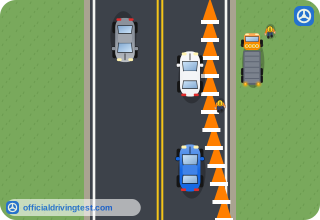
- Speed up to leave the work zone as quickly as you can
- Drive slower than all of the traffic around you
- Slow down abruptly each time you see workers
- Maintain a steady speed consistent with the traffic flow
Show answer
Correct answer: Maintain a steady speed consistent with the traffic flow
In a work zone you maintain a steady speed consistent with the traffic flow unless otherwise directed.
Source: Nebraska Driver's Manual (January 2025), page 53 · Open this page in the manual (Manual page 53)
-
In a work zone, what should you do with your lane position?
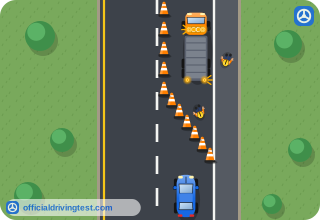
- Adjust it away from workers and equipment
- Move to the center of the lane regardless of the workers
- Move toward the workers to leave room for other traffic
- Drive on the shoulder to pass the workers
Show answer
Correct answer: Adjust it away from workers and equipment
In a work zone you adjust your lane position away from workers and equipment.
Source: Nebraska Driver's Manual (January 2025), page 53 · Open this page in the manual (Manual page 53)
-
In a work zone, how should you treat your speed and your braking readiness?
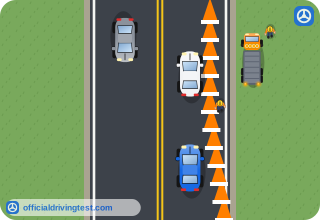
- Slow abruptly, and do not expect to have to stop
- Keep your speed fixed and do not use your brakes
- Do not slow abruptly, but be prepared to stop anytime
- Brake gently, but only when workers are in sight
Show answer
Correct answer: Do not slow abruptly, but be prepared to stop anytime
In a work zone you do not slow your speed abruptly but are prepared to stop anytime.
Source: Nebraska Driver's Manual (January 2025), page 53 · Open this page in the manual (Manual page 53)
-
When may you pass snow removal equipment?

- Whenever the equipment is moving below the speed limit
- Whenever the equipment's lights are turned on
- Only when the equipment has pulled onto the shoulder
- Only if the roadway ahead can clearly be seen
Show answer
Correct answer: Only if the roadway ahead can clearly be seen
Snow can restrict visibility around snow removal equipment, so pass only if the roadway ahead can clearly be seen, with extreme caution.
Source: Nebraska Driver's Manual (January 2025), page 70 · Open this page in the manual (Manual page 70)
-
What may snow removal equipment leave on the road that makes passing hazardous?

- Patches of loose gravel
- Ridges of snow
- Deep potholes
- Frozen puddles
Show answer
Correct answer: Ridges of snow
Snow removal equipment may leave ridges of snow making passing hazardous.
Source: Nebraska Driver's Manual (January 2025), page 70 · Open this page in the manual (Manual page 70)
-
What may cause snow removal equipment to skid?

- The weight of the plowed snow
- Salt spread on the road ahead of it
- Oncoming traffic
- A lack of tire chains
Show answer
Correct answer: The weight of the plowed snow
Occasionally, the weight of the plowed snow may cause the snow removal equipment to skid.
Source: Nebraska Driver's Manual (January 2025), page 70 · Open this page in the manual (Manual page 70)
-
Why should you maintain a safe following distance from snow removal equipment?

- Its flashing amber lights can distract the driver behind
- Its exhaust fumes can make the driver behind drowsy
- Flying sand and chunks of ice and snow can damage vehicles
- Its tires leave deep ruts that always trap vehicles
Show answer
Correct answer: Flying sand and chunks of ice and snow can damage vehicles
Flying sand and chunks of ice and snow from the equipment can damage vehicles.
Source: Nebraska Driver's Manual (January 2025), page 70 · Open this page in the manual (Manual page 70)
-
What following distance should you maintain from snow removal equipment or other maintenance vehicles working on roadways, except to pass?

- 25 feet
- 100 feet
- 50 feet
- 200 feet
Show answer
Correct answer: 100 feet
Maintain a following distance of 100 feet from snow removal equipment or other maintenance vehicles while working on roadways, except to pass.
Source: Nebraska Driver's Manual (January 2025), page 70 · Open this page in the manual (Manual page 70)