Nebraska: Emergency vehicles, work zones and police stops — Part 2 Practice Test
Questions in this part include: “If you believe an officer acted inappropriately during a stop, what may you do?” · “Which devices are the most commonly used to guide drivers safely through a work zone?”
Independent educational site · not affiliated with any government agency or DMV
Ready? Test yourself
- Instant feedback with an explanation
- Every answer cites its source in the manual
- Your best score is saved on this device
- Keyboard: press 1 to 4 to answer and Enter for the next question
Questions are original and based on the official manual "Nebraska Driver's Manual" (January 2025), Nebraska Department of Motor Vehicles.
All 16 questions in this practice test
Take the test above first, then use this list to study. Tap “Show answer” to see the correct answer and explanation.
Show the questions and answersHide the questions
-
If you believe an officer acted inappropriately during a stop, what may you do?
- Argue with the officer during the stop
- Refuse to give the officer your documents
- Wait a year before making any complaint
- Request to speak to a supervisor
Show answer
Correct answer: Request to speak to a supervisor
The manual says you may request to speak to a supervisor, which is best done as soon as possible after the stop.
Source: Nebraska Driver's Manual (January 2025), page 28 · Open this page in the manual (Manual page 28)
-
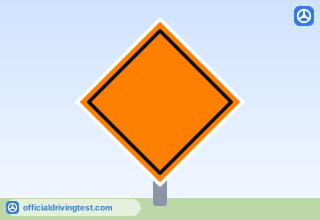
What do orange signs with messages in black letters identify?
- School zones
- Railroad crossings
- Work zones
- Service areas
Show answer
Correct answer: Work zones
The manual says orange signs with black letters are reserved strictly to identify work zones.
Source: Nebraska Driver's Manual (January 2025), page 43 · Open this page in the manual (Manual page 43)
-
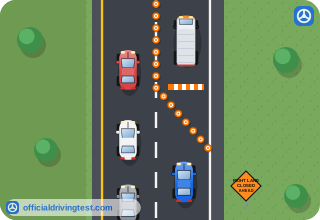
An advance work zone sign tells you to shift to another lane or reduce your speed. When should you act?
- At the last minute, so that you do not slow other traffic
- Before the last minute, since the signs give you time to react
- Only after you see workers on the road
- Only after the car ahead of you reacts
Show answer
Correct answer: Before the last minute, since the signs give you time to react
The manual says not to wait until the last minute, because the signs provide sufficient time for the driver to react without impeding traffic.
Source: Nebraska Driver's Manual (January 2025), page 43 · Open this page in the manual (Manual page 43)
-
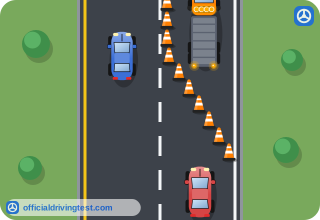
What may large flashing or sequencing arrow panels in work zones do?
- Tell drivers that a flagger is on duty ahead of them
- Mark the end of the work zone
- Show the speed limit in the work zone
- Guide drivers into lanes and show part of the road is closed
Show answer
Correct answer: Guide drivers into lanes and show part of the road is closed
Flashing arrow panels guide drivers into certain traffic lanes and inform them that part of the road ahead is closed.
Source: Nebraska Driver's Manual (January 2025), page 43 · Open this page in the manual (Manual page 43)
-
What does a flagger stationed at a work site wear?
- A reflective green vest with a badge
- A blue uniform with a badge
- A bright-colored, reflective orange vest
- A white hard hat only
Show answer
Correct answer: A bright-colored, reflective orange vest
A flagger is stationed at the site wearing a bright-colored, reflective orange vest to control traffic.
Source: Nebraska Driver's Manual (January 2025), page 43 · Open this page in the manual (Manual page 43)
-
Which device does a flagger use to stop traffic or allow it to proceed?
- A red flag only
- A STOP/SLOW paddle
- A flashing light bar
- A whistle
Show answer
Correct answer: A STOP/SLOW paddle
The flagger uses a STOP/SLOW paddle to either stop traffic or allow traffic to proceed.
Source: Nebraska Driver's Manual (January 2025), page 43 · Open this page in the manual (Manual page 43)
-
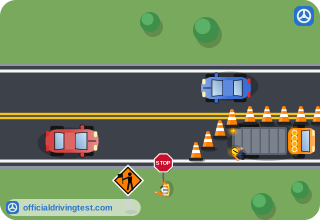
You are required to stop for a flagger in a work zone. How long must you remain stopped?
- Until the flagger turns away
- Until the vehicle behind you begins to honk
- For at least one minute
- Until you are directed by the flagger to proceed
Show answer
Correct answer: Until you are directed by the flagger to proceed
If you are required to stop, you must remain stopped until the flagger directs you to proceed.
Source: Nebraska Driver's Manual (January 2025), page 43 · Open this page in the manual (Manual page 43)
-
Which devices are the most commonly used to guide drivers safely through a work zone?
- Barricades, vertical panels, drums and cones
- Flares, rope barriers, tape and flags
- Speed bumps, rumble strips and fences
- Detour arrows and mailboxes
Show answer
Correct answer: Barricades, vertical panels, drums and cones
Barricades, vertical panels, drums and cones are the most commonly used channelizing devices to guide drivers through a work zone.
Source: Nebraska Driver's Manual (January 2025), page 43 · Open this page in the manual (Manual page 43)
-
An emergency vehicle approaches a roundabout and you have NOT yet entered it. What should you do?
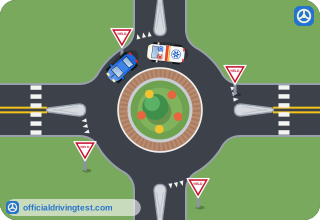
- Pull over and allow the emergency vehicle to pass
- Enter the roundabout ahead of the emergency vehicle
- Stop in the crosswalk until the emergency vehicle leaves
- Follow the emergency vehicle through the roundabout
Show answer
Correct answer: Pull over and allow the emergency vehicle to pass
If you have not entered the roundabout, you pull over and allow the emergency vehicle to pass.
Source: Nebraska Driver's Manual (January 2025), page 49 · Open this page in the manual (Manual page 49)
-
An emergency vehicle approaches and you are already in a roundabout. What should you do?
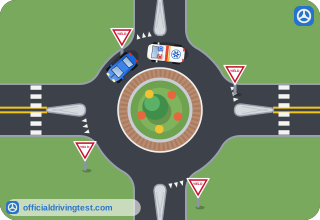
- Stop immediately where you are in the circle until it passes
- Pull onto the truck apron and stop until the vehicle passes
- Continue to your exit, then pull over once beyond the splitter island
- Go around the circle again until the vehicle has passed
Show answer
Correct answer: Continue to your exit, then pull over once beyond the splitter island
If you have entered the roundabout you continue to your exit and, once beyond the splitter island, pull over to let the emergency vehicles pass.
Source: Nebraska Driver's Manual (January 2025), page 49 · Open this page in the manual (Manual page 49)
-
On a multi-lane controlled-access highway, what must a driver approaching a stopped emergency vehicle with flashing lights do under the Move Over Law?
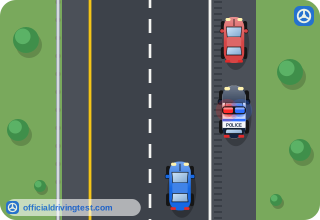
- Stop behind the stopped vehicles until the lights stop flashing
- Move into a lane at least one travel lane away from the stopped vehicles
- Stay in the lane and flash the headlights at the stopped vehicles
- Move into the lane next to the stopped vehicles and keep the same speed
Show answer
Correct answer: Move into a lane at least one travel lane away from the stopped vehicles
The Move Over Law requires moving into a lane at least one travel lane away from the stopped vehicles with flashing lights.
Source: Nebraska Driver's Manual (January 2025), page 51 · Open this page in the manual (Manual page 51)
-
Under the Move Over Law, what must a driver do if moving into another lane is not possible?
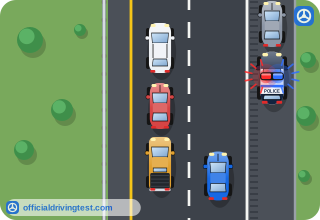
- Stop and wait behind them until the stopped vehicles leave
- Keep the same speed and sound the horn as you pass
- Pass the stopped vehicles on the right shoulder
- Reduce speed and maintain a safe speed past the stopped vehicles
Show answer
Correct answer: Reduce speed and maintain a safe speed past the stopped vehicles
If a lane change is not possible because of traffic or other conditions, the driver must reduce speed and maintain a safe speed past the stopped vehicles.
Source: Nebraska Driver's Manual (January 2025), page 51 · Open this page in the manual (Manual page 51)
-
Which of these stopped vehicles with flashing lights is covered by the Move Over Law?
- A solid waste or recycling collection vehicle
- A city transit bus stopped to pick up riders
- A delivery van
- A parked taxi
Show answer
Correct answer: A solid waste or recycling collection vehicle
The Move Over Law covers stopped solid waste or recycling collection vehicles with flashing lights, along with emergency, road assistance, utility maintenance and highway maintenance vehicles.
Source: Nebraska Driver's Manual (January 2025), page 51 · Open this page in the manual (Manual page 51)
-
What is the fine for a first offense of violating the Move Over Law?
- Up to $25
- Up to $250
- Up to $100
- Up to $1,000
Show answer
Correct answer: Up to $100
The manual states the fine for a first offense of the Move Over Law is up to $100.
Source: Nebraska Driver's Manual (January 2025), page 51 · Open this page in the manual (Manual page 51)
-
What are the penalties for a second or subsequent offense of violating the Move Over Law?
- A fine of up to $100 only
- A fine of up to $500 and/or up to 7 days in jail
- A fine of up to $1,000 and up to 30 days in jail
- Up to 7 days in jail only, with no fine
Show answer
Correct answer: A fine of up to $500 and/or up to 7 days in jail
Second and subsequent offenses can bring a fine of up to $500 and/or up to 7 days in jail.
Source: Nebraska Driver's Manual (January 2025), page 51 · Open this page in the manual (Manual page 51)
-
When the siren or flashing lights of an authorized emergency vehicle are activated, what must the driver of another vehicle do besides yielding the right-of-way?
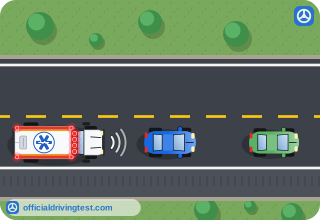
- Stop where you are in your lane until the vehicle passes
- Pull to the left edge of the roadway and stop, clear of intersections
- Slow down and continue to drive in your lane at a reduced speed
- Pull to the right edge or curb and stop, clear of any intersections
Show answer
Correct answer: Pull to the right edge or curb and stop, clear of any intersections
Drivers must pull to the right edge or curb of the roadway and stop, clear of any intersections, unless directed otherwise by a traffic officer.
Source: Nebraska Driver's Manual (January 2025), page 51 · Open this page in the manual (Manual page 51)