Nebraska: Emergency vehicles, work zones and police stops — Part 1 Practice Test
Questions in this part include: “When do law enforcement officers conduct traffic stops, according to the manual?” · “What should you do if you disagree with an officer's decision during a traffic stop?”
Independent educational site · not affiliated with any government agency or DMV
Ready? Test yourself
- Instant feedback with an explanation
- Every answer cites its source in the manual
- Your best score is saved on this device
- Keyboard: press 1 to 4 to answer and Enter for the next question
Questions are original and based on the official manual "Nebraska Driver's Manual" (January 2025), Nebraska Department of Motor Vehicles.
All 17 questions in this practice test
Take the test above first, then use this list to study. Tap “Show answer” to see the correct answer and explanation.
Show the questions and answersHide the questions
-
When do law enforcement officers conduct traffic stops, according to the manual?
- When they have reasonable suspicion of a violation
- Only when a driver is exceeding the speed limit
- Only when the driver is under the age of 21
- Only when a crash has already occurred
Show answer
Correct answer: When they have reasonable suspicion of a violation
The manual says officers conduct traffic stops when they have reasonable suspicion of a traffic violation or a criminal violation.
Source: Nebraska Driver's Manual (January 2025), page 27 · Open this page in the manual (Manual page 27)
-
When you see emergency lights behind you, what does the manual say is important for you and your passengers?
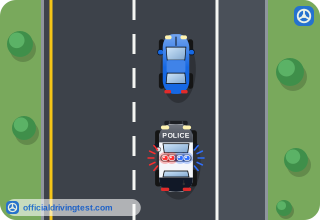
- To stop immediately where you are
- To speed up to find a safe place
- To get out of the vehicle
- To stay calm and cooperate
Show answer
Correct answer: To stay calm and cooperate
The manual says that when you see emergency lights behind you, it is important for you and your passengers to stay calm and cooperate.
Source: Nebraska Driver's Manual (January 2025), page 27 · Open this page in the manual (Manual page 27)
-
When you are pulled over by police, what should you do as soon as it is safe to do so?
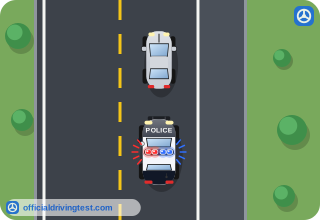
- Stop in the middle of the travel lane
- Activate your turn signal and pull to the side
- Get out and walk back to the patrol vehicle
- Turn off your headlights and leave the road
Show answer
Correct answer: Activate your turn signal and pull to the side
The manual says to activate your turn signal and pull off or to the side of the roadway as soon as it is safe.
Source: Nebraska Driver's Manual (January 2025), page 27 · Open this page in the manual (Manual page 27)
-
During a traffic stop, what should you do with the engine and audio devices?
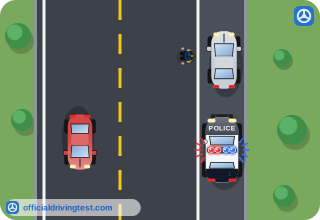
- Turn off the engine and any audio devices
- Leave the engine running and turn up the radio
- Turn off the engine but leave audio devices on
- Turn off only the audio devices
Show answer
Correct answer: Turn off the engine and any audio devices
The manual says to turn off the engine and any audio devices.
Source: Nebraska Driver's Manual (January 2025), page 28 · Open this page in the manual (Manual page 28)
-
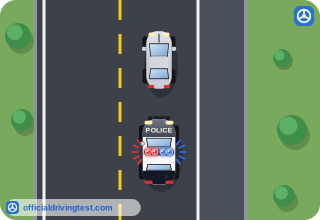
During a traffic stop, when should you exit your vehicle?
- Right away, to meet the officer
- Whenever you want to show your documents
- Only when directed by the officer
- As soon as the vehicle stops
Show answer
Correct answer: Only when directed by the officer
The manual says to stay in your vehicle unless directed by the officer to exit.
Source: Nebraska Driver's Manual (January 2025), page 28 · Open this page in the manual (Manual page 28)
-
What should you do if you are pulled over at night?
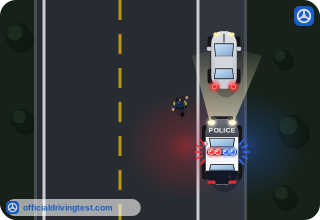
- Turn off all lights, including headlights
- Turn on your interior lights
- Turn on your high beams
- Flash your headlights at the officer
Show answer
Correct answer: Turn on your interior lights
The manual says to turn on your interior lights if you are pulled over at night to assist with visibility.
Source: Nebraska Driver's Manual (January 2025), page 28 · Open this page in the manual (Manual page 28)
-
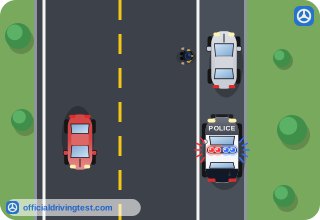
Where should you keep your hands during a traffic stop?
- Down in your lap, out of the officer's view
- Under the seat so they are not in the way
- Inside the glove compartment, ready to reach
- On the steering wheel or in a visible location
Show answer
Correct answer: On the steering wheel or in a visible location
The manual says to keep your hands on the steering wheel or in a visible location so they are easily observable.
Source: Nebraska Driver's Manual (January 2025), page 28 · Open this page in the manual (Manual page 28)
-
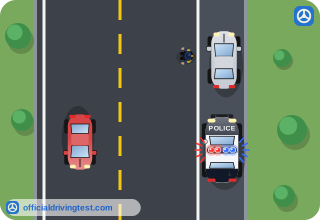
As the officer approaches your vehicle during a traffic stop, what should you do with your window?
- Keep all windows closed and locked
- Lower all windows completely
- Lower the corresponding window
- Open the door instead
Show answer
Correct answer: Lower the corresponding window
The manual says to lower the corresponding window so you and the officer can better communicate.
Source: Nebraska Driver's Manual (January 2025), page 28 · Open this page in the manual (Manual page 28)
-
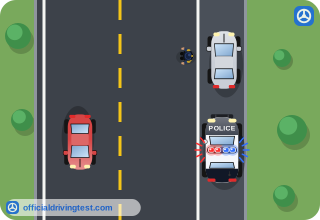
If you have a weapon in the vehicle during a traffic stop, when should you tell the officer?
- Upon first contact
- Only if the officer asks to search the vehicle
- After you hand over your documents
- Never, unless you are arrested
Show answer
Correct answer: Upon first contact
The manual says to let the officer know if you have a weapon in the vehicle upon first contact.
Source: Nebraska Driver's Manual (January 2025), page 28 · Open this page in the manual (Manual page 28)
-
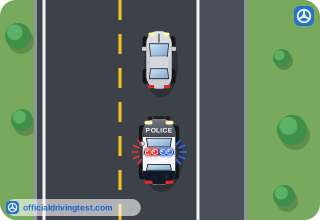
When should you reach for your driver's license or vehicle documents during a traffic stop?
- As soon as the vehicle stops
- Before the officer reaches your window
- As soon as you lower your window
- After waiting for the officer's instructions
Show answer
Correct answer: After waiting for the officer's instructions
The manual says to wait for the officer's instructions before reaching for your driver's license or vehicle documents.
Source: Nebraska Driver's Manual (January 2025), page 28 · Open this page in the manual (Manual page 28)
-
If an officer who is not in uniform does not show law enforcement credentials, what may you do?
- Drive away from the stop
- Ask to see them
- Refuse to speak with the officer
- Call the DMV
Show answer
Correct answer: Ask to see them
The manual says officers not in uniform typically show credentials and, if they do not, you may ask to see them.
Source: Nebraska Driver's Manual (January 2025), page 28 · Open this page in the manual (Manual page 28)
-
If the documents an officer asks for are out of your reach, what should you do?
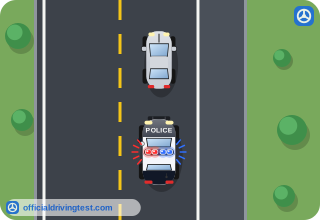
- Tell the officer where they are and wait for acknowledgement
- Reach for them quickly while the officer approaches
- Step out of the vehicle to get them without a word
- Ask a passenger to hand them over right away
Show answer
Correct answer: Tell the officer where they are and wait for acknowledgement
The manual says to tell the officer where the documents are and wait for acknowledgement before reaching for them.
Source: Nebraska Driver's Manual (January 2025), page 28 · Open this page in the manual (Manual page 28)
-
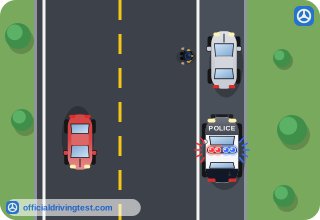
If an officer asks you to exit the vehicle during a traffic stop, what should you do?
- Stay in the vehicle with your hands visible
- Exit and stand behind the vehicle with your hands down
- Keep hands visible, exit, and stand where directed
- Exit and walk away from the vehicle
Show answer
Correct answer: Keep hands visible, exit, and stand where directed
The manual says to keep your hands visible, exit the vehicle, and stand in a location as directed by the officer.
Source: Nebraska Driver's Manual (January 2025), page 28 · Open this page in the manual (Manual page 28)
-
What may an officer do at the end of a traffic stop, according to the manual?
- Only give a verbal warning and nothing else
- A warning, a traffic ticket, or an arrest
- Only issue a ticket that includes a fine
- Only take away the driver's license
Show answer
Correct answer: A warning, a traffic ticket, or an arrest
The manual says an officer may impose a sanction such as a warning, traffic ticket which may include a fine, or arrest.
Source: Nebraska Driver's Manual (January 2025), page 28 · Open this page in the manual (Manual page 28)
-
What should you do if you disagree with an officer's decision during a traffic stop?
- Argue with the officer until the decision is explained
- Refuse to sign the ticket and leave
- Drive away and contest it by mail later
- Do not argue; contest it in court through legal channels
Show answer
Correct answer: Do not argue; contest it in court through legal channels
The manual says not to prolong the contact by arguing, and that you may contest the decision in court through established legal channels.
Source: Nebraska Driver's Manual (January 2025), page 28 · Open this page in the manual (Manual page 28)
-
According to the manual, what is true about your acceptance and signature on a traffic ticket?
- It is an admission of guilt
- It ends your right to contest the ticket
- It is not an admission of guilt
- It is required only for parking tickets
Show answer
Correct answer: It is not an admission of guilt
The manual states that your acceptance and signature on a traffic ticket is not an admission of guilt.
Source: Nebraska Driver's Manual (January 2025), page 28 · Open this page in the manual (Manual page 28)
-
What may result from refusing to sign a traffic ticket?
- Your arrest
- A warning only
- Automatic cancellation of the ticket
- Loss of your insurance
Show answer
Correct answer: Your arrest
The manual says the refusal to sign a traffic ticket may result in your arrest.
Source: Nebraska Driver's Manual (January 2025), page 28 · Open this page in the manual (Manual page 28)