Missouri: Speed and following distance
Missouri speed guides, controlling your speed, the following-distance rule, stopping distances and passing safely. Split into 4 shorter tests so you're not stuck in one long quiz.
Independent educational site · not affiliated with any government agency or DMV
Choose a part
Speed and following distance — Part 1
Questions in this part include: “Which of these does the examiner watch for as part of your use of good driving rules?”
StartSpeed and following distance — Part 2
Questions in this part include: “Which vehicles should you watch for on steep grades or when they are entering traffic?”
StartSpeed and following distance — Part 3
Questions in this part include: “Where should you stop to pick up or let off passengers?”
StartSpeed and following distance — Part 4
Questions in this part include: “If you are driving a bus or truck, how close may you follow another bus or truck in general?”
StartAll 78 Speed and following distance questions with answers
Choose a part above to take a practice test, or study every question and answer here.
Show the questions and answersHide the questions
-
Which of these does the examiner watch for as part of your use of good driving rules?
- How fast you finish the whole route
- How often you use the horn on route
- Distance from the vehicle ahead of you
- How often you change lanes on the route
Show answer
Correct answer: Distance from the vehicle ahead of you
The examiner tests for the distance between your vehicle and the vehicle in front of you, along with speed, lane use, awareness and yielding.
Source: Missouri Driver Guide (Revised August 2026), page 21 · Open this page in the manual (Manual page 21)
-
When may the driver of a motor vehicle overtake and pass to the right of another vehicle?
- When the vehicle overtaken is making or about to make a left turn
- When the vehicle overtaken is traveling below the speed limit
- When the vehicle overtaken is making or about to make a right turn
- When the driver ahead has signaled for you to go around
Show answer
Correct answer: When the vehicle overtaken is making or about to make a left turn
Passing on the right is allowed only under listed conditions, and one is when the vehicle being overtaken is making or about to make a left turn.
Source: Missouri Driver Guide (Revised August 2026), page 22 · Open this page in the manual (Manual page 22)
-
Which of these is a place where you may overtake and pass another vehicle on the right?
- On a one-way street
- On a two-lane road with a dashed center line
- On a hill with a clear view ahead
- On a street in a school zone
Show answer
Correct answer: On a one-way street
The manual lists a one-way street as one of the conditions under which a driver may overtake and pass to the right.
Source: Missouri Driver Guide (Revised August 2026), page 22 · Open this page in the manual (Manual page 22)
-
Outside a city, on what kind of highway may you pass to the right of another vehicle?
- One with unobstructed pavement clearly marked for two lanes
- One with a paved shoulder wide enough for another vehicle
- One with unobstructed pavement clearly marked for four or more lanes
- Any highway with a posted speed limit of 55 mph or more
Show answer
Correct answer: One with unobstructed pavement clearly marked for four or more lanes
Outside a city, passing on the right is allowed upon a highway with unobstructed pavement of sufficient width and clearly marked for four or more lanes of traffic.
Source: Missouri Driver Guide (Revised August 2026), page 22 · Open this page in the manual (Manual page 22)
-
On a city street, passing to the right is allowed when the unobstructed pavement is wide enough for how many lines of vehicles in each direction?
- One
- Two or more
- Three or more
- Five or more
Show answer
Correct answer: Two or more
On a city street with unobstructed pavement of sufficient width for two or more lines of vehicles in each direction, a driver may pass to the right.
Source: Missouri Driver Guide (Revised August 2026), page 22 · Open this page in the manual (Manual page 22)
-
What does the manual say about passing on the right by driving off the paved or main traveled portion of the roadway (the shoulder)?
- It is allowed when the traffic ahead is stopped
- It is allowed on highways outside a city
- It is allowed when the shoulder is paved
- It is never allowed, in any situation
Show answer
Correct answer: It is never allowed, in any situation
The manual states that in no event shall passing on the right be done by driving off the paved or main traveled portion of the roadway.
Source: Missouri Driver Guide (Revised August 2026), page 22 · Open this page in the manual (Manual page 22)
-
When your view is obstructed, within what distance of a bridge, viaduct, or tunnel must you not drive to the left side of the roadway?
- 50 feet
- 200 feet
- 300 feet
- 100 feet
Show answer
Correct answer: 100 feet
No vehicle shall be driven to the left side of the roadway when the view is obstructed upon approaching within 100 feet of any bridge, viaduct, or tunnel.
Source: Missouri Driver Guide (Revised August 2026), page 22 · Open this page in the manual (Manual page 22)
-
Within what distance of an intersection or railroad grade crossing must you not drive to the left side of the roadway?
- 25 feet
- 100 feet
- 150 feet
- 500 feet
Show answer
Correct answer: 100 feet
The manual forbids driving to the left side of the roadway when approaching within 100 feet of or at any intersection or railroad grade crossing.
Source: Missouri Driver Guide (Revised August 2026), page 22 · Open this page in the manual (Manual page 22)
-
Which of these means no vehicle may be driven to the left side of the roadway?
- The vehicle ahead is driving below the speed limit
- The vehicle ahead is signaling a right turn
- There is a solid yellow line
- The road is wet from rain
Show answer
Correct answer: There is a solid yellow line
A solid yellow line is one of the listed conditions under which no vehicle shall be driven to the left side of the roadway.
Source: Missouri Driver Guide (Revised August 2026), page 22 · Open this page in the manual (Manual page 22)
-
Where is driving to the left side of the roadway not allowed because your view is obstructed?
- On a curve where your view is obstructed
- On a straight road with a clear view ahead
- On a four-lane highway outside a city
- On a street with a wide shoulder
Show answer
Correct answer: On a curve where your view is obstructed
No vehicle shall be driven to the left side when approaching the crest of a grade or upon a curve where the driver's view is obstructed and could create a hazard.
Source: Missouri Driver Guide (Revised August 2026), page 22 · Open this page in the manual (Manual page 22)
-
A fully loaded tractor-trailer may take about how far to come to a complete stop, in the manual's comparison with a car traveling at 55 mph?
- About 200 feet
- Almost 400 feet
- About 600 feet
- About 1,000 feet
Show answer
Correct answer: Almost 400 feet
The manual says a fully loaded tractor-trailer may take almost 400 feet to come to a complete stop.
Source: Missouri Driver Guide (Revised August 2026), page 29 · Open this page in the manual (Manual page 29)
-
What is the best way to control your speed?
- Follow the vehicle ahead closely
- Use your brakes often
- Know how fast you are going
- Match the speed of the fastest traffic
Show answer
Correct answer: Know how fast you are going
The best way to control your speed is to know how fast you are going.
Source: Missouri Driver Guide (Revised August 2026), page 37 · Open this page in the manual (Manual page 37)
-
When is it especially important to check your speedometer and pay attention to posted speed limits?
- When you are driving at night on an unlit rural road
- When you leave high speed roads for much slower local roads
- When you are following a large truck on a highway
- When you start driving on a road with no traffic
Show answer
Correct answer: When you leave high speed roads for much slower local roads
It is especially true when you leave high speed roads and begin driving on much slower local roads.
Source: Missouri Driver Guide (Revised August 2026), page 37 · Open this page in the manual (Manual page 37)
-
Traffic crashes involving two or more vehicles often happen when drivers do what?
- Drive in the same lane at the same speed
- Go faster or slower than other vehicles on the road
- Use their turn signals too early
- Keep a safe distance from the vehicle ahead
Show answer
Correct answer: Go faster or slower than other vehicles on the road
Crashes involving two or more vehicles often happen when drivers go faster or slower than other vehicles on the road, while vehicles moving the same way at the same speed cannot hit one another.
Source: Missouri Driver Guide (Revised August 2026), page 38 · Open this page in the manual (Manual page 38)
-
According to the manual, how much time does speeding save?
- No more than a few minutes an hour
- About ten minutes an hour
- Up to half an hour on a long trip
- A large amount of time on highways
Show answer
Correct answer: No more than a few minutes an hour
Speeding does not save more than a few minutes an hour.
Source: Missouri Driver Guide (Revised August 2026), page 38 · Open this page in the manual (Manual page 38)
-
If you are going faster than traffic, what happens each time you pass someone?
- You gain a safer following distance
- Your fuel use drops
- There is a chance for a collision
- Other drivers have more time to see you
Show answer
Correct answer: There is a chance for a collision
Each time you pass someone, there is a chance for a collision.
Source: Missouri Driver Guide (Revised August 2026), page 38 · Open this page in the manual (Manual page 38)
-
How does going much slower than other vehicles affect the traffic around you?
- Other drivers slow down and match your speed safely
- Vehicles bunch up behind you and drivers become impatient
- Traffic spreads out and passing becomes easier
- Drivers behind you become more careful and alert
Show answer
Correct answer: Vehicles bunch up behind you and drivers become impatient
Going much slower than other vehicles tends to make vehicles bunch up behind you, and drivers then become impatient and pass you.
Source: Missouri Driver Guide (Revised August 2026), page 38 · Open this page in the manual (Manual page 38)
-
If vehicles are piled up behind you, what should you do?
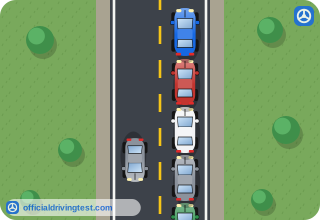
- Speed up above the limit to get away from them
- Stay in your lane and signal them to go around
- Switch on your hazard flashers and keep your speed
- Pull over and let them pass when it is safe to do so
Show answer
Correct answer: Pull over and let them pass when it is safe to do so
If vehicles are piled up behind you, you pull over and let them pass when it is safe to do so.
Source: Missouri Driver Guide (Revised August 2026), page 38 · Open this page in the manual (Manual page 38)
-
How often should you check your rearview mirrors to keep track of approaching traffic?
- Every few minutes
- Once every mile
- Every few seconds
- Only before changing lanes
Show answer
Correct answer: Every few seconds
You check your rearview mirrors every few seconds to keep track of the approaching traffic.
Source: Missouri Driver Guide (Revised August 2026), page 38 · Open this page in the manual (Manual page 38)
-
What can slowing suddenly cause?
- A traffic crash
- Brake failure
- A flat tire
- Engine stalling
Show answer
Correct answer: A traffic crash
Slowing suddenly can cause a traffic crash.
Source: Missouri Driver Guide (Revised August 2026), page 38 · Open this page in the manual (Manual page 38)
-
Which vehicles should you watch for on steep grades or when they are entering traffic?
- Emergency vehicles and school buses
- Sports cars and other high-powered vehicles
- Vehicles with out-of-state license plates
- Large trucks and small, underpowered vehicles
Show answer
Correct answer: Large trucks and small, underpowered vehicles
Large trucks and small, underpowered vehicles can lose speed on long or steep hills and take longer to get up to speed when they enter traffic.
Source: Missouri Driver Guide (Revised August 2026), page 38 · Open this page in the manual (Manual page 38)
-
Which problem does stopping suddenly cause for drivers behind you?
- It makes it harder for them to stop without hitting you
- It blocks their view of the road in front of your vehicle
- It causes the brakes on their vehicles to overheat
- It forces them to speed up and pass your vehicle
Show answer
Correct answer: It makes it harder for them to stop without hitting you
Stopping suddenly makes it harder for drivers behind you to stop without hitting you.
Source: Missouri Driver Guide (Revised August 2026), page 39 · Open this page in the manual (Manual page 39)
-
How can you avoid panic stops?
- By braking harder at the last moment
- By following closer to the vehicle ahead
- By seeing events well in advance
- By increasing your speed in traffic
Show answer
Correct answer: By seeing events well in advance
You try to avoid panic stops by seeing events well in advance.
Source: Missouri Driver Guide (Revised August 2026), page 39 · Open this page in the manual (Manual page 39)
-
You may feel comfortable driving above the advisory speed on a curve in fair weather. When should you never do so?
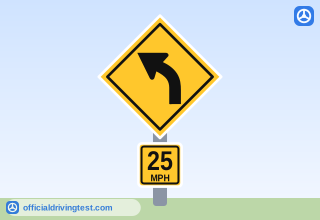
- On a road with no center line
- When another car is following you
- In rain, snow, or icy conditions
- On roads with a paved shoulder
Show answer
Correct answer: In rain, snow, or icy conditions
Although you may feel comfortable driving at a higher speed in fair weather, you should never do so in rain, snow or icy conditions.
Source: Missouri Driver Guide (Revised August 2026), page 47 · Open this page in the manual (Manual page 47)
-
A posted speed limit is the maximum allowable speed in which conditions?
- Any road conditions
- Heavy traffic
- Ideal conditions
- Slippery conditions
Show answer
Correct answer: Ideal conditions
The speed limit is the maximum allowable speed in ideal conditions, and conditions such as curves or slippery roads may make it unsafe.
Source: Missouri Driver Guide (Revised August 2026), page 50 · Open this page in the manual (Manual page 50)
-
Conditions such as hills, curves, or slippery roadways make the posted speed limit unsafe. What does the law require?
- You may still drive the posted limit if you stay in your lane
- You must slow down
- You may drive the posted limit if your vehicle is in good repair
- You must stop on the shoulder until conditions improve
Show answer
Correct answer: You must slow down
By law, when conditions demand it, you must slow down, because the posted limit does not mean every part of the road can be driven safely at that speed.
Source: Missouri Driver Guide (Revised August 2026), page 50 · Open this page in the manual (Manual page 50)
-
Under normal roadway conditions, you may not drive slower than what speed on interstate highways?
- 25 mph
- 30 mph
- 50 mph
- 40 mph
Show answer
Correct answer: 40 mph
Interstate highways have minimum speed limits, and you may not drive slower than 40 mph on them under normal roadway conditions.
Source: Missouri Driver Guide (Revised August 2026), page 50 · Open this page in the manual (Manual page 50)
-
The minimum speed on an interstate is too fast for you. What does the manual say you should do?
- Use another route
- Drive on the shoulder
- Stay in the left lane with your flashers on
- Drive slower and let traffic pass you
Show answer
Correct answer: Use another route
If the interstate minimum speed is too fast for you, you should use another route.
Source: Missouri Driver Guide (Revised August 2026), page 50 · Open this page in the manual (Manual page 50)
-
Unless posted speed limits direct otherwise, what is the maximum speed guide for rural expressways?
- 45 mph
- 65 mph
- 50 mph
- 40 mph
Show answer
Correct answer: 65 mph
The manual's guide for maximum speed lists 65 mph for rural expressways, unless posted speed limits direct otherwise.
Source: Missouri Driver Guide (Revised August 2026), page 50 · Open this page in the manual (Manual page 50)
-
Unless posted speed limits direct otherwise, what is the maximum speed guide for lettered roads?
- 45 mph
- 50 mph
- 35 mph
- 55 mph
Show answer
Correct answer: 55 mph
The manual's guide for maximum speed lists 55 mph for lettered roads, unless posted speed limits direct otherwise.
Source: Missouri Driver Guide (Revised August 2026), page 50 · Open this page in the manual (Manual page 50)
-
Unless posted speed limits direct otherwise, what is the maximum speed guide for all other roads and highways not located in an urbanized area?
- 60 mph
- 45 mph
- 50 mph
- 40 mph
Show answer
Correct answer: 60 mph
The manual's guide for maximum speed lists 60 mph for all other roads and highways not located in an urbanized area.
Source: Missouri Driver Guide (Revised August 2026), page 50 · Open this page in the manual (Manual page 50)
-
Unless posted speed limits direct otherwise, what is the maximum speed guide for interstate highways, freeways, or expressways within urbanized areas?
- 45 mph
- 50 mph
- 60 mph
- 40 mph
Show answer
Correct answer: 60 mph
The manual's guide for maximum speed lists 60 mph for interstate highways, freeways, or expressways within urbanized areas.
Source: Missouri Driver Guide (Revised August 2026), page 50 · Open this page in the manual (Manual page 50)
-
What is the speed limit in any city, town, or village, unless posted otherwise?
- 15 mph
- 25 mph
- 20 mph
- 35 mph
Show answer
Correct answer: 25 mph
The speed limit in any city, town, or village is 25 mph, unless posted otherwise.
Source: Missouri Driver Guide (Revised August 2026), page 50 · Open this page in the manual (Manual page 50)
-
Which body has the authority to set speed limits higher or lower than the uniform maximum speed limits?
- The Missouri Department of Revenue license offices
- The Missouri State Highway Patrol driver examiners
- Local license offices across the state of Missouri
- The Missouri Highway and Transportation Commission
Show answer
Correct answer: The Missouri Highway and Transportation Commission
The Missouri Highway and Transportation Commission may set speed limits higher or lower than the uniform maximums for safety reasons or to expedite the flow of traffic.
Source: Missouri Driver Guide (Revised August 2026), page 50 · Open this page in the manual (Manual page 50)
-
Why are lower speeds usually posted on interstates in urban areas?
- Interchanges and entering and exiting traffic are more frequent
- Interstate pavement is narrower in cities than in rural areas
- Large trucks are not allowed on urban interstates at all
- Minimum speed limits do not apply on interstates in cities
Show answer
Correct answer: Interchanges and entering and exiting traffic are more frequent
Lower speeds are posted on interstates for safety, usually in urban areas where interchanges and entering and exiting traffic are more frequent.
Source: Missouri Driver Guide (Revised August 2026), page 50 · Open this page in the manual (Manual page 50)
-
How often should a defensive driver check behind through the mirrors?
- Every few seconds
- Once every mile
- Only before changing lanes
- Every few minutes
Show answer
Correct answer: Every few seconds
A defensive driver keeps the eyes moving and checks behind through the mirrors every few seconds.
Source: Missouri Driver Guide (Revised August 2026), page 56 · Open this page in the manual (Manual page 56)
-
According to the manual, who causes many head-on collisions?
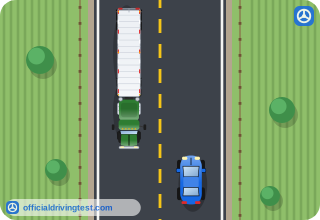
- Drivers who stop for a stop sign
- Drivers who follow too closely in the same lane
- Drivers who signal too early before a turn
- Distracted drivers crossing the center line
Show answer
Correct answer: Distracted drivers crossing the center line
Many head-on collisions occur by distracted drivers crossing the center line, so pay special attention to oncoming vehicles.
Source: Missouri Driver Guide (Revised August 2026), page 56 · Open this page in the manual (Manual page 56)
-
What causes rear-end crashes, according to the manual?
- Drivers who signal too early before they slow down
- Drivers who keep a steady speed on the highway
- Drivers who leave too much space between vehicles
- Drivers who follow too closely and cannot stop in time
Show answer
Correct answer: Drivers who follow too closely and cannot stop in time
Rear-end crashes are very common and are caused by drivers who follow too closely and cannot stop in time when the vehicle ahead suddenly stops.
Source: Missouri Driver Guide (Revised August 2026), page 57 · Open this page in the manual (Manual page 57)
-
When do you start counting in the “three second rule”?
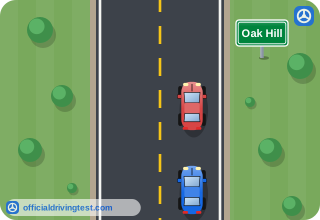
- As your own vehicle passes an object near the road
- As the vehicle ahead of you turns on its brake lights
- As the vehicle ahead of you passes an object near the road
- As you come to a stop behind the vehicle ahead
Show answer
Correct answer: As the vehicle ahead of you passes an object near the road
You choose an object near the road, and as the vehicle ahead passes it you count “one-thousand one, one-thousand two, one-thousand three.”
Source: Missouri Driver Guide (Revised August 2026), page 57 · Open this page in the manual (Manual page 57)
-
Under the “three second rule,” what does it mean if you reach the object before you finish counting?
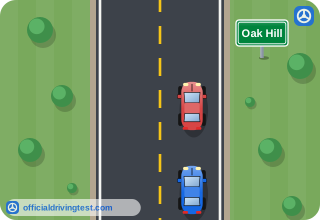
- You are too close to the vehicle ahead
- You are following at a safe distance
- You are following too far behind
- You are driving above the speed limit
Show answer
Correct answer: You are too close to the vehicle ahead
If you reach the object before you finish counting, you are too close to the vehicle ahead.
Source: Missouri Driver Guide (Revised August 2026), page 57 · Open this page in the manual (Manual page 57)
-
How can you help keep the driver behind you at a safe distance?
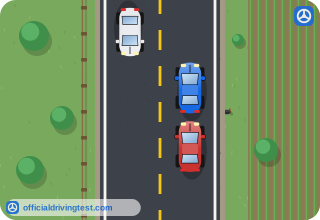
- Tap your brakes repeatedly to warn the driver behind you
- Slow down quickly so that the driver behind backs off
- Flash your headlights at the driver to warn him or her off
- Keep a steady speed and signal in advance when you slow down
Show answer
Correct answer: Keep a steady speed and signal in advance when you slow down
The manual says you can help by keeping a steady speed and signaling in advance when you slow down.
Source: Missouri Driver Guide (Revised August 2026), page 57 · Open this page in the manual (Manual page 57)
-
Where should you stop to pick up or let off passengers?
- In the lane you are driving in
- In a safe place out of traffic
- On the left side of a two-lane road
- At the nearest intersection, in the crosswalk
Show answer
Correct answer: In a safe place out of traffic
Try to find a safe place out of traffic to stop and pick up or let off passengers.
Source: Missouri Driver Guide (Revised August 2026), page 57 · Open this page in the manual (Manual page 57)
-
You want to parallel park and there is traffic coming behind you. What should you do?
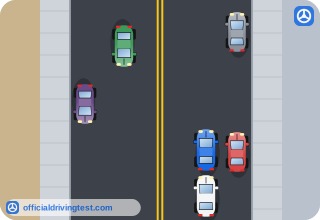
- Signal, pull next to the space, and let vehicles pass before you park
- Stop in the traffic lane and back into the space right away
- Park without signaling to avoid confusing the drivers behind
- Pull past the space and back up into it as quickly as you can
Show answer
Correct answer: Signal, pull next to the space, and let vehicles pass before you park
Put on your turn signal, pull next to the space, and allow vehicles to pass before you park.
Source: Missouri Driver Guide (Revised August 2026), page 57 · Open this page in the manual (Manual page 57)
-
You are tailgated by another driver and there is a right lane. What should you do?
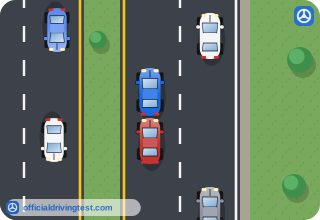
- Brake hard to warn the tailgater
- Move over to the right
- Move to the left lane and slow down
- Speed up until the tailgater falls back
Show answer
Correct answer: Move over to the right
If you are followed too closely and there is a right lane, move over to the right.
Source: Missouri Driver Guide (Revised August 2026), page 57 · Open this page in the manual (Manual page 57)
-
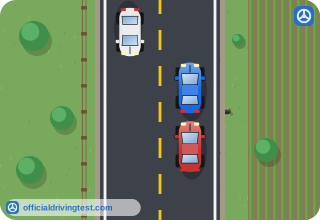
You are tailgated and there is no right lane. What should you do?
- Slow down quickly to discourage the driver behind you
- Stop in the road until the tailgater drives past you
- Speed up so that the tailgater is left far behind you
- Wait until the road ahead is clear, then reduce speed slowly
Show answer
Correct answer: Wait until the road ahead is clear, then reduce speed slowly
If there is no right lane, wait until the road ahead is clear and then reduce speed slowly, which encourages the tailgater to drive around you.
Source: Missouri Driver Guide (Revised August 2026), page 57 · Open this page in the manual (Manual page 57)
-
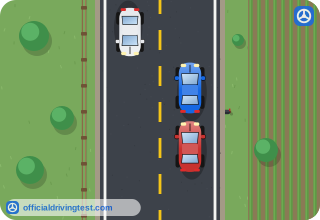
What does the manual say about slowing down quickly to discourage a tailgater?
- It is the best way to make the tailgater back off
- It is required by law when you are tailgated
- It only increases your risk of being hit from behind
- It makes the tailgater pass on the left
Show answer
Correct answer: It only increases your risk of being hit from behind
Never slow down quickly to discourage a tailgater, because this will only increase your risk of being hit from behind.
Source: Missouri Driver Guide (Revised August 2026), page 57 · Open this page in the manual (Manual page 57)
-
Where is it generally safest to drive within your lane?
- Close to the center line
- Close to the right edge of the lane
- Close to the left edge of the lane
- In the center of your lane
Show answer
Correct answer: In the center of your lane
In general, it is safest to drive in the center of your lane, and on a two-lane road you should not crowd the center line.
Source: Missouri Driver Guide (Revised August 2026), page 57 · Open this page in the manual (Manual page 57)
-
What does your stopping distance equal?
- Your braking distance minus your reaction distance
- Your reaction distance plus your following distance
- Your braking distance plus your lane-change distance
- Your reaction distance plus your braking distance
Show answer
Correct answer: Your reaction distance plus your braking distance
Stopping distance is the reaction distance plus the braking distance.
Source: Missouri Driver Guide (Revised August 2026), page 58 · Open this page in the manual (Manual page 58)
-
Which of these means you will need more space to stop your vehicle?
- You are driving slowly
- You are fully rested
- Your vehicle has bad brakes
- Your vehicle has new tires
Show answer
Correct answer: Your vehicle has bad brakes
If you are driving fast, are very tired, or if your vehicle has bad brakes, you will need more space to stop your vehicle.
Source: Missouri Driver Guide (Revised August 2026), page 58 · Open this page in the manual (Manual page 58)
-
What is the reaction distance?
- The distance you travel after you see a danger and before you apply your brakes
- The distance you travel after you apply your brakes and before the vehicle stops
- The distance between your vehicle and the one in front
- The distance you can see ahead of you at night
Show answer
Correct answer: The distance you travel after you see a danger and before you apply your brakes
The reaction distance is the distance traveled between seeing a danger and applying the brakes.
Source: Missouri Driver Guide (Revised August 2026), page 58 · Open this page in the manual (Manual page 58)
-
What is the braking distance?
- The distance you travel after you see a danger and before you apply your brakes
- The distance between your vehicle and the one behind
- The distance at which your brake lights can be seen
- The distance you travel after you apply your brakes and before the vehicle stops
Show answer
Correct answer: The distance you travel after you apply your brakes and before the vehicle stops
The braking distance is the distance traveled between applying the brakes and coming to a stop.
Source: Missouri Driver Guide (Revised August 2026), page 58 · Open this page in the manual (Manual page 58)
-
In the manual’s stopping distance chart, how many seconds of reaction time is the reaction distance based on?
- Three-quarters of a second
- One and one-half seconds
- Two and one-half seconds
- Three seconds
Show answer
Correct answer: One and one-half seconds
The chart’s reaction distance is for 1.5 seconds, so you have to be alert to react within one and one-half seconds.
Source: Missouri Driver Guide (Revised August 2026), page 58 · Open this page in the manual (Manual page 58)
-
In the manual’s chart of average stopping distance of cars on dry level pavement, what is the braking distance at 80 mph?
- 284 feet
- 230 feet
- 260 feet
- 310 feet
Show answer
Correct answer: 284 feet
The chart lists 176 feet of reaction distance and 284 feet of braking distance at 80 mph.
Source: Missouri Driver Guide (Revised August 2026), page 58 · Open this page in the manual (Manual page 58)
-
In the manual’s chart of average stopping distance of cars on dry level pavement, what is the reaction distance at 30 mph?
- 54 feet
- 78 feet
- 66 feet
- 88 feet
Show answer
Correct answer: 66 feet
The chart lists 66 feet of reaction distance and 40 feet of braking distance at 30 mph.
Source: Missouri Driver Guide (Revised August 2026), page 58 · Open this page in the manual (Manual page 58)
-
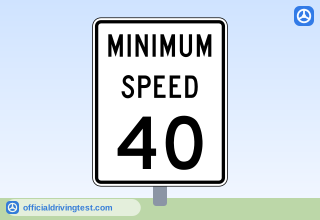
What does the manual say about driving slower than the posted minimum speed under normal driving conditions?
- It is allowed if you use your hazard flashers
- It is allowed in the left lane only
- It is against the law
- It is allowed during daylight
Show answer
Correct answer: It is against the law
It is against the law to drive slower than the posted minimum speed under normal driving conditions.
Source: Missouri Driver Guide (Revised August 2026), page 59 · Open this page in the manual (Manual page 59)
-
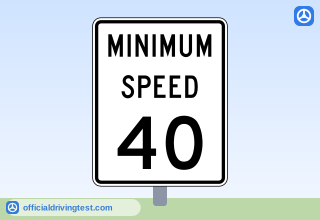
Under which condition may you drive more slowly than the posted minimum speed?
- On a dry, clear road
- In bad weather
- In light traffic
- When you are in no hurry
Show answer
Correct answer: In bad weather
You may drive more slowly than the minimum speed in bad weather, heavy traffic, or on a bad road.
Source: Missouri Driver Guide (Revised August 2026), page 59 · Open this page in the manual (Manual page 59)
-
There is no posted minimum speed. What does the manual say about driving very slowly?
- You may drive as slowly as you like when no minimum is posted
- You may drive slowly in the left lane only, never in the right
- You may drive slowly as long as your hazard flashers are on
- It is still against the law to drive so slowly that you block traffic
Show answer
Correct answer: It is still against the law to drive so slowly that you block traffic
Even with no posted minimum speed, it is against the law to drive so slowly that you block traffic.
Source: Missouri Driver Guide (Revised August 2026), page 59 · Open this page in the manual (Manual page 59)
-
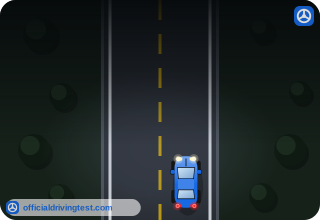
About how far ahead do headlights let you see at night?
- About 150 feet
- About 650 feet
- About 350 feet
- About 200 feet
Show answer
Correct answer: About 350 feet
The manual says headlights only let you see about 350 feet ahead.
Source: Missouri Driver Guide (Revised August 2026), page 62 · Open this page in the manual (Manual page 62)
-
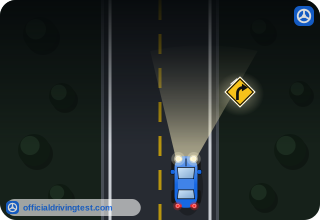
What does the manual tell you to do so that you do not overdrive your headlights at night?
- Drive at the speed limit as long as your high beams are on
- Drive slowly enough that you can stop or turn if needed
- Drive faster so you pass through dark areas quickly
- Drive at the same speed you would use in daylight
Show answer
Correct answer: Drive slowly enough that you can stop or turn if needed
Headlights show only a limited distance, so the manual says to be sure you are driving slowly enough to stop or turn if needed.
Source: Missouri Driver Guide (Revised August 2026), page 62 · Open this page in the manual (Manual page 62)
-
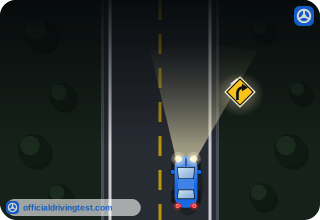
At night, what should you do when nearing a curve if you are driving the maximum posted speed limit?
- Hold your speed
- Slow down
- Speed up
- Flash your high beams
Show answer
Correct answer: Slow down
The manual says to slow down when nearing a curve if you are driving the maximum posted speed limit.
Source: Missouri Driver Guide (Revised August 2026), page 62 · Open this page in the manual (Manual page 62)
-
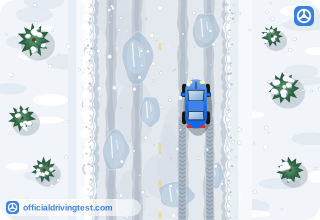
What should you do with your vehicle's cruise control when there is snow or ice on the road?
- Not use it
- Set it at a low speed
- Use it on straight roads only
- Use it only with four-wheel drive
Show answer
Correct answer: Not use it
The manual says to slow down and not use your vehicle’s cruise control system when there is snow or ice on the road.
Source: Missouri Driver Guide (Revised August 2026), page 62 · Open this page in the manual (Manual page 62)
-
On snow or ice, about how much distance should you leave between your vehicle and the vehicle ahead?
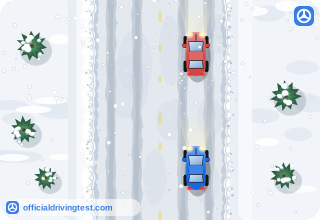
- About one to two seconds
- About eight to ten seconds
- About four to five seconds
- About fifteen to twenty seconds
Show answer
Correct answer: About eight to ten seconds
Stopping takes longer on snow or ice, so the manual says to leave about eight to ten seconds between you and the vehicle ahead.
Source: Missouri Driver Guide (Revised August 2026), page 63 · Open this page in the manual (Manual page 63)
-
Which parts of the road freeze and become slippery before other parts?
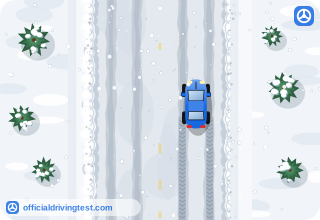
- Hills and curves
- Intersections and crosswalks
- Bridges and overpasses
- Tunnels and underpasses
Show answer
Correct answer: Bridges and overpasses
The manual says bridges and overpasses will freeze and become slippery before other parts of the road.
Source: Missouri Driver Guide (Revised August 2026), page 63 · Open this page in the manual (Manual page 63)
-
What forms a slick, greasy film on the road when it starts to rain?
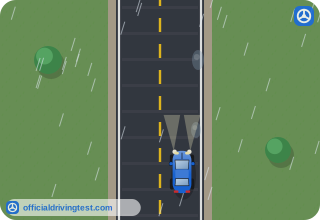
- Water mixing with the dust and oil on the road
- Rain washing the paint off the lane markings
- Water freezing on contact with the road
- Tire rubber melting into the pavement
Show answer
Correct answer: Water mixing with the dust and oil on the road
The manual says that when it starts to rain, water mixes with the dust and oil on the road to form a slick, greasy film.
Source: Missouri Driver Guide (Revised August 2026), page 63 · Open this page in the manual (Manual page 63)
-
On wet pavement, what may be harder for you to do on curves?
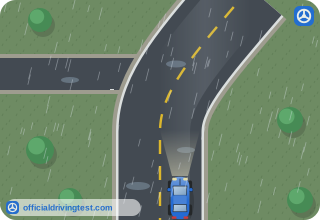
- See the curve signs
- Use your turn signal
- Stay on the road
- Judge the distance to other vehicles
Show answer
Correct answer: Stay on the road
The manual says wet pavement may make it harder for you to stay on the road on curves.
Source: Missouri Driver Guide (Revised August 2026), page 63 · Open this page in the manual (Manual page 63)
-
What is it called when your tires ride on the water rather than the pavement?
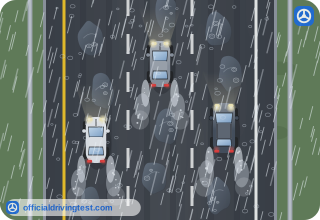
- Skidding
- Overdriving
- Fishtailing
- Hydroplaning
Show answer
Correct answer: Hydroplaning
The manual says that when tires ride on the water rather than the pavement it is known as hydroplaning, a loss of traction and control.
Source: Missouri Driver Guide (Revised August 2026), page 63 · Open this page in the manual (Manual page 63)
-
At what speeds can hydroplaning happen?
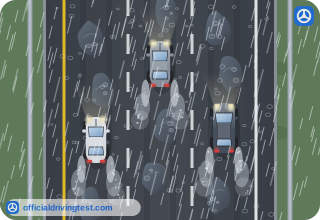
- Any speed over 35 mph
- Any speed over 20 mph
- Only at speeds over 45 mph
- Only at speeds over 65 mph
Show answer
Correct answer: Any speed over 35 mph
The manual says hydroplaning can happen at any speed over 35 mph.
Source: Missouri Driver Guide (Revised August 2026), page 63 · Open this page in the manual (Manual page 63)
-
In a severe rainstorm, at what speed can tires lose all contact with the road?
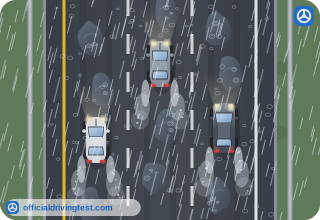
- 25 mph
- 35 mph
- 55 mph
- 45 mph
Show answer
Correct answer: 55 mph
The manual says that in a severe rainstorm the tires can lose all contact with the road at 55 mph.
Source: Missouri Driver Guide (Revised August 2026), page 63 · Open this page in the manual (Manual page 63)
-
Which of these helps you avoid hydroplaning?
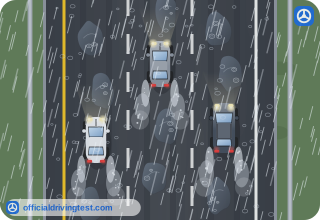
- Using cruise control on wet roads
- Braking hard when the pavement is wet
- Driving faster to stay on top of the water
- Keeping your tires properly inflated
Show answer
Correct answer: Keeping your tires properly inflated
The manual lists keeping tires properly inflated among the ways to avoid hydroplaning.
Source: Missouri Driver Guide (Revised August 2026), page 63 · Open this page in the manual (Manual page 63)
-
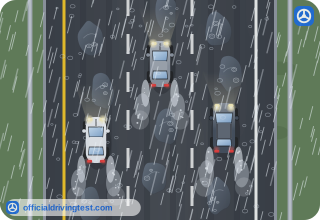
To help avoid hydroplaning, what should the tires on your vehicle have?
- Deep treads
- Shallow treads
- Smooth surfaces
- Wider sidewalls
Show answer
Correct answer: Deep treads
The manual says to have good tires with deep treads to avoid hydroplaning.
Source: Missouri Driver Guide (Revised August 2026), page 63 · Open this page in the manual (Manual page 63)
-
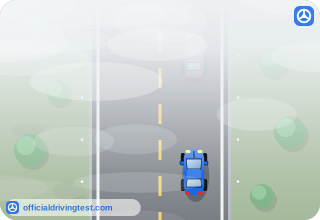
What should you do with your speed if you must drive in fog?
- Reduce it
- Keep it the same
- Increase it to leave the fog quickly
- Match the speed of the fastest vehicles
Show answer
Correct answer: Reduce it
The manual says that if you must drive in fog you should reduce your speed and be ready to stop.
Source: Missouri Driver Guide (Revised August 2026), page 64 · Open this page in the manual (Manual page 64)
-
If you are driving a bus or truck, how close may you follow another bus or truck in general?
- No closer than 300 feet
- No closer than 100 feet
- No closer than 150 feet
- No closer than 500 feet
Show answer
Correct answer: No closer than 300 feet
A bus or truck driver must not follow another bus or truck any closer than 300 feet, with exceptions.
Source: Missouri Driver Guide (Revised August 2026), page 90 · Open this page in the manual (Manual page 90)
-
When may a bus or truck driver follow another bus or truck closer than 300 feet?
- When driving on an interstate highway outside a city
- When both vehicles are empty and have their lights on
- When in a business or residential district, or when passing
- When driving on a wet road during a rain storm
Show answer
Correct answer: When in a business or residential district, or when passing
A driver may follow closer than 300 feet when in a business or residential district, or when passing.
Source: Missouri Driver Guide (Revised August 2026), page 90 · Open this page in the manual (Manual page 90)
-
For each ten feet of length in your vehicle you should keep at least one second between you and the vehicle in front. How many seconds should you keep if you drive a 40-foot vehicle?
- Two seconds
- Six seconds
- Four seconds
- Ten seconds
Show answer
Correct answer: Four seconds
With one second for each ten feet of vehicle length, a 40-foot vehicle needs four seconds between it and the vehicle in front.
Source: Missouri Driver Guide (Revised August 2026), page 90 · Open this page in the manual (Manual page 90)
-
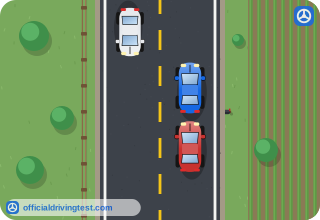
What is the first thing the commercial vehicles chapter says to do to avoid a crash with a tailgater?
- Speed up
- Brake hard
- Flash your brake lights
- Slow down
Show answer
Correct answer: Slow down
The chapter says to slow down, because it is better to be tailgated at a low speed than a high speed.
Source: Missouri Driver Guide (Revised August 2026), page 90 · Open this page in the manual (Manual page 90)
-
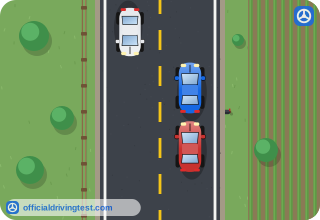
When a tailgater is behind you, what should you avoid and what should you do before turning or stopping?
- Avoid signaling and brake only at the last moment
- Avoid sudden turns or stops and signal well in advance
- Make sudden turns to get away from the tailgater
- Avoid slowing down and stop without signaling
Show answer
Correct answer: Avoid sudden turns or stops and signal well in advance
To avoid a crash with a tailgater, avoid any sudden turns or stops and signal well in advance.
Source: Missouri Driver Guide (Revised August 2026), page 90 · Open this page in the manual (Manual page 90)
-
Why should you increase the distance between you and the vehicle in front when you are being tailgated?
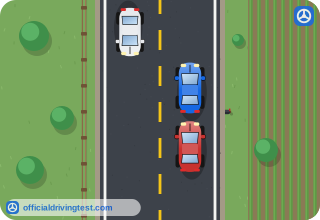
- It makes the tailgater pass you sooner
- It helps you avoid any sudden stops
- It lets the tailgater see your taillights
- It lowers your stopping distance
Show answer
Correct answer: It helps you avoid any sudden stops
Increasing the distance between you and the vehicle in front will help you to avoid any sudden stops.
Source: Missouri Driver Guide (Revised August 2026), page 91 · Open this page in the manual (Manual page 91)
-
Why should you not flash your taillights or brake lights at a tailgater?
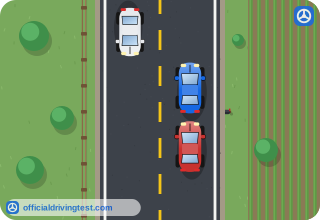
- The flashing can quickly burn out the brake light bulbs on a heavy vehicle
- The flashing is against Missouri law for every commercial vehicle on the road
- The tailgater may take the flashing as a signal that it is safe to pass you
- The tailgater may not believe your brake lights when you do slow down or stop
Show answer
Correct answer: The tailgater may not believe your brake lights when you do slow down or stop
The tailgater may not believe your brake lights when you do slow down or stop.
Source: Missouri Driver Guide (Revised August 2026), page 91 · Open this page in the manual (Manual page 91)