Missouri: Speed and following distance — Part 3 Practice Test
Questions in this part include: “Where should you stop to pick up or let off passengers?” · “What is the reaction distance?”
Independent educational site · not affiliated with any government agency or DMV
Ready? Test yourself
- Instant feedback with an explanation
- Every answer cites its source in the manual
- Your best score is saved on this device
Questions are original and based on the official manual "Missouri Driver Guide" (Revised August 2026), Missouri Department of Revenue.
All 19 questions in this practice test
Take the test above first, then use this list to study. Tap “Show answer” to see the correct answer and explanation.
Show the questions and answersHide the questions
-
How can you help keep the driver behind you at a safe distance?
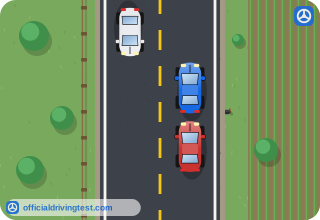
- Tap your brakes repeatedly to warn the driver behind you
- Slow down quickly so that the driver behind backs off
- Flash your headlights at the driver to warn him or her off
- Keep a steady speed and signal in advance when you slow down
Show answer
Correct answer: Keep a steady speed and signal in advance when you slow down
The manual says you can help by keeping a steady speed and signaling in advance when you slow down.
Source: Missouri Driver Guide (Revised August 2026), page 57 · Open this page in the manual (Manual page 57)
-
Where should you stop to pick up or let off passengers?
- In the lane you are driving in
- In a safe place out of traffic
- On the left side of a two-lane road
- At the nearest intersection, in the crosswalk
Show answer
Correct answer: In a safe place out of traffic
Try to find a safe place out of traffic to stop and pick up or let off passengers.
Source: Missouri Driver Guide (Revised August 2026), page 57 · Open this page in the manual (Manual page 57)
-
You want to parallel park and there is traffic coming behind you. What should you do?
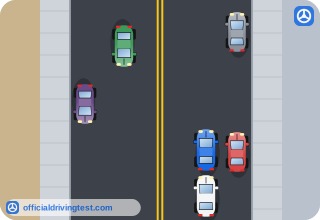
- Signal, pull next to the space, and let vehicles pass before you park
- Stop in the traffic lane and back into the space right away
- Park without signaling to avoid confusing the drivers behind
- Pull past the space and back up into it as quickly as you can
Show answer
Correct answer: Signal, pull next to the space, and let vehicles pass before you park
Put on your turn signal, pull next to the space, and allow vehicles to pass before you park.
Source: Missouri Driver Guide (Revised August 2026), page 57 · Open this page in the manual (Manual page 57)
-
You are tailgated by another driver and there is a right lane. What should you do?
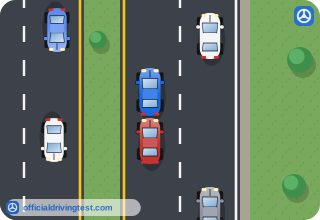
- Brake hard to warn the tailgater
- Move over to the right
- Move to the left lane and slow down
- Speed up until the tailgater falls back
Show answer
Correct answer: Move over to the right
If you are followed too closely and there is a right lane, move over to the right.
Source: Missouri Driver Guide (Revised August 2026), page 57 · Open this page in the manual (Manual page 57)
-
You are tailgated and there is no right lane. What should you do?
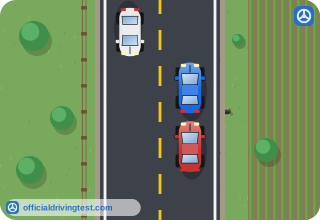
- Slow down quickly to discourage the driver behind you
- Stop in the road until the tailgater drives past you
- Speed up so that the tailgater is left far behind you
- Wait until the road ahead is clear, then reduce speed slowly
Show answer
Correct answer: Wait until the road ahead is clear, then reduce speed slowly
If there is no right lane, wait until the road ahead is clear and then reduce speed slowly, which encourages the tailgater to drive around you.
Source: Missouri Driver Guide (Revised August 2026), page 57 · Open this page in the manual (Manual page 57)
-
What does the manual say about slowing down quickly to discourage a tailgater?
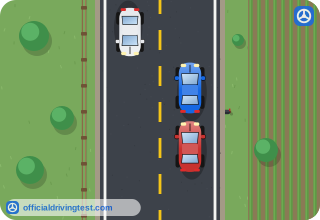
- It is the best way to make the tailgater back off
- It is required by law when you are tailgated
- It only increases your risk of being hit from behind
- It makes the tailgater pass on the left
Show answer
Correct answer: It only increases your risk of being hit from behind
Never slow down quickly to discourage a tailgater, because this will only increase your risk of being hit from behind.
Source: Missouri Driver Guide (Revised August 2026), page 57 · Open this page in the manual (Manual page 57)
-
Where is it generally safest to drive within your lane?
- Close to the center line
- Close to the right edge of the lane
- Close to the left edge of the lane
- In the center of your lane
Show answer
Correct answer: In the center of your lane
In general, it is safest to drive in the center of your lane, and on a two-lane road you should not crowd the center line.
Source: Missouri Driver Guide (Revised August 2026), page 57 · Open this page in the manual (Manual page 57)
-
What does your stopping distance equal?
- Your braking distance minus your reaction distance
- Your reaction distance plus your following distance
- Your braking distance plus your lane-change distance
- Your reaction distance plus your braking distance
Show answer
Correct answer: Your reaction distance plus your braking distance
Stopping distance is the reaction distance plus the braking distance.
Source: Missouri Driver Guide (Revised August 2026), page 58 · Open this page in the manual (Manual page 58)
-
Which of these means you will need more space to stop your vehicle?
- You are driving slowly
- You are fully rested
- Your vehicle has bad brakes
- Your vehicle has new tires
Show answer
Correct answer: Your vehicle has bad brakes
If you are driving fast, are very tired, or if your vehicle has bad brakes, you will need more space to stop your vehicle.
Source: Missouri Driver Guide (Revised August 2026), page 58 · Open this page in the manual (Manual page 58)
-
What is the reaction distance?
- The distance you travel after you see a danger and before you apply your brakes
- The distance you travel after you apply your brakes and before the vehicle stops
- The distance between your vehicle and the one in front
- The distance you can see ahead of you at night
Show answer
Correct answer: The distance you travel after you see a danger and before you apply your brakes
The reaction distance is the distance traveled between seeing a danger and applying the brakes.
Source: Missouri Driver Guide (Revised August 2026), page 58 · Open this page in the manual (Manual page 58)
-
What is the braking distance?
- The distance you travel after you see a danger and before you apply your brakes
- The distance between your vehicle and the one behind
- The distance at which your brake lights can be seen
- The distance you travel after you apply your brakes and before the vehicle stops
Show answer
Correct answer: The distance you travel after you apply your brakes and before the vehicle stops
The braking distance is the distance traveled between applying the brakes and coming to a stop.
Source: Missouri Driver Guide (Revised August 2026), page 58 · Open this page in the manual (Manual page 58)
-
In the manual’s stopping distance chart, how many seconds of reaction time is the reaction distance based on?
- Three-quarters of a second
- One and one-half seconds
- Two and one-half seconds
- Three seconds
Show answer
Correct answer: One and one-half seconds
The chart’s reaction distance is for 1.5 seconds, so you have to be alert to react within one and one-half seconds.
Source: Missouri Driver Guide (Revised August 2026), page 58 · Open this page in the manual (Manual page 58)
-
In the manual’s chart of average stopping distance of cars on dry level pavement, what is the braking distance at 80 mph?
- 284 feet
- 230 feet
- 260 feet
- 310 feet
Show answer
Correct answer: 284 feet
The chart lists 176 feet of reaction distance and 284 feet of braking distance at 80 mph.
Source: Missouri Driver Guide (Revised August 2026), page 58 · Open this page in the manual (Manual page 58)
-
In the manual’s chart of average stopping distance of cars on dry level pavement, what is the reaction distance at 30 mph?
- 54 feet
- 78 feet
- 66 feet
- 88 feet
Show answer
Correct answer: 66 feet
The chart lists 66 feet of reaction distance and 40 feet of braking distance at 30 mph.
Source: Missouri Driver Guide (Revised August 2026), page 58 · Open this page in the manual (Manual page 58)
-
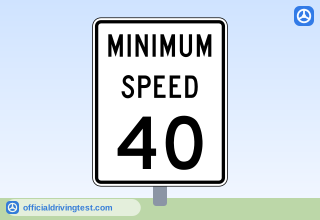
What does the manual say about driving slower than the posted minimum speed under normal driving conditions?
- It is allowed if you use your hazard flashers
- It is allowed in the left lane only
- It is against the law
- It is allowed during daylight
Show answer
Correct answer: It is against the law
It is against the law to drive slower than the posted minimum speed under normal driving conditions.
Source: Missouri Driver Guide (Revised August 2026), page 59 · Open this page in the manual (Manual page 59)
-
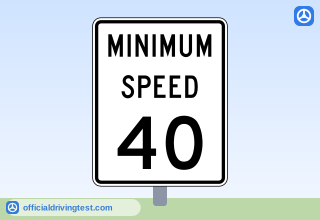
Under which condition may you drive more slowly than the posted minimum speed?
- On a dry, clear road
- In bad weather
- In light traffic
- When you are in no hurry
Show answer
Correct answer: In bad weather
You may drive more slowly than the minimum speed in bad weather, heavy traffic, or on a bad road.
Source: Missouri Driver Guide (Revised August 2026), page 59 · Open this page in the manual (Manual page 59)
-
There is no posted minimum speed. What does the manual say about driving very slowly?
- You may drive as slowly as you like when no minimum is posted
- You may drive slowly in the left lane only, never in the right
- You may drive slowly as long as your hazard flashers are on
- It is still against the law to drive so slowly that you block traffic
Show answer
Correct answer: It is still against the law to drive so slowly that you block traffic
Even with no posted minimum speed, it is against the law to drive so slowly that you block traffic.
Source: Missouri Driver Guide (Revised August 2026), page 59 · Open this page in the manual (Manual page 59)
-
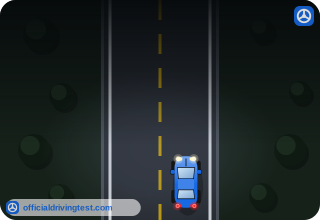
About how far ahead do headlights let you see at night?
- About 150 feet
- About 650 feet
- About 350 feet
- About 200 feet
Show answer
Correct answer: About 350 feet
The manual says headlights only let you see about 350 feet ahead.
Source: Missouri Driver Guide (Revised August 2026), page 62 · Open this page in the manual (Manual page 62)
-
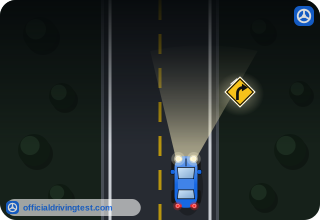
What does the manual tell you to do so that you do not overdrive your headlights at night?
- Drive at the speed limit as long as your high beams are on
- Drive slowly enough that you can stop or turn if needed
- Drive faster so you pass through dark areas quickly
- Drive at the same speed you would use in daylight
Show answer
Correct answer: Drive slowly enough that you can stop or turn if needed
Headlights show only a limited distance, so the manual says to be sure you are driving slowly enough to stop or turn if needed.
Source: Missouri Driver Guide (Revised August 2026), page 62 · Open this page in the manual (Manual page 62)