Missouri: Speed and following distance — Part 4 Practice Test
Questions in this part include: “If you are driving a bus or truck, how close may you follow another bus or truck in general?” · “When may a bus or truck driver follow another bus or truck closer than 300 feet?”
Independent educational site · not affiliated with any government agency or DMV
Ready? Test yourself
- Instant feedback with an explanation
- Every answer cites its source in the manual
- Your best score is saved on this device
Questions are original and based on the official manual "Missouri Driver Guide" (Revised August 2026), Missouri Department of Revenue.
All 19 questions in this practice test
Take the test above first, then use this list to study. Tap “Show answer” to see the correct answer and explanation.
Show the questions and answersHide the questions
-
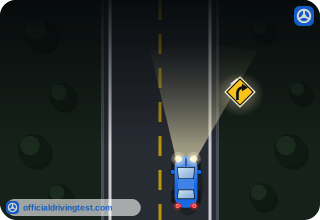
At night, what should you do when nearing a curve if you are driving the maximum posted speed limit?
- Hold your speed
- Slow down
- Speed up
- Flash your high beams
Show answer
Correct answer: Slow down
The manual says to slow down when nearing a curve if you are driving the maximum posted speed limit.
Source: Missouri Driver Guide (Revised August 2026), page 62 · Open this page in the manual (Manual page 62)
-
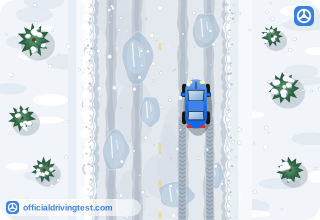
What should you do with your vehicle's cruise control when there is snow or ice on the road?
- Not use it
- Set it at a low speed
- Use it on straight roads only
- Use it only with four-wheel drive
Show answer
Correct answer: Not use it
The manual says to slow down and not use your vehicle’s cruise control system when there is snow or ice on the road.
Source: Missouri Driver Guide (Revised August 2026), page 62 · Open this page in the manual (Manual page 62)
-
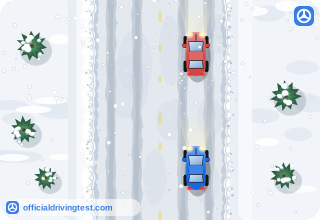
On snow or ice, about how much distance should you leave between your vehicle and the vehicle ahead?
- About one to two seconds
- About eight to ten seconds
- About four to five seconds
- About fifteen to twenty seconds
Show answer
Correct answer: About eight to ten seconds
Stopping takes longer on snow or ice, so the manual says to leave about eight to ten seconds between you and the vehicle ahead.
Source: Missouri Driver Guide (Revised August 2026), page 63 · Open this page in the manual (Manual page 63)
-
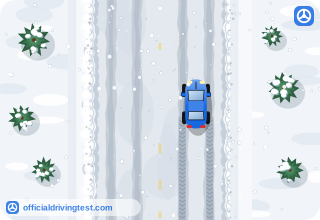
Which parts of the road freeze and become slippery before other parts?
- Hills and curves
- Intersections and crosswalks
- Bridges and overpasses
- Tunnels and underpasses
Show answer
Correct answer: Bridges and overpasses
The manual says bridges and overpasses will freeze and become slippery before other parts of the road.
Source: Missouri Driver Guide (Revised August 2026), page 63 · Open this page in the manual (Manual page 63)
-
What forms a slick, greasy film on the road when it starts to rain?
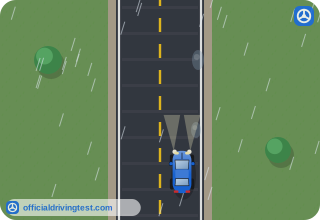
- Water mixing with the dust and oil on the road
- Rain washing the paint off the lane markings
- Water freezing on contact with the road
- Tire rubber melting into the pavement
Show answer
Correct answer: Water mixing with the dust and oil on the road
The manual says that when it starts to rain, water mixes with the dust and oil on the road to form a slick, greasy film.
Source: Missouri Driver Guide (Revised August 2026), page 63 · Open this page in the manual (Manual page 63)
-
On wet pavement, what may be harder for you to do on curves?
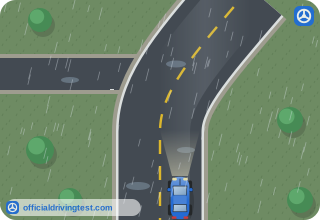
- See the curve signs
- Use your turn signal
- Stay on the road
- Judge the distance to other vehicles
Show answer
Correct answer: Stay on the road
The manual says wet pavement may make it harder for you to stay on the road on curves.
Source: Missouri Driver Guide (Revised August 2026), page 63 · Open this page in the manual (Manual page 63)
-
What is it called when your tires ride on the water rather than the pavement?
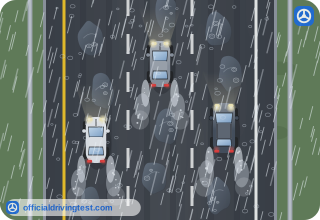
- Skidding
- Overdriving
- Fishtailing
- Hydroplaning
Show answer
Correct answer: Hydroplaning
The manual says that when tires ride on the water rather than the pavement it is known as hydroplaning, a loss of traction and control.
Source: Missouri Driver Guide (Revised August 2026), page 63 · Open this page in the manual (Manual page 63)
-
At what speeds can hydroplaning happen?
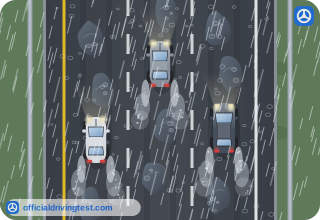
- Any speed over 35 mph
- Any speed over 20 mph
- Only at speeds over 45 mph
- Only at speeds over 65 mph
Show answer
Correct answer: Any speed over 35 mph
The manual says hydroplaning can happen at any speed over 35 mph.
Source: Missouri Driver Guide (Revised August 2026), page 63 · Open this page in the manual (Manual page 63)
-
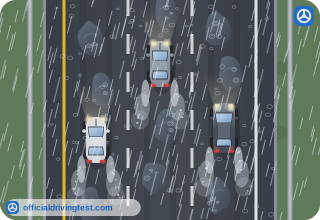
In a severe rainstorm, at what speed can tires lose all contact with the road?
- 25 mph
- 35 mph
- 55 mph
- 45 mph
Show answer
Correct answer: 55 mph
The manual says that in a severe rainstorm the tires can lose all contact with the road at 55 mph.
Source: Missouri Driver Guide (Revised August 2026), page 63 · Open this page in the manual (Manual page 63)
-
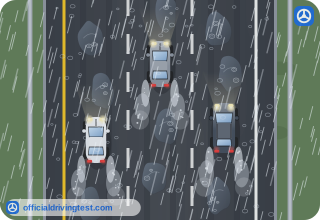
Which of these helps you avoid hydroplaning?
- Using cruise control on wet roads
- Braking hard when the pavement is wet
- Driving faster to stay on top of the water
- Keeping your tires properly inflated
Show answer
Correct answer: Keeping your tires properly inflated
The manual lists keeping tires properly inflated among the ways to avoid hydroplaning.
Source: Missouri Driver Guide (Revised August 2026), page 63 · Open this page in the manual (Manual page 63)
-
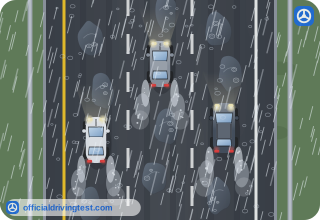
To help avoid hydroplaning, what should the tires on your vehicle have?
- Deep treads
- Shallow treads
- Smooth surfaces
- Wider sidewalls
Show answer
Correct answer: Deep treads
The manual says to have good tires with deep treads to avoid hydroplaning.
Source: Missouri Driver Guide (Revised August 2026), page 63 · Open this page in the manual (Manual page 63)
-
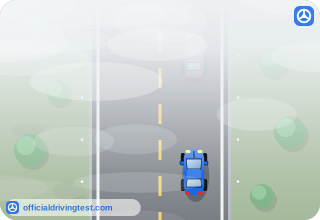
What should you do with your speed if you must drive in fog?
- Reduce it
- Keep it the same
- Increase it to leave the fog quickly
- Match the speed of the fastest vehicles
Show answer
Correct answer: Reduce it
The manual says that if you must drive in fog you should reduce your speed and be ready to stop.
Source: Missouri Driver Guide (Revised August 2026), page 64 · Open this page in the manual (Manual page 64)
-
If you are driving a bus or truck, how close may you follow another bus or truck in general?
- No closer than 300 feet
- No closer than 100 feet
- No closer than 150 feet
- No closer than 500 feet
Show answer
Correct answer: No closer than 300 feet
A bus or truck driver must not follow another bus or truck any closer than 300 feet, with exceptions.
Source: Missouri Driver Guide (Revised August 2026), page 90 · Open this page in the manual (Manual page 90)
-
When may a bus or truck driver follow another bus or truck closer than 300 feet?
- When driving on an interstate highway outside a city
- When both vehicles are empty and have their lights on
- When in a business or residential district, or when passing
- When driving on a wet road during a rain storm
Show answer
Correct answer: When in a business or residential district, or when passing
A driver may follow closer than 300 feet when in a business or residential district, or when passing.
Source: Missouri Driver Guide (Revised August 2026), page 90 · Open this page in the manual (Manual page 90)
-
For each ten feet of length in your vehicle you should keep at least one second between you and the vehicle in front. How many seconds should you keep if you drive a 40-foot vehicle?
- Two seconds
- Six seconds
- Four seconds
- Ten seconds
Show answer
Correct answer: Four seconds
With one second for each ten feet of vehicle length, a 40-foot vehicle needs four seconds between it and the vehicle in front.
Source: Missouri Driver Guide (Revised August 2026), page 90 · Open this page in the manual (Manual page 90)
-
What is the first thing the commercial vehicles chapter says to do to avoid a crash with a tailgater?
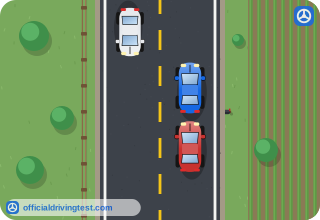
- Speed up
- Brake hard
- Flash your brake lights
- Slow down
Show answer
Correct answer: Slow down
The chapter says to slow down, because it is better to be tailgated at a low speed than a high speed.
Source: Missouri Driver Guide (Revised August 2026), page 90 · Open this page in the manual (Manual page 90)
-
When a tailgater is behind you, what should you avoid and what should you do before turning or stopping?
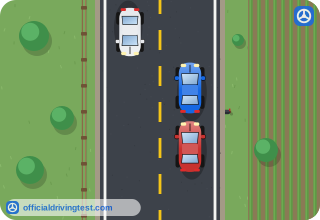
- Avoid signaling and brake only at the last moment
- Avoid sudden turns or stops and signal well in advance
- Make sudden turns to get away from the tailgater
- Avoid slowing down and stop without signaling
Show answer
Correct answer: Avoid sudden turns or stops and signal well in advance
To avoid a crash with a tailgater, avoid any sudden turns or stops and signal well in advance.
Source: Missouri Driver Guide (Revised August 2026), page 90 · Open this page in the manual (Manual page 90)
-
Why should you increase the distance between you and the vehicle in front when you are being tailgated?
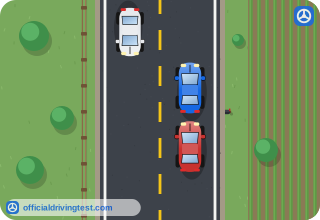
- It makes the tailgater pass you sooner
- It helps you avoid any sudden stops
- It lets the tailgater see your taillights
- It lowers your stopping distance
Show answer
Correct answer: It helps you avoid any sudden stops
Increasing the distance between you and the vehicle in front will help you to avoid any sudden stops.
Source: Missouri Driver Guide (Revised August 2026), page 91 · Open this page in the manual (Manual page 91)
-
Why should you not flash your taillights or brake lights at a tailgater?
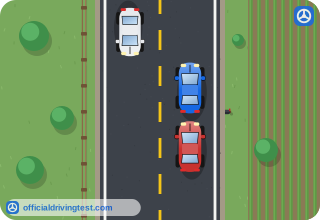
- The flashing can quickly burn out the brake light bulbs on a heavy vehicle
- The flashing is against Missouri law for every commercial vehicle on the road
- The tailgater may take the flashing as a signal that it is safe to pass you
- The tailgater may not believe your brake lights when you do slow down or stop
Show answer
Correct answer: The tailgater may not believe your brake lights when you do slow down or stop
The tailgater may not believe your brake lights when you do slow down or stop.
Source: Missouri Driver Guide (Revised August 2026), page 91 · Open this page in the manual (Manual page 91)