Missouri: Speed and following distance — Part 2 Practice Test
Questions in this part include: “Which vehicles should you watch for on steep grades or when they are entering traffic?” · “Unless posted speed limits direct otherwise, what is the maximum speed guide for rural expressways?”
Independent educational site · not affiliated with any government agency or DMV
Ready? Test yourself
- Instant feedback with an explanation
- Every answer cites its source in the manual
- Your best score is saved on this device
Questions are original and based on the official manual "Missouri Driver Guide" (Revised August 2026), Missouri Department of Revenue.
All 20 questions in this practice test
Take the test above first, then use this list to study. Tap “Show answer” to see the correct answer and explanation.
Show the questions and answersHide the questions
-
Which vehicles should you watch for on steep grades or when they are entering traffic?
- Emergency vehicles and school buses
- Sports cars and other high-powered vehicles
- Vehicles with out-of-state license plates
- Large trucks and small, underpowered vehicles
Show answer
Correct answer: Large trucks and small, underpowered vehicles
Large trucks and small, underpowered vehicles can lose speed on long or steep hills and take longer to get up to speed when they enter traffic.
Source: Missouri Driver Guide (Revised August 2026), page 38 · Open this page in the manual (Manual page 38)
-
Which problem does stopping suddenly cause for drivers behind you?
- It makes it harder for them to stop without hitting you
- It blocks their view of the road in front of your vehicle
- It causes the brakes on their vehicles to overheat
- It forces them to speed up and pass your vehicle
Show answer
Correct answer: It makes it harder for them to stop without hitting you
Stopping suddenly makes it harder for drivers behind you to stop without hitting you.
Source: Missouri Driver Guide (Revised August 2026), page 39 · Open this page in the manual (Manual page 39)
-
How can you avoid panic stops?
- By braking harder at the last moment
- By following closer to the vehicle ahead
- By seeing events well in advance
- By increasing your speed in traffic
Show answer
Correct answer: By seeing events well in advance
You try to avoid panic stops by seeing events well in advance.
Source: Missouri Driver Guide (Revised August 2026), page 39 · Open this page in the manual (Manual page 39)
-
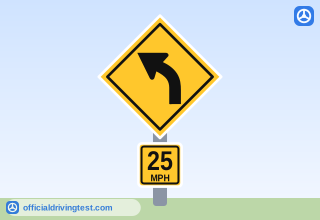
You may feel comfortable driving above the advisory speed on a curve in fair weather. When should you never do so?
- On a road with no center line
- When another car is following you
- In rain, snow, or icy conditions
- On roads with a paved shoulder
Show answer
Correct answer: In rain, snow, or icy conditions
Although you may feel comfortable driving at a higher speed in fair weather, you should never do so in rain, snow or icy conditions.
Source: Missouri Driver Guide (Revised August 2026), page 47 · Open this page in the manual (Manual page 47)
-
A posted speed limit is the maximum allowable speed in which conditions?
- Any road conditions
- Heavy traffic
- Ideal conditions
- Slippery conditions
Show answer
Correct answer: Ideal conditions
The speed limit is the maximum allowable speed in ideal conditions, and conditions such as curves or slippery roads may make it unsafe.
Source: Missouri Driver Guide (Revised August 2026), page 50 · Open this page in the manual (Manual page 50)
-
Conditions such as hills, curves, or slippery roadways make the posted speed limit unsafe. What does the law require?
- You may still drive the posted limit if you stay in your lane
- You must slow down
- You may drive the posted limit if your vehicle is in good repair
- You must stop on the shoulder until conditions improve
Show answer
Correct answer: You must slow down
By law, when conditions demand it, you must slow down, because the posted limit does not mean every part of the road can be driven safely at that speed.
Source: Missouri Driver Guide (Revised August 2026), page 50 · Open this page in the manual (Manual page 50)
-
Under normal roadway conditions, you may not drive slower than what speed on interstate highways?
- 25 mph
- 30 mph
- 50 mph
- 40 mph
Show answer
Correct answer: 40 mph
Interstate highways have minimum speed limits, and you may not drive slower than 40 mph on them under normal roadway conditions.
Source: Missouri Driver Guide (Revised August 2026), page 50 · Open this page in the manual (Manual page 50)
-
The minimum speed on an interstate is too fast for you. What does the manual say you should do?
- Use another route
- Drive on the shoulder
- Stay in the left lane with your flashers on
- Drive slower and let traffic pass you
Show answer
Correct answer: Use another route
If the interstate minimum speed is too fast for you, you should use another route.
Source: Missouri Driver Guide (Revised August 2026), page 50 · Open this page in the manual (Manual page 50)
-
Unless posted speed limits direct otherwise, what is the maximum speed guide for rural expressways?
- 45 mph
- 65 mph
- 50 mph
- 40 mph
Show answer
Correct answer: 65 mph
The manual's guide for maximum speed lists 65 mph for rural expressways, unless posted speed limits direct otherwise.
Source: Missouri Driver Guide (Revised August 2026), page 50 · Open this page in the manual (Manual page 50)
-
Unless posted speed limits direct otherwise, what is the maximum speed guide for lettered roads?
- 45 mph
- 50 mph
- 35 mph
- 55 mph
Show answer
Correct answer: 55 mph
The manual's guide for maximum speed lists 55 mph for lettered roads, unless posted speed limits direct otherwise.
Source: Missouri Driver Guide (Revised August 2026), page 50 · Open this page in the manual (Manual page 50)
-
Unless posted speed limits direct otherwise, what is the maximum speed guide for all other roads and highways not located in an urbanized area?
- 60 mph
- 45 mph
- 50 mph
- 40 mph
Show answer
Correct answer: 60 mph
The manual's guide for maximum speed lists 60 mph for all other roads and highways not located in an urbanized area.
Source: Missouri Driver Guide (Revised August 2026), page 50 · Open this page in the manual (Manual page 50)
-
Unless posted speed limits direct otherwise, what is the maximum speed guide for interstate highways, freeways, or expressways within urbanized areas?
- 45 mph
- 50 mph
- 60 mph
- 40 mph
Show answer
Correct answer: 60 mph
The manual's guide for maximum speed lists 60 mph for interstate highways, freeways, or expressways within urbanized areas.
Source: Missouri Driver Guide (Revised August 2026), page 50 · Open this page in the manual (Manual page 50)
-
What is the speed limit in any city, town, or village, unless posted otherwise?
- 15 mph
- 25 mph
- 20 mph
- 35 mph
Show answer
Correct answer: 25 mph
The speed limit in any city, town, or village is 25 mph, unless posted otherwise.
Source: Missouri Driver Guide (Revised August 2026), page 50 · Open this page in the manual (Manual page 50)
-
Which body has the authority to set speed limits higher or lower than the uniform maximum speed limits?
- The Missouri Department of Revenue license offices
- The Missouri State Highway Patrol driver examiners
- Local license offices across the state of Missouri
- The Missouri Highway and Transportation Commission
Show answer
Correct answer: The Missouri Highway and Transportation Commission
The Missouri Highway and Transportation Commission may set speed limits higher or lower than the uniform maximums for safety reasons or to expedite the flow of traffic.
Source: Missouri Driver Guide (Revised August 2026), page 50 · Open this page in the manual (Manual page 50)
-
Why are lower speeds usually posted on interstates in urban areas?
- Interchanges and entering and exiting traffic are more frequent
- Interstate pavement is narrower in cities than in rural areas
- Large trucks are not allowed on urban interstates at all
- Minimum speed limits do not apply on interstates in cities
Show answer
Correct answer: Interchanges and entering and exiting traffic are more frequent
Lower speeds are posted on interstates for safety, usually in urban areas where interchanges and entering and exiting traffic are more frequent.
Source: Missouri Driver Guide (Revised August 2026), page 50 · Open this page in the manual (Manual page 50)
-
How often should a defensive driver check behind through the mirrors?
- Every few seconds
- Once every mile
- Only before changing lanes
- Every few minutes
Show answer
Correct answer: Every few seconds
A defensive driver keeps the eyes moving and checks behind through the mirrors every few seconds.
Source: Missouri Driver Guide (Revised August 2026), page 56 · Open this page in the manual (Manual page 56)
-
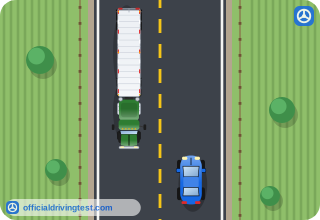
According to the manual, who causes many head-on collisions?
- Drivers who stop for a stop sign
- Drivers who follow too closely in the same lane
- Drivers who signal too early before a turn
- Distracted drivers crossing the center line
Show answer
Correct answer: Distracted drivers crossing the center line
Many head-on collisions occur by distracted drivers crossing the center line, so pay special attention to oncoming vehicles.
Source: Missouri Driver Guide (Revised August 2026), page 56 · Open this page in the manual (Manual page 56)
-
What causes rear-end crashes, according to the manual?
- Drivers who signal too early before they slow down
- Drivers who keep a steady speed on the highway
- Drivers who leave too much space between vehicles
- Drivers who follow too closely and cannot stop in time
Show answer
Correct answer: Drivers who follow too closely and cannot stop in time
Rear-end crashes are very common and are caused by drivers who follow too closely and cannot stop in time when the vehicle ahead suddenly stops.
Source: Missouri Driver Guide (Revised August 2026), page 57 · Open this page in the manual (Manual page 57)
-
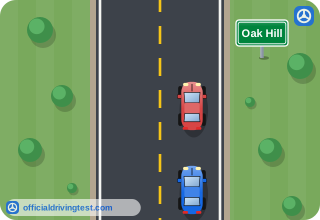
When do you start counting in the “three second rule”?
- As your own vehicle passes an object near the road
- As the vehicle ahead of you turns on its brake lights
- As the vehicle ahead of you passes an object near the road
- As you come to a stop behind the vehicle ahead
Show answer
Correct answer: As the vehicle ahead of you passes an object near the road
You choose an object near the road, and as the vehicle ahead passes it you count “one-thousand one, one-thousand two, one-thousand three.”
Source: Missouri Driver Guide (Revised August 2026), page 57 · Open this page in the manual (Manual page 57)
-
Under the “three second rule,” what does it mean if you reach the object before you finish counting?
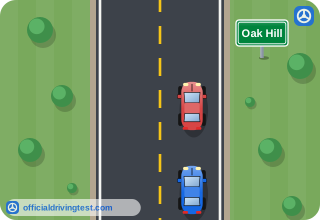
- You are too close to the vehicle ahead
- You are following at a safe distance
- You are following too far behind
- You are driving above the speed limit
Show answer
Correct answer: You are too close to the vehicle ahead
If you reach the object before you finish counting, you are too close to the vehicle ahead.
Source: Missouri Driver Guide (Revised August 2026), page 57 · Open this page in the manual (Manual page 57)