Missouri: Signals and vehicle controls
Turn and hand signals, mirrors and steering, headlights at night, braking on slippery roads and the equipment every Missouri vehicle must have. Split into 5 shorter tests so you're not stuck in one long quiz.
Independent educational site · not affiliated with any government agency or DMV
Choose a part
Signals and vehicle controls — Part 1
Questions in this part include: “When the examiner asks you to find and use the vehicle's controls, what are you tested for regarding finding a control?”
StartSignals and vehicle controls — Part 2
Questions in this part include: “When should you turn your headlights on for night driving?”
StartSignals and vehicle controls — Part 3
Questions in this part include: “What important safety advantage does four-wheel ABS offer?”
StartSignals and vehicle controls — Part 4
Questions in this part include: “If your vehicle has anti-lock brakes, which of these should you not do?”
StartSignals and vehicle controls — Part 5
Questions in this part include: “Which vehicle must have air pollution control devices as originally installed by the manufacturer?”
StartAll 91 Signals and vehicle controls questions with answers
Choose a part above to take a practice test, or study every question and answer here.
Show the questions and answersHide the questions
-
When the examiner asks you to find and use the vehicle's controls, what are you tested for regarding finding a control?
- Naming it from memory
- Adjusting it before the examiner asks
- Finding it without searching
- Repairing it if it fails
Show answer
Correct answer: Finding it without searching
You are tested for finding the control without searching and for using it correctly.
Source: Missouri Driver Guide (Revised August 2026), page 19 · Open this page in the manual (Manual page 19)
-
Before you stop, turn, or change lanes, what should you do?
- Sound your horn twice to warn nearby drivers
- Let the other drivers know by signaling
- Flash your high beams at the drivers behind you
- Wait until the other drivers have passed you
Show answer
Correct answer: Let the other drivers know by signaling
Before you stop, turn, or change lanes, you should let the other drivers know what you are going to do by signaling, with your hand and arm or your vehicle's lights.
Source: Missouri Driver Guide (Revised August 2026), page 24 · Open this page in the manual (Manual page 24)
-
How far before you turn should you signal at least?
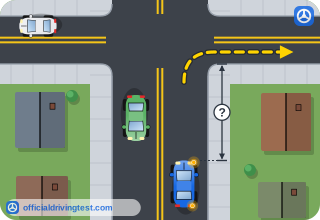
- 25 feet
- 50 feet
- 100 feet
- 300 feet
Show answer
Correct answer: 100 feet
You should signal at least 100 feet before you turn so the other drivers can be ready.
Source: Missouri Driver Guide (Revised August 2026), page 24 · Open this page in the manual (Manual page 24)
-
What does the manual say about checking your vehicle's turn signals?
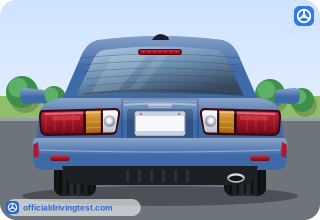
- Check them often to ensure they work properly
- Check them only before a long trip
- Check them once a year at inspection
- Check them only when a signal seems to fail
Show answer
Correct answer: Check them often to ensure they work properly
The manual says to check your vehicle's turn signals often to ensure they are working properly.
Source: Missouri Driver Guide (Revised August 2026), page 24 · Open this page in the manual (Manual page 24)
-
How should you sit while driving, according to the manual?
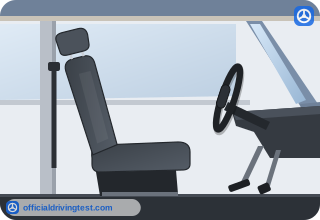
- Leaning back with one arm resting on the door armrest
- With your back straight, upright and relaxed against the seat
- Slightly forward with your chest close to the steering wheel
- Reclined so that your arms are fully extended to the wheel
Show answer
Correct answer: With your back straight, upright and relaxed against the seat
The manual advises sitting with your back straight, upright, and relaxed against the seat.
Source: Missouri Driver Guide (Revised August 2026), page 56 · Open this page in the manual (Manual page 56)
-
How far from the pedals and steering wheel should the seat be set?
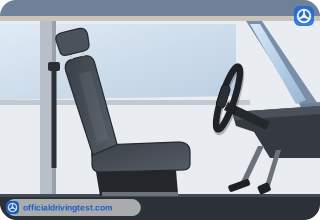
- Close enough that your arms are fully extended at the wheel
- As far back as it goes so the wheel is well out of reach
- Close enough that your elbows touch the wheel at all times
- Close enough to reach the pedals, with your elbows in front of you
Show answer
Correct answer: Close enough to reach the pedals, with your elbows in front of you
Move the seat close enough to reach the pedals but far enough away that your elbows are in front of you when you hold the steering wheel.
Source: Missouri Driver Guide (Revised August 2026), page 56 · Open this page in the manual (Manual page 56)
-
Where should your left hand be placed on the steering wheel?
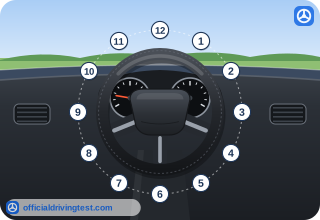
- Between the ten and twelve o’clock positions
- Between the one and two o’clock positions
- Between the seven and nine o’clock positions
- At the six o’clock position
Show answer
Correct answer: Between the seven and nine o’clock positions
The manual says to place the left hand between the seven and nine o’clock positions.
Source: Missouri Driver Guide (Revised August 2026), page 56 · Open this page in the manual (Manual page 56)
-
Where should your right hand be placed on the steering wheel?
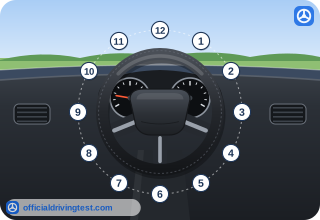
- Between the three and five o’clock positions
- Between the ten and twelve o’clock positions
- Between the nine and eleven o’clock positions
- At the twelve o’clock position
Show answer
Correct answer: Between the three and five o’clock positions
The manual says to place the right hand between the three and five o’clock positions.
Source: Missouri Driver Guide (Revised August 2026), page 56 · Open this page in the manual (Manual page 56)
-
Which technique should you use to turn the steering wheel when turning corners?
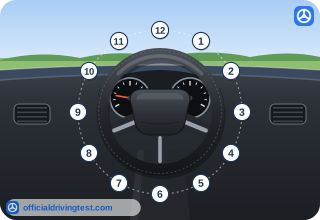
- With the palm of one hand
- One hand at the top of the wheel
- Fingertips of the left hand only
- Hand-over-hand
Show answer
Correct answer: Hand-over-hand
Turn the wheel hand-over-hand. Turning it with just the palm of one hand could cause a loss of control.
Source: Missouri Driver Guide (Revised August 2026), page 56 · Open this page in the manual (Manual page 56)
-
Why should you not turn the wheel with just the palm of one hand?
- It wears out the steering system
- You could lose control
- It makes the turn signal stay on
- It makes the vehicle accelerate
Show answer
Correct answer: You could lose control
Turning the wheel with just the palm of one hand could cause you to lose control.
Source: Missouri Driver Guide (Revised August 2026), page 56 · Open this page in the manual (Manual page 56)
-
How should you straighten the steering wheel when you complete a turn?
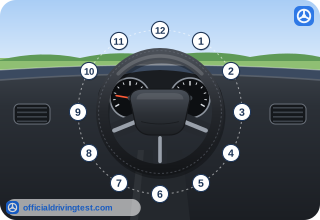
- By hand
- By letting it slide back on its own
- By pressing the brake pedal
- By releasing both hands at once
Show answer
Correct answer: By hand
When you complete a turn, you straighten out the steering wheel by hand.
Source: Missouri Driver Guide (Revised August 2026), page 56 · Open this page in the manual (Manual page 56)
-
Where should you look while steering?
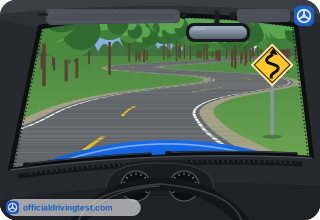
- Only at the road right in front of the hood of your vehicle
- At the rear bumper of the vehicle directly ahead of you
- Well down the road, not just at the road in front of your vehicle
- At the hands holding the steering wheel, to check your grip
Show answer
Correct answer: Well down the road, not just at the road in front of your vehicle
Looking well down the road helps you see traffic situations where you will need to steer or slow before you reach them.
Source: Missouri Driver Guide (Revised August 2026), page 56 · Open this page in the manual (Manual page 56)
-
What happens if you turn the ignition key to the “lock” position while the vehicle is still moving?
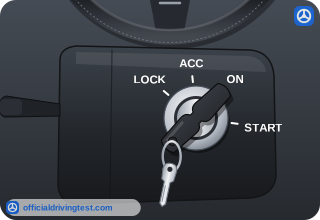
- The engine runs more quietly while you coast downhill
- The steering wheel locks and you lose control of the vehicle
- The brakes lock up and stop the vehicle more quickly
- The headlights switch off, but you can still steer normally
Show answer
Correct answer: The steering wheel locks and you lose control of the vehicle
Turning the key to “lock” in motion causes the steering wheel to lock if you try to turn it, and you will lose control of your vehicle.
Source: Missouri Driver Guide (Revised August 2026), page 57 · Open this page in the manual (Manual page 57)
-
When should you use your turn signals?
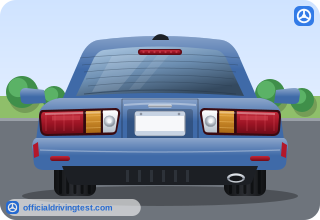
- Only when another vehicle is close enough to see you
- Before you change lanes, turn, merge into traffic, or park
- Only when turning at an intersection with other traffic
- Only when changing lanes on a road with several lanes
Show answer
Correct answer: Before you change lanes, turn, merge into traffic, or park
You should use your turn signals before you change lanes, turn right or left, merge into traffic, or park.
Source: Missouri Driver Guide (Revised August 2026), page 58 · Open this page in the manual (Manual page 58)
-
Should you signal when you change direction even if you do not see anyone else around?
- No, signaling is needed only when other vehicles are visible
- No, signaling is needed only on roads with several lanes
- Yes, but only when you are making a left turn at night
- Yes, because someone may need to know what you are doing
Show answer
Correct answer: Yes, because someone may need to know what you are doing
Get into the habit of signaling every time you change direction, since it is easy to miss someone who needs to know what you are doing.
Source: Missouri Driver Guide (Revised August 2026), page 58 · Open this page in the manual (Manual page 58)
-
There are other streets, driveways, or entrances between you and where you want to turn. When should you signal?
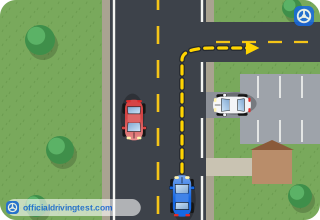
- After you have passed them
- As soon as you see the first one
- Only at the last one before your turn
- Just before you reach the first one
Show answer
Correct answer: After you have passed them
If there are other streets, driveways, or entrances between you and your turn, wait until you have passed them to signal.
Source: Missouri Driver Guide (Revised August 2026), page 58 · Open this page in the manual (Manual page 58)
-
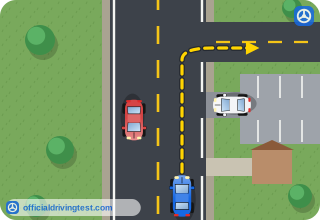
Another vehicle is about to enter the street between you and where you plan to turn. When should you signal your turn?
- Right away, before the vehicle enters
- When you are next to the vehicle
- Only when you begin the turn
- After you have passed that vehicle
Show answer
Correct answer: After you have passed that vehicle
If another vehicle is about to enter the street between you and your turn, wait until you have passed it to signal.
Source: Missouri Driver Guide (Revised August 2026), page 58 · Open this page in the manual (Manual page 58)
-
Why should you make sure your turn signal is off after a turn or lane change?
- It could drain the battery during the drive
- Other drivers might think you plan to turn again
- It could make your brake lights stay on
- It could lock the steering wheel
Show answer
Correct answer: Other drivers might think you plan to turn again
After small turns the signal may not turn off by itself. If it stays on, other drivers might think you plan to turn again.
Source: Missouri Driver Guide (Revised August 2026), page 59 · Open this page in the manual (Manual page 59)
-
According to the manual, what is the only reason to use your horn?
- To warn other drivers
- To show anger or frustration
- To greet other drivers
- To tell drivers ahead to speed up
Show answer
Correct answer: To warn other drivers
There is only one reason to use your horn: to warn other drivers. Needless use may distract other drivers and cause a crash.
Source: Missouri Driver Guide (Revised August 2026), page 59 · Open this page in the manual (Manual page 59)
-
Which of these helps avoid carbon monoxide poisoning?
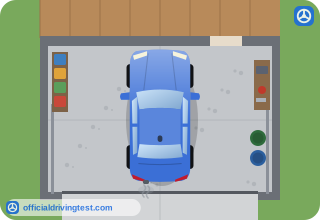
- Not leaving the motor running in a garage
- Running the motor in a closed garage for warmth
- Using the heater in a parked vehicle with the windows closed
- Leaving the vents open when following another vehicle closely
Show answer
Correct answer: Not leaving the motor running in a garage
Vehicle motors give off carbon monoxide, a deadly gas, so do not leave the motor running in a garage.
Source: Missouri Driver Guide (Revised August 2026), page 59 · Open this page in the manual (Manual page 59)
-
Which of these helps avoid carbon monoxide poisoning?
- Parking with the motor running and the windows closed
- Using the air conditioner in a parked vehicle with the windows closed
- Keeping the vents open while following closely behind another vehicle
- Not driving with a defective muffler or exhaust system
Show answer
Correct answer: Not driving with a defective muffler or exhaust system
Vehicle motors give off carbon monoxide, a deadly gas, so do not drive with a defective muffler or exhaust system.
Source: Missouri Driver Guide (Revised August 2026), page 59 · Open this page in the manual (Manual page 59)
-
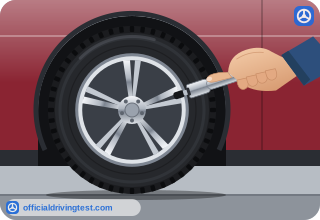
Where can you find the recommended tire pressure for your vehicle?
- On a sticker inside the glove box of the vehicle only
- In the vehicle owner’s manual or on the driver’s side door jam
- On the dashboard, beside the speedometer and gauges
- In the tire pressure table of the Missouri driver guide
Show answer
Correct answer: In the vehicle owner’s manual or on the driver’s side door jam
Check the tire pressure using the recommended PSI located in the vehicle owner’s manual or the driver’s side door jam.
Source: Missouri Driver Guide (Revised August 2026), page 60 · Open this page in the manual (Manual page 60)
-
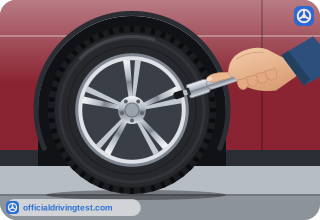
Your tire pressure is above the number listed in the owner’s manual or on the door jam. What should you do?
- Drive until the tires wear down
- Add more air to the tires
- Leave it as it is
- Let air out until it matches
Show answer
Correct answer: Let air out until it matches
If your psi is above the listed number, let air out until it matches. If below, add air or have a tire professional help you.
Source: Missouri Driver Guide (Revised August 2026), page 60 · Open this page in the manual (Manual page 60)
-
How often does the manual say to check your tires for wear and damage?
- Once a year, when the vehicle is inspected
- Only when a tire warning light comes on
- Once every month, or before a long road trip
- Only when you are buying new tires or wheels
Show answer
Correct answer: Once every month, or before a long road trip
Once every month, or before you embark upon a long road trip, check your tires for wear and damage problems.
Source: Missouri Driver Guide (Revised August 2026), page 60 · Open this page in the manual (Manual page 60)
-
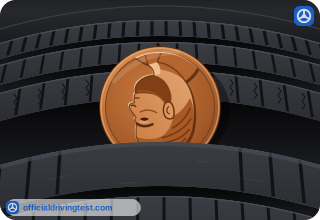
In the penny test for tire tread, what does it mean if any part of Lincoln’s head is covered by the tread?
- You are driving with the safe amount of tread
- The tread is too worn and the tire must be replaced
- The tire pressure is too low for safe driving
- The tire needs to be rotated to the other side
Show answer
Correct answer: You are driving with the safe amount of tread
If any part of Lincoln’s head is covered by the tread, you are driving with the safe amount of tread.
Source: Missouri Driver Guide (Revised August 2026), page 60 · Open this page in the manual (Manual page 60)
-
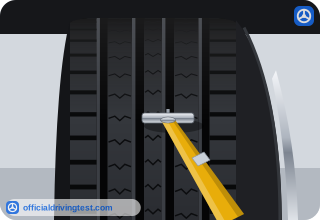
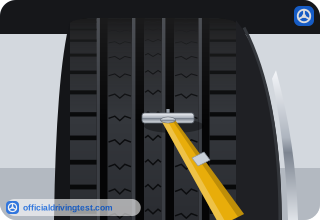
What happens to a tire’s grip when the tread gets below approximately 2/32 of an inch?
- Its pressure rises quickly and the tire may burst at once
- Its braking distance becomes shorter on wet and icy roads
- Its fuel use drops, and it wears more evenly on every road
- Its ability to grip the road in adverse conditions is greatly reduced
Show answer
Correct answer: Its ability to grip the road in adverse conditions is greatly reduced
Below approximately 2/32 of an inch of tread, the car’s ability to grip the road in adverse conditions is greatly reduced.
Source: Missouri Driver Guide (Revised August 2026), page 60 · Open this page in the manual (Manual page 60)
-
When should you turn your headlights on for night driving?
- From ½ hour after sunset until ½ hour before sunrise
- From 1 hour after sunset until 1 hour before sunrise
- From 1 hour before sunset until 1 hour after sunrise
- Only when it is fully dark and no street lights are on
Show answer
Correct answer: From ½ hour after sunset until ½ hour before sunrise
The manual says to turn headlights on from ½ hour after sunset until ½ hour before sunrise.
Source: Missouri Driver Guide (Revised August 2026), page 62 · Open this page in the manual (Manual page 62)
-
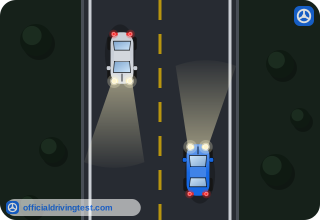
At about what distance from an oncoming vehicle should you switch to low beams?
- Within 1,000 feet
- Within 200 feet
- Within 100 feet
- Within 500 feet
Show answer
Correct answer: Within 500 feet
The manual says to use low beams when you come within 500 feet (about one block) of an oncoming vehicle.
Source: Missouri Driver Guide (Revised August 2026), page 62 · Open this page in the manual (Manual page 62)
-
At night, within what distance of the vehicle ahead should you use low beams when following it?
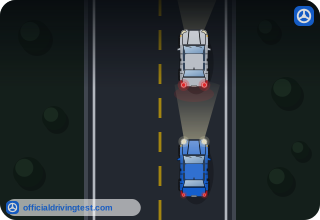
- Within 300 feet
- Within 100 feet
- Within 150 feet
- Within 1,000 feet
Show answer
Correct answer: Within 300 feet
The manual says to use low beams when following another vehicle within 300 feet.
Source: Missouri Driver Guide (Revised August 2026), page 62 · Open this page in the manual (Manual page 62)
-
At night, when should you use your high beams?
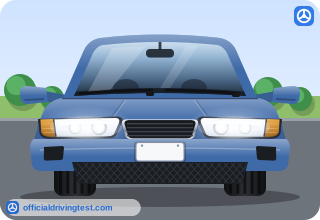
- Only when you are driving in fog
- Whenever you go around a curve
- When there are no oncoming vehicles
- Whenever you are following another vehicle
Show answer
Correct answer: When there are no oncoming vehicles
The manual says to use high beams when there are no oncoming vehicles.
Source: Missouri Driver Guide (Revised August 2026), page 62 · Open this page in the manual (Manual page 62)
-
When driving at night, what should you use as a guide if there is no edgeline?
- The line of utility poles
- The headlights of oncoming vehicles
- The edge of the shoulder gravel
- The center line
Show answer
Correct answer: The center line
The manual says to use the edgeline as a guide, and the center line if there is no edgeline.
Source: Missouri Driver Guide (Revised August 2026), page 62 · Open this page in the manual (Manual page 62)
-
Why should you watch carefully for highway signs when driving at night?
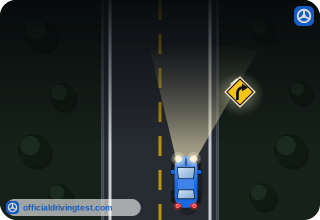
- Headlight glare makes them too bright to read
- There are fewer of them on dark roads
- They are harder to see at night
- They are placed lower to the ground at night
Show answer
Correct answer: They are harder to see at night
The manual says to watch carefully for highway signs because they are harder to see at night.
Source: Missouri Driver Guide (Revised August 2026), page 62 · Open this page in the manual (Manual page 62)
-
When driving at night, what should you watch carefully for along the side of the road?
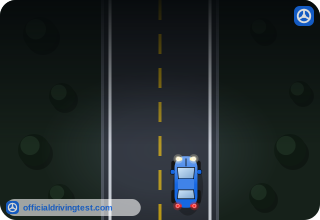
- Parking meters along the curb
- People and vehicles stopped there
- Empty parking lanes and curbs
- Road signs that are placed too low
Show answer
Correct answer: People and vehicles stopped there
The manual says to watch carefully for people and vehicles stopped on the side of the road.
Source: Missouri Driver Guide (Revised August 2026), page 62 · Open this page in the manual (Manual page 62)
-
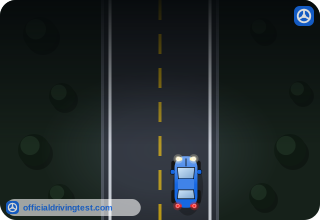
What makes seeing the road more difficult when you drive at night?
- Wet tree branches over the road
- Reflection from the lane markings
- The glow of your own dashboard lights
- The glare of oncoming headlights
Show answer
Correct answer: The glare of oncoming headlights
The manual says the glare of oncoming headlights makes seeing the road more difficult at night.
Source: Missouri Driver Guide (Revised August 2026), page 62 · Open this page in the manual (Manual page 62)
-
Besides how far ahead you can see, what else do headlights limit at night?
- Your view of the sides of the road
- Your view behind you in the mirrors
- Your view of the dashboard gauges
- Your ability to hear other vehicles
Show answer
Correct answer: Your view of the sides of the road
The manual says headlights limit your view of the sides of the road.
Source: Missouri Driver Guide (Revised August 2026), page 62 · Open this page in the manual (Manual page 62)
-
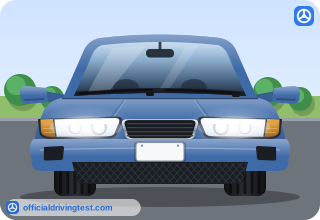
How often does the manual say to have your headlights checked for correct aim?
- Only when a headlight burns out
- Every day before you drive
- From time to time
- Once, when you buy the vehicle
Show answer
Correct answer: From time to time
The manual says to make sure headlights are clean and working well and to have them checked from time to time for correct aim.
Source: Missouri Driver Guide (Revised August 2026), page 62 · Open this page in the manual (Manual page 62)
-
For night driving, what should you make sure about your windows?
- That they are tinted dark
- That they are clean
- That they are rolled all the way down
- That they have a glare-reducing film
Show answer
Correct answer: That they are clean
The manual says to make sure your windows are clean for night driving.
Source: Missouri Driver Guide (Revised August 2026), page 62 · Open this page in the manual (Manual page 62)
-
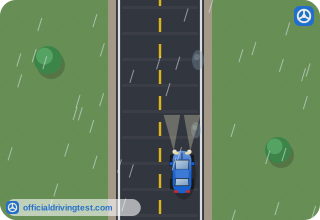
According to the manual, when must you use your headlights because of the weather?
- Only when fog is thick enough to hide the road
- Only when it rains on a highway
- Only after ½ hour past sunset when it is raining
- Any time you need to use your windshield wipers
Show answer
Correct answer: Any time you need to use your windshield wipers
The manual says you must use your headlights any time weather conditions require the use of your windshield wipers.
Source: Missouri Driver Guide (Revised August 2026), page 62 · Open this page in the manual (Manual page 62)
-
In winter, what must you clean snow and ice off before driving?
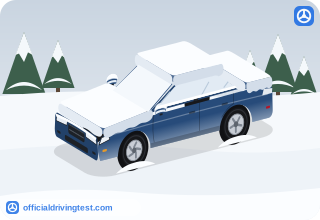
- Your windows, headlights, and taillights
- Only your windshield
- Your windows and the roof of your vehicle
- Your windows and your tires
Show answer
Correct answer: Your windows, headlights, and taillights
The manual says to clean all snow and ice off your windows, headlights, and taillights.
Source: Missouri Driver Guide (Revised August 2026), page 62 · Open this page in the manual (Manual page 62)
-
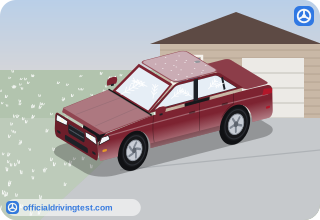
No matter how far you plan to drive in winter, when may you start driving?
- After you clear a small area of the windshield
- If the trip is short, even with some snow on the windows
- Only after all snow and ice is off your windows
- Once your wipers have pushed the snow aside
Show answer
Correct answer: Only after all snow and ice is off your windows
The manual says never to start driving until all snow and ice is off your windows, no matter how far you are going.
Source: Missouri Driver Guide (Revised August 2026), page 62 · Open this page in the manual (Manual page 62)
-
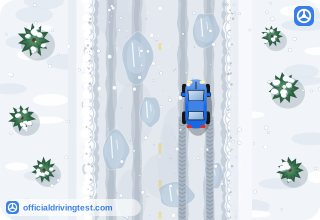
If you do not have tires rated for driving in snow, what should you have ready for bad weather?
- Tires with less air in them
- Chains to put on your tires
- A spare set of wiper blades
- A full tank of fuel
Show answer
Correct answer: Chains to put on your tires
The manual says that without snow-rated tires you should have chains ready to put on your tires during bad weather.
Source: Missouri Driver Guide (Revised August 2026), page 62 · Open this page in the manual (Manual page 62)
-
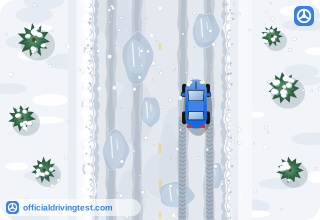
Even with snow tires or chains, what can you not do on snow or ice?
- Use your headlights
- Use your windshield wipers
- Steer the vehicle
- Drive safely at normal speeds
Show answer
Correct answer: Drive safely at normal speeds
The manual says that even with snow tires or chains you cannot drive safely on snow or ice at normal speeds.
Source: Missouri Driver Guide (Revised August 2026), page 62 · Open this page in the manual (Manual page 62)
-
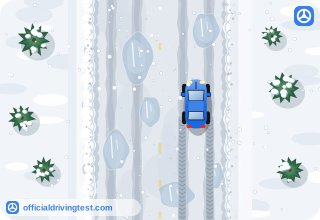
How should you start moving when your vehicle is on snow or ice?
- With a quick burst of speed
- In a high gear with firm acceleration
- Slowly and smoothly
- By rocking the brake and accelerator quickly
Show answer
Correct answer: Slowly and smoothly
The manual says to start slowly and smoothly when starting on snow or ice.
Source: Missouri Driver Guide (Revised August 2026), page 62 · Open this page in the manual (Manual page 62)
-
If your tires start to spin on snow or ice, what should you try first to clear a path?
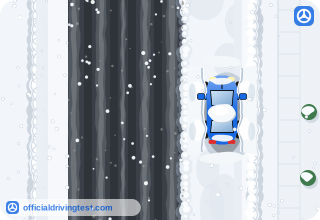
- Accelerating hard until the tires grip
- Driving backwards and forwards a few times
- Turning the steering wheel back and forth quickly
- Letting some air out of the tires
Show answer
Correct answer: Driving backwards and forwards a few times
The manual says to try clearing a path by driving backwards and forwards a few times.
Source: Missouri Driver Guide (Revised August 2026), page 62 · Open this page in the manual (Manual page 62)
-
If driving back and forth does not free your spinning tires, what can you spread around your wheels?
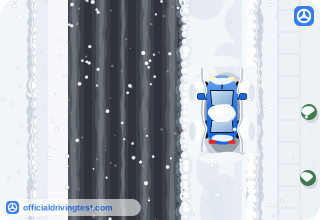
- Motor oil or windshield washer fluid
- Fresh snow packed tightly in front
- Loose leaves, grass, or wet newspaper
- Salt, sand, or cat box litter
Show answer
Correct answer: Salt, sand, or cat box litter
The manual says to spread an abrasive material like salt, sand, or cat box litter around your wheels.
Source: Missouri Driver Guide (Revised August 2026), page 62 · Open this page in the manual (Manual page 62)
-
According to the manual, why must you never let anyone stand in line with your wheels on snow or ice?
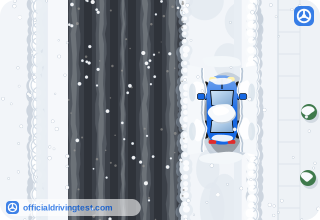
- The wheels may throw up gravel or ice and cause an injury
- The vehicle could suddenly roll forward and hit the person
- The exhaust fumes could make the person ill
- The person could slip and fall under the tires
Show answer
Correct answer: The wheels may throw up gravel or ice and cause an injury
The manual says your wheels may throw up gravel or ice and cause an injury.
Source: Missouri Driver Guide (Revised August 2026), page 62 · Open this page in the manual (Manual page 62)
-
On a slippery road, how can you check how slippery it is once you have started?
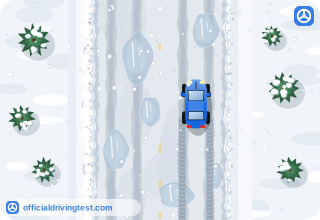
- Accelerate quickly for a moment
- Turn the wheel sharply from side to side
- Gently brake while driving
- Slam the brakes once to test them
Show answer
Correct answer: Gently brake while driving
The manual says to gently brake while driving to see how slippery the road is and then adjust your speed.
Source: Missouri Driver Guide (Revised August 2026), page 63 · Open this page in the manual (Manual page 63)
-
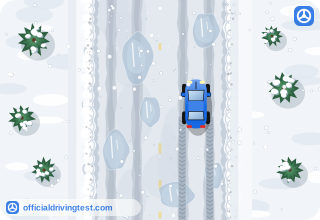
How should you apply the brakes when you want to slow down or stop on snow or ice?
- Quickly and firmly
- In one hard push
- Only with the parking brake
- Gently and smoothly
Show answer
Correct answer: Gently and smoothly
The manual says to apply the brakes gently and smoothly and never to slam on them, which may cause a skid.
Source: Missouri Driver Guide (Revised August 2026), page 63 · Open this page in the manual (Manual page 63)
-
On very slippery surfaces, what braking technique does the manual describe?
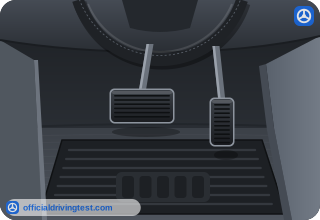
- Pump the brakes by gently pushing down and letting up several times
- Slam on the brakes once, then release them
- Alternate between the brake and the accelerator several times
- Tap the parking brake once and then coast to a stop
Show answer
Correct answer: Pump the brakes by gently pushing down and letting up several times
On very slippery surfaces the manual says to pump the brakes by gently pushing down and letting up on them several times.
Source: Missouri Driver Guide (Revised August 2026), page 63 · Open this page in the manual (Manual page 63)
-
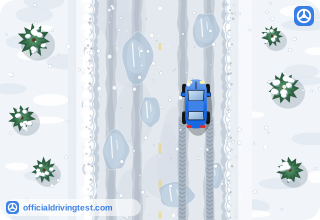
Why should you not use four-wheel drive on ice?
- It prevents the wheels from gripping any surface
- Four-wheel drive vehicles can easily overturn on ice
- It causes the engine to overheat on slick surfaces
- It uses more fuel and wears the tires faster
Show answer
Correct answer: Four-wheel drive vehicles can easily overturn on ice
The manual says not to use four-wheel drive on ice because four-wheel drive vehicles can easily overturn on ice.
Source: Missouri Driver Guide (Revised August 2026), page 63 · Open this page in the manual (Manual page 63)
-
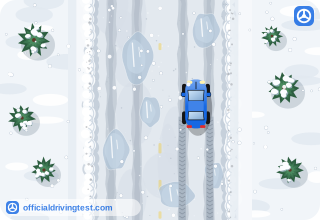
If you hit an icy patch while in four-wheel drive, what should you do?
- Brake hard to slow down at once
- Accelerate to drive through it
- Turn the wheel sharply toward the shoulder
- Take your foot off the accelerator
Show answer
Correct answer: Take your foot off the accelerator
The manual says to take your foot off the accelerator if you hit an icy patch in four-wheel drive.
Source: Missouri Driver Guide (Revised August 2026), page 63 · Open this page in the manual (Manual page 63)
-
Why should you not use cruise control on wet pavement?
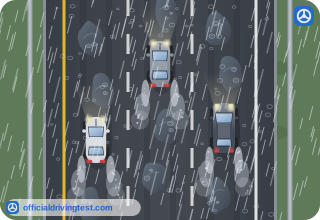
- It cuts power to the tires as soon as rain begins
- It will keep providing power to the tires if you lose traction
- It makes the steering wheel harder to turn on curves
- It can shut off the engine when the tires get wet
Show answer
Correct answer: It will keep providing power to the tires if you lose traction
The manual says cruise control keeps providing power to the tires if you lose traction and may cause you to lose control.
Source: Missouri Driver Guide (Revised August 2026), page 63 · Open this page in the manual (Manual page 63)
-
What important safety advantage does four-wheel ABS offer?
- It shortens your stopping distance on every road surface
- It keeps the vehicle from skidding on ice at any speed
- It prevents the wheels from locking during emergency braking
- It stops the engine from stalling during hard braking
Show answer
Correct answer: It prevents the wheels from locking during emergency braking
The manual says four-wheel ABS prevents the wheels from locking during emergency braking situations.
Source: Missouri Driver Guide (Revised August 2026), page 63 · Open this page in the manual (Manual page 63)
-
With ABS under hard braking, what should you do when you feel a pulsing in the brake pedal?
- Lift your foot off the brake and pump the pedal several times
- Keep your foot on the brake with firm, continuous pressure while steering
- Release the pedal, then press it again once the pulsing stops
- Brake lightly and steer only after the vehicle has stopped
Show answer
Correct answer: Keep your foot on the brake with firm, continuous pressure while steering
The manual says to keep your foot on the brake and maintain firm and continuous pressure while steering so the ABS works properly.
Source: Missouri Driver Guide (Revised August 2026), page 64 · Open this page in the manual (Manual page 64)
-
If your vehicle has ABS, what do mechanical noises and slight pedal pulsations tell you?
- The brakes are failing and need repair
- The wheels have already locked
- The brake fluid is low
- They are normal and show the ABS is working
Show answer
Correct answer: They are normal and show the ABS is working
The manual says mechanical noises and slight pedal pulsations are normal and let you know the ABS is working.
Source: Missouri Driver Guide (Revised August 2026), page 64 · Open this page in the manual (Manual page 64)
-
If your vehicle has anti-lock brakes, which of these should you not do?
- Pump your brakes
- Keep your foot on the brake
- Steer while braking
- Maintain firm pressure on the pedal
Show answer
Correct answer: Pump your brakes
The manual says that with anti-lock brakes you should not pump your brakes or forget to steer.
Source: Missouri Driver Guide (Revised August 2026), page 64 · Open this page in the manual (Manual page 64)
-
If your vehicle has an anti-lock brake system, where does the manual tell you to look for proper braking techniques in special situations?
- A driving school
- The state patrol office
- Your owner’s manual
- Your insurance agent
Show answer
Correct answer: Your owner’s manual
The manual says to refer to your owner’s manual for proper braking techniques in special situations if your vehicle has ABS.
Source: Missouri Driver Guide (Revised August 2026), page 63 · Open this page in the manual (Manual page 63)
-
Which headlight setting should you use when you must drive in fog?
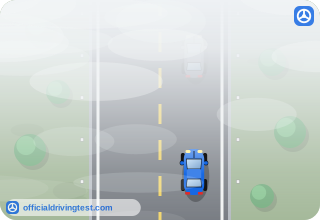
- High beam
- Low beam
- Parking lights only
- Flashing high beams
Show answer
Correct answer: Low beam
The manual says to keep headlights on low beam in fog because you will see less with high beams.
Source: Missouri Driver Guide (Revised August 2026), page 64 · Open this page in the manual (Manual page 64)
-
What does the NTSB recommend for drivers of 12- and 15-passenger vans?
- Carry no more than four passengers at any time
- Drive them only on roads with a posted limit under 55 mph
- Get specific training on handling and operating these vans
- Have the vehicle inspected each time it is loaded
Show answer
Correct answer: Get specific training on handling and operating these vans
The manual says the NTSB recommends that all drivers of 12- and 15-passenger vans obtain specific training on handling and operating them.
Source: Missouri Driver Guide (Revised August 2026), page 66 · Open this page in the manual (Manual page 66)
-
According to the NTSB, 12- and 15-passenger vans are inherently unstable when loaded to their designed level and carrying how many passengers?
- More than five
- More than ten
- More than twenty
- Fewer than three
Show answer
Correct answer: More than ten
The manual says the NTSB determined that 12- and 15-passenger vans are inherently unstable when carrying more than ten passengers.
Source: Missouri Driver Guide (Revised August 2026), page 66 · Open this page in the manual (Manual page 66)
-
What condition must your vehicle’s brakes be in?
- Adjusted within the past year
- Good working order
- Replaced every two years
- Free of any dust
Show answer
Correct answer: Good working order
The manual requires that brakes be in good working order.
Source: Missouri Driver Guide (Revised August 2026), page 84 · Open this page in the manual (Manual page 84)
-
What headlights must your vehicle have?
- At least two functioning amber headlights
- At least one functioning white headlight
- At least four functioning white headlights
- At least two functioning white headlights
Show answer
Correct answer: At least two functioning white headlights
Your vehicle must have at least two functioning white headlights.
Source: Missouri Driver Guide (Revised August 2026), page 84 · Open this page in the manual (Manual page 84)
-
Your vehicle must have at least two functioning red taillights and reflectors that other drivers can see from what distance?
- 500 feet
- 100 feet
- 250 feet
- 1,000 feet
Show answer
Correct answer: 500 feet
Taillights and reflectors must be visible to other drivers from 500 feet.
Source: Missouri Driver Guide (Revised August 2026), page 84 · Open this page in the manual (Manual page 84)
-
Which signaling devices must your vehicle have in working order?
- Turn signals and backup lights, whichever the owner chooses
- Brake lights and fog lights, whichever the owner prefers
- Turn signals and brake lights as originally installed
- Hazard flashers and fog lights as originally installed
Show answer
Correct answer: Turn signals and brake lights as originally installed
Your vehicle must have functioning turn signals and brake lights as originally installed by the manufacturer.
Source: Missouri Driver Guide (Revised August 2026), page 84 · Open this page in the manual (Manual page 84)
-
What must be true of your vehicle’s steering mechanism?
- It must be rebuilt every five years
- It must not have too much play or binding
- It must be fitted with power assist
- It must be adjusted by a licensed dealer
Show answer
Correct answer: It must not have too much play or binding
The steering mechanism must not have too much play or binding.
Source: Missouri Driver Guide (Revised August 2026), page 84 · Open this page in the manual (Manual page 84)
-
What must you not have on your vehicle, regarding tires and wheels?
- Tires with a bright tread color
- Tires with raised white letters
- Wheels with a decorative finish
- Bald or mismatched tires
Show answer
Correct answer: Bald or mismatched tires
You must not have bald or mismatched tires on your vehicle.
Source: Missouri Driver Guide (Revised August 2026), page 84 · Open this page in the manual (Manual page 84)
-
A vehicle made after what date must have safety glass in all windows?
- January 1, 1936
- January 1, 1926
- January 1, 1946
- January 1, 1956
Show answer
Correct answer: January 1, 1936
A vehicle made after January 1, 1936 must have safety glass in all windows.
Source: Missouri Driver Guide (Revised August 2026), page 84 · Open this page in the manual (Manual page 84)
-
What is required of the viewing area of your windshield?
- It must be replaced every two years
- It must be tinted on the lower half
- It may not be badly broken
- It must be cleaned with approved fluid
Show answer
Correct answer: It may not be badly broken
The viewing area of your windshield may not be badly broken.
Source: Missouri Driver Guide (Revised August 2026), page 84 · Open this page in the manual (Manual page 84)
-
Which of these may be on the windshield even though material that reduces visibility is not allowed?
- Decorations on the lower portion of the windshield
- Informational signs on the upper tinted portion
- Any sticker on the driver’s side of the windshield
- Parking permits on the center of the windshield
Show answer
Correct answer: Informational signs on the upper tinted portion
Besides labels and stickers required by law or ordinance, only informational signs on the upper portion of the windshield normally tinted by manufacturers are allowed.
Source: Missouri Driver Guide (Revised August 2026), page 84 · Open this page in the manual (Manual page 84)
-
What is required of your vehicle’s windshield wipers?
- They must be new
- They must be rubber
- They must run at two speeds
- They must work
Show answer
Correct answer: They must work
The vehicle’s windshield wipers must work.
Source: Missouri Driver Guide (Revised August 2026), page 84 · Open this page in the manual (Manual page 84)
-
What kind of horn must your vehicle have?
- A horn that can be heard only by the driver of the vehicle
- A horn that plays a musical tone chosen by the owner
- A functioning horn that other drivers and pedestrians can hear
- A horn that sounds only above thirty miles an hour
Show answer
Correct answer: A functioning horn that other drivers and pedestrians can hear
Your vehicle must have a functioning horn that other drivers and pedestrians can hear.
Source: Missouri Driver Guide (Revised August 2026), page 84 · Open this page in the manual (Manual page 84)
-
What parts must your vehicle’s exhaust system have?
- A removable exhaust pipe and tailpipe only
- An attached exhaust pipe, muffler, and tailpipe
- A tailpipe and a spare muffler
- An exhaust pipe and an air filter
Show answer
Correct answer: An attached exhaust pipe, muffler, and tailpipe
Your vehicle must have an attached exhaust pipe, muffler, and tailpipe.
Source: Missouri Driver Guide (Revised August 2026), page 84 · Open this page in the manual (Manual page 84)
-
If your vehicle was made after 1967, what mirrors must it have?
- An outside rearview mirror only
- Two outside mirrors and no inside mirror
- An inside mirror only
- An inside and an outside rearview mirror
Show answer
Correct answer: An inside and an outside rearview mirror
A vehicle made after 1967 must have an inside and an outside rearview mirror.
Source: Missouri Driver Guide (Revised August 2026), page 84 · Open this page in the manual (Manual page 84)
-
Which vehicle must have air pollution control devices as originally installed by the manufacturer?
- One made after 1967 without a diesel motor
- One made after 1967 that has a diesel motor
- One made before 1967 that is not diesel
- One made after 1967 only if it is a truck
Show answer
Correct answer: One made after 1967 without a diesel motor
A vehicle made after 1967 that does not have a diesel motor must have air pollution control devices as originally installed by the manufacturer.
Source: Missouri Driver Guide (Revised August 2026), page 84 · Open this page in the manual (Manual page 84)
-
What must be true of the fuel system, including all lines, hoses, connections, and tanks?
- It must be replaced by a dealer every five years
- It must be fitted with a locking gas cap
- It must be firmly attached and must not leak
- It must be shielded by a metal plate underneath
Show answer
Correct answer: It must be firmly attached and must not leak
The fuel system must be firmly attached and must not leak.
Source: Missouri Driver Guide (Revised August 2026), page 84 · Open this page in the manual (Manual page 84)
-
Trucks without rear fenders must have mud flaps if they are registered for over how many pounds?
- 8,000 pounds
- 24,000 pounds
- 16,000 pounds
- 30,000 pounds
Show answer
Correct answer: 24,000 pounds
Trucks without rear fenders that are registered for over 24,000 pounds must have mud flaps.
Source: Missouri Driver Guide (Revised August 2026), page 84 · Open this page in the manual (Manual page 84)
-
How high above the ground may the bumper on a passenger vehicle be at its highest point?
- No more than 12 inches
- No more than 30 inches
- No more than 36 inches
- No more than 22 inches
Show answer
Correct answer: No more than 22 inches
Bumpers on passenger vehicles may not exceed 22 inches above the ground, measured at the highest point.
Source: Missouri Driver Guide (Revised August 2026), page 84 · Open this page in the manual (Manual page 84)
-
What determines commercial vehicle bumper heights?
- Gross vehicle weight rating
- The number of axles
- The length of the vehicle
- The model year
Show answer
Correct answer: Gross vehicle weight rating
Commercial vehicle bumper heights are determined by gross vehicle weight rating.
Source: Missouri Driver Guide (Revised August 2026), page 84 · Open this page in the manual (Manual page 84)
-
What must the frames around your license plates not do?
- Be made of plastic
- Have a dealer’s name on them
- Cover any part of the plates
- Be painted a dark color
Show answer
Correct answer: Cover any part of the plates
Plates must be securely fastened with all parts visible and clean, and frames must not cover any part of the plates.
Source: Missouri Driver Guide (Revised August 2026), page 85 · Open this page in the manual (Manual page 85)
-
If you receive two license plates, where must you place them?
- Both on the back of your vehicle, one above the other
- One on the front and one on the back of your vehicle
- Both on the front of your vehicle, side by side
- One on each side of your vehicle near the doors
Show answer
Correct answer: One on the front and one on the back of your vehicle
When you receive two plates, one goes on the front and one on the back.
Source: Missouri Driver Guide (Revised August 2026), page 85 · Open this page in the manual (Manual page 85)
-
Where must the one license plate for a trailer or a motorcycle be placed?
- On the front of the vehicle
- On the left side of the vehicle
- Anywhere that it is visible
- On the back of the vehicle
Show answer
Correct answer: On the back of the vehicle
A trailer or a motorcycle receives only one plate, which must be on the back of the vehicle.
Source: Missouri Driver Guide (Revised August 2026), page 85 · Open this page in the manual (Manual page 85)
-
You have a truck licensed in excess of 12,000 pounds and receive only one plate. Where must it be placed?
- On the front of the truck
- On the rear of the truck
- On the driver’s door
- On the left rear fender
Show answer
Correct answer: On the front of the truck
A truck licensed in excess of 12,000 pounds receives one plate, which must be placed on the front of the truck.
Source: Missouri Driver Guide (Revised August 2026), page 85 · Open this page in the manual (Manual page 85)
-
What must shine on the rear license plate of your vehicle so the plate can be seen from 50 feet?
- A yellow light
- A red light
- A white light
- A blinking amber light
Show answer
Correct answer: A white light
Your vehicle must have a white light shining on the rear license plate so the plate can be seen from 50 feet.
Source: Missouri Driver Guide (Revised August 2026), page 85 · Open this page in the manual (Manual page 85)
-
Something in your vehicle overhangs the rear by more than how many feet before you need special equipment?
- Two feet
- Five feet
- Three feet
- Eight feet
Show answer
Correct answer: Five feet
Special equipment is needed if something in your vehicle overhangs the rear by more than five feet.
Source: Missouri Driver Guide (Revised August 2026), page 85 · Open this page in the manual (Manual page 85)
-
During the day, what must be on the end of a projection that overhangs the rear by more than five feet?
- A yellow flag or cloth at least 12 inches square
- A red flag or cloth at least 6 inches square
- A white flag or cloth at least 24 inches square
- A red flag or cloth at least 16 inches square
Show answer
Correct answer: A red flag or cloth at least 16 inches square
During the day the end of the projection must have a red flag or cloth that is at least 16 inches square.
Source: Missouri Driver Guide (Revised August 2026), page 85 · Open this page in the manual (Manual page 85)
-
From half an hour after sunset until half an hour before sunrise, what must the end of a rear projection have?
- A red light
- A white light
- A flashing amber light
- A reflective orange flag
Show answer
Correct answer: A red light
The end of the projection must have a red light from half an hour after sunset until half an hour before sunrise.
Source: Missouri Driver Guide (Revised August 2026), page 85 · Open this page in the manual (Manual page 85)
-
When you are towing another vehicle, your towline must keep the two vehicles within what distance of each other?
- 5 feet
- 25 feet
- 15 feet
- 50 feet
Show answer
Correct answer: 15 feet
When towing another vehicle, the towline must keep the vehicles within 15 feet of each other.
Source: Missouri Driver Guide (Revised August 2026), page 85 · Open this page in the manual (Manual page 85)
-
When you are towing another vehicle, what is required from half an hour after sunset until half an hour before sunrise?
- Only the towing vehicle needs lights on
- Both vehicles must have lights on
- Both vehicles must display a red flag
- Only the towed vehicle needs lights on
Show answer
Correct answer: Both vehicles must have lights on
From half an hour after sunset until half an hour before sunrise, both the towing and towed vehicles must have lights on.
Source: Missouri Driver Guide (Revised August 2026), page 85 · Open this page in the manual (Manual page 85)
-
Where must a “slow moving vehicle” sign be placed on a vehicle?
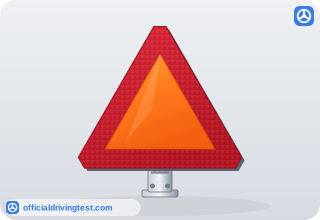
- On the front, near the middle, and two feet above the road
- On the rear, near the bumper, and one foot above the road
- On the left side, near the door, and six feet above the road
- On the rear, near the middle, and four feet or more above the road
Show answer
Correct answer: On the rear, near the middle, and four feet or more above the road
The slow moving vehicle sign must be on the rear of the vehicle, near the middle, and four feet or more above the road, clean and reflective.
Source: Missouri Driver Guide (Revised August 2026), page 85 · Open this page in the manual (Manual page 85)
-
During what dates may your vehicle have studded snow tires?
- Only from November 1 to April 1
- Only from October 1 to March 1
- Only from December 1 to March 15
- All year long
Show answer
Correct answer: Only from November 1 to April 1
Your vehicle may have studded snow tires only from November 1 to April 1.
Source: Missouri Driver Guide (Revised August 2026), page 85 · Open this page in the manual (Manual page 85)
-
Tinting or sun-screening material is permitted on the side and rear windows. What limit applies to front door windows?
- No more than 35% light blockage
- No more than 50% light blockage
- No more than 65% light blockage
- No more than 80% light blockage
Show answer
Correct answer: No more than 65% light blockage
Front door windows may have tinting of no more than 65% light blockage.
Source: Missouri Driver Guide (Revised August 2026), page 85 · Open this page in the manual (Manual page 85)