Missouri: Right-of-way, turning and passing
Who yields at intersections and four-way stops, turning and U-turns, multiple turn lanes, roundabouts, passing and funeral processions. Split into 5 shorter tests so you're not stuck in one long quiz.
Independent educational site · not affiliated with any government agency or DMV
Choose a part
Right-of-way, turning and passing — Part 1
Questions in this part include: “Which driving error can cost you your license when it causes injury or death?”
StartRight-of-way, turning and passing — Part 2
Questions in this part include: “Before you make any turn, what should you look for?”
StartRight-of-way, turning and passing — Part 3
Questions in this part include: “How far may a vehicle travel in a two-way left-turn lane?”
StartRight-of-way, turning and passing — Part 4
Questions in this part include: “What should you use to let others know you are exiting a roundabout?”
StartRight-of-way, turning and passing — Part 5
Questions in this part include: “For what purpose must you never join a funeral procession?”
StartAll 86 Right-of-way, turning and passing questions with answers
Choose a part above to take a practice test, or study every question and answer here.
Show the questions and answersHide the questions
-
Which driving error can cost you your license when it causes injury or death?
- Failing to yield the right-of-way
- Stopping for a pedestrian at a crosswalk
- Using a turn signal before changing lanes
- Driving slower than other traffic in the right lane
Show answer
Correct answer: Failing to yield the right-of-way
Failing to yield the right-of-way and causing injury or death is a listed reason for losing your license.
Source: Missouri Driver Guide (Revised August 2026), page 15 · Open this page in the manual (Manual page 15)
-
How many turns will you be asked to make during the driving test?
- At least two right and two left turns
- At least one right and one left turn
- At least three right and three left turns
- At least four left turns only
Show answer
Correct answer: At least two right and two left turns
The test includes at least two right and two left turns.
Source: Missouri Driver Guide (Revised August 2026), page 20 · Open this page in the manual (Manual page 20)
-
Which of these are you tested for when making turns?
- Sounding the horn before each turn you make
- Shifting to neutral before each turn you make
- Giving the proper turn signal at the proper time
- Turning on the hazard lights before each turn
Show answer
Correct answer: Giving the proper turn signal at the proper time
On turns you are tested for giving the proper turn signal at the proper time.
Source: Missouri Driver Guide (Revised August 2026), page 20 · Open this page in the manual (Manual page 20)
-
At stop signs, what are you tested for in the driving test?
- Slowing to a rolling stop
- Stopping just past the crosswalk
- Sounding the horn before entering
- Making a full stop at the proper place
Show answer
Correct answer: Making a full stop at the proper place
At stop signs you are tested for making a full stop at the proper place.
Source: Missouri Driver Guide (Revised August 2026), page 20 · Open this page in the manual (Manual page 20)
-
At intersections, what are you tested for regarding the right-of-way?
- Yielding the right-of-way without blocking traffic
- Waving other drivers through ahead of you
- Waiting for the examiner's signal to go
- Taking the right-of-way from slower drivers
Show answer
Correct answer: Yielding the right-of-way without blocking traffic
At intersections you are tested for yielding the right-of-way without blocking traffic.
Source: Missouri Driver Guide (Revised August 2026), page 20 · Open this page in the manual (Manual page 20)
-
According to the manual, what is your highest duty as a motorist?
- To drive your vehicle carefully and prudently
- To reach your destination as quickly as you can
- To take the right-of-way whenever you have it
- To keep pace with the traffic around you
Show answer
Correct answer: To drive your vehicle carefully and prudently
The manual says a motorist's highest duty is to drive carefully and prudently, in a manner that is safe for pedestrians, cyclists, and other motorists.
Source: Missouri Driver Guide (Revised August 2026), page 22 · Open this page in the manual (Manual page 22)
-
What does the law say about the right-of-way?
- It gives the right-of-way to the driver who is going fastest
- It gives the right-of-way to the driver of the larger vehicle
- It says who must yield; it does not give any driver the right-of-way
- It gives the right-of-way to whichever driver reaches the road first
Show answer
Correct answer: It says who must yield; it does not give any driver the right-of-way
The law says who must yield the right-of-way; it does not give any driver the right-of-way.
Source: Missouri Driver Guide (Revised August 2026), page 22 · Open this page in the manual (Manual page 22)
-
What must you do regardless of the circumstances?
- Insist on your right-of-way when the law says you have it
- Do everything you can to avoid striking a pedestrian or vehicle
- Keep moving at the posted speed limit to keep traffic flowing
- Yield only to vehicles that are larger than yours
Show answer
Correct answer: Do everything you can to avoid striking a pedestrian or vehicle
You must do everything you can to prevent striking a pedestrian or another vehicle, regardless of the circumstances.
Source: Missouri Driver Guide (Revised August 2026), page 22 · Open this page in the manual (Manual page 22)
-
When do the right-of-way rules tell drivers who must yield?
- Only where a police officer is directing traffic
- Only at intersections that have a working traffic signal
- Only on roads with more than two lanes
- Where there are no signs or signals to regulate traffic
Show answer
Correct answer: Where there are no signs or signals to regulate traffic
Where vehicles or pedestrians are likely to meet and no signs or signals regulate traffic, the right-of-way rules say who goes first and who must wait.
Source: Missouri Driver Guide (Revised August 2026), page 22 · Open this page in the manual (Manual page 22)
-
A driver turning left must yield to which vehicles?
- Oncoming vehicles going straight
- Vehicles parked at the curb
- Vehicles waiting at a side street
- Vehicles in the lane to the left
Show answer
Correct answer: Oncoming vehicles going straight
The manual says drivers turning left must yield to oncoming vehicles going straight.
Source: Missouri Driver Guide (Revised August 2026), page 23 · Open this page in the manual (Manual page 23)
-
At a four-way stop, who may proceed before the other drivers?
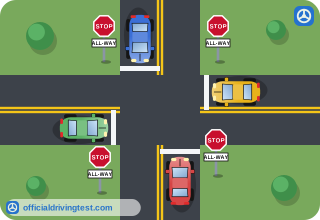
- The driver in the fastest-moving vehicle
- The driver who is signaling a right turn
- The driver who reaches the intersection first
- The driver of the largest vehicle there
Show answer
Correct answer: The driver who reaches the intersection first
At a four-way stop, the driver reaching the intersection first may proceed before the other drivers, after coming to a complete stop.
Source: Missouri Driver Guide (Revised August 2026), page 23 · Open this page in the manual (Manual page 23)
-
What must drivers entering a road from a driveway, alley, or roadside do?
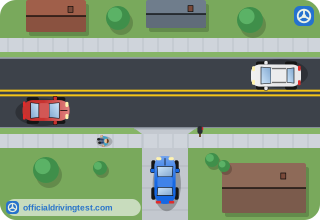
- Enter quickly before traffic on the main road arrives
- Yield to vehicles already on the main road
- Sound the horn and then enter the road
- Stop only if pedestrians are on the sidewalk
Show answer
Correct answer: Yield to vehicles already on the main road
Drivers entering a road from a driveway, alley, or roadside must yield to vehicles already on the main road.
Source: Missouri Driver Guide (Revised August 2026), page 23 · Open this page in the manual (Manual page 23)
-
At an intersection with no stop sign or traffic signal (other than a roundabout), whom must drivers yield to?
- Vehicles coming from the left
- Vehicles that are slowing down
- The larger vehicle
- Vehicles coming from the right
Show answer
Correct answer: Vehicles coming from the right
At an intersection with no stop sign or traffic signal, except roundabouts, drivers must yield to vehicles coming from the right.
Source: Missouri Driver Guide (Revised August 2026), page 23 · Open this page in the manual (Manual page 23)
-
When approaching a roundabout, whom must you always yield to?
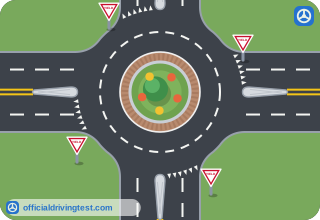
- Traffic in the circle and pedestrians in the crosswalks
- Vehicles that are about to enter from the other entrances
- Large trucks only, because they need more room
- Only vehicles that are exiting the roundabout
Show answer
Correct answer: Traffic in the circle and pedestrians in the crosswalks
When approaching a roundabout intersection, always yield to traffic in the circle and pedestrians in the crosswalks, and wait for a gap in traffic.
Source: Missouri Driver Guide (Revised August 2026), page 23 · Open this page in the manual (Manual page 23)
-
If there are no signs or lane markings to control turning, which lane should you turn from?
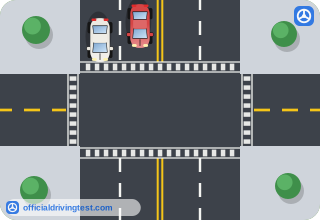
- The lane closest to the direction you want to go
- The lane that has the least traffic at the time
- The lane closest to the center of the road
- The lane farthest from the direction you want to go
Show answer
Correct answer: The lane closest to the direction you want to go
You should turn from the lane that is closest to the direction you want to go, so you cross the fewest lanes of traffic.
Source: Missouri Driver Guide (Revised August 2026), page 24 · Open this page in the manual (Manual page 24)
-
If there are no signs or lane markings to control turning, which lane should you turn into?
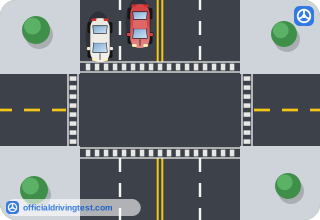
- The lane farthest from the one you came from
- The lane with the fewest vehicles in it
- The lane closest to the one you came from
- The lane closest to the oncoming traffic
Show answer
Correct answer: The lane closest to the one you came from
You should turn into the lane closest to the one you came from, which means you will cross the fewest lanes of traffic.
Source: Missouri Driver Guide (Revised August 2026), page 24 · Open this page in the manual (Manual page 24)
-
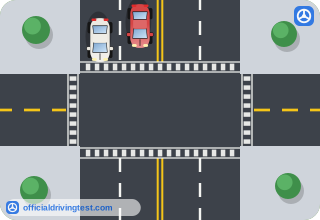
When making a turn, how should you go from one lane to the other?
- Quickly, even if you must cross lane lines to finish the turn
- Smoothly, without crossing lane lines or interfering with traffic
- Gradually, by crossing lane lines before you start the turn
- Slowly, stopping in the intersection if traffic is heavy
Show answer
Correct answer: Smoothly, without crossing lane lines or interfering with traffic
When making turns, go from one lane to the other as smoothly as possible without crossing lane lines or interfering with traffic.
Source: Missouri Driver Guide (Revised August 2026), page 24 · Open this page in the manual (Manual page 24)
-
Once you have completed your turn, what may you do?
- Make a U-turn if the street is clear
- Stop in the lane until traffic clears
- Turn on your hazard lights
- Change to another lane if you need to
Show answer
Correct answer: Change to another lane if you need to
Once you have completed your turn, you can change to another lane if you need to.
Source: Missouri Driver Guide (Revised August 2026), page 24 · Open this page in the manual (Manual page 24)
-
Before you make any turn, what should you look for?
- Only the vehicles that are behind you
- Only the traffic signal and road signs
- Only the vehicles that are in your own lane
- Oncoming traffic or pedestrians, looking both ways
Show answer
Correct answer: Oncoming traffic or pedestrians, looking both ways
Before you make any turn, you should look both ways for oncoming traffic or pedestrians.
Source: Missouri Driver Guide (Revised August 2026), page 24 · Open this page in the manual (Manual page 24)
-
Where should you not make a U-turn because your vehicle may not be seen by other drivers?
- On a straight road with a clear view
- On any curve or near the crest of a hill
- On a street with no signs posted
- On a road with a wide shoulder
Show answer
Correct answer: On any curve or near the crest of a hill
U-turns should not be made on any curve or near the crest of a hill when your vehicle may not be seen by other drivers.
Source: Missouri Driver Guide (Revised August 2026), page 25 · Open this page in the manual (Manual page 25)
-
At which location must you never make a U-turn?
- On a road with a posted speed limit under 25 mph
- At a location with a solid white edge line
- At a location marked with a "No U-Turn" sign
- On any road that has more than two lanes
Show answer
Correct answer: At a location marked with a "No U-Turn" sign
Never make a U-turn at a location that is marked with a "No U-Turn" sign.
Source: Missouri Driver Guide (Revised August 2026), page 25 · Open this page in the manual (Manual page 25)
-
A U-turn must never be made at what kind of intersection?
- One controlled by a traffic signal or police officer
- One that has crosswalks on all four sides
- One where two roads of equal size meet
- One with no vehicles in sight in any direction
Show answer
Correct answer: One controlled by a traffic signal or police officer
The manual says never to make a U-turn at an intersection controlled by a traffic signal or police officer.
Source: Missouri Driver Guide (Revised August 2026), page 25 · Open this page in the manual (Manual page 25)
-
On right turns, what should you avoid?
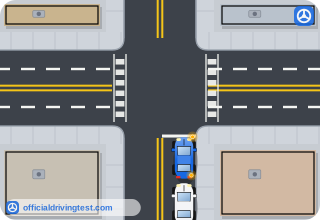
- Swinging wide to the left before turning
- Slowing down before the turn
- Signaling before you reach the intersection
- Looking both ways before you start the turn
Show answer
Correct answer: Swinging wide to the left before turning
On right turns, avoid swinging wide to the left before turning.
Source: Missouri Driver Guide (Revised August 2026), page 25 · Open this page in the manual (Manual page 25)
-
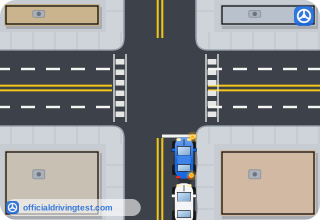
Why should you avoid swinging wide to the left before a right turn?
- Oncoming drivers may think you are about to yield
- Pedestrians in the crosswalk may not see your turn signal
- The driver behind may try to pass you on the right
- The driver behind may think you are stopping and brake hard
Show answer
Correct answer: The driver behind may try to pass you on the right
If you swing wide, the driver behind you may think you are changing lanes or going to turn left, and may try to pass you on the right.
Source: Missouri Driver Guide (Revised August 2026), page 25 · Open this page in the manual (Manual page 25)
-
If you swing wide as you complete a right turn, who will not expect to see you there?
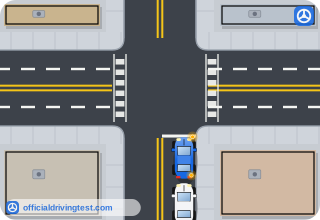
- Drivers parked at the curb
- Drivers who are in the far lane
- Pedestrians waiting behind you
- Drivers who are stopped at a signal behind you
Show answer
Correct answer: Drivers who are in the far lane
If you swing wide as you complete the turn, drivers in the far lane will not expect to see you there and you could cause a crash.
Source: Missouri Driver Guide (Revised August 2026), page 25 · Open this page in the manual (Manual page 25)
-
When making a left turn, what should you avoid doing?
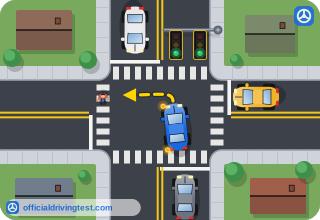
- Using your turn signal before the turn
- Slowing down before you start the turn
- Checking for oncoming traffic before the turn
- Cutting the corner so sharply that you hit someone
Show answer
Correct answer: Cutting the corner so sharply that you hit someone
When making a left turn, avoid cutting the corner so sharply that you run into someone approaching from the left.
Source: Missouri Driver Guide (Revised August 2026), page 25 · Open this page in the manual (Manual page 25)
-
When making a left turn, what must you leave room for?
- Vehicles behind you to pass on your left
- Parked vehicles to pull out ahead of you
- Vehicles behind you to pass on your right
- Oncoming vehicles to turn left in front of you
Show answer
Correct answer: Oncoming vehicles to turn left in front of you
When making a left turn, you must leave room for oncoming vehicles to turn left in front of you.
Source: Missouri Driver Guide (Revised August 2026), page 25 · Open this page in the manual (Manual page 25)
-
When turning left from a one-way street onto a two-way street, in which lane do you begin the turn?
- The right lane
- The left lane
- The center lane
- Whichever lane is closest to the curb
Show answer
Correct answer: The left lane
For a turn from a one-way street onto a two-way street, begin the turn in the left lane.
Source: Missouri Driver Guide (Revised August 2026), page 25 · Open this page in the manual (Manual page 25)
-
After turning from a one-way street onto a two-way street, where do you enter the two-way road?
- To the left of its yellow dividing line
- Across its yellow dividing line into any lane
- To the right of its yellow dividing line
- Into whichever lane is farthest from the turn
Show answer
Correct answer: To the right of its yellow dividing line
You enter the two-way road to the right of its yellow dividing line.
Source: Missouri Driver Guide (Revised August 2026), page 25 · Open this page in the manual (Manual page 25)
-
When may you enter the right lane of a four-lane two-way road after turning from a one-way street?
- If that lane is free of traffic
- Only after you have stopped in the left lane
- Only if you are driving a large vehicle
- Never, because you must use the lane next to the line
Show answer
Correct answer: If that lane is free of traffic
If the two-way road is a four-lane road, you may enter it in the right lane if that lane is free of traffic.
Source: Missouri Driver Guide (Revised August 2026), page 25 · Open this page in the manual (Manual page 25)
-
How do you begin a left turn from a two-way street onto a one-way street?
- With your left wheel as close as possible to the yellow dividing line
- With your right wheel as close as possible to the right curb line
- With your left wheel as far as possible from the yellow dividing line
- With your car centered between the yellow dividing line and the curb
Show answer
Correct answer: With your left wheel as close as possible to the yellow dividing line
For a turn from a two-way street onto a one-way street, begin the turn with your left wheel as close as possible to the yellow dividing line.
Source: Missouri Driver Guide (Revised August 2026), page 25 · Open this page in the manual (Manual page 25)
-
What should you do when turning from a two-way street onto a one-way road that has two lanes?
- Always turn into its left lane, even if a vehicle is in it
- Always turn into its right lane, even if a vehicle is in it
- Turn into its left lane or right lane, whichever is free of traffic
- Turn into the center of the road, then move into a lane
Show answer
Correct answer: Turn into its left lane or right lane, whichever is free of traffic
If the one-way road has two lanes, turn into its left lane or right lane, whichever is free of traffic.
Source: Missouri Driver Guide (Revised August 2026), page 25 · Open this page in the manual (Manual page 25)
-
After turning from a two-way street onto a two-way street, where do you enter the road?
- On its center line
- To the right of its center line
- To the left of its center line
- Across its center line into the farthest lane
Show answer
Correct answer: To the right of its center line
When turning from a two-way street onto a two-way street, enter the road to the right of its center line.
Source: Missouri Driver Guide (Revised August 2026), page 25 · Open this page in the manual (Manual page 25)
-
When turning from the left side lane of two left-turn lanes, which lane do you enter?
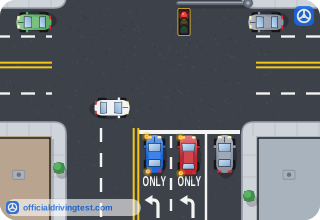
- The right lane, on the right of the yellow dividing line
- The left lane, on the left of the yellow dividing line
- Either lane, whichever is free of traffic
- The left lane, on the right of the yellow dividing line
Show answer
Correct answer: The left lane, on the right of the yellow dividing line
If you are turning from the left side, left-turn lane, enter the left lane on the right of the yellow dividing line.
Source: Missouri Driver Guide (Revised August 2026), page 26 · Open this page in the manual (Manual page 26)
-
When turning from the right side lane of two left-turn lanes, which lane do you enter?
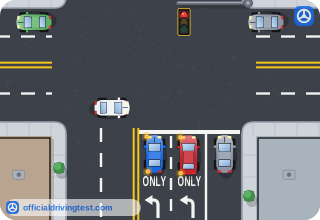
- The left lane
- The center lane
- Either lane
- The right lane
Show answer
Correct answer: The right lane
If you are turning from the right side, left-turn lane, you enter the right lane.
Source: Missouri Driver Guide (Revised August 2026), page 26 · Open this page in the manual (Manual page 26)
-
When should you enter a two-way left-turn lane?
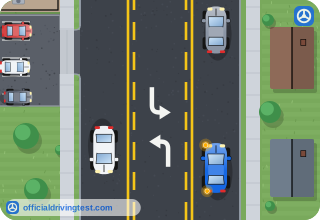
- When you want to pass slower traffic ahead of you
- When preparing to slow down or stop for a left turn
- When you need a lane to travel a long distance
- When you are entering the road from a side street
Show answer
Correct answer: When preparing to slow down or stop for a left turn
Only enter this lane when preparing to slow down or stop before making a left turn from the main roadway.
Source: Missouri Driver Guide (Revised August 2026), page 26 · Open this page in the manual (Manual page 26)
-
How far may a vehicle travel in a two-way left-turn lane?
- No more than 100 feet
- No more than 250 feet
- No more than 500 feet
- No more than 1,000 feet
Show answer
Correct answer: No more than 500 feet
A vehicle may not travel in a two-way left-turn lane for more than 500 feet.
Source: Missouri Driver Guide (Revised August 2026), page 26 · Open this page in the manual (Manual page 26)
-
What does the manual say about using a two-way left-turn lane when entering the roadway from a side street?
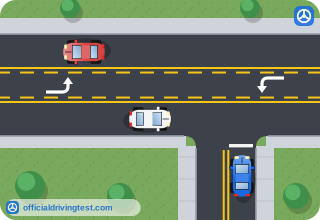
- Do not use it
- Use it to merge into traffic
- Use it only at night
- Use it if traffic is heavy
Show answer
Correct answer: Do not use it
The manual says not to use the two-way left-turn lane when entering the roadway from a side street.
Source: Missouri Driver Guide (Revised August 2026), page 26 · Open this page in the manual (Manual page 26)
-
A roundabout may be used as an alternative to which kinds of intersections?
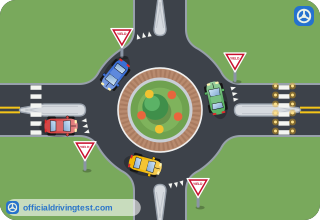
- Signalized and all-way stop intersections
- Railroad grade crossings and freeway ramps
- School zones and work zones
- Tunnels and bridges
Show answer
Correct answer: Signalized and all-way stop intersections
Roundabouts are a traffic control device that may be used as an alternative to signalized and all-way stop intersections.
Source: Missouri Driver Guide (Revised August 2026), page 26 · Open this page in the manual (Manual page 26)
-
Which traffic sign do roundabouts feature at all entering roadway legs?
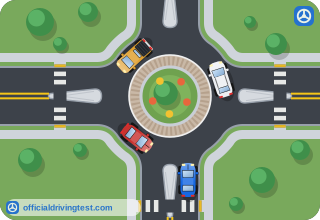
- Stop signs
- Merge signs
- Yield signs
- Do Not Enter signs
Show answer
Correct answer: Yield signs
Roundabouts feature yield traffic signs at all entering roadway legs.
Source: Missouri Driver Guide (Revised August 2026), page 26 · Open this page in the manual (Manual page 26)
-
What kind of turn do drivers make as they approach and enter a roundabout?
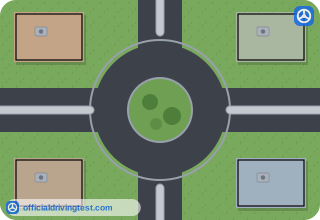
- A sharp left turn
- A slight right turn
- A U-turn
- No turn, they go straight ahead
Show answer
Correct answer: A slight right turn
At a roundabout, drivers who approach the intersection make a slight right turn to go counterclockwise around a circular center island.
Source: Missouri Driver Guide (Revised August 2026), page 26 · Open this page in the manual (Manual page 26)
-
In which direction do you travel around the center island of a roundabout?
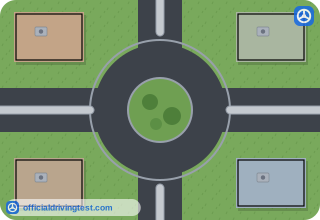
- Clockwise
- Whichever way is shorter
- In either direction, depending on your exit
- Counterclockwise
Show answer
Correct answer: Counterclockwise
Drivers make a slight right turn to go counterclockwise around the circular center island.
Source: Missouri Driver Guide (Revised August 2026), page 26 · Open this page in the manual (Manual page 26)
-
What should you do before entering a roundabout?
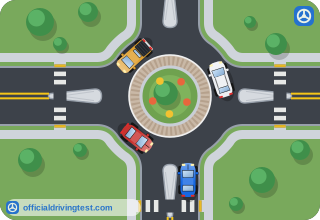
- Sound your horn
- Speed up to merge
- Stop in the crosswalk
- Slow down
Show answer
Correct answer: Slow down
The manual says to slow down before entering the roundabout.
Source: Missouri Driver Guide (Revised August 2026), page 26 · Open this page in the manual (Manual page 26)
-
At a multi-lane roundabout, what directs you into the correct lane?
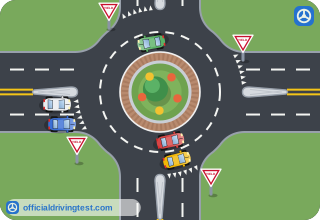
- The vehicle in front of you
- Roadside signs and pavement markings
- The flow of vehicles around you
- Your turn signal
Show answer
Correct answer: Roadside signs and pavement markings
For multi-lane roundabouts, observe roadside signs and pavement markings to direct you into the correct lane.
Source: Missouri Driver Guide (Revised August 2026), page 26 · Open this page in the manual (Manual page 26)
-
As you drive toward a roundabout entrance, which way should you look?
- To your right
- Straight ahead only
- To your left
- Behind you
Show answer
Correct answer: To your left
Look to your left as you drive towards the entrance, and yield to traffic already in the roundabout, bicyclists, and pedestrians in the crosswalk.
Source: Missouri Driver Guide (Revised August 2026), page 26 · Open this page in the manual (Manual page 26)
-
When should you enter a roundabout?
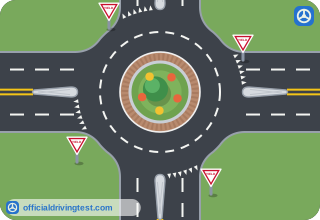
- When there is a gap in traffic
- As soon as you reach the entrance
- When the traffic in the circle stops
- When the vehicle ahead of you enters
Show answer
Correct answer: When there is a gap in traffic
Enter when there is a gap in traffic and merge with the other flow of vehicles.
Source: Missouri Driver Guide (Revised August 2026), page 26 · Open this page in the manual (Manual page 26)
-
What must you never do to enter a roundabout?
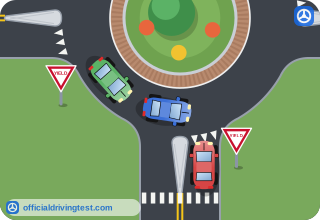
- Make a left turn
- Make a right turn
- Slow down
- Yield to pedestrians
Show answer
Correct answer: Make a left turn
The manual says to NEVER make a left turn to enter a roundabout.
Source: Missouri Driver Guide (Revised August 2026), page 26 · Open this page in the manual (Manual page 26)
-
While traveling through a roundabout, which side of the center island must you stay on?
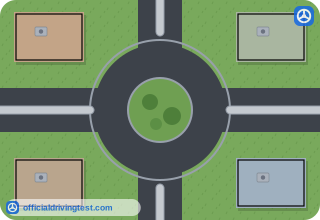
- The left side
- Either side, depending on your exit
- The right side
- The side that has the fewest vehicles
Show answer
Correct answer: The right side
The manual says to always stay to the right of the center island.
Source: Missouri Driver Guide (Revised August 2026), page 27 · Open this page in the manual (Manual page 27)
-
Who has the right of way at a roundabout?
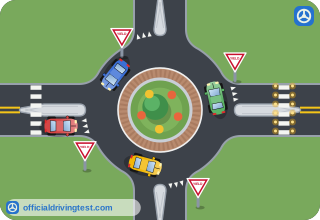
- Vehicles entering the roundabout
- Vehicles within the roundabout
- Vehicles waiting at the crosswalk
- Vehicles about to exit
Show answer
Correct answer: Vehicles within the roundabout
Vehicles within the roundabout have the right of way.
Source: Missouri Driver Guide (Revised August 2026), page 27 · Open this page in the manual (Manual page 27)
-
What should you not do within a roundabout?
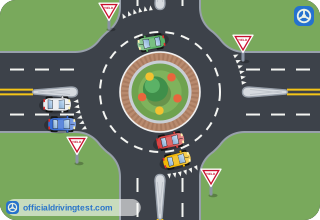
- Keep a slow speed when exiting
- Use your right turn signal to exit
- Watch for pedestrians and bicyclists
- Change lanes
Show answer
Correct answer: Change lanes
The manual says not to change lanes within a roundabout.
Source: Missouri Driver Guide (Revised August 2026), page 27 · Open this page in the manual (Manual page 27)
-
Why should you give special consideration to trucks, trailers, and other large vehicles in a roundabout?
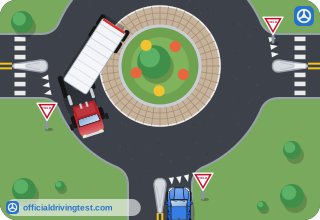
- They are always allowed to pass other vehicles in it
- They may need to use more than one lane
- They may stop in the circle to let traffic by
- They may travel the wrong way around the circle
Show answer
Correct answer: They may need to use more than one lane
Trucks, trailers, and other large vehicles may need to use more than one lane within a roundabout.
Source: Missouri Driver Guide (Revised August 2026), page 27 · Open this page in the manual (Manual page 27)
-
What does the manual say not to attempt in a roundabout, especially around large trucks?
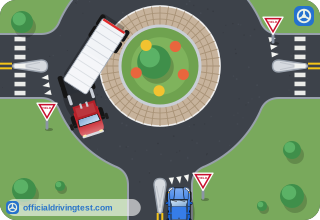
- To use your right turn signal
- To watch for pedestrians
- To pass any vehicles
- To yield to vehicles in the circle
Show answer
Correct answer: To pass any vehicles
The manual says not to attempt to pass any vehicles in a roundabout, especially large trucks.
Source: Missouri Driver Guide (Revised August 2026), page 27 · Open this page in the manual (Manual page 27)
-
What should you do if you miss your exit from a roundabout?
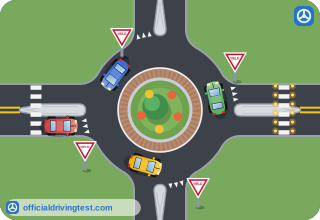
- Keep going until you reach the right exit
- Stop and reverse to the exit you missed
- Cut across the center island to the exit
- Pull over and wait until traffic clears
Show answer
Correct answer: Keep going until you reach the right exit
If you miss your exit, continue through the roundabout until you reach your appropriate exit.
Source: Missouri Driver Guide (Revised August 2026), page 27 · Open this page in the manual (Manual page 27)
-
When exiting a roundabout, what should you watch for?
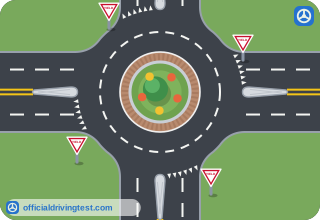
- Pedestrians and bicyclists crossing the street
- Large trucks that are about to enter the circle
- Stop signs and signals placed at each exit
- Vehicles stopped at the center island ahead
Show answer
Correct answer: Pedestrians and bicyclists crossing the street
When exiting, watch for pedestrians and bicyclists crossing the street.
Source: Missouri Driver Guide (Revised August 2026), page 27 · Open this page in the manual (Manual page 27)
-
Why should you maintain a slow speed when exiting a roundabout?
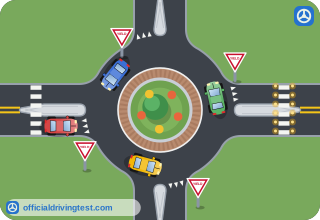
- To leave room for vehicles still entering the circle
- To give large trucks time to use the apron
- To avoid losing control or striking traffic islands
- To avoid being passed by vehicles in the circle
Show answer
Correct answer: To avoid losing control or striking traffic islands
You maintain a slow speed when exiting to avoid losing control or striking traffic islands.
Source: Missouri Driver Guide (Revised August 2026), page 27 · Open this page in the manual (Manual page 27)
-
What should you use to let others know you are exiting a roundabout?
- Your left turn signal
- Your right turn signal
- Your hazard lights
- Your high beams
Show answer
Correct answer: Your right turn signal
Use your right turn signal to let others know you are exiting.
Source: Missouri Driver Guide (Revised August 2026), page 27 · Open this page in the manual (Manual page 27)
-
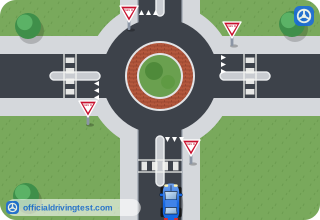
When exiting a roundabout, when may you accelerate?
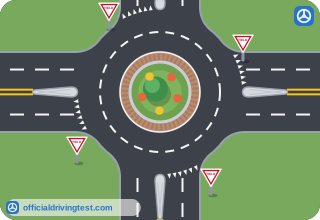
- As soon as you have passed the last vehicle in the circle
- As soon as you can see the road beyond the exit
- As soon as your front wheels are past the center island
- Once you are beyond the pedestrian crossing at the exit
Show answer
Correct answer: Once you are beyond the pedestrian crossing at the exit
The manual says not to accelerate until you are beyond the pedestrian crossing at the exit.
Source: Missouri Driver Guide (Revised August 2026), page 27 · Open this page in the manual (Manual page 27)
-
What is a truck apron at a roundabout?
- A paved lane at the entrance for vehicles waiting to merge
- A painted crossing where pedestrians cross at the exit
- The paved area inside it for the rear wheels of large trucks
- A raised area in the center that no vehicle may enter
Show answer
Correct answer: The paved area inside it for the rear wheels of large trucks
A truck apron, also known as off-tracking, is the paved area on the inside of the roundabout for the rear wheels of large trucks to use when turning.
Source: Missouri Driver Guide (Revised August 2026), page 27 · Open this page in the manual (Manual page 27)
-
Which vehicles are not to use a roundabout truck apron?
- Cars, SUVs, and pickup trucks
- Trucks making a turn
- Tractor-trailers with a single trailer
- Trucks that carry freight only
Show answer
Correct answer: Cars, SUVs, and pickup trucks
Truck aprons are not to be used by cars, SUVs or pickup trucks.
Source: Missouri Driver Guide (Revised August 2026), page 27 · Open this page in the manual (Manual page 27)
-
At a J-turn intersection, how do drivers get to the opposing lanes?
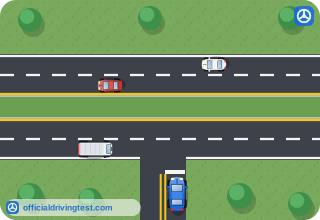
- Turn right, merge into the far left lane, then turn left
- Cross the fast-moving lanes and turn left directly
- Turn left at once and merge into the far right lane
- Stop in the median and wait for a gap to turn left
Show answer
Correct answer: Turn right, merge into the far left lane, then turn left
At a J-turn intersection, drivers turn right in the same direction of traffic, merge into the far left lane, and then make a left turn in the direction they intend to travel.
Source: Missouri Driver Guide (Revised August 2026), page 27 · Open this page in the manual (Manual page 27)
-
The J-turn is an alternative to traditional roadway intersections on what kind of road?
- A two-lane road
- A one-way street
- A four-lane highway
- A residential street
Show answer
Correct answer: A four-lane highway
The J-turn is an alternative to traditional roadway intersections on a four-lane highway.
Source: Missouri Driver Guide (Revised August 2026), page 27 · Open this page in the manual (Manual page 27)
-
What must you obey when local governments make traffic ordinances in addition to state laws?
- Only the regulations set by the state
- Any traffic sign or regulation, whether local or state
- Only local rules, because they replace state laws
- Only the signs that are posted on state highways
Show answer
Correct answer: Any traffic sign or regulation, whether local or state
You must obey any traffic sign or regulation whether set by a municipality, county, or the state.
Source: Missouri Driver Guide (Revised August 2026), page 27 · Open this page in the manual (Manual page 27)
-
Which of these may cities and towns regulate by local ordinance?
- Setting the age at which a driver may get a license
- Setting the points for a traffic offense
- Setting the minimum insurance a driver must carry
- Prohibiting commercial vehicles from using certain streets
Show answer
Correct answer: Prohibiting commercial vehicles from using certain streets
Cities and towns may have regulations that prohibit commercial vehicles from using certain streets.
Source: Missouri Driver Guide (Revised August 2026), page 27 · Open this page in the manual (Manual page 27)
-
You are facing a green light. What must you do about pedestrians in the intersection?
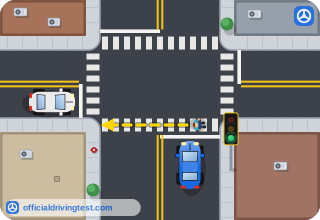
- Yield the right-of-way to all of them
- Proceed, because the green light gives you the right-of-way
- Sound your horn so they hurry
- Yield only if they are in a marked crosswalk
Show answer
Correct answer: Yield the right-of-way to all of them
The manual says that even with a green light you must yield the right-of-way to all pedestrians in the intersection.
Source: Missouri Driver Guide (Revised August 2026), page 30 · Open this page in the manual (Manual page 30)
-
As you prepare for a right turn, especially on a red traffic signal, whom should you be cautious of?
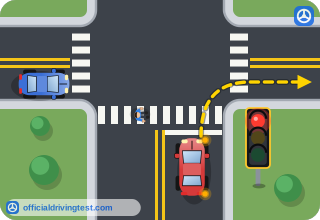
- Only vehicles approaching from your left side
- Pedestrians or bicyclists approaching on your right
- Only oncoming traffic in the opposite lane
- Only pedestrians standing in front of you
Show answer
Correct answer: Pedestrians or bicyclists approaching on your right
The manual says to be cautious of pedestrians or bicyclists approaching on your right when preparing for a right turn.
Source: Missouri Driver Guide (Revised August 2026), page 31 · Open this page in the manual (Manual page 31)
-
If you are driving in a funeral procession, how closely should you follow the vehicle in front of you?
- At least six car lengths back
- As closely as is practical and safe
- At the following distance you use in normal traffic
- Far enough back to let other traffic merge between vehicles
Show answer
Correct answer: As closely as is practical and safe
The manual says to follow the vehicle in front as closely as is practical and safe.
Source: Missouri Driver Guide (Revised August 2026), page 33 · Open this page in the manual (Manual page 33)
-
What must every vehicle in a funeral procession use?
- Its low beam headlights only
- Its horn at each intersection
- Its high beams
- Its flashing emergency lights
Show answer
Correct answer: Its flashing emergency lights
The manual says every vehicle in the procession must use its flashing emergency lights.
Source: Missouri Driver Guide (Revised August 2026), page 33 · Open this page in the manual (Manual page 33)
-
At intersections, who has the right-of-way regardless of any traffic control device, except for emergency vehicles or when directed otherwise by law enforcement officials?
- An organized funeral procession
- A delivery truck with its hazard lights on
- A vehicle turning left
- Any vehicle with its headlights on
Show answer
Correct answer: An organized funeral procession
The manual says an organized funeral procession has the right-of-way at all intersections regardless of any traffic control device, with those exceptions.
Source: Missouri Driver Guide (Revised August 2026), page 33 · Open this page in the manual (Manual page 33)
-
What should a driver not involved in a funeral procession avoid doing while the procession's vehicles are in motion?
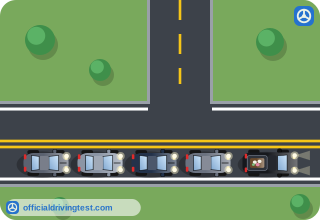
- Driving beside the procession in another lane
- Following the procession at a safe distance
- Driving between the vehicles in the procession
- Slowing down for the procession
Show answer
Correct answer: Driving between the vehicles in the procession
The manual says not to drive between the vehicles that are part of the procession when they are in motion.
Source: Missouri Driver Guide (Revised August 2026), page 34 · Open this page in the manual (Manual page 34)
-
For what purpose must you never join a funeral procession?
- To pay respects to the family
- To obtain the right-of-way
- To attend the funeral as a mourner
- To follow a relative's car to the service
Show answer
Correct answer: To obtain the right-of-way
The manual says not to join a funeral procession for the purpose of obtaining the right-of-way.
Source: Missouri Driver Guide (Revised August 2026), page 34 · Open this page in the manual (Manual page 34)
-
When may a driver not involved in a funeral procession pass a vehicle in the procession?
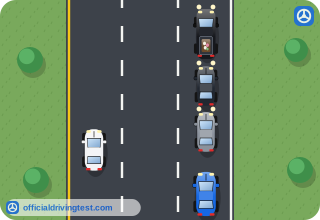
- Whenever the procession is moving below the speed limit
- Whenever the driver signals first and sees no traffic
- Never, under any circumstances, even where a passing lane exists
- Only where a passing lane is provided
Show answer
Correct answer: Only where a passing lane is provided
The manual says not to pass any vehicle in the procession except where a passing lane has been specifically provided.
Source: Missouri Driver Guide (Revised August 2026), page 34 · Open this page in the manual (Manual page 34)
-
A funeral procession is going through a red signal light at an intersection. When may you enter that intersection?
- Only if you do not cross the procession's path
- Whenever you have a green light for your own direction
- After you sound your horn and slow down
- Whenever no emergency vehicle is present nearby
Show answer
Correct answer: Only if you do not cross the procession's path
The manual says not to enter an intersection in which a procession is going through a red signal unless you can do so without crossing the procession's path.
Source: Missouri Driver Guide (Revised August 2026), page 34 · Open this page in the manual (Manual page 34)
-
If you miss your turn or exit, what should you do?
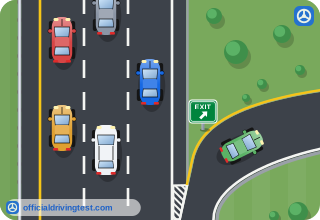
- Go on to where you can safely turn around
- Back up to the turn if no one is behind you
- Stop in the lane and let others pass
- Slow down and back up along the shoulder
Show answer
Correct answer: Go on to where you can safely turn around
Drivers do not expect a vehicle to back toward them, so you should not back up but go on to where you can safely turn around.
Source: Missouri Driver Guide (Revised August 2026), page 43 · Open this page in the manual (Manual page 43)
-
What should you do if you are confused about directions while in a travel lane?
- Stop in the lane and turn on your hazard lights
- Stop in the lane and wait for other drivers to go around
- Back up to the last safe place to stop
- Keep moving until you can safely pull off the road
Show answer
Correct answer: Keep moving until you can safely pull off the road
You should not stop in travel lanes for any reason, such as confusion; keep moving until you can safely pull off the road.
Source: Missouri Driver Guide (Revised August 2026), page 43 · Open this page in the manual (Manual page 43)
-
On a road with three or more lanes traveling in the same direction, which lane should you stay in except to pass?
- The center lane
- The right lane
- The left lane
- Whichever lane is moving fastest
Show answer
Correct answer: The right lane
On a road with three or more lanes in your direction, you should stay in the right lane except to pass.
Source: Missouri Driver Guide (Revised August 2026), page 43 · Open this page in the manual (Manual page 43)
-
On a road with three or more lanes in your direction, when may you use the center lane instead of the right lane?
- When you are driving below the speed limit
- When much traffic is entering the right lane
- When the center lane has no vehicles in it
- When it is raining or the road is wet
Show answer
Correct answer: When much traffic is entering the right lane
If there is a considerable amount of traffic entering the right travel lane, then use the center travel lane.
Source: Missouri Driver Guide (Revised August 2026), page 43 · Open this page in the manual (Manual page 43)
-
On multi-lane roads, which lane is intended to be used to pass slower vehicles?
- The right-most lane
- The center lane only
- The shoulder
- The left-most lane
Show answer
Correct answer: The left-most lane
On multi-lane roads, the left-most lane is intended to be used to pass slower vehicles.
Source: Missouri Driver Guide (Revised August 2026), page 43 · Open this page in the manual (Manual page 43)
-
On multi-lane roads, what may happen if you pass on the right?
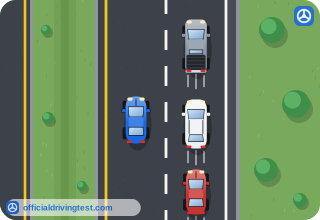
- The other driver may have difficulty seeing you
- The driver ahead may not hear your horn
- Right lanes are always narrower
- Other drivers expect traffic to move slower there
Show answer
Correct answer: The other driver may have difficulty seeing you
If you pass on the right, the other driver may have difficulty seeing you and might suddenly change lanes in front of you.
Source: Missouri Driver Guide (Revised August 2026), page 43 · Open this page in the manual (Manual page 43)
-
Why should you never pass on the shoulder?
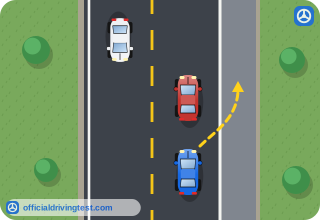
- Shoulders are reserved for emergency vehicles only
- The shoulder is always too narrow for a car
- Other drivers will not expect you there
- Shoulders slow your vehicle down too much
Show answer
Correct answer: Other drivers will not expect you there
Never pass on the shoulder, because other drivers will not expect you to be there and may pull off the road without looking.
Source: Missouri Driver Guide (Revised August 2026), page 43 · Open this page in the manual (Manual page 43)
-
A stop line is painted on the road, but it is located past the stop sign. Where must you stop?
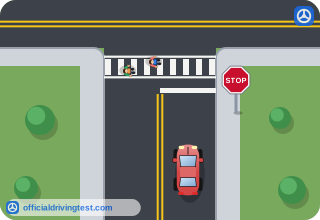
- At the sign, before reaching the stop line
- Halfway between the sign and the stop line
- At the stop line
- Anywhere before the crosswalk
Show answer
Correct answer: At the stop line
You must stop at the stop line if one is present, even if it is located past the stop sign.
Source: Missouri Driver Guide (Revised August 2026), page 49 · Open this page in the manual (Manual page 49)
-
You come to a stop sign with no stop line. What does the manual tell you to do?
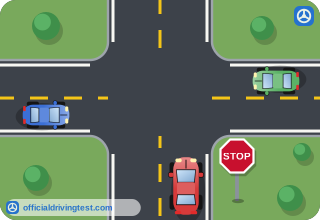
- Slow down and proceed through if no traffic is in sight
- Stop near the intersection edge, look both ways, proceed when safe
- Stop in the middle of the intersection to see both ways
- Stop beyond the intersection, then back up to look both ways
Show answer
Correct answer: Stop near the intersection edge, look both ways, proceed when safe
With no stop line, you pull up and stop near the edge of the intersection, look both ways, and proceed when it is safe.
Source: Missouri Driver Guide (Revised August 2026), page 49 · Open this page in the manual (Manual page 49)
-
At a stop sign you have come to a full stop. What must you wait for before moving?
- Only the crossing vehicles, since pedestrians must yield to you
- A wave from the nearest pedestrian
- Only the vehicle directly ahead of you to move
- Crossing vehicles and pedestrians to clear the intersection
Show answer
Correct answer: Crossing vehicles and pedestrians to clear the intersection
When you see a stop sign you must come to a full stop and wait until crossing vehicles and pedestrians have cleared the intersection.
Source: Missouri Driver Guide (Revised August 2026), page 49 · Open this page in the manual (Manual page 49)
-
What does a yield sign mean?
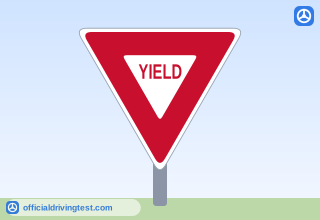
- Come to a full stop every time, then proceed ahead of other traffic
- Speed up and merge ahead of the other traffic in the intersection
- Slow down and yield the right-of-way to traffic in the intersection
- Traffic on the other road must yield the right-of-way to you
Show answer
Correct answer: Slow down and yield the right-of-way to traffic in the intersection
A yield sign means you must slow down and yield the right-of-way to traffic in the intersection you are crossing or the roadway you are entering.
Source: Missouri Driver Guide (Revised August 2026), page 49 · Open this page in the manual (Manual page 49)
-
A vehicle is coming to a stop sign. What should a defensive driver do?
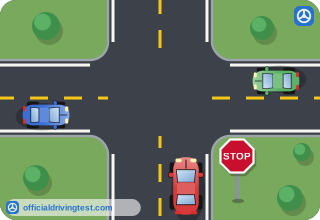
- Assume it will stop and keep your speed
- Be ready to react if it does not stop
- Wave the driver across the intersection
- Speed up to pass before it arrives
Show answer
Correct answer: Be ready to react if it does not stop
A defensive driver does not assume that a vehicle coming to a stop sign is going to stop.
Source: Missouri Driver Guide (Revised August 2026), page 56 · Open this page in the manual (Manual page 56)
-
A pedestrian or another vehicle fails to give you the right-of-way. What does the manual say about causing a crash?
- Never cause a crash on purpose
- You may cause a crash to teach the other driver a lesson
- You may cause a crash if you were not at fault
- You may cause a crash to avoid being late
Show answer
Correct answer: Never cause a crash on purpose
The manual says never to cause a crash on purpose, even if a pedestrian or another vehicle fails to give you the right-of-way.
Source: Missouri Driver Guide (Revised August 2026), page 56 · Open this page in the manual (Manual page 56)
-
At an intersection, other traffic has a red light or a stop sign. What should you still do?
- Rely on the signal and keep your speed
- Look straight ahead only
- Look to the left and right
- Honk to warn the other traffic
Show answer
Correct answer: Look to the left and right
Some drivers may not obey traffic signals or signs, so look left and right at an intersection even if other traffic has a red light or a stop sign.
Source: Missouri Driver Guide (Revised August 2026), page 56 · Open this page in the manual (Manual page 56)