Missouri: Right-of-way, turning and passing — Part 5 Practice Test
Questions in this part include: “For what purpose must you never join a funeral procession?” · “On a road with three or more lanes in your direction, when may you use the center lane instead of the right lane?”
Independent educational site · not affiliated with any government agency or DMV
Ready? Test yourself
- Instant feedback with an explanation
- Every answer cites its source in the manual
- Your best score is saved on this device
Questions are original and based on the official manual "Missouri Driver Guide" (Revised August 2026), Missouri Department of Revenue.
All 17 questions in this practice test
Take the test above first, then use this list to study. Tap “Show answer” to see the correct answer and explanation.
Show the questions and answersHide the questions
-
For what purpose must you never join a funeral procession?
- To pay respects to the family
- To obtain the right-of-way
- To attend the funeral as a mourner
- To follow a relative's car to the service
Show answer
Correct answer: To obtain the right-of-way
The manual says not to join a funeral procession for the purpose of obtaining the right-of-way.
Source: Missouri Driver Guide (Revised August 2026), page 34 · Open this page in the manual (Manual page 34)
-
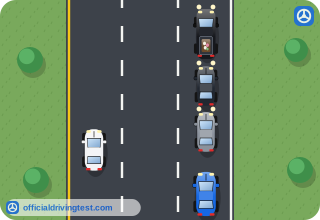
When may a driver not involved in a funeral procession pass a vehicle in the procession?
- Whenever the procession is moving below the speed limit
- Whenever the driver signals first and sees no traffic
- Never, under any circumstances, even where a passing lane exists
- Only where a passing lane is provided
Show answer
Correct answer: Only where a passing lane is provided
The manual says not to pass any vehicle in the procession except where a passing lane has been specifically provided.
Source: Missouri Driver Guide (Revised August 2026), page 34 · Open this page in the manual (Manual page 34)
-
A funeral procession is going through a red signal light at an intersection. When may you enter that intersection?
- Only if you do not cross the procession's path
- Whenever you have a green light for your own direction
- After you sound your horn and slow down
- Whenever no emergency vehicle is present nearby
Show answer
Correct answer: Only if you do not cross the procession's path
The manual says not to enter an intersection in which a procession is going through a red signal unless you can do so without crossing the procession's path.
Source: Missouri Driver Guide (Revised August 2026), page 34 · Open this page in the manual (Manual page 34)
-
If you miss your turn or exit, what should you do?
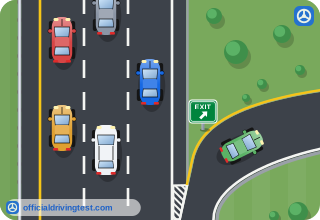
- Go on to where you can safely turn around
- Back up to the turn if no one is behind you
- Stop in the lane and let others pass
- Slow down and back up along the shoulder
Show answer
Correct answer: Go on to where you can safely turn around
Drivers do not expect a vehicle to back toward them, so you should not back up but go on to where you can safely turn around.
Source: Missouri Driver Guide (Revised August 2026), page 43 · Open this page in the manual (Manual page 43)
-
What should you do if you are confused about directions while in a travel lane?
- Stop in the lane and turn on your hazard lights
- Stop in the lane and wait for other drivers to go around
- Back up to the last safe place to stop
- Keep moving until you can safely pull off the road
Show answer
Correct answer: Keep moving until you can safely pull off the road
You should not stop in travel lanes for any reason, such as confusion; keep moving until you can safely pull off the road.
Source: Missouri Driver Guide (Revised August 2026), page 43 · Open this page in the manual (Manual page 43)
-
On a road with three or more lanes traveling in the same direction, which lane should you stay in except to pass?
- The center lane
- The right lane
- The left lane
- Whichever lane is moving fastest
Show answer
Correct answer: The right lane
On a road with three or more lanes in your direction, you should stay in the right lane except to pass.
Source: Missouri Driver Guide (Revised August 2026), page 43 · Open this page in the manual (Manual page 43)
-
On a road with three or more lanes in your direction, when may you use the center lane instead of the right lane?
- When you are driving below the speed limit
- When much traffic is entering the right lane
- When the center lane has no vehicles in it
- When it is raining or the road is wet
Show answer
Correct answer: When much traffic is entering the right lane
If there is a considerable amount of traffic entering the right travel lane, then use the center travel lane.
Source: Missouri Driver Guide (Revised August 2026), page 43 · Open this page in the manual (Manual page 43)
-
On multi-lane roads, which lane is intended to be used to pass slower vehicles?
- The right-most lane
- The center lane only
- The shoulder
- The left-most lane
Show answer
Correct answer: The left-most lane
On multi-lane roads, the left-most lane is intended to be used to pass slower vehicles.
Source: Missouri Driver Guide (Revised August 2026), page 43 · Open this page in the manual (Manual page 43)
-
On multi-lane roads, what may happen if you pass on the right?
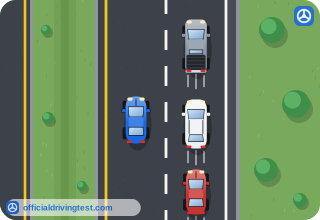
- The other driver may have difficulty seeing you
- The driver ahead may not hear your horn
- Right lanes are always narrower
- Other drivers expect traffic to move slower there
Show answer
Correct answer: The other driver may have difficulty seeing you
If you pass on the right, the other driver may have difficulty seeing you and might suddenly change lanes in front of you.
Source: Missouri Driver Guide (Revised August 2026), page 43 · Open this page in the manual (Manual page 43)
-
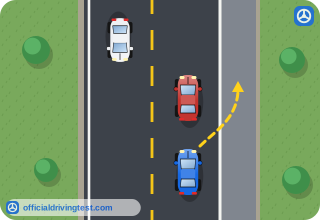
Why should you never pass on the shoulder?
- Shoulders are reserved for emergency vehicles only
- The shoulder is always too narrow for a car
- Other drivers will not expect you there
- Shoulders slow your vehicle down too much
Show answer
Correct answer: Other drivers will not expect you there
Never pass on the shoulder, because other drivers will not expect you to be there and may pull off the road without looking.
Source: Missouri Driver Guide (Revised August 2026), page 43 · Open this page in the manual (Manual page 43)
-
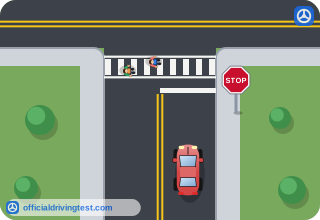
A stop line is painted on the road, but it is located past the stop sign. Where must you stop?
- At the sign, before reaching the stop line
- Halfway between the sign and the stop line
- At the stop line
- Anywhere before the crosswalk
Show answer
Correct answer: At the stop line
You must stop at the stop line if one is present, even if it is located past the stop sign.
Source: Missouri Driver Guide (Revised August 2026), page 49 · Open this page in the manual (Manual page 49)
-
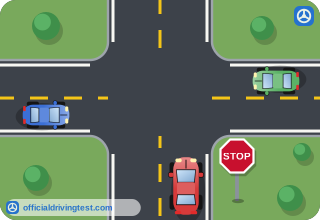
You come to a stop sign with no stop line. What does the manual tell you to do?
- Slow down and proceed through if no traffic is in sight
- Stop near the intersection edge, look both ways, proceed when safe
- Stop in the middle of the intersection to see both ways
- Stop beyond the intersection, then back up to look both ways
Show answer
Correct answer: Stop near the intersection edge, look both ways, proceed when safe
With no stop line, you pull up and stop near the edge of the intersection, look both ways, and proceed when it is safe.
Source: Missouri Driver Guide (Revised August 2026), page 49 · Open this page in the manual (Manual page 49)
-
At a stop sign you have come to a full stop. What must you wait for before moving?
- Only the crossing vehicles, since pedestrians must yield to you
- A wave from the nearest pedestrian
- Only the vehicle directly ahead of you to move
- Crossing vehicles and pedestrians to clear the intersection
Show answer
Correct answer: Crossing vehicles and pedestrians to clear the intersection
When you see a stop sign you must come to a full stop and wait until crossing vehicles and pedestrians have cleared the intersection.
Source: Missouri Driver Guide (Revised August 2026), page 49 · Open this page in the manual (Manual page 49)
-
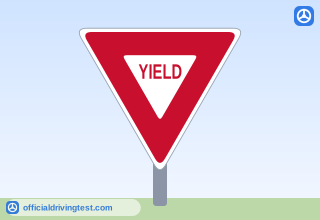
What does a yield sign mean?
- Come to a full stop every time, then proceed ahead of other traffic
- Speed up and merge ahead of the other traffic in the intersection
- Slow down and yield the right-of-way to traffic in the intersection
- Traffic on the other road must yield the right-of-way to you
Show answer
Correct answer: Slow down and yield the right-of-way to traffic in the intersection
A yield sign means you must slow down and yield the right-of-way to traffic in the intersection you are crossing or the roadway you are entering.
Source: Missouri Driver Guide (Revised August 2026), page 49 · Open this page in the manual (Manual page 49)
-
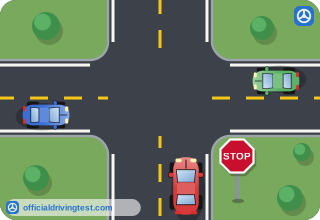
A vehicle is coming to a stop sign. What should a defensive driver do?
- Assume it will stop and keep your speed
- Be ready to react if it does not stop
- Wave the driver across the intersection
- Speed up to pass before it arrives
Show answer
Correct answer: Be ready to react if it does not stop
A defensive driver does not assume that a vehicle coming to a stop sign is going to stop.
Source: Missouri Driver Guide (Revised August 2026), page 56 · Open this page in the manual (Manual page 56)
-
A pedestrian or another vehicle fails to give you the right-of-way. What does the manual say about causing a crash?
- Never cause a crash on purpose
- You may cause a crash to teach the other driver a lesson
- You may cause a crash if you were not at fault
- You may cause a crash to avoid being late
Show answer
Correct answer: Never cause a crash on purpose
The manual says never to cause a crash on purpose, even if a pedestrian or another vehicle fails to give you the right-of-way.
Source: Missouri Driver Guide (Revised August 2026), page 56 · Open this page in the manual (Manual page 56)
-
At an intersection, other traffic has a red light or a stop sign. What should you still do?
- Rely on the signal and keep your speed
- Look straight ahead only
- Look to the left and right
- Honk to warn the other traffic
Show answer
Correct answer: Look to the left and right
Some drivers may not obey traffic signals or signs, so look left and right at an intersection even if other traffic has a red light or a stop sign.
Source: Missouri Driver Guide (Revised August 2026), page 56 · Open this page in the manual (Manual page 56)