Missouri: Right-of-way, turning and passing — Part 1 Practice Test
Questions in this part include: “Which driving error can cost you your license when it causes injury or death?” · “What does the law say about the right-of-way?”
Independent educational site · not affiliated with any government agency or DMV
Ready? Test yourself
- Instant feedback with an explanation
- Every answer cites its source in the manual
- Your best score is saved on this device
Questions are original and based on the official manual "Missouri Driver Guide" (Revised August 2026), Missouri Department of Revenue.
All 18 questions in this practice test
Take the test above first, then use this list to study. Tap “Show answer” to see the correct answer and explanation.
Show the questions and answersHide the questions
-
Which driving error can cost you your license when it causes injury or death?
- Failing to yield the right-of-way
- Stopping for a pedestrian at a crosswalk
- Using a turn signal before changing lanes
- Driving slower than other traffic in the right lane
Show answer
Correct answer: Failing to yield the right-of-way
Failing to yield the right-of-way and causing injury or death is a listed reason for losing your license.
Source: Missouri Driver Guide (Revised August 2026), page 15 · Open this page in the manual (Manual page 15)
-
How many turns will you be asked to make during the driving test?
- At least two right and two left turns
- At least one right and one left turn
- At least three right and three left turns
- At least four left turns only
Show answer
Correct answer: At least two right and two left turns
The test includes at least two right and two left turns.
Source: Missouri Driver Guide (Revised August 2026), page 20 · Open this page in the manual (Manual page 20)
-
Which of these are you tested for when making turns?
- Sounding the horn before each turn you make
- Shifting to neutral before each turn you make
- Giving the proper turn signal at the proper time
- Turning on the hazard lights before each turn
Show answer
Correct answer: Giving the proper turn signal at the proper time
On turns you are tested for giving the proper turn signal at the proper time.
Source: Missouri Driver Guide (Revised August 2026), page 20 · Open this page in the manual (Manual page 20)
-
At stop signs, what are you tested for in the driving test?
- Slowing to a rolling stop
- Stopping just past the crosswalk
- Sounding the horn before entering
- Making a full stop at the proper place
Show answer
Correct answer: Making a full stop at the proper place
At stop signs you are tested for making a full stop at the proper place.
Source: Missouri Driver Guide (Revised August 2026), page 20 · Open this page in the manual (Manual page 20)
-
At intersections, what are you tested for regarding the right-of-way?
- Yielding the right-of-way without blocking traffic
- Waving other drivers through ahead of you
- Waiting for the examiner's signal to go
- Taking the right-of-way from slower drivers
Show answer
Correct answer: Yielding the right-of-way without blocking traffic
At intersections you are tested for yielding the right-of-way without blocking traffic.
Source: Missouri Driver Guide (Revised August 2026), page 20 · Open this page in the manual (Manual page 20)
-
According to the manual, what is your highest duty as a motorist?
- To drive your vehicle carefully and prudently
- To reach your destination as quickly as you can
- To take the right-of-way whenever you have it
- To keep pace with the traffic around you
Show answer
Correct answer: To drive your vehicle carefully and prudently
The manual says a motorist's highest duty is to drive carefully and prudently, in a manner that is safe for pedestrians, cyclists, and other motorists.
Source: Missouri Driver Guide (Revised August 2026), page 22 · Open this page in the manual (Manual page 22)
-
What does the law say about the right-of-way?
- It gives the right-of-way to the driver who is going fastest
- It gives the right-of-way to the driver of the larger vehicle
- It says who must yield; it does not give any driver the right-of-way
- It gives the right-of-way to whichever driver reaches the road first
Show answer
Correct answer: It says who must yield; it does not give any driver the right-of-way
The law says who must yield the right-of-way; it does not give any driver the right-of-way.
Source: Missouri Driver Guide (Revised August 2026), page 22 · Open this page in the manual (Manual page 22)
-
What must you do regardless of the circumstances?
- Insist on your right-of-way when the law says you have it
- Do everything you can to avoid striking a pedestrian or vehicle
- Keep moving at the posted speed limit to keep traffic flowing
- Yield only to vehicles that are larger than yours
Show answer
Correct answer: Do everything you can to avoid striking a pedestrian or vehicle
You must do everything you can to prevent striking a pedestrian or another vehicle, regardless of the circumstances.
Source: Missouri Driver Guide (Revised August 2026), page 22 · Open this page in the manual (Manual page 22)
-
When do the right-of-way rules tell drivers who must yield?
- Only where a police officer is directing traffic
- Only at intersections that have a working traffic signal
- Only on roads with more than two lanes
- Where there are no signs or signals to regulate traffic
Show answer
Correct answer: Where there are no signs or signals to regulate traffic
Where vehicles or pedestrians are likely to meet and no signs or signals regulate traffic, the right-of-way rules say who goes first and who must wait.
Source: Missouri Driver Guide (Revised August 2026), page 22 · Open this page in the manual (Manual page 22)
-
A driver turning left must yield to which vehicles?
- Oncoming vehicles going straight
- Vehicles parked at the curb
- Vehicles waiting at a side street
- Vehicles in the lane to the left
Show answer
Correct answer: Oncoming vehicles going straight
The manual says drivers turning left must yield to oncoming vehicles going straight.
Source: Missouri Driver Guide (Revised August 2026), page 23 · Open this page in the manual (Manual page 23)
-
At a four-way stop, who may proceed before the other drivers?
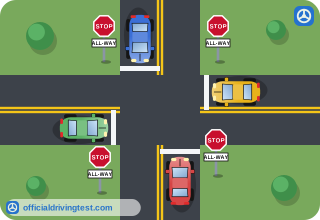
- The driver in the fastest-moving vehicle
- The driver who is signaling a right turn
- The driver who reaches the intersection first
- The driver of the largest vehicle there
Show answer
Correct answer: The driver who reaches the intersection first
At a four-way stop, the driver reaching the intersection first may proceed before the other drivers, after coming to a complete stop.
Source: Missouri Driver Guide (Revised August 2026), page 23 · Open this page in the manual (Manual page 23)
-
What must drivers entering a road from a driveway, alley, or roadside do?
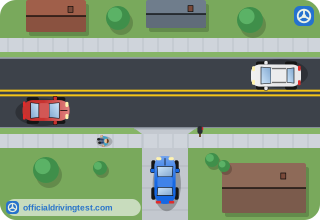
- Enter quickly before traffic on the main road arrives
- Yield to vehicles already on the main road
- Sound the horn and then enter the road
- Stop only if pedestrians are on the sidewalk
Show answer
Correct answer: Yield to vehicles already on the main road
Drivers entering a road from a driveway, alley, or roadside must yield to vehicles already on the main road.
Source: Missouri Driver Guide (Revised August 2026), page 23 · Open this page in the manual (Manual page 23)
-
At an intersection with no stop sign or traffic signal (other than a roundabout), whom must drivers yield to?
- Vehicles coming from the left
- Vehicles that are slowing down
- The larger vehicle
- Vehicles coming from the right
Show answer
Correct answer: Vehicles coming from the right
At an intersection with no stop sign or traffic signal, except roundabouts, drivers must yield to vehicles coming from the right.
Source: Missouri Driver Guide (Revised August 2026), page 23 · Open this page in the manual (Manual page 23)
-
When approaching a roundabout, whom must you always yield to?
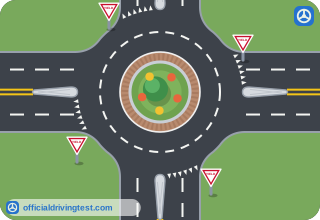
- Traffic in the circle and pedestrians in the crosswalks
- Vehicles that are about to enter from the other entrances
- Large trucks only, because they need more room
- Only vehicles that are exiting the roundabout
Show answer
Correct answer: Traffic in the circle and pedestrians in the crosswalks
When approaching a roundabout intersection, always yield to traffic in the circle and pedestrians in the crosswalks, and wait for a gap in traffic.
Source: Missouri Driver Guide (Revised August 2026), page 23 · Open this page in the manual (Manual page 23)
-
If there are no signs or lane markings to control turning, which lane should you turn from?
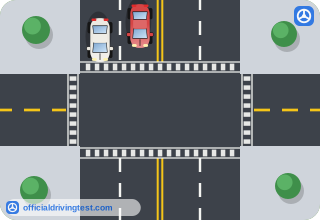
- The lane closest to the direction you want to go
- The lane that has the least traffic at the time
- The lane closest to the center of the road
- The lane farthest from the direction you want to go
Show answer
Correct answer: The lane closest to the direction you want to go
You should turn from the lane that is closest to the direction you want to go, so you cross the fewest lanes of traffic.
Source: Missouri Driver Guide (Revised August 2026), page 24 · Open this page in the manual (Manual page 24)
-
If there are no signs or lane markings to control turning, which lane should you turn into?
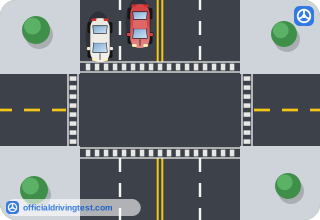
- The lane farthest from the one you came from
- The lane with the fewest vehicles in it
- The lane closest to the one you came from
- The lane closest to the oncoming traffic
Show answer
Correct answer: The lane closest to the one you came from
You should turn into the lane closest to the one you came from, which means you will cross the fewest lanes of traffic.
Source: Missouri Driver Guide (Revised August 2026), page 24 · Open this page in the manual (Manual page 24)
-
When making a turn, how should you go from one lane to the other?
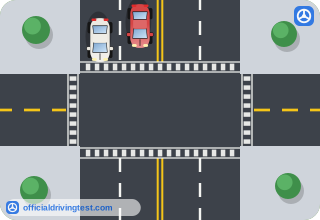
- Quickly, even if you must cross lane lines to finish the turn
- Smoothly, without crossing lane lines or interfering with traffic
- Gradually, by crossing lane lines before you start the turn
- Slowly, stopping in the intersection if traffic is heavy
Show answer
Correct answer: Smoothly, without crossing lane lines or interfering with traffic
When making turns, go from one lane to the other as smoothly as possible without crossing lane lines or interfering with traffic.
Source: Missouri Driver Guide (Revised August 2026), page 24 · Open this page in the manual (Manual page 24)
-
Once you have completed your turn, what may you do?
- Make a U-turn if the street is clear
- Stop in the lane until traffic clears
- Turn on your hazard lights
- Change to another lane if you need to
Show answer
Correct answer: Change to another lane if you need to
Once you have completed your turn, you can change to another lane if you need to.
Source: Missouri Driver Guide (Revised August 2026), page 24 · Open this page in the manual (Manual page 24)