Missouri: Right-of-way, turning and passing — Part 4 Practice Test
Questions in this part include: “What should you use to let others know you are exiting a roundabout?” · “What must you obey when local governments make traffic ordinances in addition to state laws?”
Independent educational site · not affiliated with any government agency or DMV
Ready? Test yourself
- Instant feedback with an explanation
- Every answer cites its source in the manual
- Your best score is saved on this device
Questions are original and based on the official manual "Missouri Driver Guide" (Revised August 2026), Missouri Department of Revenue.
All 17 questions in this practice test
Take the test above first, then use this list to study. Tap “Show answer” to see the correct answer and explanation.
Show the questions and answersHide the questions
-
What should you do if you miss your exit from a roundabout?
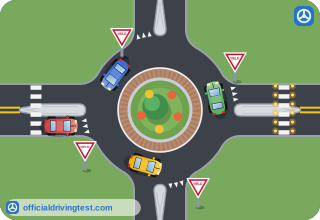
- Keep going until you reach the right exit
- Stop and reverse to the exit you missed
- Cut across the center island to the exit
- Pull over and wait until traffic clears
Show answer
Correct answer: Keep going until you reach the right exit
If you miss your exit, continue through the roundabout until you reach your appropriate exit.
Source: Missouri Driver Guide (Revised August 2026), page 27 · Open this page in the manual (Manual page 27)
-
When exiting a roundabout, what should you watch for?
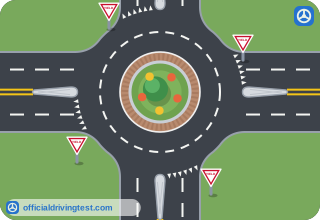
- Pedestrians and bicyclists crossing the street
- Large trucks that are about to enter the circle
- Stop signs and signals placed at each exit
- Vehicles stopped at the center island ahead
Show answer
Correct answer: Pedestrians and bicyclists crossing the street
When exiting, watch for pedestrians and bicyclists crossing the street.
Source: Missouri Driver Guide (Revised August 2026), page 27 · Open this page in the manual (Manual page 27)
-
Why should you maintain a slow speed when exiting a roundabout?
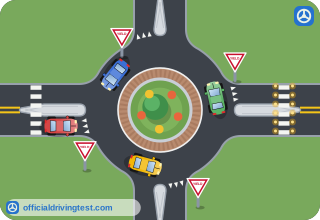
- To leave room for vehicles still entering the circle
- To give large trucks time to use the apron
- To avoid losing control or striking traffic islands
- To avoid being passed by vehicles in the circle
Show answer
Correct answer: To avoid losing control or striking traffic islands
You maintain a slow speed when exiting to avoid losing control or striking traffic islands.
Source: Missouri Driver Guide (Revised August 2026), page 27 · Open this page in the manual (Manual page 27)
-
What should you use to let others know you are exiting a roundabout?
- Your left turn signal
- Your right turn signal
- Your hazard lights
- Your high beams
Show answer
Correct answer: Your right turn signal
Use your right turn signal to let others know you are exiting.
Source: Missouri Driver Guide (Revised August 2026), page 27 · Open this page in the manual (Manual page 27)
-
When exiting a roundabout, when may you accelerate?
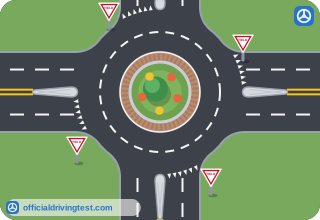
- As soon as you have passed the last vehicle in the circle
- As soon as you can see the road beyond the exit
- As soon as your front wheels are past the center island
- Once you are beyond the pedestrian crossing at the exit
Show answer
Correct answer: Once you are beyond the pedestrian crossing at the exit
The manual says not to accelerate until you are beyond the pedestrian crossing at the exit.
Source: Missouri Driver Guide (Revised August 2026), page 27 · Open this page in the manual (Manual page 27)
-
What is a truck apron at a roundabout?
- A paved lane at the entrance for vehicles waiting to merge
- A painted crossing where pedestrians cross at the exit
- The paved area inside it for the rear wheels of large trucks
- A raised area in the center that no vehicle may enter
Show answer
Correct answer: The paved area inside it for the rear wheels of large trucks
A truck apron, also known as off-tracking, is the paved area on the inside of the roundabout for the rear wheels of large trucks to use when turning.
Source: Missouri Driver Guide (Revised August 2026), page 27 · Open this page in the manual (Manual page 27)
-
Which vehicles are not to use a roundabout truck apron?
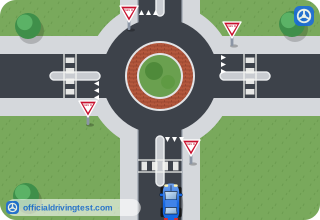
- Cars, SUVs, and pickup trucks
- Trucks making a turn
- Tractor-trailers with a single trailer
- Trucks that carry freight only
Show answer
Correct answer: Cars, SUVs, and pickup trucks
Truck aprons are not to be used by cars, SUVs or pickup trucks.
Source: Missouri Driver Guide (Revised August 2026), page 27 · Open this page in the manual (Manual page 27)
-
At a J-turn intersection, how do drivers get to the opposing lanes?
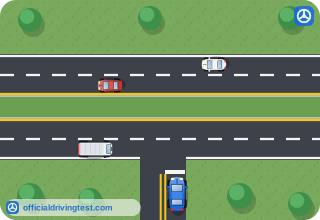
- Turn right, merge into the far left lane, then turn left
- Cross the fast-moving lanes and turn left directly
- Turn left at once and merge into the far right lane
- Stop in the median and wait for a gap to turn left
Show answer
Correct answer: Turn right, merge into the far left lane, then turn left
At a J-turn intersection, drivers turn right in the same direction of traffic, merge into the far left lane, and then make a left turn in the direction they intend to travel.
Source: Missouri Driver Guide (Revised August 2026), page 27 · Open this page in the manual (Manual page 27)
-
The J-turn is an alternative to traditional roadway intersections on what kind of road?
- A two-lane road
- A one-way street
- A four-lane highway
- A residential street
Show answer
Correct answer: A four-lane highway
The J-turn is an alternative to traditional roadway intersections on a four-lane highway.
Source: Missouri Driver Guide (Revised August 2026), page 27 · Open this page in the manual (Manual page 27)
-
What must you obey when local governments make traffic ordinances in addition to state laws?
- Only the regulations set by the state
- Any traffic sign or regulation, whether local or state
- Only local rules, because they replace state laws
- Only the signs that are posted on state highways
Show answer
Correct answer: Any traffic sign or regulation, whether local or state
You must obey any traffic sign or regulation whether set by a municipality, county, or the state.
Source: Missouri Driver Guide (Revised August 2026), page 27 · Open this page in the manual (Manual page 27)
-
Which of these may cities and towns regulate by local ordinance?
- Setting the age at which a driver may get a license
- Setting the points for a traffic offense
- Setting the minimum insurance a driver must carry
- Prohibiting commercial vehicles from using certain streets
Show answer
Correct answer: Prohibiting commercial vehicles from using certain streets
Cities and towns may have regulations that prohibit commercial vehicles from using certain streets.
Source: Missouri Driver Guide (Revised August 2026), page 27 · Open this page in the manual (Manual page 27)
-
You are facing a green light. What must you do about pedestrians in the intersection?
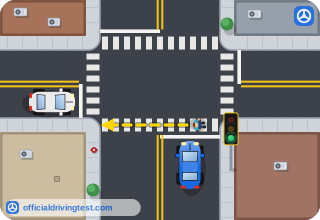
- Yield the right-of-way to all of them
- Proceed, because the green light gives you the right-of-way
- Sound your horn so they hurry
- Yield only if they are in a marked crosswalk
Show answer
Correct answer: Yield the right-of-way to all of them
The manual says that even with a green light you must yield the right-of-way to all pedestrians in the intersection.
Source: Missouri Driver Guide (Revised August 2026), page 30 · Open this page in the manual (Manual page 30)
-
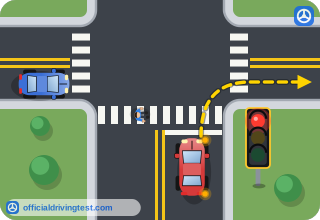
As you prepare for a right turn, especially on a red traffic signal, whom should you be cautious of?
- Only vehicles approaching from your left side
- Pedestrians or bicyclists approaching on your right
- Only oncoming traffic in the opposite lane
- Only pedestrians standing in front of you
Show answer
Correct answer: Pedestrians or bicyclists approaching on your right
The manual says to be cautious of pedestrians or bicyclists approaching on your right when preparing for a right turn.
Source: Missouri Driver Guide (Revised August 2026), page 31 · Open this page in the manual (Manual page 31)
-
If you are driving in a funeral procession, how closely should you follow the vehicle in front of you?
- At least six car lengths back
- As closely as is practical and safe
- At the following distance you use in normal traffic
- Far enough back to let other traffic merge between vehicles
Show answer
Correct answer: As closely as is practical and safe
The manual says to follow the vehicle in front as closely as is practical and safe.
Source: Missouri Driver Guide (Revised August 2026), page 33 · Open this page in the manual (Manual page 33)
-
What must every vehicle in a funeral procession use?
- Its low beam headlights only
- Its horn at each intersection
- Its high beams
- Its flashing emergency lights
Show answer
Correct answer: Its flashing emergency lights
The manual says every vehicle in the procession must use its flashing emergency lights.
Source: Missouri Driver Guide (Revised August 2026), page 33 · Open this page in the manual (Manual page 33)
-
At intersections, who has the right-of-way regardless of any traffic control device, except for emergency vehicles or when directed otherwise by law enforcement officials?
- An organized funeral procession
- A delivery truck with its hazard lights on
- A vehicle turning left
- Any vehicle with its headlights on
Show answer
Correct answer: An organized funeral procession
The manual says an organized funeral procession has the right-of-way at all intersections regardless of any traffic control device, with those exceptions.
Source: Missouri Driver Guide (Revised August 2026), page 33 · Open this page in the manual (Manual page 33)
-
What should a driver not involved in a funeral procession avoid doing while the procession's vehicles are in motion?
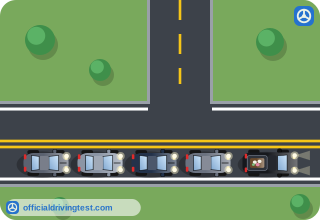
- Driving beside the procession in another lane
- Following the procession at a safe distance
- Driving between the vehicles in the procession
- Slowing down for the procession
Show answer
Correct answer: Driving between the vehicles in the procession
The manual says not to drive between the vehicles that are part of the procession when they are in motion.
Source: Missouri Driver Guide (Revised August 2026), page 34 · Open this page in the manual (Manual page 34)