Missouri: Emergencies
Skids, brake failure, blowouts, flooded roads, crashes with deer, what to do after a crash and moving your vehicle off the road. Split into 4 shorter tests so you're not stuck in one long quiz.
Independent educational site · not affiliated with any government agency or DMV
Choose a part
Emergencies — Part 1
Questions in this part include: “When should you not try to change a tire?”
StartEmergencies — Part 2
Questions in this part include: “After a deer-vehicle crash, why should you obtain a police report if one is required?”
StartEmergencies — Part 3
Questions in this part include: “When your wheels run off the paved edge of the road, what may they do?”
StartEmergencies — Part 4
Questions in this part include: “How does the manual define a traffic crash?”
StartAll 67 Emergencies questions with answers
Choose a part above to take a practice test, or study every question and answer here.
Show the questions and answersHide the questions
-
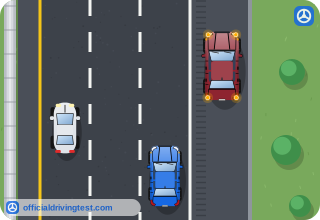
If your vehicle breaks down on a highway, what should you make sure of?
- That your engine keeps running to power the flashers
- That your headlights are turned off to save the battery
- That your hood is closed and the doors are unlocked
- That other drivers can see you and your vehicle
Show answer
Correct answer: That other drivers can see you and your vehicle
If your vehicle breaks down on a highway, you make sure other drivers can see you and your vehicle.
Source: Missouri Driver Guide (Revised August 2026), page 40 · Open this page in the manual (Manual page 40)
-
If possible, how should you notify authorities that your vehicle has broken down?
- Wave down the first vehicle that passes and ask for help
- Use a two-way radio, telephone, or cellular phone
- Walk along the road until you reach the next exit
- Sound your horn repeatedly until someone stops
Show answer
Correct answer: Use a two-way radio, telephone, or cellular phone
If possible, you use a two-way radio, telephone, or cellular phone to notify authorities.
Source: Missouri Driver Guide (Revised August 2026), page 41 · Open this page in the manual (Manual page 41)
-
If you are having vehicle trouble and have to stop, what should you do if at all possible?
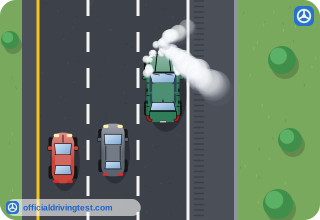
- Get your vehicle off the road and away from traffic
- Stop in the center of your lane to block traffic
- Leave your vehicle in the lane so drivers can see it
- Stop on the left shoulder of the road
Show answer
Correct answer: Get your vehicle off the road and away from traffic
If at all possible, you get your vehicle off the road and away from traffic.
Source: Missouri Driver Guide (Revised August 2026), page 41 · Open this page in the manual (Manual page 41)
-
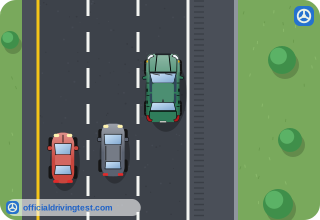
What should you turn on to show you are having vehicle trouble?
- Your high beams
- Your windshield wipers
- Your emergency flashers
- Your brake lights only
Show answer
Correct answer: Your emergency flashers
You turn on your emergency flashers to show you are having trouble.
Source: Missouri Driver Guide (Revised August 2026), page 41 · Open this page in the manual (Manual page 41)
-
If you cannot get your vehicle off the roadway, where should you try to stop?
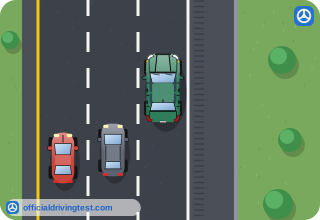
- Just over the top of a hill, where traffic must slow
- Where other drivers have a clear view of your vehicle
- Just around a curve, where traffic slows down
- Under a bridge where it is shaded
Show answer
Correct answer: Where other drivers have a clear view of your vehicle
You try to stop where other drivers have a clear view of your vehicle, not just over a hill or around a curve.
Source: Missouri Driver Guide (Revised August 2026), page 41 · Open this page in the manual (Manual page 41)
-
Where do you place emergency flares to warn other drivers that your vehicle is there?
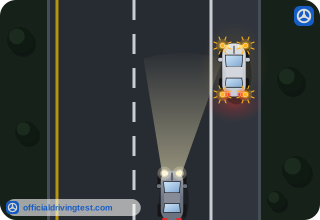
- In front of the vehicle
- Beside the driver’s door
- On the roof of the vehicle
- Behind the vehicle
Show answer
Correct answer: Behind the vehicle
You place emergency flares behind the vehicle, which alerts other drivers to change lanes if necessary.
Source: Missouri Driver Guide (Revised August 2026), page 41 · Open this page in the manual (Manual page 41)
-
When should you not try to change a tire?
- If the flat tire is on the left side of the vehicle
- If it is dark outside or the weather is bad
- If it means you have to be in a traffic lane
- If the shoulder of the road is covered with gravel
Show answer
Correct answer: If it means you have to be in a traffic lane
You do not try to change a tire if it means you have to be in a traffic lane.
Source: Missouri Driver Guide (Revised August 2026), page 41 · Open this page in the manual (Manual page 41)
-
What can you do to signal an emergency?
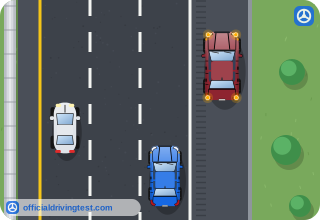
- Lift the hood or tie a white cloth to the antenna
- Open all the doors and the trunk of your vehicle
- Place a reflective sign on the roof of the vehicle
- Turn off all of the lights to avoid confusion
Show answer
Correct answer: Lift the hood or tie a white cloth to the antenna
You can lift the hood or tie a white cloth to the antenna, side mirror, or door handle to signal an emergency.
Source: Missouri Driver Guide (Revised August 2026), page 41 · Open this page in the manual (Manual page 41)
-
How should you act in areas marked with deer crossing signs?
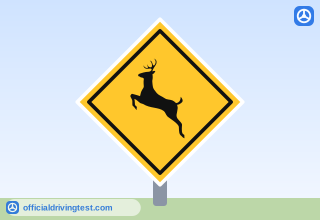
- Use your horn continuously
- Be especially alert and use caution
- Drive in the center of the road
- Turn off your headlights
Show answer
Correct answer: Be especially alert and use caution
The manual advises being especially alert and using caution when traveling through areas marked with deer crossing signs.
Source: Missouri Driver Guide (Revised August 2026), page 59 · Open this page in the manual (Manual page 59)
-
You see one deer cross the road. What should you expect?
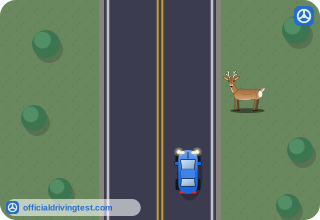
- There are probably others nearby
- It is probably the only deer in the area
- Other deer will probably wait for several hours
- Other deer will not cross for the rest of the day
Show answer
Correct answer: There are probably others nearby
Deer seldom travel alone, so if you see one crossing the road there are likely others nearby.
Source: Missouri Driver Guide (Revised August 2026), page 59 · Open this page in the manual (Manual page 59)
-
In which areas should you be especially cautious because deer tend to congregate there?
- Around busy highway interchanges
- Around large parking lots
- Around fields, streams, and gardens
- Around railroad crossings
Show answer
Correct answer: Around fields, streams, and gardens
Be especially cautious in areas around fields, streams, and gardens where deer tend to congregate.
Source: Missouri Driver Guide (Revised August 2026), page 59 · Open this page in the manual (Manual page 59)
-
In which months do most deer-related crashes occur?
- February through April, and in August
- January, May, and October through December
- June, July, August, and September only
- March, April, June, July, and August
Show answer
Correct answer: January, May, and October through December
Most deer-related crashes occur in January, May, and October through December.
Source: Missouri Driver Guide (Revised August 2026), page 59 · Open this page in the manual (Manual page 59)
-
When are the highest-risk periods for deer-vehicle crashes?
- From late morning until the early afternoon hours
- From mid-afternoon until about an hour before sunset
- During the hours around noon and mid-afternoon only
- Sunset to midnight and shortly before and after sunrise
Show answer
Correct answer: Sunset to midnight and shortly before and after sunrise
The highest-risk periods are from sunset to midnight and the hours shortly before and after sunrise.
Source: Missouri Driver Guide (Revised August 2026), page 59 · Open this page in the manual (Manual page 59)
-
After dark, when should you use high beams to help avoid a deer-vehicle crash?
- Only when driving through a town
- Only when it is raining
- When there is no opposing traffic
- When following another vehicle closely
Show answer
Correct answer: When there is no opposing traffic
High beams illuminate the eyes of deer on or near a roadway and give you greater reaction time, but use them only when there is no opposing traffic.
Source: Missouri Driver Guide (Revised August 2026), page 59 · Open this page in the manual (Manual page 59)
-
You see that a crash with a deer is unavoidable. What should you do?
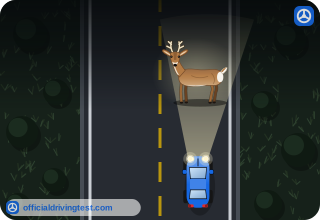
- Swerve into the oncoming lane
- Swerve off the road
- Accelerate to pass the deer
- Do not swerve
Show answer
Correct answer: Do not swerve
Swerving off the road or into the path of an oncoming car can increase the risk of injury.
Source: Missouri Driver Guide (Revised August 2026), page 60 · Open this page in the manual (Manual page 60)
-
What should you check before slowing suddenly for a deer?
- That your high beams are on
- That there is no traffic behind you
- That your seat is moved back
- That your hazard flashers are off
Show answer
Correct answer: That there is no traffic behind you
Make sure there is no traffic behind you before slowing suddenly. Too much brake pressure can cause the front end of the vehicle to drop down.
Source: Missouri Driver Guide (Revised August 2026), page 60 · Open this page in the manual (Manual page 60)
-
After a deer-vehicle crash, whom does the manual say to contact to report where the crash occurred?
- A local Missouri Department of Conservation agent
- A local Department of Revenue license office
- A local driver education instructor
- The local tire shop
Show answer
Correct answer: A local Missouri Department of Conservation agent
Reporting to a Missouri Department of Conservation agent where the crash occurred can help to identify frequent deer crossing areas.
Source: Missouri Driver Guide (Revised August 2026), page 60 · Open this page in the manual (Manual page 60)
-
After a deer-vehicle crash, why should you obtain a police report if one is required?
- To renew your driver license and registration early
- To get your vehicle registered again after the crash
- To file a claim for coverage with your insurance company
- To apply for a hunting permit from the Conservation agent
Show answer
Correct answer: To file a claim for coverage with your insurance company
A police report (if required) is needed to file a claim for coverage with your insurance company.
Source: Missouri Driver Guide (Revised August 2026), page 60 · Open this page in the manual (Manual page 60)
-
If you think your tires are hydroplaning, what should you do?
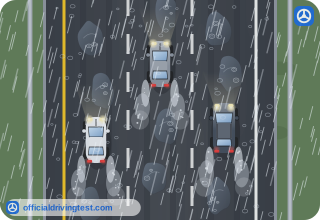
- Hit the brakes firmly to regain traction
- Take your foot off the accelerator and slow down
- Steer sharply toward the shoulder
- Speed up to get through the water
Show answer
Correct answer: Take your foot off the accelerator and slow down
The manual says to take your foot off the accelerator and slow down, and not to hit the brakes, which may cause a skid.
Source: Missouri Driver Guide (Revised August 2026), page 63 · Open this page in the manual (Manual page 63)
-
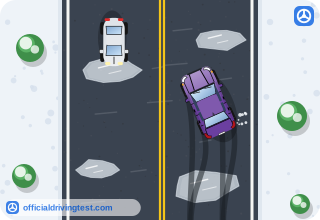
If your vehicle starts to skid, what should you do with the pedals?
- Press the accelerator harder to pull out of the skid
- Take your foot off the accelerator and do not hit the brakes
- Brake as hard as you can to stop the skid
- Pump the brake pedal quickly until the skid stops
Show answer
Correct answer: Take your foot off the accelerator and do not hit the brakes
The manual says to take your foot off the accelerator but not to hit the brakes in a skid.
Source: Missouri Driver Guide (Revised August 2026), page 64 · Open this page in the manual (Manual page 64)
-
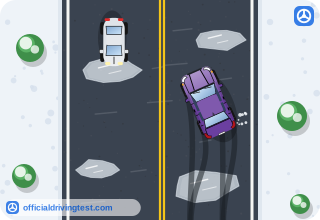
In a skid, which way should you gently turn the steering wheel?
- Opposite to the direction your rear wheels are sliding
- Toward the nearest shoulder
- Straight ahead and hold it still
- In the direction your rear wheels are sliding
Show answer
Correct answer: In the direction your rear wheels are sliding
The manual says to gently turn the steering wheel in the direction that your rear wheels are sliding.
Source: Missouri Driver Guide (Revised August 2026), page 64 · Open this page in the manual (Manual page 64)
-
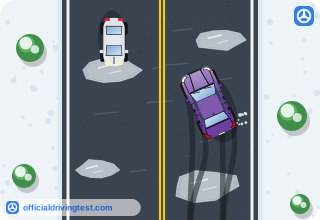
What will only make a skid worse?
- Hitting the brakes or jerking the steering wheel
- Taking your foot off the accelerator
- Turning the wheel gently in the direction of the slide
- Letting the vehicle straighten itself
Show answer
Correct answer: Hitting the brakes or jerking the steering wheel
The manual says hitting the brakes or jerking the steering wheel will only make the skid worse.
Source: Missouri Driver Guide (Revised August 2026), page 64 · Open this page in the manual (Manual page 64)
-
How does handling a skid differ between front-wheel and rear-wheel drive vehicles?
- Front-wheel drive: brake first, then steer
- Rear-wheel drive: steer opposite to the slide
- It is the same for both types
- Only front-wheel drive vehicles can be steered out
Show answer
Correct answer: It is the same for both types
The manual says handling a skid is the same for front-wheel and rear-wheel drive vehicles.
Source: Missouri Driver Guide (Revised August 2026), page 64 · Open this page in the manual (Manual page 64)
-
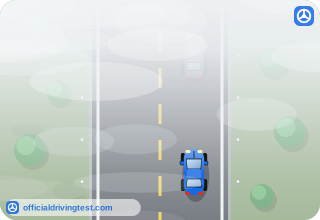
If fog becomes so thick that you cannot see, what should you do?
- Slow to a crawl and follow the taillights of the vehicle ahead
- Stop in your lane and turn off your lights to avoid being hit
- Keep driving with your high beams on to see farther
- Pull off the road and stop, leaving your lights and emergency flashers on
Show answer
Correct answer: Pull off the road and stop, leaving your lights and emergency flashers on
The manual says to pull off the road and stop, leaving your lights and emergency flashers on.
Source: Missouri Driver Guide (Revised August 2026), page 64 · Open this page in the manual (Manual page 64)
-
What does the manual call the most important rule in any emergency?
- Stop the vehicle at once
- Call for help right away
- Do not panic
- Honk your horn
Show answer
Correct answer: Do not panic
The manual says the most important rule in any emergency is do not panic, because staying calm helps you remember what to do.
Source: Missouri Driver Guide (Revised August 2026), page 64 · Open this page in the manual (Manual page 64)
-
If you have power steering or a locking steering wheel, when may you turn off the ignition key in an emergency?
- As soon as the emergency begins
- Only after you have come to a full stop
- Once you have slowed below 20 mph
- When you shift into a low gear
Show answer
Correct answer: Only after you have come to a full stop
The manual says never to turn off the ignition key until you have come to a full stop if you have power steering or a locking steering wheel.
Source: Missouri Driver Guide (Revised August 2026), page 64 · Open this page in the manual (Manual page 64)
-
If your brake pedal suddenly sinks to the floor, what should you do first?
- Turn off the ignition and coast to a stop
- Shift into park and release the pedal
- Pull the parking brake as hard as you can
- Pump the brake pedal fast and hard several times
Show answer
Correct answer: Pump the brake pedal fast and hard several times
The manual says to pump the brake pedal fast and hard several times when the brake pedal sinks to the floor.
Source: Missouri Driver Guide (Revised August 2026), page 64 · Open this page in the manual (Manual page 64)
-
If pumping does not restore your brakes, how should you use the emergency or parking brake?
- Gradually
- All at once
- In short, hard pulls
- Only after you have stopped
Show answer
Correct answer: Gradually
The manual says to use the emergency or parking brake, but to use it gradually.
Source: Missouri Driver Guide (Revised August 2026), page 64 · Open this page in the manual (Manual page 64)
-
In a brake failure, which gear should you shift to while looking for a place to stop?
- Neutral
- Park
- A low gear
- Reverse
Show answer
Correct answer: A low gear
The manual says to shift to a low gear and look for a place to slow to a stop after brake failure.
Source: Missouri Driver Guide (Revised August 2026), page 64 · Open this page in the manual (Manual page 64)
-
After your vehicle has stopped following a brake failure, what should you do?
- Drive slowly to the nearest garage for repair
- Call for help instead of driving to a garage
- Restart the engine and test the brakes
- Pump the brakes again and drive on
Show answer
Correct answer: Call for help instead of driving to a garage
The manual says to call for help after the vehicle has stopped and not to try to drive to a garage.
Source: Missouri Driver Guide (Revised August 2026), page 64 · Open this page in the manual (Manual page 64)
-
What might you hear if you have a tire blowout?
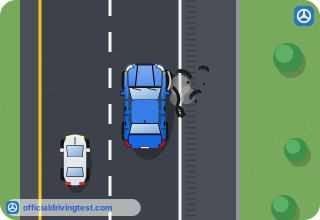
- A steady hissing sound that slowly fades
- A series of loud clicks
- A long grinding noise
- A loud “bang” then “thump, thump, thump”
Show answer
Correct answer: A loud “bang” then “thump, thump, thump”
The manual says a tire blowout may sound like a loud “bang” then “thump, thump, thump.”
Source: Missouri Driver Guide (Revised August 2026), page 65 · Open this page in the manual (Manual page 65)
-
If you have a tire blowout, what should you do with the pedals?
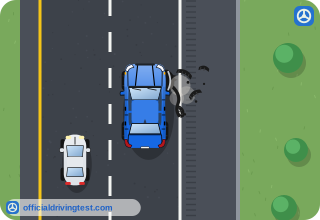
- Take your foot off the accelerator and do not hit the brakes
- Brake hard right away and steer toward the shoulder
- Loosen your grip on the wheel and coast in your lane
- Press the accelerator to regain control of the steering
Show answer
Correct answer: Take your foot off the accelerator and do not hit the brakes
The manual says to take your foot off the accelerator but not to hit the brakes after a tire blowout.
Source: Missouri Driver Guide (Revised August 2026), page 65 · Open this page in the manual (Manual page 65)
-
How should you hold the steering wheel after a tire blowout?
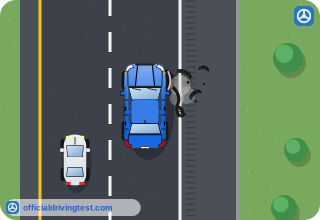
- Loosely
- With one hand only
- Tightly
- Gently, letting it turn on its own
Show answer
Correct answer: Tightly
The manual says to hold the steering wheel tightly after a tire blowout.
Source: Missouri Driver Guide (Revised August 2026), page 65 · Open this page in the manual (Manual page 65)
-
After a tire blowout, where should you let your vehicle slow to a stop?
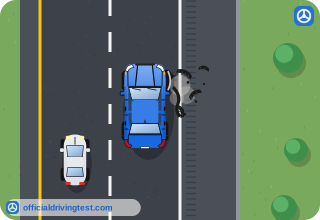
- In the nearest lane
- Completely off the road
- On the center line
- On the edge of your lane
Show answer
Correct answer: Completely off the road
The manual says to let your vehicle slow to a stop completely off the road.
Source: Missouri Driver Guide (Revised August 2026), page 65 · Open this page in the manual (Manual page 65)
-
When should you apply the brakes after a tire blowout?
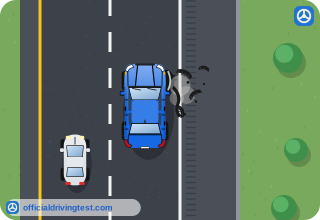
- Immediately
- Before taking your foot off the accelerator
- Only after changing the tire
- When the vehicle is almost stopped
Show answer
Correct answer: When the vehicle is almost stopped
The manual says to apply the brakes when the vehicle is almost stopped after a tire blowout.
Source: Missouri Driver Guide (Revised August 2026), page 65 · Open this page in the manual (Manual page 65)
-
After a tire blowout, when should you change the tire?
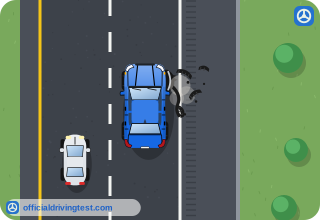
- Only if you can do so without placing yourself in danger
- Right away, wherever the vehicle stopped
- Only after dark when traffic is lighter
- Only after you have driven to a place with better lighting
Show answer
Correct answer: Only if you can do so without placing yourself in danger
The manual says to change the tire only if you can do so without placing yourself in danger.
Source: Missouri Driver Guide (Revised August 2026), page 65 · Open this page in the manual (Manual page 65)
-
When your wheels run off the paved edge of the road, what may they do?
- Pull to the left
- Cause the engine to stall
- Pull to the right
- Make the brakes lock automatically
Show answer
Correct answer: Pull to the right
The manual says that if your wheels run off the paved edge of the road, the wheels may pull to the right.
Source: Missouri Driver Guide (Revised August 2026), page 65 · Open this page in the manual (Manual page 65)
-
After your wheels run off the pavement, how much braking should you use?
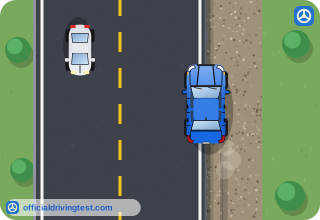
- Hard braking to stop quickly
- Only gentle brake pressure, if necessary
- Firm braking at the start of the slide
- Pumping the brakes quickly and often
Show answer
Correct answer: Only gentle brake pressure, if necessary
The manual says not to hit the brakes after running off the pavement and to apply only gentle brake pressure, if necessary.
Source: Missouri Driver Guide (Revised August 2026), page 65 · Open this page in the manual (Manual page 65)
-
When may you turn back onto the pavement after your wheels run off the road?
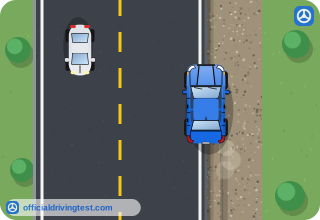
- Right away, with a sharp turn of the steering wheel
- Only after stopping completely and turning on flashers
- Only after braking hard to stop on the shoulder
- Once you have slowed, have control, and the lane is clear
Show answer
Correct answer: Once you have slowed, have control, and the lane is clear
The manual says to turn back onto the pavement when the vehicle has slowed and you have control, if the lane is free of traffic.
Source: Missouri Driver Guide (Revised August 2026), page 65 · Open this page in the manual (Manual page 65)
-
If your vehicle does not turn when you turn the wheel, what should you do first?
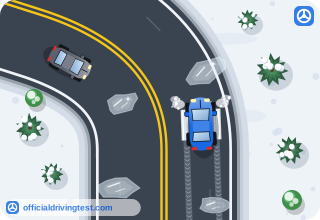
- Take your foot off the accelerator
- Shift into reverse
- Pull the parking brake all the way up
- Turn off the ignition
Show answer
Correct answer: Take your foot off the accelerator
The manual says to take your foot off the accelerator if your vehicle does not turn when you turn the wheel.
Source: Missouri Driver Guide (Revised August 2026), page 65 · Open this page in the manual (Manual page 65)
-
If your steering fails, when may you hit the brakes?
- Only after you have turned on your emergency flashers
- Only after you have shifted into a low gear
- Only when the vehicle has almost stopped, or if you have to
- Immediately, to stop as fast as possible
Show answer
Correct answer: Only when the vehicle has almost stopped, or if you have to
The manual says to let the vehicle slow down by itself and not hit the brakes until it has almost stopped, or unless you have to.
Source: Missouri Driver Guide (Revised August 2026), page 65 · Open this page in the manual (Manual page 65)
-
If your vehicle’s headlights go out, what should you try first?
- The windshield wiper switch
- The dimmer switch or headlight switch
- The parking brake lever and pedal
- The cruise control switch panel
Show answer
Correct answer: The dimmer switch or headlight switch
The manual says to try the dimmer switch or headlight switch, which might turn the headlights on again.
Source: Missouri Driver Guide (Revised August 2026), page 65 · Open this page in the manual (Manual page 65)
-
If your headlights go out and the switches do not help, what should you do?
- Turn the dome light on and continue to your destination
- Turn off all lights and stop in the lane
- Flash your horn until traffic clears
- Put the parking lights, emergency flashers, or turn signals on
Show answer
Correct answer: Put the parking lights, emergency flashers, or turn signals on
The manual says to put the parking lights, emergency flashers, or turn signals on if the switches do not work.
Source: Missouri Driver Guide (Revised August 2026), page 65 · Open this page in the manual (Manual page 65)
-
After you pull off the road because your headlights failed, what should you do with the emergency flashers?
- Leave them on
- Turn them off to save the battery
- Turn them on only at night
- Turn them off once you are stopped
Show answer
Correct answer: Leave them on
The manual says to pull off the road but leave the emergency flashers on after a headlight failure.
Source: Missouri Driver Guide (Revised August 2026), page 65 · Open this page in the manual (Manual page 65)
-
If your accelerator becomes stuck, what should you shift to?
- Park
- Reverse
- Neutral
- A low gear
Show answer
Correct answer: Neutral
The manual says to shift to neutral and apply the brakes if your accelerator becomes stuck.
Source: Missouri Driver Guide (Revised August 2026), page 65 · Open this page in the manual (Manual page 65)
-
If your accelerator is stuck, how should you warn other drivers?
- By flashing your high beams and braking hard
- By honking and flashing your emergency lights
- By tapping the brakes and turning on your turn signal
- By turning on your hazard lights only
Show answer
Correct answer: By honking and flashing your emergency lights
The manual says to warn other drivers by honking and flashing your emergency lights when your accelerator is stuck.
Source: Missouri Driver Guide (Revised August 2026), page 65 · Open this page in the manual (Manual page 65)
-
If your accelerator is stuck, when should you turn off the ignition?
- As soon as you notice that the accelerator is stuck
- As soon as you have shifted into neutral
- Never, because it locks the steering wheel
- When you no longer need to change direction and have stopped
Show answer
Correct answer: When you no longer need to change direction and have stopped
The manual says to turn off the ignition when you no longer need to change direction and have stopped.
Source: Missouri Driver Guide (Revised August 2026), page 65 · Open this page in the manual (Manual page 65)
-
What does turning off the key do in many vehicles?
- It locks the steering wheel
- It locks the brakes
- It releases the stuck pedal
- It shifts the transmission to neutral
Show answer
Correct answer: It locks the steering wheel
The manual notes that turning off the key locks the steering wheel of many vehicles.
Source: Missouri Driver Guide (Revised August 2026), page 65 · Open this page in the manual (Manual page 65)
-
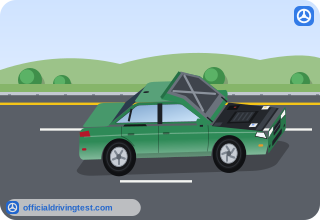
If your hood suddenly flies open and blocks your view, how can you see?
- Keep going and use your mirrors until the hood drops
- Stop in your lane and try to close the hood at once
- Roll down the window and look around whatever blocks your view
- Turn on the windshield wipers and keep driving at speed
Show answer
Correct answer: Roll down the window and look around whatever blocks your view
The manual says to roll down the window so you can look around whatever is blocking your view.
Source: Missouri Driver Guide (Revised August 2026), page 65 · Open this page in the manual (Manual page 65)
-
If your hood suddenly flies open and blocks your view, what should you do with your vehicle?
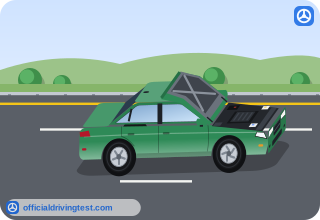
- Keep your vehicle in the lane and honk until the view clears
- Turn on your emergency flashers and pull your vehicle off the road
- Turn off all lights and stop where you are
- Speed up to get out of the traffic quickly
Show answer
Correct answer: Turn on your emergency flashers and pull your vehicle off the road
The manual says to roll down the window so you can look around what blocks your view, turn on your emergency flashers, and pull your vehicle off the road.
Source: Missouri Driver Guide (Revised August 2026), page 65 · Open this page in the manual (Manual page 65)
-
If a vehicle is approaching head-on in your lane, what should you do?
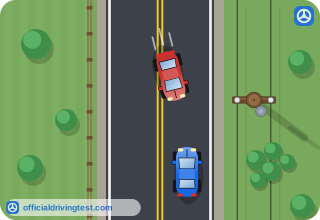
- Slow down, swing into the left lane, and sound your horn
- Speed up to pass the vehicle before it reaches you
- Stop in your lane and flash your high beams only
- Slow down, pull over to the right, and sound your horn
Show answer
Correct answer: Slow down, pull over to the right, and sound your horn
The manual says to slow down, pull over to the right and sound your horn.
Source: Missouri Driver Guide (Revised August 2026), page 65 · Open this page in the manual (Manual page 65)
-
According to the manual, what may the other driver do if you swing into the left lane to avoid a vehicle approaching head-on?
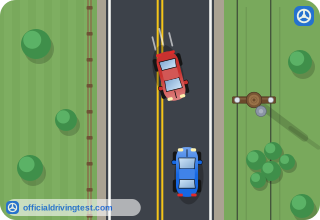
- Pull back over into that lane, too
- Lose sight of your headlights
- Stop in the middle of the road
- Speed up to pass you on the right
Show answer
Correct answer: Pull back over into that lane, too
The manual says not to swing into the left lane because the other driver may pull back over into that lane, too.
Source: Missouri Driver Guide (Revised August 2026), page 65 · Open this page in the manual (Manual page 65)
-
How does the manual define a traffic crash?
- Only when two moving vehicles hit each other and someone is hurt
- Only when a vehicle is damaged enough that it needs a tow truck
- Injuring yourself or someone else, or damaging property, while driving
- Only when a law enforcement officer is called to the scene
Show answer
Correct answer: Injuring yourself or someone else, or damaging property, while driving
A traffic crash is when you injure yourself or someone else, or cause property damage, while driving your vehicle.
Source: Missouri Driver Guide (Revised August 2026), page 81 · Open this page in the manual (Manual page 81)
-
You have a crash with a parked vehicle. What should you do?
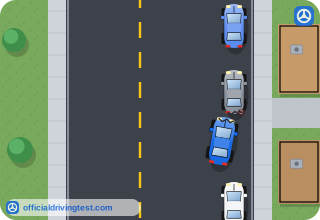
- Leave a note on the vehicle and drive away if no one is hurt
- Do not leave, because leaving the scene of a crash is a crime
- Leave the scene if the damage seems minor and no one is nearby
- Drive away if the owner of the parked vehicle cannot be found
Show answer
Correct answer: Do not leave, because leaving the scene of a crash is a crime
Even a crash with a parked vehicle must not be left, because leaving the scene of a traffic crash is a crime.
Source: Missouri Driver Guide (Revised August 2026), page 81 · Open this page in the manual (Manual page 81)
-
If you are in a crash, what should you do first with your vehicle?
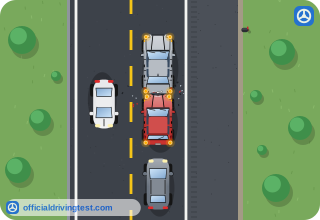
- Leave it in the lane where it stopped until the police arrive
- Turn off the engine and stay in the traffic lane
- Back it up to the point where the crash began
- Move it off the road if possible to avoid other crashes
Show answer
Correct answer: Move it off the road if possible to avoid other crashes
The manual says to stop and move your vehicle off the road if possible, especially if it may cause other crashes.
Source: Missouri Driver Guide (Revised August 2026), page 81 · Open this page in the manual (Manual page 81)
-
What does the manual say to do for a person who is hurt in a crash?
- Make the person comfortable, do not move him or her, and call an ambulance
- Move the person to the shoulder before calling anyone for help
- Help the person stand up and walk off the road to the shoulder
- Wait until a law enforcement officer arrives before helping at all
Show answer
Correct answer: Make the person comfortable, do not move him or her, and call an ambulance
You should help anyone who is hurt, try to make the injured person comfortable without moving him or her, and call an ambulance.
Source: Missouri Driver Guide (Revised August 2026), page 81 · Open this page in the manual (Manual page 81)
-
When should you use flares, reflectors, or flashlights to warn other traffic after a crash?
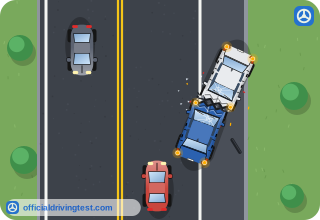
- Only if the crash blocks a freeway lane
- Only if a vehicle is on fire or leaking fuel
- If the crash has happened at night or in bad weather
- Every time a crash occurs, even in daylight
Show answer
Correct answer: If the crash has happened at night or in bad weather
Flares, reflectors, or flashlights should be used to warn other traffic if the crash happened at night or in bad weather.
Source: Missouri Driver Guide (Revised August 2026), page 81 · Open this page in the manual (Manual page 81)
-
After a crash, which of these must you exchange with everyone involved?
- Your Social Security number and place of birth
- The name of your insurance company and policy number
- The name of your employer and your job title
- Your date of birth and your height and weight
Show answer
Correct answer: The name of your insurance company and policy number
You exchange your name, address, driver license number, VIN and license plate number, and the name of your insurance company and policy number.
Source: Missouri Driver Guide (Revised August 2026), page 81 · Open this page in the manual (Manual page 81)
-
After a crash, how long should you stay at the scene?
- Until the other driver says you may leave
- Until your insurance company has been called
- Until the vehicles have been moved to the shoulder
- Until a law enforcement officer says you may leave
Show answer
Correct answer: Until a law enforcement officer says you may leave
You should stay until a law enforcement officer says you may leave the crash scene.
Source: Missouri Driver Guide (Revised August 2026), page 81 · Open this page in the manual (Manual page 81)
-
When should you contact your insurance company after a crash?
- As soon as possible, even if the crash was not your fault
- Only if the crash was your fault
- Only if someone was injured in the crash
- Only after the Department asks for proof of insurance
Show answer
Correct answer: As soon as possible, even if the crash was not your fault
You should contact your insurance company as soon as possible, even if the crash was not your fault.
Source: Missouri Driver Guide (Revised August 2026), page 81 · Open this page in the manual (Manual page 81)
-
Under the “steer it and clear it” message, what should you do after a minor traffic crash with no injuries?
- Stay in the lane so the scene of the crash is not disturbed
- Turn on your hazard lights and wait in the lane where you stopped
- Move your vehicle to the shoulder or a nearby place off the road
- Call the police and leave the vehicles exactly where they stopped
Show answer
Correct answer: Move your vehicle to the shoulder or a nearby place off the road
After a minor crash with no injuries you should move your vehicle onto the shoulder or another nearby location off the roadway.
Source: Missouri Driver Guide (Revised August 2026), page 81 · Open this page in the manual (Manual page 81)
-
What is the state law that requires vehicles in minor, non-injury crashes to move off the road known as?
- The “Quick Clear” law
- The “Move It” law
- The “Shoulder Safety” law
- The “Hazard Lights” law
Show answer
Correct answer: The “Move It” law
The law requiring vehicles in minor, non-injury crashes to move off the road is known as the “Move It” law.
Source: Missouri Driver Guide (Revised August 2026), page 81 · Open this page in the manual (Manual page 81)
-
When operating wholly within the state, Missouri law does not require emergency equipment for commercial vehicles licensed for how much weight or less?
- 10,000 pounds
- 15,000 pounds
- 20,000 pounds
- 12,000 pounds
Show answer
Correct answer: 12,000 pounds
Missouri law does not require emergency equipment for commercial vehicles licensed for 12,000 pounds or less when operating wholly within the state.
Source: Missouri Driver Guide (Revised August 2026), page 89 · Open this page in the manual (Manual page 89)
-
What must the fire extinguisher on a commercial motor vehicle licensed for more than 12,000 pounds be rated at?
- 5 B:C or more
- 2 A:B or more
- 5 A:C or more
- 10 A:B or more
Show answer
Correct answer: 5 B:C or more
The extinguisher must be rated at 5 B:C or more by Underwriter’s Laboratories Incorporated.
Source: Missouri Driver Guide (Revised August 2026), page 89 · Open this page in the manual (Manual page 89)
-
A commercial motor vehicle licensed for more than 12,000 pounds must carry which spare item if its overload protective devices are not of a reset type?
- Two spare headlight bulbs and one spare turn signal bulb for each kind used
- One spare battery of the type used to start the engine of the vehicle
- One spare fuse or other overload protective device for each kind and size used
- One spare fuse box mounted in the cab beside the driver’s seat for repairs
Show answer
Correct answer: One spare fuse or other overload protective device for each kind and size used
The vehicle must carry one spare fuse or other overload protective device for each kind and size used, if the devices are not of a reset type.
Source: Missouri Driver Guide (Revised August 2026), page 89 · Open this page in the manual (Manual page 89)
-
A commercial vehicle licensed for more than 12,000 pounds must carry one of which combinations of warning devices?
- Two liquid-burning pot torches and four red reflective cones
- Four red electric lanterns and one red flag with two fuses
- Three bi-directional emergency red reflective triangles
- Three fuses and two red electric lanterns with one flare
Show answer
Correct answer: Three bi-directional emergency red reflective triangles
One of the allowed warning-device options is three bi-directional emergency red reflective triangles.
Source: Missouri Driver Guide (Revised August 2026), page 89 · Open this page in the manual (Manual page 89)
-
The combination of three flares, three fuses and two red flags must not be carried by vehicles doing what?
- Transporting explosive or flammable material
- Carrying passengers for hire on a regular route
- Hauling solid waste for a local business
- Traveling on an interstate highway at night
Show answer
Correct answer: Transporting explosive or flammable material
The flares, fuses and red flags combination must not be carried by vehicles transporting explosive or flammable material or using flammable compressed gas as a motor fuel.
Source: Missouri Driver Guide (Revised August 2026), page 89 · Open this page in the manual (Manual page 89)