Missouri: Emergencies — Part 4 Practice Test
Questions in this part include: “How does the manual define a traffic crash?” · “Under the “steer it and clear it” message, what should you do after a minor traffic crash with no injuries?”
Independent educational site · not affiliated with any government agency or DMV
Ready? Test yourself
- Instant feedback with an explanation
- Every answer cites its source in the manual
- Your best score is saved on this device
Questions are original and based on the official manual "Missouri Driver Guide" (Revised August 2026), Missouri Department of Revenue.
All 16 questions in this practice test
Take the test above first, then use this list to study. Tap “Show answer” to see the correct answer and explanation.
Show the questions and answersHide the questions
-
According to the manual, what may the other driver do if you swing into the left lane to avoid a vehicle approaching head-on?
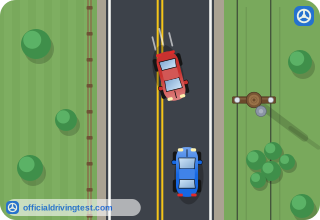
- Pull back over into that lane, too
- Lose sight of your headlights
- Stop in the middle of the road
- Speed up to pass you on the right
Show answer
Correct answer: Pull back over into that lane, too
The manual says not to swing into the left lane because the other driver may pull back over into that lane, too.
Source: Missouri Driver Guide (Revised August 2026), page 65 · Open this page in the manual (Manual page 65)
-
How does the manual define a traffic crash?
- Only when two moving vehicles hit each other and someone is hurt
- Only when a vehicle is damaged enough that it needs a tow truck
- Injuring yourself or someone else, or damaging property, while driving
- Only when a law enforcement officer is called to the scene
Show answer
Correct answer: Injuring yourself or someone else, or damaging property, while driving
A traffic crash is when you injure yourself or someone else, or cause property damage, while driving your vehicle.
Source: Missouri Driver Guide (Revised August 2026), page 81 · Open this page in the manual (Manual page 81)
-
You have a crash with a parked vehicle. What should you do?
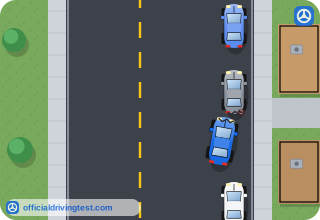
- Leave a note on the vehicle and drive away if no one is hurt
- Do not leave, because leaving the scene of a crash is a crime
- Leave the scene if the damage seems minor and no one is nearby
- Drive away if the owner of the parked vehicle cannot be found
Show answer
Correct answer: Do not leave, because leaving the scene of a crash is a crime
Even a crash with a parked vehicle must not be left, because leaving the scene of a traffic crash is a crime.
Source: Missouri Driver Guide (Revised August 2026), page 81 · Open this page in the manual (Manual page 81)
-
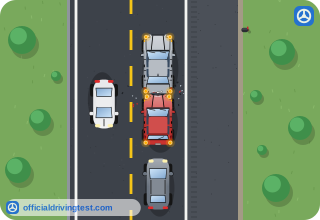
If you are in a crash, what should you do first with your vehicle?
- Leave it in the lane where it stopped until the police arrive
- Turn off the engine and stay in the traffic lane
- Back it up to the point where the crash began
- Move it off the road if possible to avoid other crashes
Show answer
Correct answer: Move it off the road if possible to avoid other crashes
The manual says to stop and move your vehicle off the road if possible, especially if it may cause other crashes.
Source: Missouri Driver Guide (Revised August 2026), page 81 · Open this page in the manual (Manual page 81)
-
What does the manual say to do for a person who is hurt in a crash?
- Make the person comfortable, do not move him or her, and call an ambulance
- Move the person to the shoulder before calling anyone for help
- Help the person stand up and walk off the road to the shoulder
- Wait until a law enforcement officer arrives before helping at all
Show answer
Correct answer: Make the person comfortable, do not move him or her, and call an ambulance
You should help anyone who is hurt, try to make the injured person comfortable without moving him or her, and call an ambulance.
Source: Missouri Driver Guide (Revised August 2026), page 81 · Open this page in the manual (Manual page 81)
-
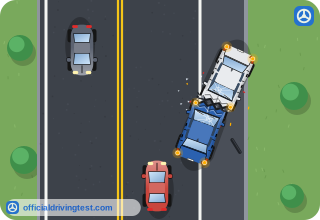
When should you use flares, reflectors, or flashlights to warn other traffic after a crash?
- Only if the crash blocks a freeway lane
- Only if a vehicle is on fire or leaking fuel
- If the crash has happened at night or in bad weather
- Every time a crash occurs, even in daylight
Show answer
Correct answer: If the crash has happened at night or in bad weather
Flares, reflectors, or flashlights should be used to warn other traffic if the crash happened at night or in bad weather.
Source: Missouri Driver Guide (Revised August 2026), page 81 · Open this page in the manual (Manual page 81)
-
After a crash, which of these must you exchange with everyone involved?
- Your Social Security number and place of birth
- The name of your insurance company and policy number
- The name of your employer and your job title
- Your date of birth and your height and weight
Show answer
Correct answer: The name of your insurance company and policy number
You exchange your name, address, driver license number, VIN and license plate number, and the name of your insurance company and policy number.
Source: Missouri Driver Guide (Revised August 2026), page 81 · Open this page in the manual (Manual page 81)
-
After a crash, how long should you stay at the scene?
- Until the other driver says you may leave
- Until your insurance company has been called
- Until the vehicles have been moved to the shoulder
- Until a law enforcement officer says you may leave
Show answer
Correct answer: Until a law enforcement officer says you may leave
You should stay until a law enforcement officer says you may leave the crash scene.
Source: Missouri Driver Guide (Revised August 2026), page 81 · Open this page in the manual (Manual page 81)
-
When should you contact your insurance company after a crash?
- As soon as possible, even if the crash was not your fault
- Only if the crash was your fault
- Only if someone was injured in the crash
- Only after the Department asks for proof of insurance
Show answer
Correct answer: As soon as possible, even if the crash was not your fault
You should contact your insurance company as soon as possible, even if the crash was not your fault.
Source: Missouri Driver Guide (Revised August 2026), page 81 · Open this page in the manual (Manual page 81)
-
Under the “steer it and clear it” message, what should you do after a minor traffic crash with no injuries?
- Stay in the lane so the scene of the crash is not disturbed
- Turn on your hazard lights and wait in the lane where you stopped
- Move your vehicle to the shoulder or a nearby place off the road
- Call the police and leave the vehicles exactly where they stopped
Show answer
Correct answer: Move your vehicle to the shoulder or a nearby place off the road
After a minor crash with no injuries you should move your vehicle onto the shoulder or another nearby location off the roadway.
Source: Missouri Driver Guide (Revised August 2026), page 81 · Open this page in the manual (Manual page 81)
-
What is the state law that requires vehicles in minor, non-injury crashes to move off the road known as?
- The “Quick Clear” law
- The “Move It” law
- The “Shoulder Safety” law
- The “Hazard Lights” law
Show answer
Correct answer: The “Move It” law
The law requiring vehicles in minor, non-injury crashes to move off the road is known as the “Move It” law.
Source: Missouri Driver Guide (Revised August 2026), page 81 · Open this page in the manual (Manual page 81)
-
When operating wholly within the state, Missouri law does not require emergency equipment for commercial vehicles licensed for how much weight or less?
- 10,000 pounds
- 15,000 pounds
- 20,000 pounds
- 12,000 pounds
Show answer
Correct answer: 12,000 pounds
Missouri law does not require emergency equipment for commercial vehicles licensed for 12,000 pounds or less when operating wholly within the state.
Source: Missouri Driver Guide (Revised August 2026), page 89 · Open this page in the manual (Manual page 89)
-
What must the fire extinguisher on a commercial motor vehicle licensed for more than 12,000 pounds be rated at?
- 5 B:C or more
- 2 A:B or more
- 5 A:C or more
- 10 A:B or more
Show answer
Correct answer: 5 B:C or more
The extinguisher must be rated at 5 B:C or more by Underwriter’s Laboratories Incorporated.
Source: Missouri Driver Guide (Revised August 2026), page 89 · Open this page in the manual (Manual page 89)
-
A commercial motor vehicle licensed for more than 12,000 pounds must carry which spare item if its overload protective devices are not of a reset type?
- Two spare headlight bulbs and one spare turn signal bulb for each kind used
- One spare battery of the type used to start the engine of the vehicle
- One spare fuse or other overload protective device for each kind and size used
- One spare fuse box mounted in the cab beside the driver’s seat for repairs
Show answer
Correct answer: One spare fuse or other overload protective device for each kind and size used
The vehicle must carry one spare fuse or other overload protective device for each kind and size used, if the devices are not of a reset type.
Source: Missouri Driver Guide (Revised August 2026), page 89 · Open this page in the manual (Manual page 89)
-
A commercial vehicle licensed for more than 12,000 pounds must carry one of which combinations of warning devices?
- Two liquid-burning pot torches and four red reflective cones
- Four red electric lanterns and one red flag with two fuses
- Three bi-directional emergency red reflective triangles
- Three fuses and two red electric lanterns with one flare
Show answer
Correct answer: Three bi-directional emergency red reflective triangles
One of the allowed warning-device options is three bi-directional emergency red reflective triangles.
Source: Missouri Driver Guide (Revised August 2026), page 89 · Open this page in the manual (Manual page 89)
-
The combination of three flares, three fuses and two red flags must not be carried by vehicles doing what?
- Transporting explosive or flammable material
- Carrying passengers for hire on a regular route
- Hauling solid waste for a local business
- Traveling on an interstate highway at night
Show answer
Correct answer: Transporting explosive or flammable material
The flares, fuses and red flags combination must not be carried by vehicles transporting explosive or flammable material or using flammable compressed gas as a motor fuel.
Source: Missouri Driver Guide (Revised August 2026), page 89 · Open this page in the manual (Manual page 89)