Missouri: Emergencies — Part 2 Practice Test
Questions in this part include: “After a deer-vehicle crash, why should you obtain a police report if one is required?” · “What does the manual call the most important rule in any emergency?”
Independent educational site · not affiliated with any government agency or DMV
Ready? Test yourself
- Instant feedback with an explanation
- Every answer cites its source in the manual
- Your best score is saved on this device
Questions are original and based on the official manual "Missouri Driver Guide" (Revised August 2026), Missouri Department of Revenue.
All 17 questions in this practice test
Take the test above first, then use this list to study. Tap “Show answer” to see the correct answer and explanation.
Show the questions and answersHide the questions
-
After a deer-vehicle crash, why should you obtain a police report if one is required?
- To renew your driver license and registration early
- To get your vehicle registered again after the crash
- To file a claim for coverage with your insurance company
- To apply for a hunting permit from the Conservation agent
Show answer
Correct answer: To file a claim for coverage with your insurance company
A police report (if required) is needed to file a claim for coverage with your insurance company.
Source: Missouri Driver Guide (Revised August 2026), page 60 · Open this page in the manual (Manual page 60)
-
If you think your tires are hydroplaning, what should you do?
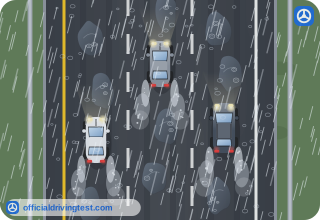
- Hit the brakes firmly to regain traction
- Take your foot off the accelerator and slow down
- Steer sharply toward the shoulder
- Speed up to get through the water
Show answer
Correct answer: Take your foot off the accelerator and slow down
The manual says to take your foot off the accelerator and slow down, and not to hit the brakes, which may cause a skid.
Source: Missouri Driver Guide (Revised August 2026), page 63 · Open this page in the manual (Manual page 63)
-
If your vehicle starts to skid, what should you do with the pedals?
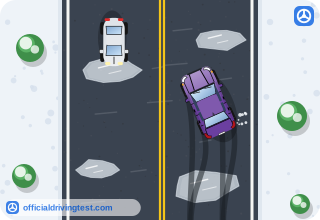
- Press the accelerator harder to pull out of the skid
- Take your foot off the accelerator and do not hit the brakes
- Brake as hard as you can to stop the skid
- Pump the brake pedal quickly until the skid stops
Show answer
Correct answer: Take your foot off the accelerator and do not hit the brakes
The manual says to take your foot off the accelerator but not to hit the brakes in a skid.
Source: Missouri Driver Guide (Revised August 2026), page 64 · Open this page in the manual (Manual page 64)
-
In a skid, which way should you gently turn the steering wheel?
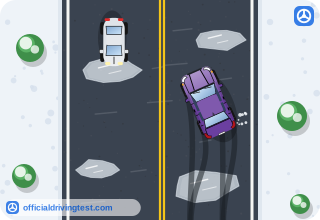
- Opposite to the direction your rear wheels are sliding
- Toward the nearest shoulder
- Straight ahead and hold it still
- In the direction your rear wheels are sliding
Show answer
Correct answer: In the direction your rear wheels are sliding
The manual says to gently turn the steering wheel in the direction that your rear wheels are sliding.
Source: Missouri Driver Guide (Revised August 2026), page 64 · Open this page in the manual (Manual page 64)
-
What will only make a skid worse?
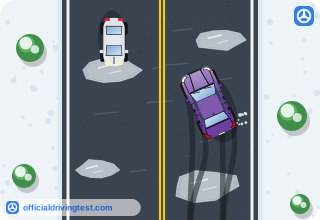
- Hitting the brakes or jerking the steering wheel
- Taking your foot off the accelerator
- Turning the wheel gently in the direction of the slide
- Letting the vehicle straighten itself
Show answer
Correct answer: Hitting the brakes or jerking the steering wheel
The manual says hitting the brakes or jerking the steering wheel will only make the skid worse.
Source: Missouri Driver Guide (Revised August 2026), page 64 · Open this page in the manual (Manual page 64)
-
How does handling a skid differ between front-wheel and rear-wheel drive vehicles?
- Front-wheel drive: brake first, then steer
- Rear-wheel drive: steer opposite to the slide
- It is the same for both types
- Only front-wheel drive vehicles can be steered out
Show answer
Correct answer: It is the same for both types
The manual says handling a skid is the same for front-wheel and rear-wheel drive vehicles.
Source: Missouri Driver Guide (Revised August 2026), page 64 · Open this page in the manual (Manual page 64)
-
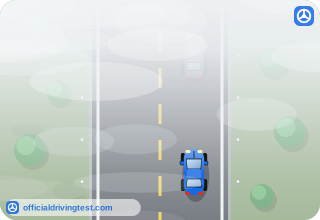
If fog becomes so thick that you cannot see, what should you do?
- Slow to a crawl and follow the taillights of the vehicle ahead
- Stop in your lane and turn off your lights to avoid being hit
- Keep driving with your high beams on to see farther
- Pull off the road and stop, leaving your lights and emergency flashers on
Show answer
Correct answer: Pull off the road and stop, leaving your lights and emergency flashers on
The manual says to pull off the road and stop, leaving your lights and emergency flashers on.
Source: Missouri Driver Guide (Revised August 2026), page 64 · Open this page in the manual (Manual page 64)
-
What does the manual call the most important rule in any emergency?
- Stop the vehicle at once
- Call for help right away
- Do not panic
- Honk your horn
Show answer
Correct answer: Do not panic
The manual says the most important rule in any emergency is do not panic, because staying calm helps you remember what to do.
Source: Missouri Driver Guide (Revised August 2026), page 64 · Open this page in the manual (Manual page 64)
-
If you have power steering or a locking steering wheel, when may you turn off the ignition key in an emergency?
- As soon as the emergency begins
- Only after you have come to a full stop
- Once you have slowed below 20 mph
- When you shift into a low gear
Show answer
Correct answer: Only after you have come to a full stop
The manual says never to turn off the ignition key until you have come to a full stop if you have power steering or a locking steering wheel.
Source: Missouri Driver Guide (Revised August 2026), page 64 · Open this page in the manual (Manual page 64)
-
If your brake pedal suddenly sinks to the floor, what should you do first?
- Turn off the ignition and coast to a stop
- Shift into park and release the pedal
- Pull the parking brake as hard as you can
- Pump the brake pedal fast and hard several times
Show answer
Correct answer: Pump the brake pedal fast and hard several times
The manual says to pump the brake pedal fast and hard several times when the brake pedal sinks to the floor.
Source: Missouri Driver Guide (Revised August 2026), page 64 · Open this page in the manual (Manual page 64)
-
If pumping does not restore your brakes, how should you use the emergency or parking brake?
- Gradually
- All at once
- In short, hard pulls
- Only after you have stopped
Show answer
Correct answer: Gradually
The manual says to use the emergency or parking brake, but to use it gradually.
Source: Missouri Driver Guide (Revised August 2026), page 64 · Open this page in the manual (Manual page 64)
-
In a brake failure, which gear should you shift to while looking for a place to stop?
- Neutral
- Park
- A low gear
- Reverse
Show answer
Correct answer: A low gear
The manual says to shift to a low gear and look for a place to slow to a stop after brake failure.
Source: Missouri Driver Guide (Revised August 2026), page 64 · Open this page in the manual (Manual page 64)
-
After your vehicle has stopped following a brake failure, what should you do?
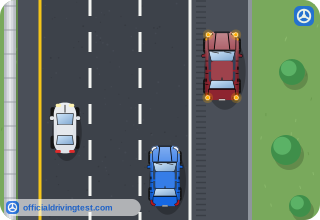
- Drive slowly to the nearest garage for repair
- Call for help instead of driving to a garage
- Restart the engine and test the brakes
- Pump the brakes again and drive on
Show answer
Correct answer: Call for help instead of driving to a garage
The manual says to call for help after the vehicle has stopped and not to try to drive to a garage.
Source: Missouri Driver Guide (Revised August 2026), page 64 · Open this page in the manual (Manual page 64)
-
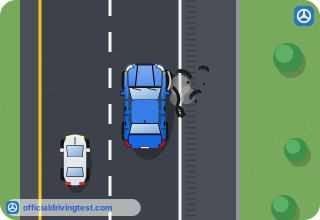
What might you hear if you have a tire blowout?
- A steady hissing sound that slowly fades
- A series of loud clicks
- A long grinding noise
- A loud “bang” then “thump, thump, thump”
Show answer
Correct answer: A loud “bang” then “thump, thump, thump”
The manual says a tire blowout may sound like a loud “bang” then “thump, thump, thump.”
Source: Missouri Driver Guide (Revised August 2026), page 65 · Open this page in the manual (Manual page 65)
-
If you have a tire blowout, what should you do with the pedals?
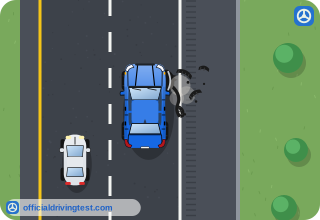
- Take your foot off the accelerator and do not hit the brakes
- Brake hard right away and steer toward the shoulder
- Loosen your grip on the wheel and coast in your lane
- Press the accelerator to regain control of the steering
Show answer
Correct answer: Take your foot off the accelerator and do not hit the brakes
The manual says to take your foot off the accelerator but not to hit the brakes after a tire blowout.
Source: Missouri Driver Guide (Revised August 2026), page 65 · Open this page in the manual (Manual page 65)
-
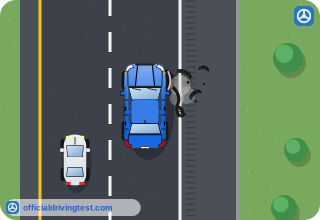
How should you hold the steering wheel after a tire blowout?
- Loosely
- With one hand only
- Tightly
- Gently, letting it turn on its own
Show answer
Correct answer: Tightly
The manual says to hold the steering wheel tightly after a tire blowout.
Source: Missouri Driver Guide (Revised August 2026), page 65 · Open this page in the manual (Manual page 65)
-
After a tire blowout, where should you let your vehicle slow to a stop?
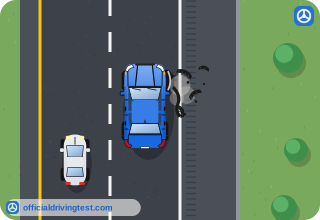
- In the nearest lane
- Completely off the road
- On the center line
- On the edge of your lane
Show answer
Correct answer: Completely off the road
The manual says to let your vehicle slow to a stop completely off the road.
Source: Missouri Driver Guide (Revised August 2026), page 65 · Open this page in the manual (Manual page 65)