Missouri: Emergencies — Part 1 Practice Test
Questions in this part include: “When should you not try to change a tire?” · “When are the highest-risk periods for deer-vehicle crashes?”
Independent educational site · not affiliated with any government agency or DMV
Ready? Test yourself
- Instant feedback with an explanation
- Every answer cites its source in the manual
- Your best score is saved on this device
Questions are original and based on the official manual "Missouri Driver Guide" (Revised August 2026), Missouri Department of Revenue.
All 17 questions in this practice test
Take the test above first, then use this list to study. Tap “Show answer” to see the correct answer and explanation.
Show the questions and answersHide the questions
-
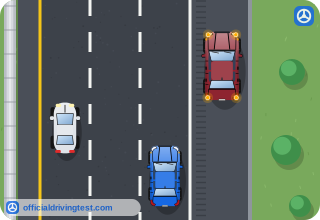
If your vehicle breaks down on a highway, what should you make sure of?
- That your engine keeps running to power the flashers
- That your headlights are turned off to save the battery
- That your hood is closed and the doors are unlocked
- That other drivers can see you and your vehicle
Show answer
Correct answer: That other drivers can see you and your vehicle
If your vehicle breaks down on a highway, you make sure other drivers can see you and your vehicle.
Source: Missouri Driver Guide (Revised August 2026), page 40 · Open this page in the manual (Manual page 40)
-
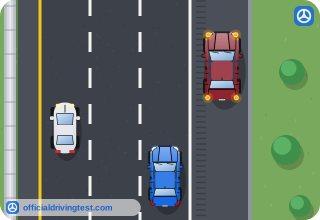
If possible, how should you notify authorities that your vehicle has broken down?
- Wave down the first vehicle that passes and ask for help
- Use a two-way radio, telephone, or cellular phone
- Walk along the road until you reach the next exit
- Sound your horn repeatedly until someone stops
Show answer
Correct answer: Use a two-way radio, telephone, or cellular phone
If possible, you use a two-way radio, telephone, or cellular phone to notify authorities.
Source: Missouri Driver Guide (Revised August 2026), page 41 · Open this page in the manual (Manual page 41)
-
If you are having vehicle trouble and have to stop, what should you do if at all possible?
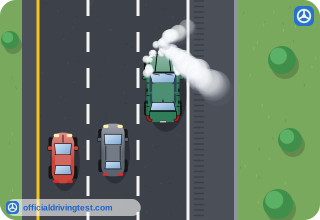
- Get your vehicle off the road and away from traffic
- Stop in the center of your lane to block traffic
- Leave your vehicle in the lane so drivers can see it
- Stop on the left shoulder of the road
Show answer
Correct answer: Get your vehicle off the road and away from traffic
If at all possible, you get your vehicle off the road and away from traffic.
Source: Missouri Driver Guide (Revised August 2026), page 41 · Open this page in the manual (Manual page 41)
-
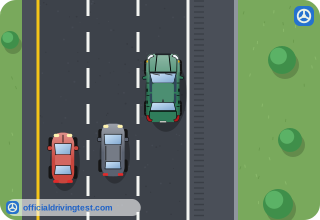
What should you turn on to show you are having vehicle trouble?
- Your high beams
- Your windshield wipers
- Your emergency flashers
- Your brake lights only
Show answer
Correct answer: Your emergency flashers
You turn on your emergency flashers to show you are having trouble.
Source: Missouri Driver Guide (Revised August 2026), page 41 · Open this page in the manual (Manual page 41)
-
If you cannot get your vehicle off the roadway, where should you try to stop?
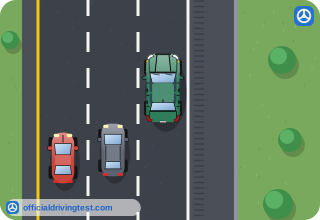
- Just over the top of a hill, where traffic must slow
- Where other drivers have a clear view of your vehicle
- Just around a curve, where traffic slows down
- Under a bridge where it is shaded
Show answer
Correct answer: Where other drivers have a clear view of your vehicle
You try to stop where other drivers have a clear view of your vehicle, not just over a hill or around a curve.
Source: Missouri Driver Guide (Revised August 2026), page 41 · Open this page in the manual (Manual page 41)
-
Where do you place emergency flares to warn other drivers that your vehicle is there?
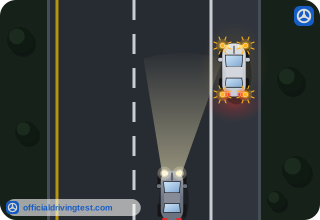
- In front of the vehicle
- Beside the driver’s door
- On the roof of the vehicle
- Behind the vehicle
Show answer
Correct answer: Behind the vehicle
You place emergency flares behind the vehicle, which alerts other drivers to change lanes if necessary.
Source: Missouri Driver Guide (Revised August 2026), page 41 · Open this page in the manual (Manual page 41)
-
When should you not try to change a tire?
- If the flat tire is on the left side of the vehicle
- If it is dark outside or the weather is bad
- If it means you have to be in a traffic lane
- If the shoulder of the road is covered with gravel
Show answer
Correct answer: If it means you have to be in a traffic lane
You do not try to change a tire if it means you have to be in a traffic lane.
Source: Missouri Driver Guide (Revised August 2026), page 41 · Open this page in the manual (Manual page 41)
-
What can you do to signal an emergency?
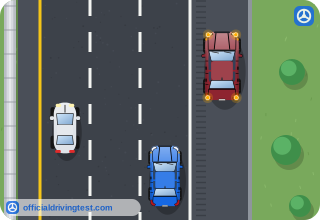
- Lift the hood or tie a white cloth to the antenna
- Open all the doors and the trunk of your vehicle
- Place a reflective sign on the roof of the vehicle
- Turn off all of the lights to avoid confusion
Show answer
Correct answer: Lift the hood or tie a white cloth to the antenna
You can lift the hood or tie a white cloth to the antenna, side mirror, or door handle to signal an emergency.
Source: Missouri Driver Guide (Revised August 2026), page 41 · Open this page in the manual (Manual page 41)
-
How should you act in areas marked with deer crossing signs?
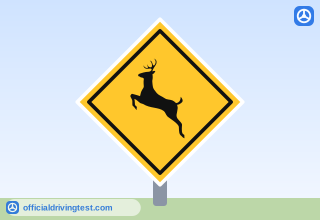
- Use your horn continuously
- Be especially alert and use caution
- Drive in the center of the road
- Turn off your headlights
Show answer
Correct answer: Be especially alert and use caution
The manual advises being especially alert and using caution when traveling through areas marked with deer crossing signs.
Source: Missouri Driver Guide (Revised August 2026), page 59 · Open this page in the manual (Manual page 59)
-
You see one deer cross the road. What should you expect?
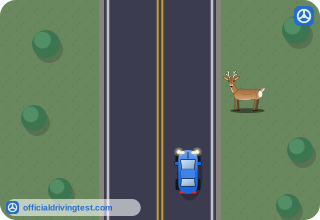
- There are probably others nearby
- It is probably the only deer in the area
- Other deer will probably wait for several hours
- Other deer will not cross for the rest of the day
Show answer
Correct answer: There are probably others nearby
Deer seldom travel alone, so if you see one crossing the road there are likely others nearby.
Source: Missouri Driver Guide (Revised August 2026), page 59 · Open this page in the manual (Manual page 59)
-
In which areas should you be especially cautious because deer tend to congregate there?
- Around busy highway interchanges
- Around large parking lots
- Around fields, streams, and gardens
- Around railroad crossings
Show answer
Correct answer: Around fields, streams, and gardens
Be especially cautious in areas around fields, streams, and gardens where deer tend to congregate.
Source: Missouri Driver Guide (Revised August 2026), page 59 · Open this page in the manual (Manual page 59)
-
In which months do most deer-related crashes occur?
- February through April, and in August
- January, May, and October through December
- June, July, August, and September only
- March, April, June, July, and August
Show answer
Correct answer: January, May, and October through December
Most deer-related crashes occur in January, May, and October through December.
Source: Missouri Driver Guide (Revised August 2026), page 59 · Open this page in the manual (Manual page 59)
-
When are the highest-risk periods for deer-vehicle crashes?
- From late morning until the early afternoon hours
- From mid-afternoon until about an hour before sunset
- During the hours around noon and mid-afternoon only
- Sunset to midnight and shortly before and after sunrise
Show answer
Correct answer: Sunset to midnight and shortly before and after sunrise
The highest-risk periods are from sunset to midnight and the hours shortly before and after sunrise.
Source: Missouri Driver Guide (Revised August 2026), page 59 · Open this page in the manual (Manual page 59)
-
After dark, when should you use high beams to help avoid a deer-vehicle crash?
- Only when driving through a town
- Only when it is raining
- When there is no opposing traffic
- When following another vehicle closely
Show answer
Correct answer: When there is no opposing traffic
High beams illuminate the eyes of deer on or near a roadway and give you greater reaction time, but use them only when there is no opposing traffic.
Source: Missouri Driver Guide (Revised August 2026), page 59 · Open this page in the manual (Manual page 59)
-
You see that a crash with a deer is unavoidable. What should you do?
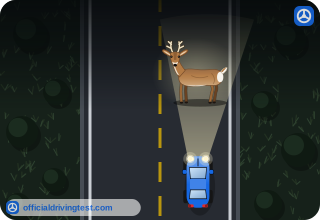
- Swerve into the oncoming lane
- Swerve off the road
- Accelerate to pass the deer
- Do not swerve
Show answer
Correct answer: Do not swerve
Swerving off the road or into the path of an oncoming car can increase the risk of injury.
Source: Missouri Driver Guide (Revised August 2026), page 60 · Open this page in the manual (Manual page 60)
-
What should you check before slowing suddenly for a deer?
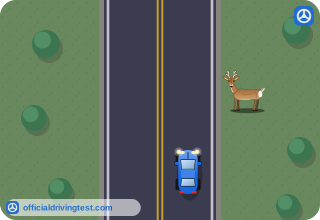
- That your high beams are on
- That there is no traffic behind you
- That your seat is moved back
- That your hazard flashers are off
Show answer
Correct answer: That there is no traffic behind you
Make sure there is no traffic behind you before slowing suddenly. Too much brake pressure can cause the front end of the vehicle to drop down.
Source: Missouri Driver Guide (Revised August 2026), page 60 · Open this page in the manual (Manual page 60)
-
After a deer-vehicle crash, whom does the manual say to contact to report where the crash occurred?
- A local Missouri Department of Conservation agent
- A local Department of Revenue license office
- A local driver education instructor
- The local tire shop
Show answer
Correct answer: A local Missouri Department of Conservation agent
Reporting to a Missouri Department of Conservation agent where the crash occurred can help to identify frequent deer crossing areas.
Source: Missouri Driver Guide (Revised August 2026), page 60 · Open this page in the manual (Manual page 60)