Minnesota: Emergency vehicles and work zones
Yielding to emergency vehicles, the Move Over Law, firefighting vehicles, fleeing police, work zone signs and the zipper merge. Split into 3 shorter tests so you're not stuck in one long quiz.
Independent educational site · not affiliated with any government agency or DMV
Choose a part
Emergency vehicles and work zones — Part 1
Questions in this part include: “The Move Over rule also applies when you pass which of these vehicles, stopped with its warning lights activated?”
StartEmergency vehicles and work zones — Part 2
Questions in this part include: “If you disagree with a citation, what should you do?”
StartEmergency vehicles and work zones — Part 3
Questions in this part include: “What should you expect in a highway work zone?”
StartAll 62 Emergency vehicles and work zones questions with answers
Choose a part above to take a practice test, or study every question and answer here.
Show the questions and answersHide the questions
-
Why does the manual say you need to be extra cautious in work zones?
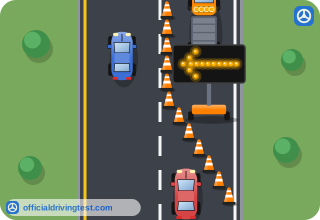
- People work in dangerous conditions near moving cars
- Speed limits there are not enforced by police
- Work zones are closed to cars during daylight
- Lane markings there are only meant as advice
Show answer
Correct answer: People work in dangerous conditions near moving cars
In work zones, people are working in dangerous conditions very close to moving vehicles, so drivers need to be extra cautious.
Source: Minnesota Driver’s Manual (June 2026), page 1
-
Besides distracted driving, what does the manual say you must be aware of when driving in work zones?
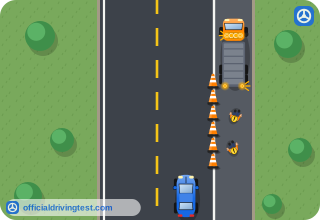
- School buses and crossing guards
- Railroad crossings and toll booths
- Zipper merges and altered lanes
- Snowplows and parked police cars
Show answer
Correct answer: Zipper merges and altered lanes
When driving in work zones, you must be aware of distracted driving, zipper merges and altered lanes.
Source: Minnesota Driver’s Manual (June 2026), page 1
-
What must you do in a work or construction zone?
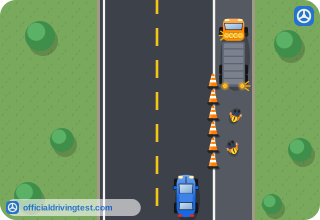
- Keep your speed so traffic keeps moving
- Stop and wait for a flag person to wave you on
- Change lanes as soon as you see the zone
- Slow down and drive with care
Show answer
Correct answer: Slow down and drive with care
In work or construction zones you must slow down and drive with care.
Source: Minnesota Driver’s Manual (June 2026), page 26
-
You cannot safely move a lane away from a stopped emergency vehicle with flashing lights. What must you do?
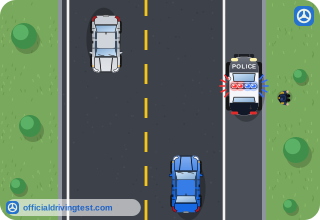
- Slow down
- Sound your horn and keep your speed
- Speed up to get past it quickly
- Sound your horn to warn the officers
Show answer
Correct answer: Slow down
If you cannot safely move a lane away from a stopped emergency vehicle with flashing lights, you must slow down and pass with caution.
Source: Minnesota Driver’s Manual (June 2026), page 27
-
If an emergency vehicle approaches while you are in a roundabout, what should you do?
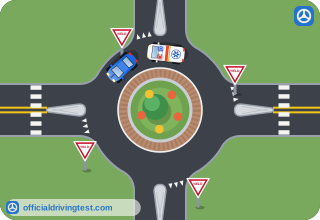
- Stop where you are inside the roundabout
- Pull over to the side inside the roundabout
- Exit the roundabout immediately and then pull over
- Continue around the roundabout once more
Show answer
Correct answer: Exit the roundabout immediately and then pull over
If an emergency vehicle approaches, exit the roundabout immediately and then pull over.
Source: Minnesota Driver’s Manual (June 2026), page 30
-
An emergency vehicle with flashing red lights and a siren or bell approaches on a two-way road. What must you do?
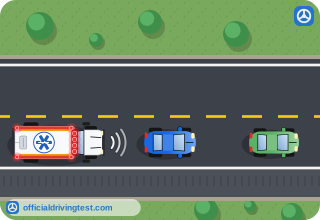
- Pull to the left and stop
- Slow down and keep driving
- Pull to the nearest side and keep moving
- Pull to the right and stop
Show answer
Correct answer: Pull to the right and stop
On a two-way road you must pull to the right and stop for an approaching emergency vehicle.
Source: Minnesota Driver’s Manual (June 2026), page 44
-
An emergency vehicle with flashing red lights and a siren approaches on a one-way road. What must you do?
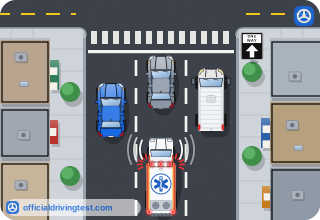
- Pull to the nearest side and stop
- Pull to the right and stop
- Pull to the left and stop
- Stay in your lane and slow down
Show answer
Correct answer: Pull to the nearest side and stop
On a one-way road you pull to the nearest side and stop.
Source: Minnesota Driver’s Manual (June 2026), page 44
-
You are in an intersection when an emergency vehicle with flashing lights and a siren approaches. What should you do?
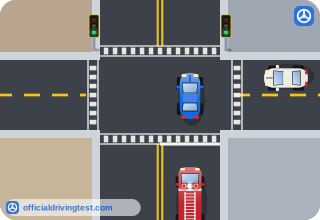
- Stop immediately where you are in the intersection
- Back up out of the intersection to the stop line
- Proceed through the intersection before stopping
- Turn around and leave the intersection quickly
Show answer
Correct answer: Proceed through the intersection before stopping
If you are in an intersection, proceed through it before stopping.
Source: Minnesota Driver’s Manual (June 2026), page 44
-
After pulling over for an emergency vehicle, how long must you remain stopped?
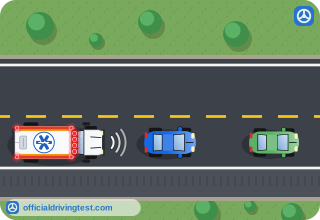
- Until the first emergency vehicle has passed
- Until all emergency vehicles have passed
- Until you can no longer hear the siren
- For at least one minute
Show answer
Correct answer: Until all emergency vehicles have passed
You must remain stopped until all emergency vehicles have passed.
Source: Minnesota Driver’s Manual (June 2026), page 44
-
For how long after failing to yield to an emergency vehicle may a law enforcement officer with probable cause arrest you?
- Within one hour
- Within 12 hours
- Within three days
- Within four hours
Show answer
Correct answer: Within four hours
An officer with probable cause may arrest you within four hours of the violation of the emergency vehicle law.
Source: Minnesota Driver’s Manual (June 2026), page 44
-
When do you not need to stop for an approaching emergency vehicle?
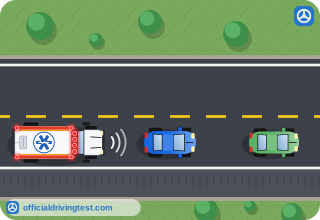
- When a fence, wall or median strip separates it from your lane
- When it is traveling on the opposite side of any road
- When you are driving more than 35 mph
- When you are already in the right-hand lane
Show answer
Correct answer: When a fence, wall or median strip separates it from your lane
You need not stop if a physical barrier like a fence, wall or median strip separates the vehicle from your lane.
Source: Minnesota Driver’s Manual (June 2026), page 44
-
An emergency vehicle with flashing lights is stopped next to a road with two lanes in your direction. What does the "Move Over Law" require if it is safe?
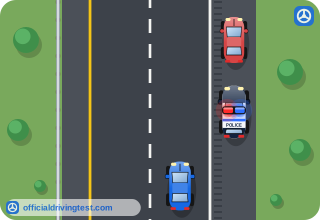
- Stop behind the stopped vehicle until it leaves
- Stay in your lane and keep the same speed
- Move to the lane farthest away from the vehicle
- Move into the lane next to the stopped vehicle
Show answer
Correct answer: Move to the lane farthest away from the vehicle
The Move Over Law requires moving to the lane farthest from the vehicle if it is safe to do so.
Source: Minnesota Driver’s Manual (June 2026), page 44
-
Under the Move Over Law, what should you do if you cannot move a lane away or have only one lane in your direction?
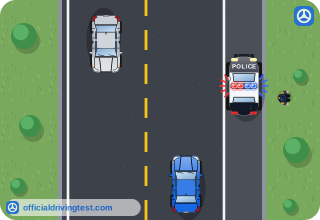
- Stop until the vehicle leaves
- Slow down and pass with caution
- Pass at the same speed
- Change lanes without signaling
Show answer
Correct answer: Slow down and pass with caution
If you cannot move over, slow down and pass with caution.
Source: Minnesota Driver’s Manual (June 2026), page 44
-
The Move Over rule also applies when you pass which of these vehicles, stopped with its warning lights activated?
- A taxi picking up a passenger
- A bicycle at the roadside
- A parked motorcycle
- A solid waste or recycling vehicle
Show answer
Correct answer: A solid waste or recycling vehicle
The manual lists solid waste and recycling vehicles stopped with warning lights among those that require the same rule.
Source: Minnesota Driver’s Manual (June 2026), page 44
-
Which vehicles are allowed to follow within 500 feet of a firefighting vehicle on an emergency run?
- Only vehicles on official emergency business
- Any vehicle traveling in the same lane
- Only vehicles that are sounding a horn
- Only vehicles below the posted speed limit
Show answer
Correct answer: Only vehicles on official emergency business
Only vehicles on official emergency business may follow within 500 feet of a firefighting vehicle on an emergency run.
Source: Minnesota Driver’s Manual (June 2026), page 44
-
When may you drive over an unprotected fire hose?
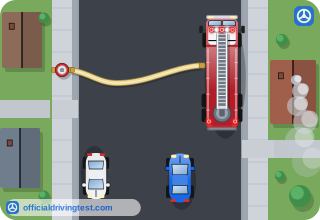
- When the hose lies across a side street and no other route exists
- When no firefighter is in sight of the hose
- When directed by a law enforcement officer or fire department official
- When you drive over it very slowly and carefully
Show answer
Correct answer: When directed by a law enforcement officer or fire department official
Do not drive over an unprotected fire hose unless directed by a law enforcement officer or fire department official.
Source: Minnesota Driver’s Manual (June 2026), page 44
-
When you see emergency lights behind you, what should you do with your speed and signal?
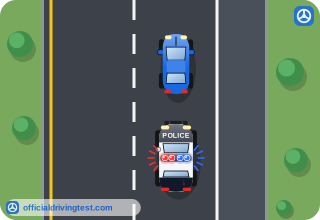
- Slow down and activate your turn signal
- Speed up to find a safe place and flash your lights
- Stop immediately in your lane
- Slow down and turn on your hazard lights only
Show answer
Correct answer: Slow down and activate your turn signal
The manual says to slow down and activate your turn signal when you see emergency lights behind you.
Source: Minnesota Driver’s Manual (June 2026), page 45
-
When you see emergency lights behind you on a multi-lane road and are closer to the left shoulder, when may you move to the left shoulder?
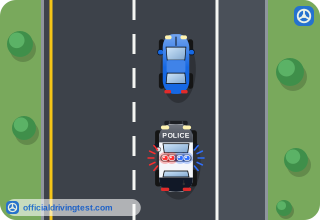
- Never, you must always use the right shoulder
- If no other cars are on the road
- If there is a full lane to park
- If the officer waves you left
Show answer
Correct answer: If there is a full lane to park
On a multi-lane road, move to the left shoulder only if you are closer to it and there is a full lane to park.
Source: Minnesota Driver’s Manual (June 2026), page 45
-
When stopped by a law enforcement officer, where should you avoid stopping?
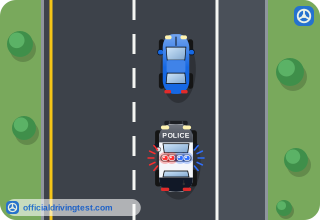
- On a straight and level section of the road
- On a bridge, curve or within the lane of traffic
- On the right shoulder as soon as it is safe
- In a well-lit area near other vehicles
Show answer
Correct answer: On a bridge, curve or within the lane of traffic
The manual says to avoid stopping on a bridge, curve or within the lane of traffic.
Source: Minnesota Driver’s Manual (June 2026), page 45
-
If you are stopped by an officer after dark, what should you do?
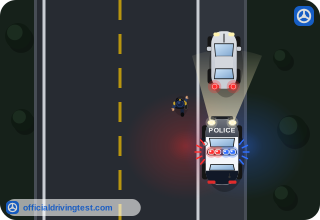
- Turn off your headlights and hazard lights
- Get out and walk toward the officer
- Keep the interior light off to avoid glare
- Turn on your vehicle's interior light
Show answer
Correct answer: Turn on your vehicle's interior light
If stopped after dark, turn on your vehicle's interior light.
Source: Minnesota Driver’s Manual (June 2026), page 45
-
During a traffic stop, what should you do with your doors and your position?
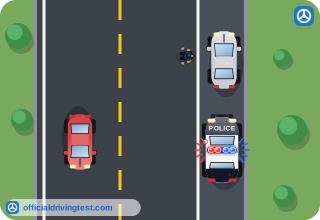
- Keep doors shut and stay in the vehicle unless told otherwise
- Open the driver's door and speak to the officer outside
- Step out and stand beside your vehicle with your hands up
- Move to the passenger seat of the vehicle at once
Show answer
Correct answer: Keep doors shut and stay in the vehicle unless told otherwise
Keep all doors shut and remain in the vehicle unless the officer directs otherwise.
Source: Minnesota Driver’s Manual (June 2026), page 45
-
During a traffic stop, where should you keep your hands?
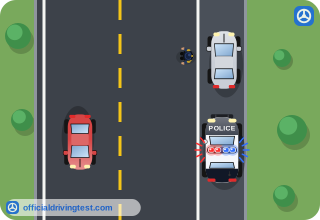
- Resting on top of the dashboard
- Out of the window, open and empty
- On the steering wheel, easily visible
- Folded in your lap below the wheel
Show answer
Correct answer: On the steering wheel, easily visible
Keep your hands on the steering wheel so they are easily visible.
Source: Minnesota Driver’s Manual (June 2026), page 45
-
The officer asks for your documents and they are out of reach. What should you do?
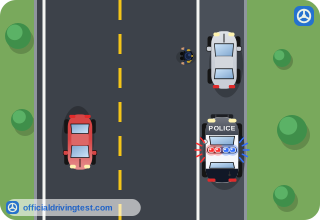
- Reach for them quickly and hand them to the officer
- Tell the officer where they are before reaching for them
- Wait until the officer reaches in to take them
- Get out of the vehicle to find them
Show answer
Correct answer: Tell the officer where they are before reaching for them
If the documents are out of reach, tell the officer where they are located before reaching for them.
Source: Minnesota Driver’s Manual (June 2026), page 45
-
If you disagree with a citation, what should you do?
- Argue your point with the officer at the roadside
- Refuse to accept the citation from the officer
- Ask the officer's supervisor to cancel the citation
- Not argue with the officer, and explain your view in court
Show answer
Correct answer: Not argue with the officer, and explain your view in court
You should not argue; you can explain your point of view in court.
Source: Minnesota Driver’s Manual (June 2026), page 45
-
Failure to follow a lawful order or direction of a law enforcement officer can result in
- your arrest
- a warning only
- loss of your vehicle registration
- a visit to a driver improvement class only
Show answer
Correct answer: your arrest
Failure to comply with any lawful order of an officer is illegal and can result in arrest.
Source: Minnesota Driver’s Manual (June 2026), page 45
-
You have a firearm in the vehicle. When should you tell the officer about it?
- Only if the officer asks you about one
- After you hand over your license and insurance
- When the officer first approaches, hands on the wheel
- Only if the firearm is loaded and within reach
Show answer
Correct answer: When the officer first approaches, hands on the wheel
Inform the officer you have a firearm and where it is located when they first approach.
Source: Minnesota Driver’s Manual (June 2026), page 45
-
What may the officer do with a firearm in your vehicle during a traffic stop?
- Keep it permanently as evidence of the stop
- Take possession of it until the interaction is complete
- Ask you to unload it before the stop continues
- Lock it in the trunk of your vehicle
Show answer
Correct answer: Take possession of it until the interaction is complete
The officer may take possession of the weapon for safety reasons until the interaction is complete.
Source: Minnesota Driver’s Manual (June 2026), page 45
-
During a traffic stop, if you need to reach for an item, what should you do?
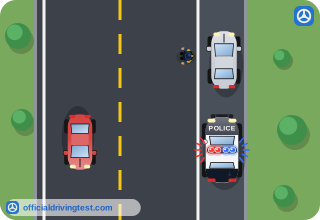
- Reach slowly with one hand while keeping the other visible
- Reach quickly and then explain what you took
- Signal with your hand and then reach for it
- Tell the officer what you need and wait for verbal permission
Show answer
Correct answer: Tell the officer what you need and wait for verbal permission
Tell the officer what you need to locate and wait for verbal permission before doing so.
Source: Minnesota Driver’s Manual (June 2026), page 45
-
During a traffic stop, if you need to exit your vehicle, what should you do?
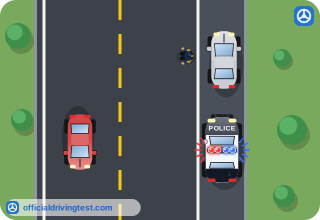
- Ask the officer verbally and wait for permission
- Step out and show your hands to the officer
- Exit and stay standing by your door
- Open the door and wait for the officer to come
Show answer
Correct answer: Ask the officer verbally and wait for permission
If you need to exit your vehicle, ask the officer verbally and wait for permission before exiting.
Source: Minnesota Driver’s Manual (June 2026), page 45
-
Which of these is listed as an acceptable form of identification during a traffic stop?
- Library card
- Employee badge
- Military ID
- Credit card
Show answer
Correct answer: Military ID
The manual lists a military ID among the acceptable forms of identification at a traffic stop, with licenses, a temporary license, a learner's permit and a consulate or international driver's license.
Source: Minnesota Driver’s Manual (June 2026), page 46
-
What does accepting a citation mean?
- You admit guilt and agree to pay the fine without a hearing
- You acknowledge receipt and promise to appear in court if required
- You waive your right to a court hearing
- You agree to attend driver education training
Show answer
Correct answer: You acknowledge receipt and promise to appear in court if required
You are not admitting guilt or responsibility by accepting a citation; you acknowledge receipt and promise to appear in court if required.
Source: Minnesota Driver’s Manual (June 2026), page 46
-
What does a citation contain about the violation?
- Only the amount of the fine and the date of the court hearing
- Only the officer's name and badge number
- A list of witnesses to the violation
- The specific code or statute and a description of the violation
Show answer
Correct answer: The specific code or statute and a description of the violation
The citation will contain the specific code or statute and a description of the violation.
Source: Minnesota Driver’s Manual (June 2026), page 46
-
If you have concerns about an officer's conduct during a traffic stop, whom can you contact?
- The officer's law enforcement agency or supervisor
- The Department of Motor Vehicles in your county
- The instructor of your driver education course
- The clerk of the local court
Show answer
Correct answer: The officer's law enforcement agency or supervisor
Contact the officer's law enforcement agency or supervisor using the officer information on the citation.
Source: Minnesota Driver’s Manual (June 2026), page 46
-
Fleeing a police officer in a motor vehicle is what kind of crime?
- A misdemeanor
- A gross misdemeanor
- A felony
- A petty misdemeanor
Show answer
Correct answer: A felony
Fleeing a police officer in a motor vehicle is illegal, dangerous, and a felony.
Source: Minnesota Driver’s Manual (June 2026), page 46
-
What is the maximum prison sentence for fleeing a police officer in a motor vehicle when no one is hurt?
- Up to 90 days in a county jail
- Up to three years and one day
- Up to one year in a county jail
- Up to seven years in state prison
Show answer
Correct answer: Up to three years and one day
The sentence may be up to three years and one day in prison, a fine up to $5,000, or both.
Source: Minnesota Driver’s Manual (June 2026), page 46
-
What is the maximum fine for fleeing a police officer in a motor vehicle when no one is hurt?
- $1,000
- $10,000
- $20,000
- $5,000
Show answer
Correct answer: $5,000
The fine may be up to $5,000, up to three years and one day in prison, or both.
Source: Minnesota Driver’s Manual (June 2026), page 46
-
If a death occurs while you are fleeing a police officer, what prison sentence may you receive?
- Up to 10 years
- Up to five years
- Up to seven years
- Up to 20 years
Show answer
Correct answer: Up to 10 years
If a death occurs, you may be sentenced to up to 10 years in prison, fined up to $20,000 or both.
Source: Minnesota Driver’s Manual (June 2026), page 46
-
If great bodily harm occurs while you are fleeing a police officer, what prison sentence may you receive?
- Up to three years
- Up to five years
- Up to seven years
- Up to 10 years
Show answer
Correct answer: Up to seven years
If great bodily harm occurs, you may be sentenced to up to seven years in prison, fined up to $14,000 or both.
Source: Minnesota Driver’s Manual (June 2026), page 46
-
If substantial bodily harm occurs while you are fleeing a police officer, what is the maximum fine?
- $5,000
- $10,000
- $14,000
- $20,000
Show answer
Correct answer: $10,000
If substantial bodily harm occurs, you may be sentenced to up to five years in prison, fined up to $10,000 or both.
Source: Minnesota Driver’s Manual (June 2026), page 46
-
When does machinery operate in a highway work zone?
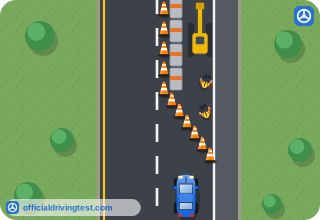
- Only during daylight hours on weekdays
- Day and night, moving or stationary
- Only when workers are present at the site
- Only on weekdays when a flag person is there
Show answer
Correct answer: Day and night, moving or stationary
Machinery operates day and night and can be moving or stationary in highway work zones.
Source: Minnesota Driver’s Manual (June 2026), page 54
-
What happens if you fail to obey a flag person in a work zone?
- You receive only a written warning
- Nothing, if no workers are nearby
- A violation and a financial penalty
- Your license is cancelled for a year
Show answer
Correct answer: A violation and a financial penalty
Failure to obey a flag person in a work zone will result in a violation and financial penalty.
Source: Minnesota Driver’s Manual (June 2026), page 54
-
A work zone has no reduced speed limit posting. What speed limit must you obey?
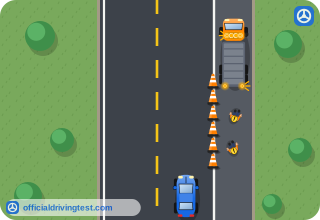
- The posted speed limit
- Any speed that seems safe
- 10 mph below the posted limit
- The limit of the nearest school zone
Show answer
Correct answer: The posted speed limit
If there are no reduced speed limit postings, obey the posted speed limit.
Source: Minnesota Driver’s Manual (June 2026), page 54
-
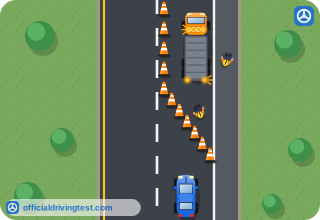
What should you do in a work zone to keep a safe distance from workers and equipment?
- Drive in the center of the road
- Use your high beams
- Adjust your lane position
- Follow the vehicle ahead closely
Show answer
Correct answer: Adjust your lane position
Stay alert and adjust your lane position to keep a safe distance from workers and equipment.
Source: Minnesota Driver’s Manual (June 2026), page 54
-
What should you expect in a highway work zone?
- Delays, especially during peak travel times
- Wider lanes than on the open highway
- Higher speed limits than on the open road
- No delays, even at peak travel times
Show answer
Correct answer: Delays, especially during peak travel times
Drivers should expect delays in work zones, especially during peak travel times.
Source: Minnesota Driver’s Manual (June 2026), page 54
-
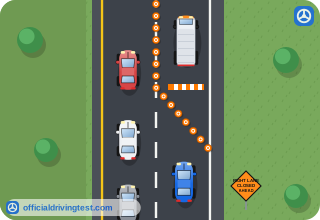
When you see the “lane closed ahead” sign and traffic is backing up, what should you do?
- Merge into the open lane as soon as you can
- Stop and wait for a driver to let you in
- Use the shoulder to pass the line of traffic
- Stay in your current lane until the point of merge
Show answer
Correct answer: Stay in your current lane until the point of merge
In the zipper merge, you stay in your current lane until the point of merge.
Source: Minnesota Driver’s Manual (June 2026), page 54
-
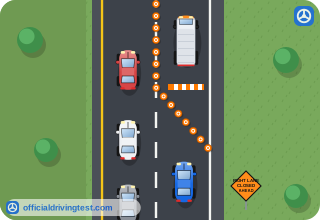
In a zipper merge, how do drivers merge into the remaining lane?
- The faster lane goes first
- They take turns with other drivers
- Trucks go first
- The driver who arrives first goes alone
Show answer
Correct answer: They take turns with other drivers
Drivers take turns with other drivers to safely and smoothly merge into the remaining lane.
Source: Minnesota Driver’s Manual (June 2026), page 54
-
What does early merging lead to, according to the manual?
- Longer backups, more crashes and road rage incidents
- Shorter backups, fewer crashes and calmer drivers
- Faster traffic flow with the same number of crashes
- Less congestion but more wear on vehicles
Show answer
Correct answer: Longer backups, more crashes and road rage incidents
Early merging leads to longer backups, more crashes and road rage incidents.
Source: Minnesota Driver’s Manual (June 2026), page 54
-
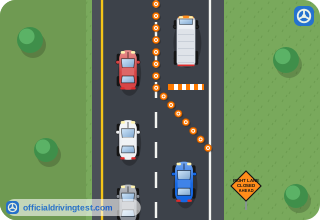
Which is a benefit of the zipper merge?
- It allows drivers to pass on the shoulder
- It makes it legal to exceed the speed limit
- It increases worker safety when a lane is closed
- It lets one lane go ahead of the other
Show answer
Correct answer: It increases worker safety when a lane is closed
The zipper merge increases worker safety when a lane is closed due to construction, reconstruction or maintenance.
Source: Minnesota Driver’s Manual (June 2026), page 55
-
Which is a benefit of the zipper merge for lane changes?
- It gives priority to the faster of the two lanes
- It reduces speed differences between the lanes
- It removes the need to signal when merging
- It lets drivers merge at whatever speed they like
Show answer
Correct answer: It reduces speed differences between the lanes
The zipper merge reduces the difference in speeds between two lanes, making lane changes easier and safer.
Source: Minnesota Driver’s Manual (June 2026), page 55
-
Which is a benefit of the zipper merge at freeway interchanges?
- It adds extra lanes
- It closes the on-ramp
- It speeds up trucks only
- It reduces congestion
Show answer
Correct answer: It reduces congestion
The zipper merge reduces congestion at freeway interchanges, especially in metropolitan areas.
Source: Minnesota Driver’s Manual (June 2026), page 55
-
The zipper merge creates a sense of fairness because of what?
- The shoulder is open to all drivers
- The faster lane merges first
- Trucks wait for cars
- All lanes are moving at the same speed
Show answer
Correct answer: All lanes are moving at the same speed
It creates a sense of fairness when all lanes are moving at the same speed.
Source: Minnesota Driver’s Manual (June 2026), page 55
-
What should you do when you see an orange sign?
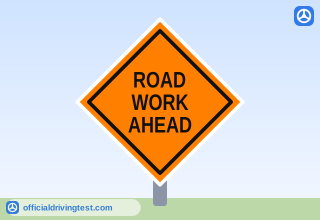
- Speed up to clear the work area quickly
- Move into the left lane right away
- Slow down
- Sound your horn to warn the workers
Show answer
Correct answer: Slow down
The manual says to slow down when you see an orange sign, because it warns of lane restrictions, detours and other road work hazards.
Source: Minnesota Driver’s Manual (June 2026), page 64
-
What do orange signs warn drivers of?
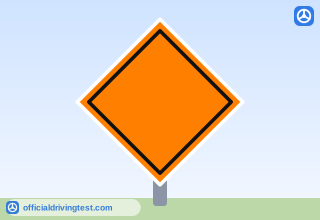
- Exits, distances to cities and interstate interchanges
- Restricted lanes of traffic, detours and other road work hazards
- Services such as gas, food, motels and rest areas
- Historic sites, parks and other points of interest
Show answer
Correct answer: Restricted lanes of traffic, detours and other road work hazards
Orange signs warn drivers of restricted lanes of traffic, detours and other road work hazards.
Source: Minnesota Driver’s Manual (June 2026), page 64
-
What are drums, cones, tubes, flashing arrows and orange- and white-striped barriers used for?
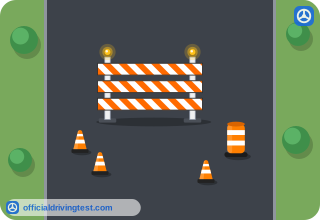
- To show drivers where the speed limit changes
- To mark the lanes workers may use for parking
- To warn drivers that a road is closed for the season
- To keep traffic out of a construction area or dangerous areas
Show answer
Correct answer: To keep traffic out of a construction area or dangerous areas
Drums, cones, tubes, flashing arrows and striped barriers keep traffic out of a construction area or areas where it is dangerous to drive.
Source: Minnesota Driver’s Manual (June 2026), page 64
-
In a work zone, a person holds an orange sign, a flag or a stop sign and gives you directions. What should you do?
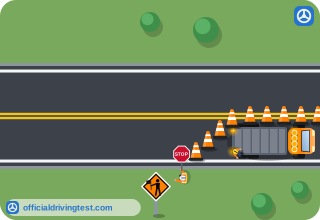
- Always follow their directions
- Follow them only if no posted sign says otherwise
- Follow them only when workers are close to your lane
- Keep your normal speed and use your own judgment
Show answer
Correct answer: Always follow their directions
People holding orange signs, flags or stop signs give directions in work zones, and the manual says to always follow their directions.
Source: Minnesota Driver’s Manual (June 2026), page 64
-
What does an orange diamond sign showing a standing figure with an outstretched arm and a small square flag indicate?
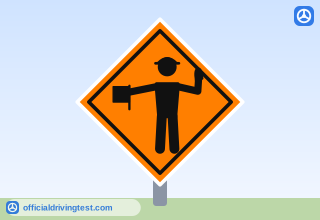
- A road closure begins ahead
- A school crossing guard is on duty ahead
- A person with a flag is ahead
- A railroad crossing is ahead
Show answer
Correct answer: A person with a flag is ahead
An orange diamond sign showing a person holding a flag indicates that a person with a flag is ahead, so drive cautiously.
Source: Minnesota Driver’s Manual (June 2026), page 64
-
What should you do when you see an orange diamond sign showing a figure digging with a shovel?
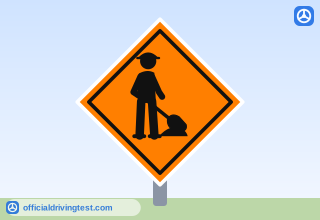
- Stop and wait until a worker waves you through the area
- Slow down and adjust your lane position to stay away from workers
- Move onto the shoulder and let the workers finish first
- Keep your speed and stay near the center of the road
Show answer
Correct answer: Slow down and adjust your lane position to stay away from workers
An orange diamond sign showing a worker digging indicates that workers are performing maintenance on the roadway, so slow down and adjust your lane position to stay away from workers.
Source: Minnesota Driver’s Manual (June 2026), page 64
-
You see the flashing lights of an ambulance, fire truck or police car on the shoulder of a freeway. What must you do?
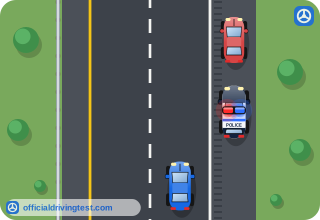
- Stop in your lane until the emergency vehicle leaves the shoulder
- Move onto the shoulder behind the emergency vehicle
- Keep your speed and lane, using your horn if needed
- Move a lane away if you can do so safely; if not, slow down
Show answer
Correct answer: Move a lane away if you can do so safely; if not, slow down
You must move a lane away from the emergency vehicle if it is possible to do so safely; if you cannot, slow down.
Source: Minnesota Driver’s Manual (June 2026), page 77
-
On a freeway, an emergency vehicle with its lights and siren activated is behind you. What should you do?
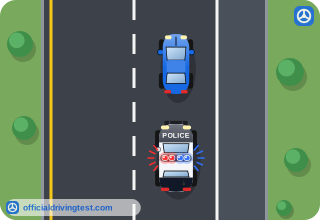
- Move to the nearest side of the road and stop
- Speed up and move to the far lane
- Slow down but stay in your lane
- Stop in your lane with your turn signal on
Show answer
Correct answer: Move to the nearest side of the road and stop
The manual says to move to the nearest side of the road and stop, using your turn signal.
Source: Minnesota Driver’s Manual (June 2026), page 77
-
When moving aside for an emergency vehicle behind you, what should you not do?
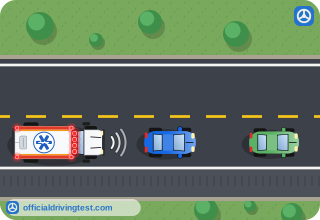
- Use your turn signal
- Remain stopped until it has completely passed
- Slam on the brakes or swerve into other lanes
- Look for other emergency vehicles that may be following
Show answer
Correct answer: Slam on the brakes or swerve into other lanes
The manual says not to slam on the brakes or swerve into other lanes.
Source: Minnesota Driver’s Manual (June 2026), page 77
-
After an emergency vehicle has passed you, what should you look for before pulling out?
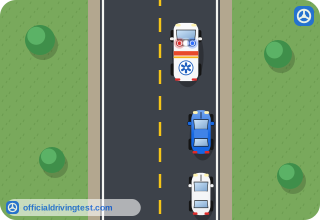
- A police car to escort you back into traffic
- Other emergency vehicles that may be following it
- Other drivers using hazard warning lights
- A green traffic signal ahead
Show answer
Correct answer: Other emergency vehicles that may be following it
The manual says to look for other emergency vehicles that may be following before pulling out.
Source: Minnesota Driver’s Manual (June 2026), page 77
-
How far back must you stay from a firefighting vehicle on an emergency run?
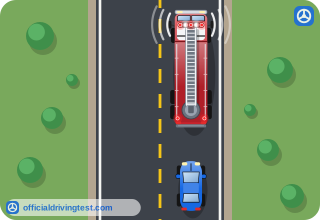
- At least 100 feet
- At least 200 feet
- At least 300 feet
- At least 500 feet
Show answer
Correct answer: At least 500 feet
Stay at least 500 feet back from a firefighting vehicle on an emergency run.
Source: Minnesota Driver’s Manual (June 2026), page 77