Minnesota: Emergency vehicles and work zones — Part 3 Practice Test
Questions in this part include: “What should you expect in a highway work zone?” · “Which is a benefit of the zipper merge for lane changes?”
Independent educational site · not affiliated with any government agency or DMV
Ready? Test yourself
- Instant feedback with an explanation
- Every answer cites its source in the manual
- Your best score is saved on this device
Questions are original and based on the official manual "Minnesota Driver’s Manual" (June 2026), Minnesota Driver and Vehicle Services.
All 20 questions in this practice test
Take the test above first, then use this list to study. Tap “Show answer” to see the correct answer and explanation.
Show the questions and answersHide the questions
-
What should you do in a work zone to keep a safe distance from workers and equipment?
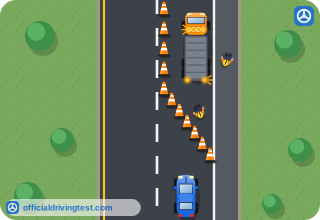
- Drive in the center of the road
- Use your high beams
- Adjust your lane position
- Follow the vehicle ahead closely
Show answer
Correct answer: Adjust your lane position
Stay alert and adjust your lane position to keep a safe distance from workers and equipment.
Source: Minnesota Driver’s Manual (June 2026), page 54
-
What should you expect in a highway work zone?
- Delays, especially during peak travel times
- Wider lanes than on the open highway
- Higher speed limits than on the open road
- No delays, even at peak travel times
Show answer
Correct answer: Delays, especially during peak travel times
Drivers should expect delays in work zones, especially during peak travel times.
Source: Minnesota Driver’s Manual (June 2026), page 54
-
When you see the “lane closed ahead” sign and traffic is backing up, what should you do?
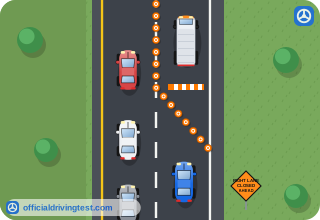
- Merge into the open lane as soon as you can
- Stop and wait for a driver to let you in
- Use the shoulder to pass the line of traffic
- Stay in your current lane until the point of merge
Show answer
Correct answer: Stay in your current lane until the point of merge
In the zipper merge, you stay in your current lane until the point of merge.
Source: Minnesota Driver’s Manual (June 2026), page 54
-
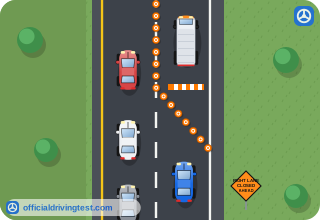
In a zipper merge, how do drivers merge into the remaining lane?
- The faster lane goes first
- They take turns with other drivers
- Trucks go first
- The driver who arrives first goes alone
Show answer
Correct answer: They take turns with other drivers
Drivers take turns with other drivers to safely and smoothly merge into the remaining lane.
Source: Minnesota Driver’s Manual (June 2026), page 54
-
What does early merging lead to, according to the manual?
- Longer backups, more crashes and road rage incidents
- Shorter backups, fewer crashes and calmer drivers
- Faster traffic flow with the same number of crashes
- Less congestion but more wear on vehicles
Show answer
Correct answer: Longer backups, more crashes and road rage incidents
Early merging leads to longer backups, more crashes and road rage incidents.
Source: Minnesota Driver’s Manual (June 2026), page 54
-
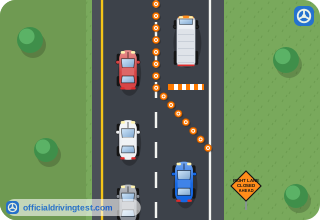
Which is a benefit of the zipper merge?
- It allows drivers to pass on the shoulder
- It makes it legal to exceed the speed limit
- It increases worker safety when a lane is closed
- It lets one lane go ahead of the other
Show answer
Correct answer: It increases worker safety when a lane is closed
The zipper merge increases worker safety when a lane is closed due to construction, reconstruction or maintenance.
Source: Minnesota Driver’s Manual (June 2026), page 55
-
Which is a benefit of the zipper merge for lane changes?
- It gives priority to the faster of the two lanes
- It reduces speed differences between the lanes
- It removes the need to signal when merging
- It lets drivers merge at whatever speed they like
Show answer
Correct answer: It reduces speed differences between the lanes
The zipper merge reduces the difference in speeds between two lanes, making lane changes easier and safer.
Source: Minnesota Driver’s Manual (June 2026), page 55
-
Which is a benefit of the zipper merge at freeway interchanges?
- It adds extra lanes
- It closes the on-ramp
- It speeds up trucks only
- It reduces congestion
Show answer
Correct answer: It reduces congestion
The zipper merge reduces congestion at freeway interchanges, especially in metropolitan areas.
Source: Minnesota Driver’s Manual (June 2026), page 55
-
The zipper merge creates a sense of fairness because of what?
- The shoulder is open to all drivers
- The faster lane merges first
- Trucks wait for cars
- All lanes are moving at the same speed
Show answer
Correct answer: All lanes are moving at the same speed
It creates a sense of fairness when all lanes are moving at the same speed.
Source: Minnesota Driver’s Manual (June 2026), page 55
-
What should you do when you see an orange sign?
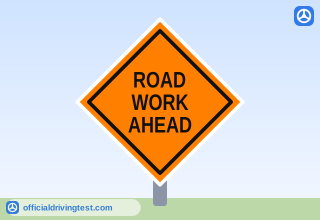
- Speed up to clear the work area quickly
- Move into the left lane right away
- Slow down
- Sound your horn to warn the workers
Show answer
Correct answer: Slow down
The manual says to slow down when you see an orange sign, because it warns of lane restrictions, detours and other road work hazards.
Source: Minnesota Driver’s Manual (June 2026), page 64
-
What do orange signs warn drivers of?
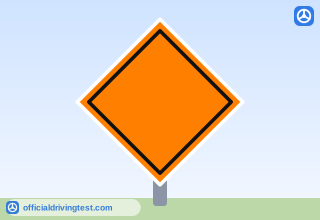
- Exits, distances to cities and interstate interchanges
- Restricted lanes of traffic, detours and other road work hazards
- Services such as gas, food, motels and rest areas
- Historic sites, parks and other points of interest
Show answer
Correct answer: Restricted lanes of traffic, detours and other road work hazards
Orange signs warn drivers of restricted lanes of traffic, detours and other road work hazards.
Source: Minnesota Driver’s Manual (June 2026), page 64
-
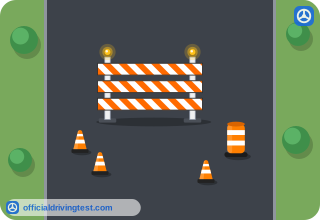
What are drums, cones, tubes, flashing arrows and orange- and white-striped barriers used for?
- To show drivers where the speed limit changes
- To mark the lanes workers may use for parking
- To warn drivers that a road is closed for the season
- To keep traffic out of a construction area or dangerous areas
Show answer
Correct answer: To keep traffic out of a construction area or dangerous areas
Drums, cones, tubes, flashing arrows and striped barriers keep traffic out of a construction area or areas where it is dangerous to drive.
Source: Minnesota Driver’s Manual (June 2026), page 64
-
In a work zone, a person holds an orange sign, a flag or a stop sign and gives you directions. What should you do?
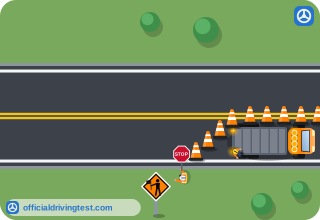
- Always follow their directions
- Follow them only if no posted sign says otherwise
- Follow them only when workers are close to your lane
- Keep your normal speed and use your own judgment
Show answer
Correct answer: Always follow their directions
People holding orange signs, flags or stop signs give directions in work zones, and the manual says to always follow their directions.
Source: Minnesota Driver’s Manual (June 2026), page 64
-
What does an orange diamond sign showing a standing figure with an outstretched arm and a small square flag indicate?
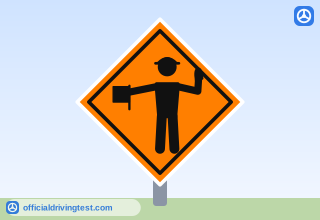
- A road closure begins ahead
- A school crossing guard is on duty ahead
- A person with a flag is ahead
- A railroad crossing is ahead
Show answer
Correct answer: A person with a flag is ahead
An orange diamond sign showing a person holding a flag indicates that a person with a flag is ahead, so drive cautiously.
Source: Minnesota Driver’s Manual (June 2026), page 64
-
What should you do when you see an orange diamond sign showing a figure digging with a shovel?
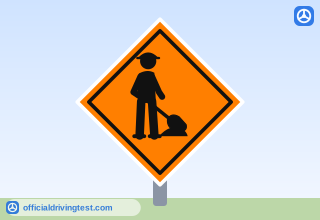
- Stop and wait until a worker waves you through the area
- Slow down and adjust your lane position to stay away from workers
- Move onto the shoulder and let the workers finish first
- Keep your speed and stay near the center of the road
Show answer
Correct answer: Slow down and adjust your lane position to stay away from workers
An orange diamond sign showing a worker digging indicates that workers are performing maintenance on the roadway, so slow down and adjust your lane position to stay away from workers.
Source: Minnesota Driver’s Manual (June 2026), page 64
-
You see the flashing lights of an ambulance, fire truck or police car on the shoulder of a freeway. What must you do?
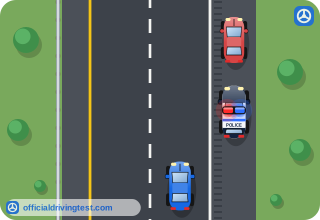
- Stop in your lane until the emergency vehicle leaves the shoulder
- Move onto the shoulder behind the emergency vehicle
- Keep your speed and lane, using your horn if needed
- Move a lane away if you can do so safely; if not, slow down
Show answer
Correct answer: Move a lane away if you can do so safely; if not, slow down
You must move a lane away from the emergency vehicle if it is possible to do so safely; if you cannot, slow down.
Source: Minnesota Driver’s Manual (June 2026), page 77
-
On a freeway, an emergency vehicle with its lights and siren activated is behind you. What should you do?
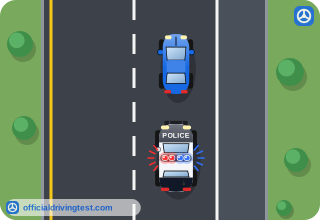
- Move to the nearest side of the road and stop
- Speed up and move to the far lane
- Slow down but stay in your lane
- Stop in your lane with your turn signal on
Show answer
Correct answer: Move to the nearest side of the road and stop
The manual says to move to the nearest side of the road and stop, using your turn signal.
Source: Minnesota Driver’s Manual (June 2026), page 77
-
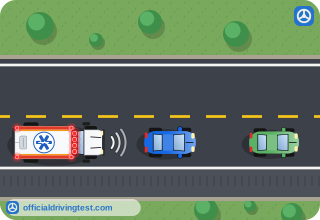
When moving aside for an emergency vehicle behind you, what should you not do?
- Use your turn signal
- Remain stopped until it has completely passed
- Slam on the brakes or swerve into other lanes
- Look for other emergency vehicles that may be following
Show answer
Correct answer: Slam on the brakes or swerve into other lanes
The manual says not to slam on the brakes or swerve into other lanes.
Source: Minnesota Driver’s Manual (June 2026), page 77
-
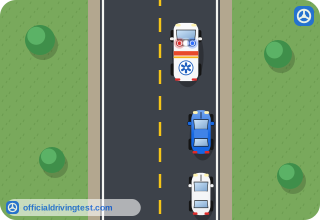
After an emergency vehicle has passed you, what should you look for before pulling out?
- A police car to escort you back into traffic
- Other emergency vehicles that may be following it
- Other drivers using hazard warning lights
- A green traffic signal ahead
Show answer
Correct answer: Other emergency vehicles that may be following it
The manual says to look for other emergency vehicles that may be following before pulling out.
Source: Minnesota Driver’s Manual (June 2026), page 77
-
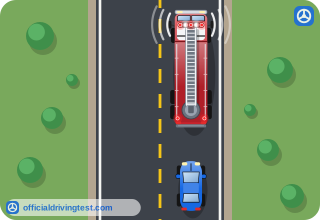
How far back must you stay from a firefighting vehicle on an emergency run?
- At least 100 feet
- At least 200 feet
- At least 300 feet
- At least 500 feet
Show answer
Correct answer: At least 500 feet
Stay at least 500 feet back from a firefighting vehicle on an emergency run.
Source: Minnesota Driver’s Manual (June 2026), page 77