Minnesota: Emergency vehicles and work zones — Part 2 Practice Test
Questions in this part include: “If you disagree with a citation, what should you do?” · “Fleeing a police officer in a motor vehicle is what kind of crime?”
Independent educational site · not affiliated with any government agency or DMV
Ready? Test yourself
- Instant feedback with an explanation
- Every answer cites its source in the manual
- Your best score is saved on this device
Questions are original and based on the official manual "Minnesota Driver’s Manual" (June 2026), Minnesota Driver and Vehicle Services.
All 21 questions in this practice test
Take the test above first, then use this list to study. Tap “Show answer” to see the correct answer and explanation.
Show the questions and answersHide the questions
-
During a traffic stop, where should you keep your hands?
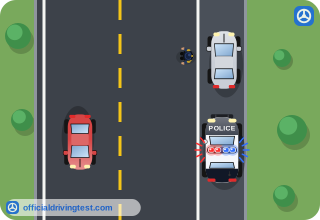
- Resting on top of the dashboard
- Out of the window, open and empty
- On the steering wheel, easily visible
- Folded in your lap below the wheel
Show answer
Correct answer: On the steering wheel, easily visible
Keep your hands on the steering wheel so they are easily visible.
Source: Minnesota Driver’s Manual (June 2026), page 45
-
The officer asks for your documents and they are out of reach. What should you do?
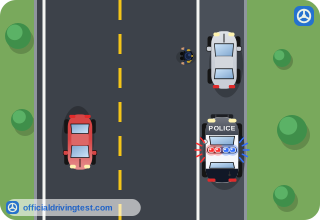
- Reach for them quickly and hand them to the officer
- Tell the officer where they are before reaching for them
- Wait until the officer reaches in to take them
- Get out of the vehicle to find them
Show answer
Correct answer: Tell the officer where they are before reaching for them
If the documents are out of reach, tell the officer where they are located before reaching for them.
Source: Minnesota Driver’s Manual (June 2026), page 45
-
If you disagree with a citation, what should you do?
- Argue your point with the officer at the roadside
- Refuse to accept the citation from the officer
- Ask the officer's supervisor to cancel the citation
- Not argue with the officer, and explain your view in court
Show answer
Correct answer: Not argue with the officer, and explain your view in court
You should not argue; you can explain your point of view in court.
Source: Minnesota Driver’s Manual (June 2026), page 45
-
Failure to follow a lawful order or direction of a law enforcement officer can result in
- your arrest
- a warning only
- loss of your vehicle registration
- a visit to a driver improvement class only
Show answer
Correct answer: your arrest
Failure to comply with any lawful order of an officer is illegal and can result in arrest.
Source: Minnesota Driver’s Manual (June 2026), page 45
-
You have a firearm in the vehicle. When should you tell the officer about it?
- Only if the officer asks you about one
- After you hand over your license and insurance
- When the officer first approaches, hands on the wheel
- Only if the firearm is loaded and within reach
Show answer
Correct answer: When the officer first approaches, hands on the wheel
Inform the officer you have a firearm and where it is located when they first approach.
Source: Minnesota Driver’s Manual (June 2026), page 45
-
What may the officer do with a firearm in your vehicle during a traffic stop?
- Keep it permanently as evidence of the stop
- Take possession of it until the interaction is complete
- Ask you to unload it before the stop continues
- Lock it in the trunk of your vehicle
Show answer
Correct answer: Take possession of it until the interaction is complete
The officer may take possession of the weapon for safety reasons until the interaction is complete.
Source: Minnesota Driver’s Manual (June 2026), page 45
-
During a traffic stop, if you need to reach for an item, what should you do?
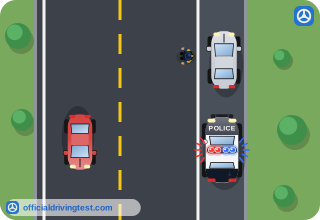
- Reach slowly with one hand while keeping the other visible
- Reach quickly and then explain what you took
- Signal with your hand and then reach for it
- Tell the officer what you need and wait for verbal permission
Show answer
Correct answer: Tell the officer what you need and wait for verbal permission
Tell the officer what you need to locate and wait for verbal permission before doing so.
Source: Minnesota Driver’s Manual (June 2026), page 45
-
During a traffic stop, if you need to exit your vehicle, what should you do?
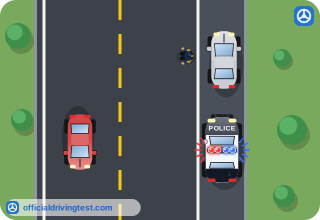
- Ask the officer verbally and wait for permission
- Step out and show your hands to the officer
- Exit and stay standing by your door
- Open the door and wait for the officer to come
Show answer
Correct answer: Ask the officer verbally and wait for permission
If you need to exit your vehicle, ask the officer verbally and wait for permission before exiting.
Source: Minnesota Driver’s Manual (June 2026), page 45
-
Which of these is listed as an acceptable form of identification during a traffic stop?
- Library card
- Employee badge
- Military ID
- Credit card
Show answer
Correct answer: Military ID
The manual lists a military ID among the acceptable forms of identification at a traffic stop, with licenses, a temporary license, a learner's permit and a consulate or international driver's license.
Source: Minnesota Driver’s Manual (June 2026), page 46
-
What does accepting a citation mean?
- You admit guilt and agree to pay the fine without a hearing
- You acknowledge receipt and promise to appear in court if required
- You waive your right to a court hearing
- You agree to attend driver education training
Show answer
Correct answer: You acknowledge receipt and promise to appear in court if required
You are not admitting guilt or responsibility by accepting a citation; you acknowledge receipt and promise to appear in court if required.
Source: Minnesota Driver’s Manual (June 2026), page 46
-
What does a citation contain about the violation?
- Only the amount of the fine and the date of the court hearing
- Only the officer's name and badge number
- A list of witnesses to the violation
- The specific code or statute and a description of the violation
Show answer
Correct answer: The specific code or statute and a description of the violation
The citation will contain the specific code or statute and a description of the violation.
Source: Minnesota Driver’s Manual (June 2026), page 46
-
If you have concerns about an officer's conduct during a traffic stop, whom can you contact?
- The officer's law enforcement agency or supervisor
- The Department of Motor Vehicles in your county
- The instructor of your driver education course
- The clerk of the local court
Show answer
Correct answer: The officer's law enforcement agency or supervisor
Contact the officer's law enforcement agency or supervisor using the officer information on the citation.
Source: Minnesota Driver’s Manual (June 2026), page 46
-
Fleeing a police officer in a motor vehicle is what kind of crime?
- A misdemeanor
- A gross misdemeanor
- A felony
- A petty misdemeanor
Show answer
Correct answer: A felony
Fleeing a police officer in a motor vehicle is illegal, dangerous, and a felony.
Source: Minnesota Driver’s Manual (June 2026), page 46
-
What is the maximum prison sentence for fleeing a police officer in a motor vehicle when no one is hurt?
- Up to 90 days in a county jail
- Up to three years and one day
- Up to one year in a county jail
- Up to seven years in state prison
Show answer
Correct answer: Up to three years and one day
The sentence may be up to three years and one day in prison, a fine up to $5,000, or both.
Source: Minnesota Driver’s Manual (June 2026), page 46
-
What is the maximum fine for fleeing a police officer in a motor vehicle when no one is hurt?
- $1,000
- $10,000
- $20,000
- $5,000
Show answer
Correct answer: $5,000
The fine may be up to $5,000, up to three years and one day in prison, or both.
Source: Minnesota Driver’s Manual (June 2026), page 46
-
If a death occurs while you are fleeing a police officer, what prison sentence may you receive?
- Up to 10 years
- Up to five years
- Up to seven years
- Up to 20 years
Show answer
Correct answer: Up to 10 years
If a death occurs, you may be sentenced to up to 10 years in prison, fined up to $20,000 or both.
Source: Minnesota Driver’s Manual (June 2026), page 46
-
If great bodily harm occurs while you are fleeing a police officer, what prison sentence may you receive?
- Up to three years
- Up to five years
- Up to seven years
- Up to 10 years
Show answer
Correct answer: Up to seven years
If great bodily harm occurs, you may be sentenced to up to seven years in prison, fined up to $14,000 or both.
Source: Minnesota Driver’s Manual (June 2026), page 46
-
If substantial bodily harm occurs while you are fleeing a police officer, what is the maximum fine?
- $5,000
- $10,000
- $14,000
- $20,000
Show answer
Correct answer: $10,000
If substantial bodily harm occurs, you may be sentenced to up to five years in prison, fined up to $10,000 or both.
Source: Minnesota Driver’s Manual (June 2026), page 46
-
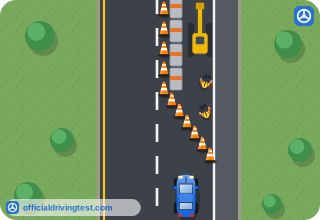
When does machinery operate in a highway work zone?
- Only during daylight hours on weekdays
- Day and night, moving or stationary
- Only when workers are present at the site
- Only on weekdays when a flag person is there
Show answer
Correct answer: Day and night, moving or stationary
Machinery operates day and night and can be moving or stationary in highway work zones.
Source: Minnesota Driver’s Manual (June 2026), page 54
-
What happens if you fail to obey a flag person in a work zone?
- You receive only a written warning
- Nothing, if no workers are nearby
- A violation and a financial penalty
- Your license is cancelled for a year
Show answer
Correct answer: A violation and a financial penalty
Failure to obey a flag person in a work zone will result in a violation and financial penalty.
Source: Minnesota Driver’s Manual (June 2026), page 54
-
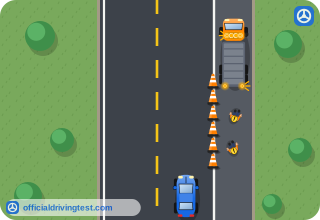
A work zone has no reduced speed limit posting. What speed limit must you obey?
- The posted speed limit
- Any speed that seems safe
- 10 mph below the posted limit
- The limit of the nearest school zone
Show answer
Correct answer: The posted speed limit
If there are no reduced speed limit postings, obey the posted speed limit.
Source: Minnesota Driver’s Manual (June 2026), page 54