Minnesota: Emergency vehicles and work zones — Part 1 Practice Test
Questions in this part include: “The Move Over rule also applies when you pass which of these vehicles, stopped with its warning lights activated?” · “Which vehicles are allowed to follow within 500 feet of a firefighting vehicle on an emergency run?”
Independent educational site · not affiliated with any government agency or DMV
Ready? Test yourself
- Instant feedback with an explanation
- Every answer cites its source in the manual
- Your best score is saved on this device
Questions are original and based on the official manual "Minnesota Driver’s Manual" (June 2026), Minnesota Driver and Vehicle Services.
All 21 questions in this practice test
Take the test above first, then use this list to study. Tap “Show answer” to see the correct answer and explanation.
Show the questions and answersHide the questions
-
Why does the manual say you need to be extra cautious in work zones?
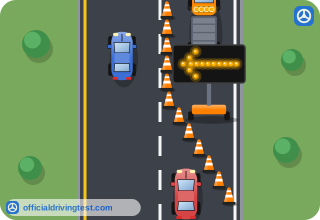
- People work in dangerous conditions near moving cars
- Speed limits there are not enforced by police
- Work zones are closed to cars during daylight
- Lane markings there are only meant as advice
Show answer
Correct answer: People work in dangerous conditions near moving cars
In work zones, people are working in dangerous conditions very close to moving vehicles, so drivers need to be extra cautious.
Source: Minnesota Driver’s Manual (June 2026), page 1
-
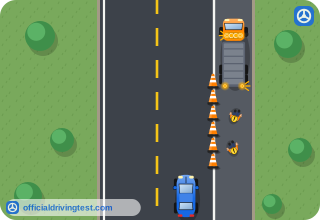
Besides distracted driving, what does the manual say you must be aware of when driving in work zones?
- School buses and crossing guards
- Railroad crossings and toll booths
- Zipper merges and altered lanes
- Snowplows and parked police cars
Show answer
Correct answer: Zipper merges and altered lanes
When driving in work zones, you must be aware of distracted driving, zipper merges and altered lanes.
Source: Minnesota Driver’s Manual (June 2026), page 1
-
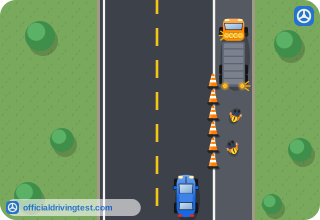
What must you do in a work or construction zone?
- Keep your speed so traffic keeps moving
- Stop and wait for a flag person to wave you on
- Change lanes as soon as you see the zone
- Slow down and drive with care
Show answer
Correct answer: Slow down and drive with care
In work or construction zones you must slow down and drive with care.
Source: Minnesota Driver’s Manual (June 2026), page 26
-
You cannot safely move a lane away from a stopped emergency vehicle with flashing lights. What must you do?
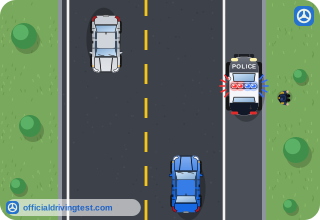
- Slow down
- Sound your horn and keep your speed
- Speed up to get past it quickly
- Sound your horn to warn the officers
Show answer
Correct answer: Slow down
If you cannot safely move a lane away from a stopped emergency vehicle with flashing lights, you must slow down and pass with caution.
Source: Minnesota Driver’s Manual (June 2026), page 27
-
If an emergency vehicle approaches while you are in a roundabout, what should you do?
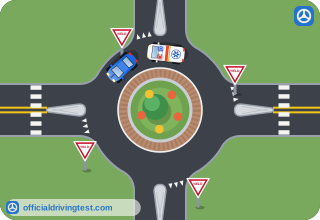
- Stop where you are inside the roundabout
- Pull over to the side inside the roundabout
- Exit the roundabout immediately and then pull over
- Continue around the roundabout once more
Show answer
Correct answer: Exit the roundabout immediately and then pull over
If an emergency vehicle approaches, exit the roundabout immediately and then pull over.
Source: Minnesota Driver’s Manual (June 2026), page 30
-
An emergency vehicle with flashing red lights and a siren or bell approaches on a two-way road. What must you do?
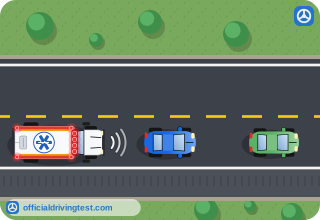
- Pull to the left and stop
- Slow down and keep driving
- Pull to the nearest side and keep moving
- Pull to the right and stop
Show answer
Correct answer: Pull to the right and stop
On a two-way road you must pull to the right and stop for an approaching emergency vehicle.
Source: Minnesota Driver’s Manual (June 2026), page 44
-
An emergency vehicle with flashing red lights and a siren approaches on a one-way road. What must you do?
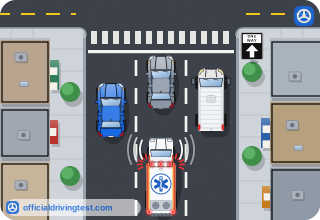
- Pull to the nearest side and stop
- Pull to the right and stop
- Pull to the left and stop
- Stay in your lane and slow down
Show answer
Correct answer: Pull to the nearest side and stop
On a one-way road you pull to the nearest side and stop.
Source: Minnesota Driver’s Manual (June 2026), page 44
-
You are in an intersection when an emergency vehicle with flashing lights and a siren approaches. What should you do?
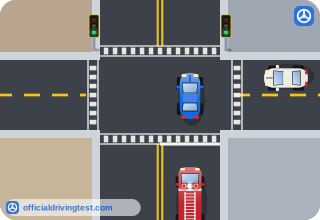
- Stop immediately where you are in the intersection
- Back up out of the intersection to the stop line
- Proceed through the intersection before stopping
- Turn around and leave the intersection quickly
Show answer
Correct answer: Proceed through the intersection before stopping
If you are in an intersection, proceed through it before stopping.
Source: Minnesota Driver’s Manual (June 2026), page 44
-
After pulling over for an emergency vehicle, how long must you remain stopped?
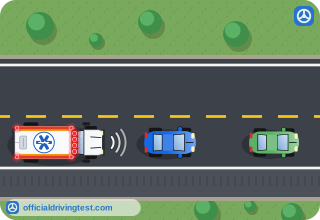
- Until the first emergency vehicle has passed
- Until all emergency vehicles have passed
- Until you can no longer hear the siren
- For at least one minute
Show answer
Correct answer: Until all emergency vehicles have passed
You must remain stopped until all emergency vehicles have passed.
Source: Minnesota Driver’s Manual (June 2026), page 44
-
For how long after failing to yield to an emergency vehicle may a law enforcement officer with probable cause arrest you?
- Within one hour
- Within 12 hours
- Within three days
- Within four hours
Show answer
Correct answer: Within four hours
An officer with probable cause may arrest you within four hours of the violation of the emergency vehicle law.
Source: Minnesota Driver’s Manual (June 2026), page 44
-
When do you not need to stop for an approaching emergency vehicle?
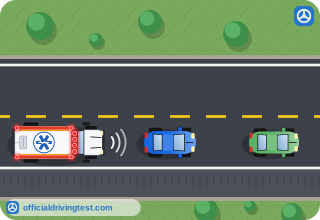
- When a fence, wall or median strip separates it from your lane
- When it is traveling on the opposite side of any road
- When you are driving more than 35 mph
- When you are already in the right-hand lane
Show answer
Correct answer: When a fence, wall or median strip separates it from your lane
You need not stop if a physical barrier like a fence, wall or median strip separates the vehicle from your lane.
Source: Minnesota Driver’s Manual (June 2026), page 44
-
An emergency vehicle with flashing lights is stopped next to a road with two lanes in your direction. What does the "Move Over Law" require if it is safe?
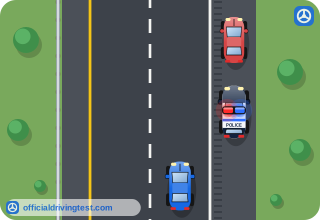
- Stop behind the stopped vehicle until it leaves
- Stay in your lane and keep the same speed
- Move to the lane farthest away from the vehicle
- Move into the lane next to the stopped vehicle
Show answer
Correct answer: Move to the lane farthest away from the vehicle
The Move Over Law requires moving to the lane farthest from the vehicle if it is safe to do so.
Source: Minnesota Driver’s Manual (June 2026), page 44
-
Under the Move Over Law, what should you do if you cannot move a lane away or have only one lane in your direction?
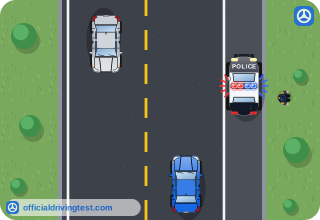
- Stop until the vehicle leaves
- Slow down and pass with caution
- Pass at the same speed
- Change lanes without signaling
Show answer
Correct answer: Slow down and pass with caution
If you cannot move over, slow down and pass with caution.
Source: Minnesota Driver’s Manual (June 2026), page 44
-
The Move Over rule also applies when you pass which of these vehicles, stopped with its warning lights activated?
- A taxi picking up a passenger
- A bicycle at the roadside
- A parked motorcycle
- A solid waste or recycling vehicle
Show answer
Correct answer: A solid waste or recycling vehicle
The manual lists solid waste and recycling vehicles stopped with warning lights among those that require the same rule.
Source: Minnesota Driver’s Manual (June 2026), page 44
-
Which vehicles are allowed to follow within 500 feet of a firefighting vehicle on an emergency run?
- Only vehicles on official emergency business
- Any vehicle traveling in the same lane
- Only vehicles that are sounding a horn
- Only vehicles below the posted speed limit
Show answer
Correct answer: Only vehicles on official emergency business
Only vehicles on official emergency business may follow within 500 feet of a firefighting vehicle on an emergency run.
Source: Minnesota Driver’s Manual (June 2026), page 44
-
When may you drive over an unprotected fire hose?
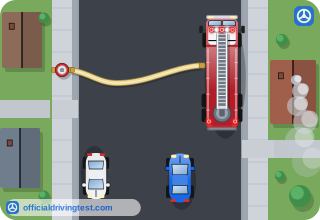
- When the hose lies across a side street and no other route exists
- When no firefighter is in sight of the hose
- When directed by a law enforcement officer or fire department official
- When you drive over it very slowly and carefully
Show answer
Correct answer: When directed by a law enforcement officer or fire department official
Do not drive over an unprotected fire hose unless directed by a law enforcement officer or fire department official.
Source: Minnesota Driver’s Manual (June 2026), page 44
-
When you see emergency lights behind you, what should you do with your speed and signal?
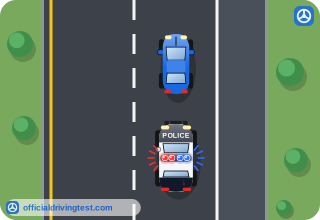
- Slow down and activate your turn signal
- Speed up to find a safe place and flash your lights
- Stop immediately in your lane
- Slow down and turn on your hazard lights only
Show answer
Correct answer: Slow down and activate your turn signal
The manual says to slow down and activate your turn signal when you see emergency lights behind you.
Source: Minnesota Driver’s Manual (June 2026), page 45
-
When you see emergency lights behind you on a multi-lane road and are closer to the left shoulder, when may you move to the left shoulder?
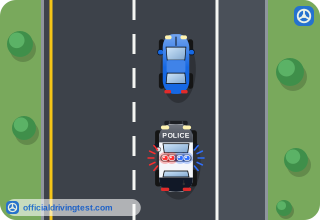
- Never, you must always use the right shoulder
- If no other cars are on the road
- If there is a full lane to park
- If the officer waves you left
Show answer
Correct answer: If there is a full lane to park
On a multi-lane road, move to the left shoulder only if you are closer to it and there is a full lane to park.
Source: Minnesota Driver’s Manual (June 2026), page 45
-
When stopped by a law enforcement officer, where should you avoid stopping?
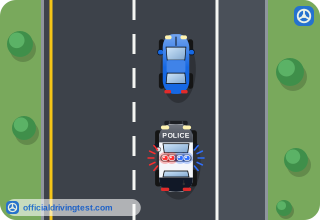
- On a straight and level section of the road
- On a bridge, curve or within the lane of traffic
- On the right shoulder as soon as it is safe
- In a well-lit area near other vehicles
Show answer
Correct answer: On a bridge, curve or within the lane of traffic
The manual says to avoid stopping on a bridge, curve or within the lane of traffic.
Source: Minnesota Driver’s Manual (June 2026), page 45
-
If you are stopped by an officer after dark, what should you do?
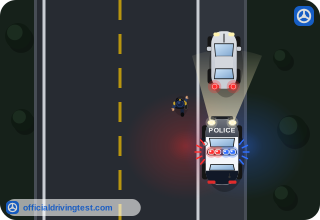
- Turn off your headlights and hazard lights
- Get out and walk toward the officer
- Keep the interior light off to avoid glare
- Turn on your vehicle's interior light
Show answer
Correct answer: Turn on your vehicle's interior light
If stopped after dark, turn on your vehicle's interior light.
Source: Minnesota Driver’s Manual (June 2026), page 45
-
During a traffic stop, what should you do with your doors and your position?
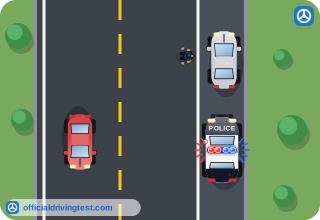
- Keep doors shut and stay in the vehicle unless told otherwise
- Open the driver's door and speak to the officer outside
- Step out and stand beside your vehicle with your hands up
- Move to the passenger seat of the vehicle at once
Show answer
Correct answer: Keep doors shut and stay in the vehicle unless told otherwise
Keep all doors shut and remain in the vehicle unless the officer directs otherwise.
Source: Minnesota Driver’s Manual (June 2026), page 45