Michigan: Railroad crossings Practice Test
Stop distances, active vs. passive crossings, and what to do if you get stuck on the tracks.
Independent educational site · not affiliated with any government agency or DMV
Ready? Test yourself
- Instant feedback with an explanation
- Every answer cites its source in the manual
- Your best score is saved on this device
- Keyboard: press 1 to 4 to answer and Enter for the next question
Questions are original and based on the official manual "What Every Driver Must Know" (October 2025), Michigan Secretary of State.
Did you know?
- In 1904, the speed limit in Saginaw was 8 mph for cars and 10 mph for bicycles.
- In 1922, the Detroit Police Department began keeping traffic crash statistics.
- In 1945, the first chemical test to identify suspected drunken drivers was administered by the Detroit Police Department.
More background reading from the manual →
All 21 questions in this practice test
Take the test above first, then use this list to study. Tap “Show answer” to see the correct answer and explanation.
Show the questions and answersHide the questions
-
According to the Michigan driver's manual, what does a 'traffic control system' for a railroad crossing include?
- Only the flashing lights and gates at the crossing
- All signs, signals, markings and illuminated devices
- Only the crossbuck sign posted at the crossing
- Only the pavement markings painted near the tracks
Show answer
Correct answer: All signs, signals, markings and illuminated devices
A traffic control system for a railroad crossing includes all signs, signals, markings and illuminated devices that allow rail and road traffic to move safely and efficiently.
Source: What Every Driver Must Know (October 2025), page 35 · Open this page in the manual (Manual page 35)
-
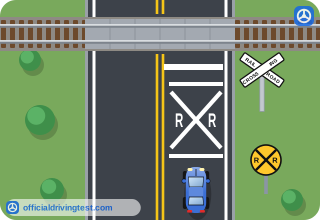
What is the general rule when approaching any railroad crossing?
- Speed up to clear the tracks before a train arrives
- Honk your horn and proceed without stopping
- Change lanes to get a better view of the tracks
- Slow down and look both ways
Show answer
Correct answer: Slow down and look both ways
When approaching any railroad crossing, drivers must slow down and look both ways, since ignoring a signal or trying to beat a train across could be fatal.
Source: What Every Driver Must Know (October 2025), page 35 · Open this page in the manual (Manual page 35)
-
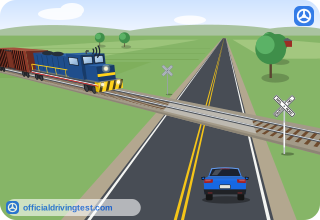
Why can it be dangerous to misjudge an approaching train?
- Trains always travel slower than the posted speed limit
- Trains can take a mile or more to stop and are closer than they appear
- Trains automatically stop before every crossing
- Trains are required to sound a horn one mile before every crossing
Show answer
Correct answer: Trains can take a mile or more to stop and are closer than they appear
Trains can take a mile or more to stop, and an approaching train is closer and moving faster than it appears, so it could be fatal to misjudge it.
Source: What Every Driver Must Know (October 2025), page 35 · Open this page in the manual (Manual page 35)
-
Whether you are on foot, on a bicycle or in a vehicle, what does the manual say about crossing railroad tracks?
- You may cross anywhere the tracks are visible and clear
- You may stop briefly on the tracks to check for traffic
- You may walk along the tracks if no train is in sight
- You should cross only at designated crossings
Show answer
Correct answer: You should cross only at designated crossings
Whether on foot, on a bicycle or in a vehicle, you should cross railroad tracks only at designated crossings. Walking down or stopping on the tracks is illegal and dangerous.
Source: What Every Driver Must Know (October 2025), page 35 · Open this page in the manual (Manual page 35)
-
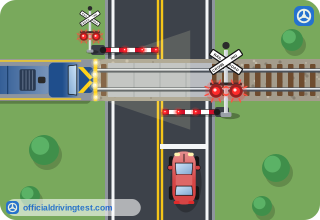
If a train is coming and you see the railroad crossing advance warning sign, where must vehicles stop?
- No more than 50 feet or less than 15 feet from the tracks
- Exactly at the crossbuck sign, regardless of distance
- No more than 15 feet or less than 50 feet from the tracks
- At least 100 feet from the tracks
Show answer
Correct answer: No more than 50 feet or less than 15 feet from the tracks
When a train is coming, all vehicles must stop no more than 50 feet and no less than 15 feet from the tracks.
Source: What Every Driver Must Know (October 2025), page 35 · Open this page in the manual (Manual page 35)
-
How far can a train overhang the tracks on each side?
- No more than 1 foot
- At least 6 feet
- At least 3 feet
- Trains never overhang the tracks
Show answer
Correct answer: At least 3 feet
Trains overhang the tracks by at least three feet on each side, and their cargo may extend even farther.
Source: What Every Driver Must Know (October 2025), page 35 · Open this page in the manual (Manual page 35)
-
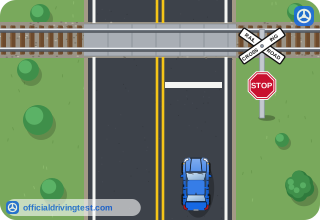
If there is a stop sign at a railroad crossing, when must you stop?
- Only if you can see or hear a train approaching
- Only during nighttime hours
- You must stop whether or not a train is in sight
- Only if the crossing gates are down
Show answer
Correct answer: You must stop whether or not a train is in sight
If there is a stop sign at the crossing, you must stop whether or not a train is in sight.
Source: What Every Driver Must Know (October 2025), page 36 · Open this page in the manual (Manual page 36)
-
Unless clearly marked otherwise, which of these vehicles must stop at a railroad crossing and make sure no train is coming, even without a stop sign or signal?
- School buses, for-hire passenger vehicles and gasoline trucks
- Motorcycles, mopeds and other two-wheeled motor vehicles
- Any passenger car or pickup truck that is towing a trailer
- Vehicles registered outside of Michigan, such as moving trucks
Show answer
Correct answer: School buses, for-hire passenger vehicles and gasoline trucks
Unless clearly marked otherwise, school buses, vehicles carrying passengers for hire, gasoline trucks and other vehicles carrying hazardous materials must stop and make sure no train is coming, even if there is no stop sign or railroad crossing signal.
Source: What Every Driver Must Know (October 2025), page 36 · Open this page in the manual (Manual page 36)
-
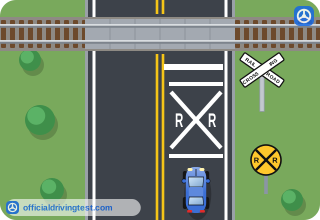
At a railroad crossing with a passive control system (no flashing lights or gates), what must a driver do?
- Proceed at normal speed since no train warning devices are present
- Only stop if another vehicle is already waiting at the crossing
- Wait for a police officer to direct traffic before crossing
- Slow down or stop as necessary, yield to rail traffic and check both ways
Show answer
Correct answer: Slow down or stop as necessary, yield to rail traffic and check both ways
Passive crossings use advance warning signs, pavement markings and crossbuck signs with yield or stop signs instead of lights or gates. Drivers must slow down or stop as necessary, yield to rail traffic, check both directions, and never race a train.
Source: What Every Driver Must Know (October 2025), page 36 · Open this page in the manual (Manual page 36)
-
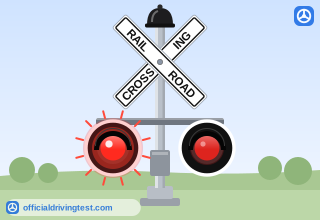
What must a driver do when encountering an active railroad crossing control system (gates, flashing lights, bells)?
- Proceed carefully as long as no train is visible
- Stop when the bells are ringing, the lights are flashing, or the gate is down or in motion
- Only stop if the gate is fully down; flashing lights alone do not require stopping
- Sound the horn and drive through quickly before the gate closes
Show answer
Correct answer: Stop when the bells are ringing, the lights are flashing, or the gate is down or in motion
No matter what active control system you encounter, you must stop when the bells are ringing, the lights are flashing, or the gate is down or in motion.
Source: What Every Driver Must Know (October 2025), page 36 · Open this page in the manual (Manual page 36)
-
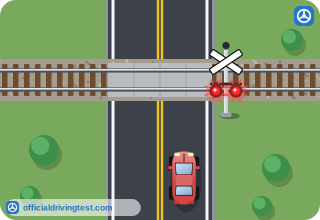
What must you never do at an activated railroad crossing signal?
- Turn off your engine while waiting
- Roll down your window to listen for the train
- Drive through, around or under the crossing gates
- Turn on your hazard lights while stopped
Show answer
Correct answer: Drive through, around or under the crossing gates
Do not drive through, around or under any activated railroad crossing system.
Source: What Every Driver Must Know (October 2025), page 36 · Open this page in the manual (Manual page 36)
-
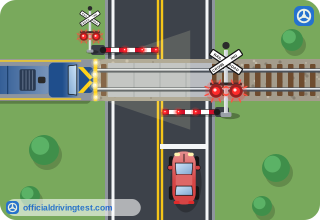
After a train has passed an activated crossing, when may you proceed?
- As soon as the train's last car has passed the crossing
- As soon as the bells stop ringing, even if the gates are still down
- Not until the gates rise, signals and bells stop, and all tracks are clear
- After waiting exactly 20 seconds from when the train passed
Show answer
Correct answer: Not until the gates rise, signals and bells stop, and all tracks are clear
Once the train has passed, do not proceed until the gates are raised, signals stop flashing, bells stop ringing and you are sure that all tracks are clear.
Source: What Every Driver Must Know (October 2025), page 36 · Open this page in the manual (Manual page 36)
-
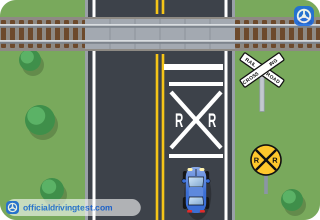
According to the grade crossing safety tips, what should you never do at a railroad crossing?
- Check both directions before crossing
- Yield to an approaching train
- Stop on the railroad tracks
- Slow down before reaching the tracks
Show answer
Correct answer: Stop on the railroad tracks
One of the key grade crossing safety tips is: never stop on railroad tracks.
Source: What Every Driver Must Know (October 2025), page 36 · Open this page in the manual (Manual page 36)
-
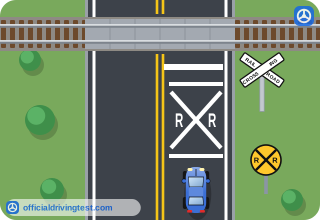
What does the manual recommend regarding your vehicle's gears while crossing railroad tracks?
- Downshift to first gear before crossing
- Shift to a higher gear only after crossing
- Shift to neutral halfway across the tracks
- Avoid changing gears while crossing the tracks
Show answer
Correct answer: Avoid changing gears while crossing the tracks
Grade crossing safety tips include: avoid changing gears while crossing railroad tracks.
Source: What Every Driver Must Know (October 2025), page 36 · Open this page in the manual (Manual page 36)
-
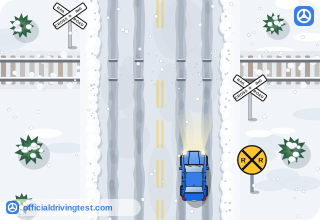
When there is snow on the road at a railroad crossing, what should you do?
- Stop completely on the tracks to check for traction
- Cross slowly in a low gear to save fuel
- Cross with enough speed to keep from getting stuck
- Wait for the snow to be cleared before crossing
Show answer
Correct answer: Cross with enough speed to keep from getting stuck
When there is snow on the road, proceed over the tracks with enough speed to prevent you from becoming stuck at the railroad crossing.
Source: What Every Driver Must Know (October 2025), page 36 · Open this page in the manual (Manual page 36)
-
If traffic signals have caused vehicles to back up near a railroad crossing, when should you cross the tracks?
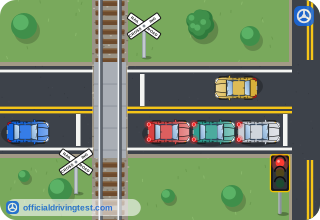
- Only if there is enough space to clear the far side by at least 6 feet
- As long as the vehicle ahead of you has already crossed
- Only if there is enough space to clear the far side by at least 3 feet
- You should never cross if any traffic is backed up ahead
Show answer
Correct answer: Only if there is enough space to clear the far side by at least 6 feet
When traffic may have backed up near a crossing, never cross the tracks unless there is enough space for your vehicle to completely clear the far side of the tracks by at least 6 feet.
Source: What Every Driver Must Know (October 2025), page 36 · Open this page in the manual (Manual page 36)
-
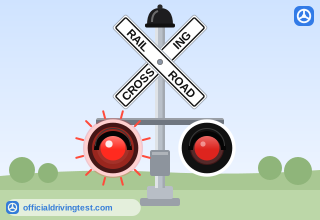
Once railroad crossing lights and gates are activated, or you hear the horn of an approaching train, about how much time do you have before the train arrives?
- About 5 seconds
- About 60 seconds
- About 2 minutes
- About 20 seconds
Show answer
Correct answer: About 20 seconds
Once railroad crossing lights and gates are activated, or you hear the horn of an approaching train, you have about 20 seconds before the train arrives.
Source: What Every Driver Must Know (October 2025), page 36 · Open this page in the manual (Manual page 36)
-
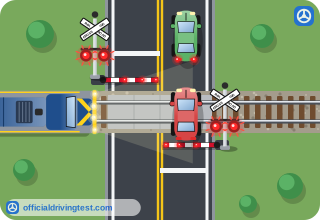
If your vehicle becomes stuck on the tracks and the crossing gates are activated or a train is clearly approaching, what should you do first?
- Try repeatedly to restart the vehicle before doing anything else
- Immediately get everyone out and far from the tracks, then call 911
- Stay in the vehicle with hazard lights on and wait for help
- Push the vehicle off the tracks before calling for help
Show answer
Correct answer: Immediately get everyone out and far from the tracks, then call 911
If the crossing gates are activated, or a train is clearly approaching, immediately get everyone out of the vehicle and as far away from the tracks as possible, then call 911.
Source: What Every Driver Must Know (October 2025), page 36 · Open this page in the manual (Manual page 36)
-
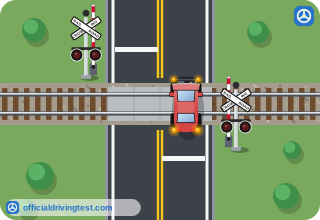
If your vehicle becomes stuck on the tracks but the crossing lights and gates are NOT activated and no train is in sight, what should you do?
- Wait inside the vehicle until a train appears
- Leave the vehicle where it is and walk home to call for help later
- Immediately call 911 only, without leaving the vehicle
- Get everyone out and away from the tracks, then call the railroad's emergency number on the blue Emergency Notification Sign and report the crossing identification number, then call 911
Show answer
Correct answer: Get everyone out and away from the tracks, then call the railroad's emergency number on the blue Emergency Notification Sign and report the crossing identification number, then call 911
If crossing lights or gates are NOT activated, or there is no train in sight, get everyone out of the vehicle and as far away from the tracks as possible, call the railroad's emergency number on the blue Emergency Notification Sign, report the problem and provide the crossing identification number, then call 911.
Source: What Every Driver Must Know (October 2025), page 36 · Open this page in the manual (Manual page 36)
-
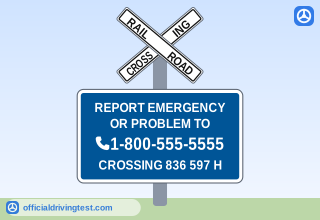
What is an Emergency Notification System (ENS) sign at a railroad crossing?
- A sign that shows the train schedule for that crossing
- A sign used to notify the railroad of an emergency or a device malfunction
- A sign that displays the speed limit for trains at that crossing
- A sign that only appears at crossings without gates
Show answer
Correct answer: A sign used to notify the railroad of an emergency or a device malfunction
An Emergency Notification System (ENS) sign, posted at or near a highway-rail grade crossing, lists a telephone number along with the crossing's US DOT number and is used to notify the railroad of an emergency or a warning device malfunction.
Source: What Every Driver Must Know (October 2025), page 37 · Open this page in the manual (Manual page 37)
-
What format is the crossing identification number shown on the Emergency Notification Sign?
- Six digits and one letter
- Four digits only
- Two letters and four digits
- A single digit
Show answer
Correct answer: Six digits and one letter
The crossing identification number shown on the Emergency Notification Sign consists of six digits and one letter.
Source: What Every Driver Must Know (October 2025), page 37 · Open this page in the manual (Manual page 37)