Michigan: 30 Hardest Driving Test Questions
Questions that need a second thought, picked for close numbers, exceptions and easy-to-confuse rules. Take your time.
Independent educational site · not affiliated with any government agency or DMV
Ready? Test yourself
- Instant feedback with an explanation
- Every answer cites its source in the manual
- Your best score is saved on this device
- Keyboard: press 1 to 4 to answer and Enter for the next question
Questions are original and based on the official manual "What Every Driver Must Know" (October 2025), Michigan Secretary of State.
All 30 questions in this practice test
Take the test above first, then use this list to study. Tap “Show answer” to see the correct answer and explanation.
Show the questions and answersHide the questions
-
Under Michigan law, leaving a child unattended in a vehicle is illegal, if it poses an unreasonable risk of harm, below what age?
- 4 years
- 6 years
- 8 years
- 10 years
Show answer
Correct answer: 6 years
It is illegal to leave a child younger than 6 unattended in a vehicle without supervision, unless supervised by a non-incapacitated person age 13 or older.
Source: What Every Driver Must Know (October 2025), page 26 · Open this page in the manual (Manual page 26)
-
A driver must stop at least how many feet from a school bus that has its red overhead lights flashing?
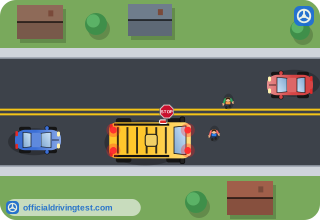
- 10 feet
- 15 feet
- 20 feet
- 30 feet
Show answer
Correct answer: 20 feet
Drivers must stop at least 20 feet from a school bus when its red overhead lights are flashing.
Source: What Every Driver Must Know (October 2025), page 28 · Open this page in the manual (Manual page 28)
-
How far behind a moving emergency vehicle with flashing lights and a sounding siren must you stay?
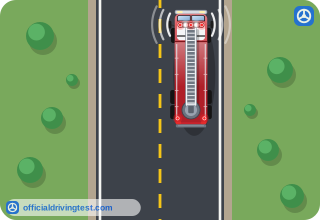
- At least 100 feet
- At least 200 feet
- At least 1,000 feet
- At least 500 feet
Show answer
Correct answer: At least 500 feet
Drivers must stay at least 500 feet behind any moving emergency vehicle displaying flashing warning lights and sounding a siren.
Source: What Every Driver Must Know (October 2025), page 28 · Open this page in the manual (Manual page 28)
-
Within what distance of an oncoming vehicle is it illegal to use or flash your high-beam headlights?
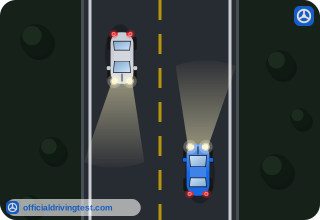
- 100 feet
- 500 feet
- 1,000 feet
- 2,500 feet
Show answer
Correct answer: 500 feet
It is illegal to use or even flash high-beam headlights within 500 feet of an oncoming vehicle.
Source: What Every Driver Must Know (October 2025), page 64 · Open this page in the manual (Manual page 64)
-
Under Michigan law, a person younger than 18 is generally prohibited from riding in the open bed of a pickup truck traveling faster than what speed?
- 10 mph
- 25 mph
- 35 mph
- 15 mph
Show answer
Correct answer: 15 mph
Anyone under 18 is prohibited from riding in an open pickup bed traveling more than 15 mph, with limited occupational/parade exceptions.
Source: What Every Driver Must Know (October 2025), page 25 · Open this page in the manual (Manual page 25)
-
How close to a stop sign, traffic light, or flashing beacon may you never park?
- Within 100 feet
- There is no set distance
- Within 30 feet
- Within 5 feet
Show answer
Correct answer: Within 30 feet
Never park within 30 feet of a stop sign, traffic light, or flashing beacon, including a warning sign.
Source: What Every Driver Must Know (October 2025), page 38 · Open this page in the manual (Manual page 38)
-
A flashing yellow arrow left-turn signal allows you to:
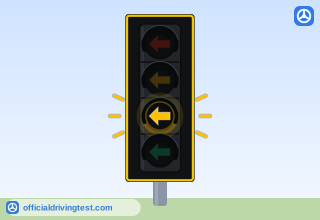
- Turn left without yielding
- Turn left when oncoming traffic is clear
- Wait until the arrow turns green
- Turn left only after stopping for 10 seconds
Show answer
Correct answer: Turn left when oncoming traffic is clear
Oncoming traffic has a green light, so you must yield. Make sure no pedestrians or bicyclists are crossing.
Source: What Every Driver Must Know (October 2025), page 50 · Open this page in the manual (Manual page 50)
-
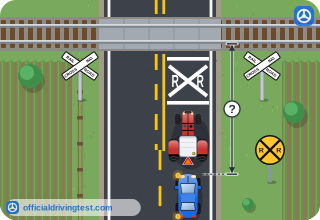
Passing is prohibited when you are within how many feet of an intersection or railroad crossing?
- 150 feet
- 200 feet
- 50 feet
- 100 feet
Show answer
Correct answer: 100 feet
Passing is prohibited within 100 feet of an intersection or railroad crossing.
Source: What Every Driver Must Know (October 2025), page 32 · Open this page in the manual (Manual page 32)
-
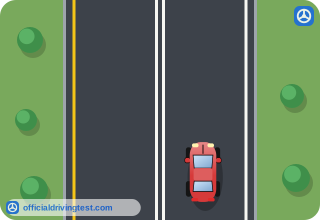
What does a double solid white line mean?
- You may cross it to pass slower traffic when safe
- Traffic on each side moves in opposite directions
- Same-direction travel on both sides; do not cross
- A bicycle lane begins just ahead
Show answer
Correct answer: Same-direction travel on both sides; do not cross
Do not cross double solid white lines.
Source: What Every Driver Must Know (October 2025), page 46 · Open this page in the manual (Manual page 46)
-
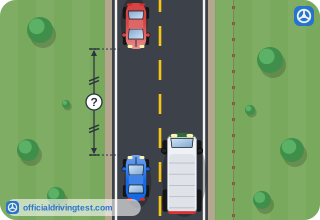
After passing another vehicle, you must return to your lane before coming within how many feet of any oncoming vehicle?
- 100 feet
- 150 feet
- 200 feet
- 300 feet
Show answer
Correct answer: 200 feet
You must return to your lane before getting within 200 feet of an oncoming vehicle.
Source: What Every Driver Must Know (October 2025), page 32 · Open this page in the manual (Manual page 32)
-
How far ahead does the manual recommend you look down the road to spot potential hazards?
- 5-10 seconds ahead
- 20-30 seconds ahead
- 1 full minute ahead
- Only as far as your headlights reach
Show answer
Correct answer: 20-30 seconds ahead
Looking 20-30 seconds down the road helps drivers spot hazards early and avoid last-second reactions.
Source: What Every Driver Must Know (October 2025), page 64 · Open this page in the manual (Manual page 64)
-
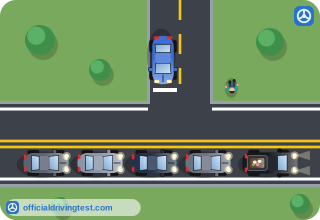
Funeral processions have the right of way over all other vehicles except for...
- delivery trucks and buses
- fire trucks, ambulances and police cars
- vehicles displaying hazard lights
- school buses only
Show answer
Correct answer: fire trucks, ambulances and police cars
Funeral processions have the right of way over all vehicles except fire trucks, ambulances, and police vehicles.
Source: What Every Driver Must Know (October 2025), page 31 · Open this page in the manual (Manual page 31)
-
In a work zone, if a construction worker's hand signals conflict with a posted traffic sign, which should a driver follow?
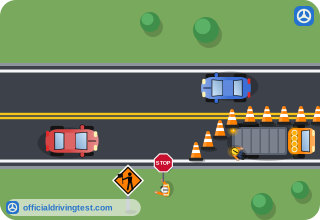
- The posted sign, since it is a legal traffic control device
- The construction worker's directions
- Whichever came first
- Neither; stop and wait for police
Show answer
Correct answer: The construction worker's directions
Construction workers have authority to direct traffic in work zones, and their directions should be followed even if they conflict with an existing traffic control device.
Source: What Every Driver Must Know (October 2025), page 27 · Open this page in the manual (Manual page 27)
-
Parking is prohibited within how many feet of the scene of a fire or a crash?
- 100 feet
- 300 feet
- 1,000 feet
- 500 feet
Show answer
Correct answer: 500 feet
Parking is prohibited within 500 feet of a fire or crash.
Source: What Every Driver Must Know (October 2025), page 38 · Open this page in the manual (Manual page 38)
-
Under Michigan's child passenger safety law, a child must ride in a car seat or booster seat until reaching which milestone, whichever comes first?
- Age 6 or 4 feet tall, whichever comes first
- Age 10 or 5 feet tall, whichever comes first
- Age 12, regardless of height
- Age 8 or 4 feet 9 inches tall, whichever comes first
Show answer
Correct answer: Age 8 or 4 feet 9 inches tall, whichever comes first
A child must stay in a car seat or booster seat until age 8 or 4'9" tall, whichever comes first.
Source: What Every Driver Must Know (October 2025), page 25 · Open this page in the manual (Manual page 25)
-
According to the manual, roughly how far does a car traveling 65 mph travel during the quarter-second it takes the brain to shift attention between two tasks?
- 12 feet
- 50 feet
- 24 feet
- 100 feet
Show answer
Correct answer: 24 feet
The manual notes a vehicle at 65 mph covers about 24 feet in the quarter-second it takes the brain to shift attention.
Source: What Every Driver Must Know (October 2025), page 23 · Open this page in the manual (Manual page 23)
-
Unless clearly marked otherwise, which of these vehicles must stop at a railroad crossing and make sure no train is coming, even without a stop sign or signal?
- School buses, for-hire passenger vehicles and gasoline trucks
- Motorcycles, mopeds and other two-wheeled motor vehicles
- Any passenger car or pickup truck that is towing a trailer
- Vehicles registered outside of Michigan, such as moving trucks
Show answer
Correct answer: School buses, for-hire passenger vehicles and gasoline trucks
Unless clearly marked otherwise, school buses, vehicles carrying passengers for hire, gasoline trucks and other vehicles carrying hazardous materials must stop and make sure no train is coming, even if there is no stop sign or railroad crossing signal.
Source: What Every Driver Must Know (October 2025), page 36 · Open this page in the manual (Manual page 36)
-
Under a Level 2 Intermediate License, unsupervised nighttime driving is generally restricted during which hours?
- 9 p.m. to 6 a.m.
- Midnight to 5 a.m.
- 10 p.m. to 5 a.m.
- 11 p.m. to 6 a.m.
Show answer
Correct answer: 10 p.m. to 5 a.m.
Level 2 license restrictions generally prohibit driving between 10 p.m. and 5 a.m. unless an exception, such as being accompanied by a qualifying adult or driving for work, applies.
Source: What Every Driver Must Know (October 2025), page 5 · Open this page in the manual (Manual page 5)
-
How close to a marked crosswalk, or to an intersection with no crosswalk, may you never park?
- Crosswalk 15 feet; intersection 20 feet
- Within 50 feet of either
- There is no distance requirement
- Crosswalk 20 feet; intersection 15 feet
Show answer
Correct answer: Crosswalk 20 feet; intersection 15 feet
Never park within 20 feet of a marked crosswalk or 15 feet of an intersection if there is no crosswalk.
Source: What Every Driver Must Know (October 2025), page 39 · Open this page in the manual (Manual page 39)
-
If a train is coming and you see the railroad crossing advance warning sign, where must vehicles stop?
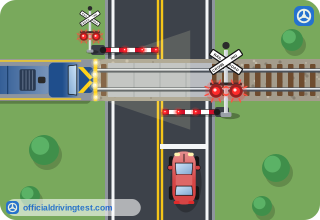
- No more than 50 feet or less than 15 feet from the tracks
- Exactly at the crossbuck sign, regardless of distance
- No more than 15 feet or less than 50 feet from the tracks
- At least 100 feet from the tracks
Show answer
Correct answer: No more than 50 feet or less than 15 feet from the tracks
When a train is coming, all vehicles must stop no more than 50 feet and no less than 15 feet from the tracks.
Source: What Every Driver Must Know (October 2025), page 35 · Open this page in the manual (Manual page 35)
-
How close to a fire station driveway may you never park?
- Within 20 feet on the same side, 75 feet on the other side if marked
- Within 15 feet on the same side, 50 feet on the other side if marked
- Within 100 feet on either side
- There is no minimum distance
Show answer
Correct answer: Within 20 feet on the same side, 75 feet on the other side if marked
Never park within 20 feet of a fire station driveway on the same side of the street or, when marked, within 75 feet of the driveway on the other side.
Source: What Every Driver Must Know (October 2025), page 38 · Open this page in the manual (Manual page 38)
-
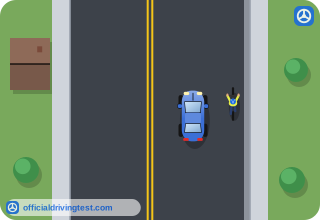
How much space does Michigan law require when passing a bicyclist?
- At least 1 foot
- At least 3 feet
- At least 10 feet
- No specific distance is required
Show answer
Correct answer: At least 3 feet
Michigan law requires leaving at least 3 feet of space between your vehicle and a bicyclist when passing; some cities require even more.
Source: What Every Driver Must Know (October 2025), page 57 · Open this page in the manual (Manual page 57)
-
On freeways posted at 70 mph, what is the maximum speed generally allowed for school buses and trucks?
- 55 mph
- 60 mph
- 70 mph, same as other traffic
- 65 mph
Show answer
Correct answer: 65 mph
School buses and trucks are restricted to 65 mph on freeways posted at 70 mph (55 mph where the posted limit is lower).
Source: What Every Driver Must Know (October 2025), page 26 · Open this page in the manual (Manual page 26)
-
Under Michigan law, which of the following is part of the legal definition of a moped?
- An engine of at least 125 cc with no maximum speed limit
- A requirement that the rider be at least 21 years old
- An engine of 100 cc or less and a top speed of 30 mph or less
- At least four wheels and a manual gear-shifting system
Show answer
Correct answer: An engine of 100 cc or less and a top speed of 30 mph or less
Michigan law defines a moped as having two or three wheels, an engine no greater than 100 cc, and a top speed no greater than 30 mph on level ground.
Source: What Every Driver Must Know (October 2025), page 56 · Open this page in the manual (Manual page 56)
-
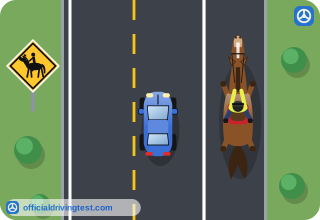
When following a horse and rider or horse-drawn buggy, you should reduce your speed to about ___ and keep a distance of at least ___.
- 5-10 mph / 5 feet
- 40 mph / 100 feet
- 15-20 mph / 20 feet
- 30-35 mph / 50 feet
Show answer
Correct answer: 15-20 mph / 20 feet
Reduce your speed to 15-20 mph and maintain at least 20 feet of distance so as not to spook the horse.
Source: What Every Driver Must Know (October 2025), page 54 · Open this page in the manual (Manual page 54)
-
Unless posted otherwise, what are the maximum and minimum speed limits on Michigan freeways?
- 65 mph maximum / 45 mph minimum
- 70 mph maximum / 55 mph minimum
- 75 mph maximum / 50 mph minimum
- 70 mph maximum, no minimum
Show answer
Correct answer: 70 mph maximum / 55 mph minimum
The manual sets a 70 mph maximum and 55 mph minimum on freeways unless posted otherwise.
Source: What Every Driver Must Know (October 2025), page 26 · Open this page in the manual (Manual page 26)
-
Driving 16 mph or more over the legal speed limit adds how many points to your Michigan driving record?
- 6 points
- 3 points
- 2 points
- 4 points
Show answer
Correct answer: 4 points
Driving 16 mph or more over the legal speed limit is a 4-point violation, the same category as drag racing and impaired driving.
Source: What Every Driver Must Know (October 2025), page 14 · Open this page in the manual (Manual page 14)
-
For a driver with one or more prior drug convictions within the past seven years, how long is a subsequent drug-related license suspension, and when can a restricted license be issued?
- Six months, with no restricted license for the first 30 days
- Two years, with no restricted license allowed at all
- One year, with no restricted license for the first 60 days
- 90 days, with no restricted license for the first 15 days
Show answer
Correct answer: One year, with no restricted license for the first 60 days
One or more prior drug convictions within seven years means the license is suspended for one year, with no restricted license during the first 60 days.
Source: What Every Driver Must Know (October 2025), page 15 · Open this page in the manual (Manual page 15)
-
Which totals of violations or points on a Michigan driving record within a two-year period will trigger a required driver assessment reexamination?
- Four or more one-point violations, or 8 or more points
- Six or more one-point violations, or 12 or more points
- Two or more one-point violations, or 6 or more points
- Ten or more one-point violations, or 20 or more points
Show answer
Correct answer: Six or more one-point violations, or 12 or more points
Six or more one-point violations, or 12 or more points, within a two-year period requires a driver assessment reexamination.
Source: What Every Driver Must Know (October 2025), page 13 · Open this page in the manual (Manual page 13)
-
A passenger vehicle traveling 55 mph can stop in about 130 feet. About how far does a commercial vehicle need to stop from the same speed?
- About 130 feet
- About 200 feet
- About 400 feet
- About 600 feet
Show answer
Correct answer: About 400 feet
A commercial vehicle traveling 55 mph needs about 400 feet to stop, compared to about 130 feet for a passenger vehicle at the same speed.
Source: What Every Driver Must Know (October 2025), page 53 · Open this page in the manual (Manual page 53)