Maryland: Sharing the road — Part 3 Practice Test
Large trucks and their No-Zones, school buses, motorcycles, bicycles and the passing distance, mopeds, scooters and low-speed vehicles, and aggressive driving. — Part 3
Independent educational site · not affiliated with any government agency or DMV
Ready? Test yourself
- Instant feedback with an explanation
- Every answer cites its source in the manual
- Your best score is saved on this device
Questions are original and based on the official manual "Maryland Driver’s Manual" (October 2025 Edition (DL-002 10-25)), Maryland Motor Vehicle Administration.
All 34 questions in this practice test
Take the test above first, then use this list to study. Tap “Show answer” to see the correct answer and explanation.
Show the questions and answersHide the questions
-
On roads without shoulders, or when cars are parked along the right side, where is a bicyclist often safest riding?
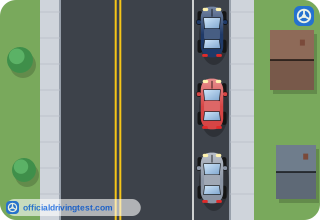
- As close to the parked cars as possible
- In the center of the travel lane
- Along the left edge of the road
- As close to the right edge as possible
Show answer
Correct answer: In the center of the travel lane
On roads without shoulders, or when cars are parked along the right side, a bicyclist is often safest riding in the center of the travel lane.
Source: Maryland Driver’s Manual (October 2025 Edition (DL-002 10-25)), page 40
-
In Maryland, when may a bicyclist use the full lane even while traveling significantly below the speed of traffic?
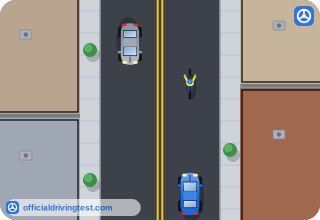
- When the bicyclist is riding with a group of other bicyclists
- When the road has no bike lane and no sidewalk beside it
- When no motor vehicle is following the bicycle
- If the lane is too narrow for a motor vehicle to safely pass it
Show answer
Correct answer: If the lane is too narrow for a motor vehicle to safely pass it
A bicyclist may use the full lane, even while traveling significantly below the speed of traffic, if the lane is too narrow for a motor vehicle to safely pass the bicycle in the lane.
Source: Maryland Driver’s Manual (October 2025 Edition (DL-002 10-25)), page 40
-
Before opening a car door, what should you do?
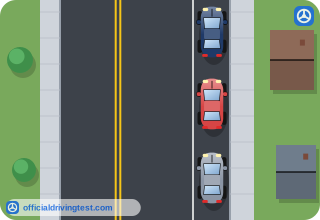
- Check for bicyclists who may be approaching from behind
- Honk your horn to warn anyone behind your vehicle
- Turn on your hazard lights before getting out
- Open the door slowly and watch for pedestrians ahead
Show answer
Correct answer: Check for bicyclists who may be approaching from behind
Before opening a car door you should check for bicyclists who may be approaching from behind.
Source: Maryland Driver’s Manual (October 2025 Edition (DL-002 10-25)), page 40
-
What can follow when you fail to yield right of way to a bicycle and a crash results?
- Fines and/or prison time, plus points on your driving record
- Points on your driving record only, with no fines or prison time
- A written warning only, with no points on your record
- A fine only, with no prison time and no points added
Show answer
Correct answer: Fines and/or prison time, plus points on your driving record
Failing to yield right of way to a bicycle, if it results in a crash, carries fines and or prison time and points on your driving record.
Source: Maryland Driver’s Manual (October 2025 Edition (DL-002 10-25)), page 40
-
What may local jurisdictions do about bicycles on sidewalks?
- Require bicyclists to ride on them
- Charge bicyclists a fee to use them
- Prohibit their use
- Allow them only on weekends
Show answer
Correct answer: Prohibit their use
Bicycles are allowed on sidewalks throughout the state, but local jurisdictions can prohibit the use of bicycles on sidewalks.
Source: Maryland Driver’s Manual (October 2025 Edition (DL-002 10-25)), page 40
-
When a bicyclist rides on a sidewalk, whom must the bicyclist give the right-of-way?
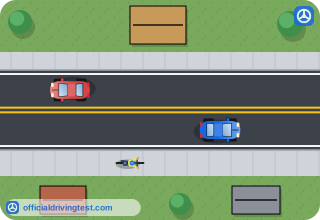
- Only motor vehicles crossing the sidewalk
- Pedestrians and those in assisted mobility devices
- Other bicyclists and skateboarders
- Nobody, because bicycles have priority on sidewalks
Show answer
Correct answer: Pedestrians and those in assisted mobility devices
A bicyclist riding on a sidewalk must give pedestrians and those in assisted mobility devices the right-of-way.
Source: Maryland Driver’s Manual (October 2025 Edition (DL-002 10-25)), page 40
-
At what times should you expect to find bicyclists on the road?
- Only during daylight hours
- Only on weekends and holidays
- Only when the weather is dry
- At all times of the day and night
Show answer
Correct answer: At all times of the day and night
The manual says to expect bicyclists in all kinds of weather and at all times of the day and night.
Source: Maryland Driver’s Manual (October 2025 Edition (DL-002 10-25)), page 40
-
As you approach a bicyclist, what should you do?
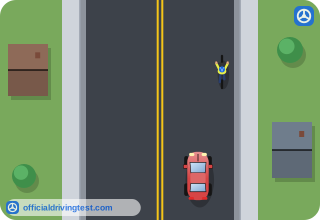
- Slow down
- Speed up to pass quickly
- Flash your high beams
- Tap your horn twice
Show answer
Correct answer: Slow down
As you approach a bicyclist you should slow down, and you should not honk your horn.
Source: Maryland Driver’s Manual (October 2025 Edition (DL-002 10-25)), page 40
-
Why should you not honk your horn at a bicyclist you are approaching?
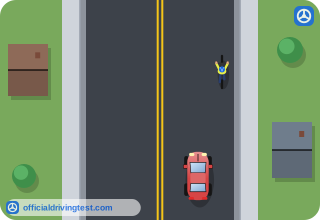
- Bicyclists cannot hear approaching vehicles
- Bicyclists must stop whenever they hear a horn
- Loud noises can startle a bicyclist and cause a crash
- Honking is only allowed in school zones
Show answer
Correct answer: Loud noises can startle a bicyclist and cause a crash
Bicyclists can usually hear an approaching vehicle, and loud noises can startle them and cause a crash.
Source: Maryland Driver’s Manual (October 2025 Edition (DL-002 10-25)), page 40
-
Bicycles do not have turn signals. How do bicyclists tell you what they plan to do?
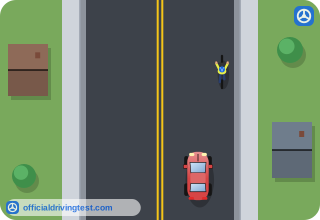
- By ringing a bell
- With hand and arm signals
- By flashing a rear light
- By moving to the edge of the lane
Show answer
Correct answer: With hand and arm signals
Because bicycles do not have turn signals, bicyclists use hand and arm signals to show what they plan to do.
Source: Maryland Driver’s Manual (October 2025 Edition (DL-002 10-25)), page 40
-
Why should you not follow a bicycle too closely?
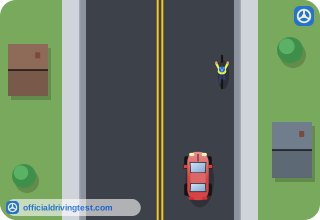
- Bicycles cannot stop quickly and a bicyclist may not hear your vehicle
- Bicycles have no brakes, so a bicyclist may roll into your car
- Bicyclists are required to ride at least 3 feet ahead of cars
- A bicyclist may swerve or change speed to avoid a hazard you cannot see
Show answer
Correct answer: A bicyclist may swerve or change speed to avoid a hazard you cannot see
Bicycles can stop and move quickly, so a bicyclist may swerve or change speed to avoid a road hazard that a motor vehicle driver cannot see.
Source: Maryland Driver’s Manual (October 2025 Edition (DL-002 10-25)), page 40
-
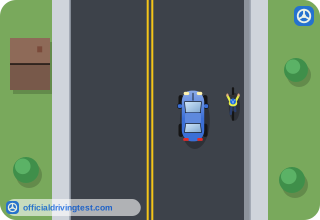
How much space must you leave between your vehicle and a bicycle when passing?
- At least 3 feet
- At least 1 foot
- At least 2 feet
- At least 5 feet
Show answer
Correct answer: At least 3 feet
When passing a bicyclist you must leave at least 3 feet between your vehicle and the bicycle.
Source: Maryland Driver’s Manual (October 2025 Edition (DL-002 10-25)), page 40
-
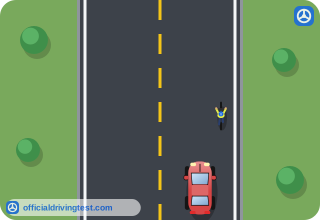
When passing a bicyclist, what should you be prepared to do?
- Speed up so you pass before the bicyclist reacts
- Cross the center line whenever a bicyclist is ahead
- Slow down and wait until oncoming traffic is clear
- Honk to make the bicyclist move to the shoulder
Show answer
Correct answer: Slow down and wait until oncoming traffic is clear
You pass a bicyclist like any slow-moving vehicle: be prepared to slow down and wait until oncoming traffic is clear.
Source: Maryland Driver’s Manual (October 2025 Edition (DL-002 10-25)), page 40
-
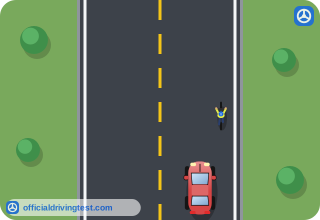
Before returning to your lane after passing a bicycle, what must you make sure of?
- That the bicyclist has signaled for you to pass
- That you see the bicycle in your rear-view mirror
- That the bicyclist has moved onto the shoulder
- That oncoming traffic has slowed down
Show answer
Correct answer: That you see the bicycle in your rear-view mirror
After passing, make sure you see the bicycle in your rear-view mirror before returning to your lane.
Source: Maryland Driver’s Manual (October 2025 Edition (DL-002 10-25)), page 40
-
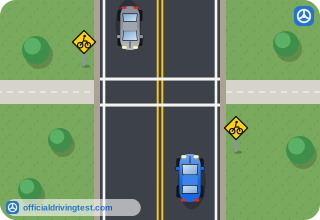
Bicyclists often ride on sidewalks and trails. What should you do before crossing a sidewalk or trail?
- Look both ways before crossing
- Honk your horn before crossing it
- Flash your headlights at the trail
- Stop and set the parking brake
Show answer
Correct answer: Look both ways before crossing
Because bicyclists often ride on sidewalks and trails, you should look both ways before crossing a sidewalk or trail.
Source: Maryland Driver’s Manual (October 2025 Edition (DL-002 10-25)), page 41
-
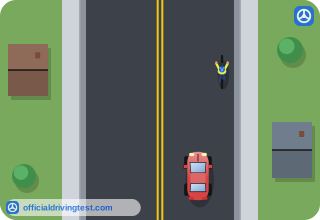
Why should drivers remember that experienced bicyclists often ride very fast?
- They may be closer than you think
- They must ride in the left lane
- They are allowed on interstate highways
- They never need to signal their turns
Show answer
Correct answer: They may be closer than you think
Experienced bicyclists often ride very fast (as fast as 35 mph) and may be closer than you think.
Source: Maryland Driver’s Manual (October 2025 Edition (DL-002 10-25)), page 41
-
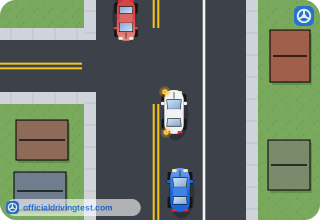
Before you move right to pass a vehicle that is turning left, what should you look closely for?
- Parked cars
- Railroad crossings
- School buses
- Bicycles
Show answer
Correct answer: Bicycles
You should look closely for bicycles before you move right to pass a vehicle that is turning left.
Source: Maryland Driver’s Manual (October 2025 Edition (DL-002 10-25)), page 41
-
When a road narrows for a bridge, parked cars, or other obstructions on the right, what should you be prepared for?
- A bicyclist on the shoulder merging left into the travel lane
- A bicyclist staying on the shoulder through the narrow part
- A bicyclist riding toward you in the left lane
- A bicyclist speeding up to pass on the right
Show answer
Correct answer: A bicyclist on the shoulder merging left into the travel lane
When a road narrows because of a bridge, parked cars or other obstructions on the right, be prepared for a bicyclist riding on the shoulder to merge left into the travel lane.
Source: Maryland Driver’s Manual (October 2025 Edition (DL-002 10-25)), page 41
-
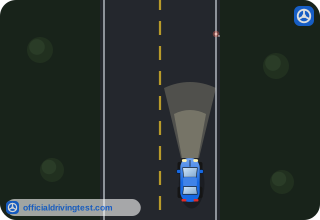
If you see a dim reflective object at night, what should you NOT assume?
- That it is moving
- That it is a bicycle
- That it is off the road
- That it is far ahead
Show answer
Correct answer: That it is off the road
A dim reflective object at night could be a bicycle in a travel lane, so do not assume it is off the road.
Source: Maryland Driver’s Manual (October 2025 Edition (DL-002 10-25)), page 41
-
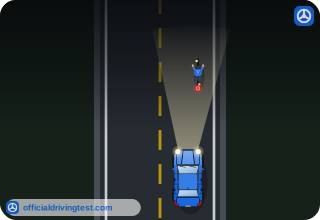
Why do bicyclists sometimes avoid shoulders at night when there are no cars?
- The law requires bicyclists to use the travel lane at night
- Tree branches, potholes, debris and the pavement edge are hard to see
- Shoulders are reserved for disabled vehicles after dark
- Bicycle lights cannot shine on a paved shoulder
Show answer
Correct answer: Tree branches, potholes, debris and the pavement edge are hard to see
At night, tree branches, potholes, debris and even the edge of the pavement are difficult to see, so bicyclists sometimes avoid shoulders.
Source: Maryland Driver’s Manual (October 2025 Edition (DL-002 10-25)), page 41
-
When approaching a bicycle at night, which headlights should you use?
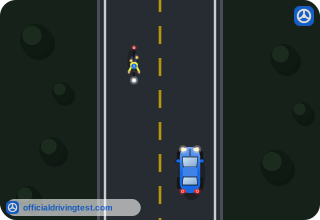
- High beam headlights
- Parking lights only
- Fog lights only
- Low beam headlights
Show answer
Correct answer: Low beam headlights
When approaching a bicycle, you should use your low beam headlights.
Source: Maryland Driver’s Manual (October 2025 Edition (DL-002 10-25)), page 41
-
Which bicyclists are most likely to change direction without warning?
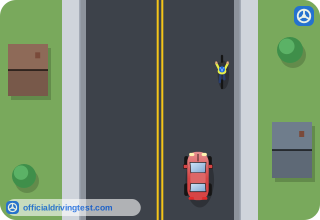
- Young bicyclists
- Experienced bicyclists
- Bicyclists in bike lanes
- Bicyclists on sidewalks
Show answer
Correct answer: Young bicyclists
Young bicyclists are most likely to change direction without warning.
Source: Maryland Driver’s Manual (October 2025 Edition (DL-002 10-25)), page 41
-
Why should you obey speed limits in school zones and residential areas?
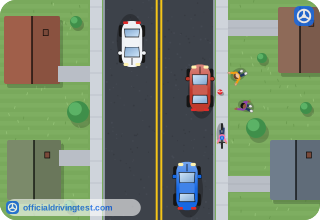
- So young bicyclists will not need to use hand and arm signals
- So bicyclists are required to obey the same limits
- So you have time to see, and drive safely around, young bicyclists
- So you can pass bicyclists at a higher speed
Show answer
Correct answer: So you have time to see, and drive safely around, young bicyclists
Obeying speed limits in school zones and residential areas gives you time to see, and drive safely around, young bicyclists.
Source: Maryland Driver’s Manual (October 2025 Edition (DL-002 10-25)), page 41
-
Where should you be aware of bicyclists entering the road?
- Only at marked bike crossings
- From driveways or near parked cars
- Only at signalized intersections
- From railroad crossings
Show answer
Correct answer: From driveways or near parked cars
Be aware of bicyclists entering the road from driveways or near parked cars.
Source: Maryland Driver’s Manual (October 2025 Edition (DL-002 10-25)), page 41
-
What must drivers of mopeds and motor scooters follow?
- The bicycle rules instead of traffic laws
- The rules for pedestrians on sidewalks
- Traffic laws only on roads over 50 mph
- All traffic laws
Show answer
Correct answer: All traffic laws
Drivers of mopeds and motor scooters must follow all traffic laws.
Source: Maryland Driver’s Manual (October 2025 Edition (DL-002 10-25)), page 41
-
Why must drivers of cars and trucks always watch for mopeds and scooters?
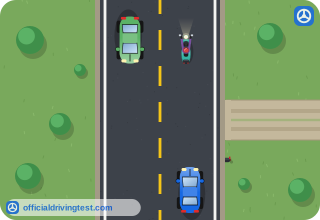
- Their size makes them very difficult to see
- They always ride in the center of the lane
- They are exempt from most traffic laws
- They travel faster than any other vehicle
Show answer
Correct answer: Their size makes them very difficult to see
Drivers of cars and trucks must always watch for mopeds and scooters because their size makes them very difficult to see.
Source: Maryland Driver’s Manual (October 2025 Edition (DL-002 10-25)), page 41
-
On which roads may mopeds and scooters be ridden?
- Any road with a posted maximum speed limit of 35 miles per hour or less
- Any road with a posted maximum speed limit of 45 miles per hour or less
- Any road with a posted maximum speed limit of 50 miles per hour or less
- Any road with a posted maximum speed limit of 55 miles per hour or less
Show answer
Correct answer: Any road with a posted maximum speed limit of 50 miles per hour or less
Mopeds and scooters may be ridden on any road with a posted maximum speed limit of 50 miles per hour or less.
Source: Maryland Driver’s Manual (October 2025 Edition (DL-002 10-25)), page 41
-
How may mopeds and scooters ride?
- In single file, never side-by-side
- Side-by-side or alone
- Alone, never beside another rider
- In groups of three or more
Show answer
Correct answer: Side-by-side or alone
Mopeds and scooters may ride side-by-side or alone.
Source: Maryland Driver’s Manual (October 2025 Edition (DL-002 10-25)), page 41
-
Where may mopeds and scooters ride?
- Only on the road, never on the shoulder
- Only on the shoulder, never on the road
- On the road or on the sidewalk
- On the road or on the shoulder
Show answer
Correct answer: On the road or on the shoulder
Mopeds and scooters may ride on the road or on the shoulder.
Source: Maryland Driver’s Manual (October 2025 Edition (DL-002 10-25)), page 41
-
Where should mopeds and scooters ride on the road?
- As close to the right side of the road as they safely can
- In the center of the lane so drivers can see them
- As close to the center line as they safely can
- In the left lane of multi-lane roads
Show answer
Correct answer: As close to the right side of the road as they safely can
Mopeds and scooters should ride as close to the right side of the road as they safely can.
Source: Maryland Driver’s Manual (October 2025 Edition (DL-002 10-25)), page 41
-
Besides at intersections, where should you be especially careful around mopeds and scooters?
- On wide roads with several lanes in each direction
- On roads with very light traffic and few turns
- On narrow roads with little room for passing
- On roads with a wide shoulder beside the lane
Show answer
Correct answer: On narrow roads with little room for passing
Be especially careful around mopeds and scooters at intersections and on narrow roads with little room for passing.
Source: Maryland Driver’s Manual (October 2025 Edition (DL-002 10-25)), page 41
-
How should a bicyclist ride, according to the rules of the road?
- Straight and single file in a predictable manner
- Two abreast in a tight group
- In a weaving pattern to stay alert
- Slowly in the middle of the road at all times
Show answer
Correct answer: Straight and single file in a predictable manner
The manual says to ride straight and single file in a predictable manner.
Source: Maryland Driver’s Manual (October 2025 Edition (DL-002 10-25)), page 53
-
What should a bicyclist do about pedestrians and traffic signals and signs?
- Yield only to motor vehicles and obey signals on busy streets
- Ignore signals when no cars are in sight
- Yield to pedestrians and obey all traffic signals and signs
- Obey signals but not stop signs
Show answer
Correct answer: Yield to pedestrians and obey all traffic signals and signs
Bicyclists must yield to pedestrians and obey all traffic signals and signs.
Source: Maryland Driver’s Manual (October 2025 Edition (DL-002 10-25)), page 53
-
What should a bicyclist plan ahead and allow time to get around?
- Only other bicyclists and pedestrians
- Road hazards, traffic, and open car doors
- Only parked trailers and large trucks
- Only school buses and emergency vehicles
Show answer
Correct answer: Road hazards, traffic, and open car doors
Bicyclists should plan ahead and allow time to get around road hazards and to deal with traffic and open car doors.
Source: Maryland Driver’s Manual (October 2025 Edition (DL-002 10-25)), page 53