Maine: Speed and following distance — Part 4 Practice Test
Managing speed, Maine speed limits, stopping distances, space cushions, night driving and road conditions. — Part 4
Independent educational site · not affiliated with any government agency or DMV
Ready? Test yourself
- Instant feedback with an explanation
- Every answer cites its source in the manual
- Your best score is saved on this device
Questions are original and based on the official manual "Maine Driver’s License Manual" (Rev 4/24), Maine Bureau of Motor Vehicles.
All 32 questions in this practice test
Take the test above first, then use this list to study. Tap “Show answer” to see the correct answer and explanation.
Show the questions and answersHide the questions
-
In which of these situations should you increase your following distance?
- At night, in fog, or in bad weather
- In light traffic on a clear, dry day
- When driving alone in daylight on a dry road
- When there is no vehicle ahead of you
Show answer
Correct answer: At night, in fog, or in bad weather
You should always increase your following distance at night, in fog, or in bad weather.
Source: Maine Driver’s License Manual (Rev 4/24), page 8-12 · Open this page in the manual (Manual page 8-12)
-
How does the extra weight of a heavy load or a trailer affect your driving?
- It shortens your braking distance
- It reduces your reaction time
- It increases your braking distance
- It has no effect if the brakes are good
Show answer
Correct answer: It increases your braking distance
When you have a heavy load or are pulling a trailer, the extra weight increases your braking distance.
Source: Maine Driver’s License Manual (Rev 4/24), page 8-12 · Open this page in the manual (Manual page 8-12)
-
Who has more control over the space behind your vehicle?
- You do
- Neither driver
- The driver two cars ahead of you
- The driver behind you
Show answer
Correct answer: The driver behind you
The driver behind you has more control over the space behind you than you do, but you can help with a steady speed and early signals.
Source: Maine Driver’s License Manual (Rev 4/24), page 8-14 · Open this page in the manual (Manual page 8-14)
-
How can you help the driver behind you when you plan to slow down or turn?
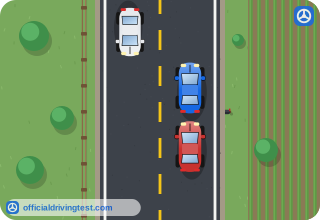
- Maintain a steady speed and signal in advance
- Brake hard as soon as you see the turn
- Pull to the center line to make room for them
- Flash your high beams at the driver behind you
Show answer
Correct answer: Maintain a steady speed and signal in advance
You can help by maintaining a steady speed and signaling in advance when you plan to slow down or turn.
Source: Maine Driver’s License Manual (Rev 4/24), page 8-14 · Open this page in the manual (Manual page 8-14)
-
If you are being followed too closely and there is a lane to your right, what should you do?
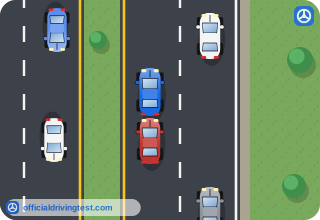
- Brake firmly to make the driver back off
- Speed up to leave the tailgater far behind
- Move over to encourage the other driver to pass
- Stay in your lane and tap your brakes lightly
Show answer
Correct answer: Move over to encourage the other driver to pass
With a lane to your right, you move over to encourage the tailgating driver to pass.
Source: Maine Driver’s License Manual (Rev 4/24), page 8-14 · Open this page in the manual (Manual page 8-14)
-
If you are being followed too closely and there is no lane to your right, what should you do?
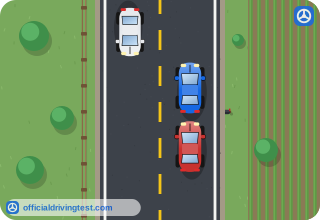
- Slow down sharply so the driver is forced to pass you
- Wait until the way ahead is clear, then reduce speed slowly
- Speed up at once to get far away from the tailgater
- Turn on your hazard flashers and hold your speed steady
Show answer
Correct answer: Wait until the way ahead is clear, then reduce speed slowly
With no right lane, wait until the way ahead is clear and then reduce speed slowly to encourage the tailgater to pass.
Source: Maine Driver’s License Manual (Rev 4/24), page 8-14 · Open this page in the manual (Manual page 8-14)
-
What is one of the biggest problems drivers have when they share space with other traffic?
- Finding a place to park their vehicle
- Judging how much space they are going to need
- Remembering to cancel turn signals after a turn
- Seeing traffic signs at night
Show answer
Correct answer: Judging how much space they are going to need
The manual says one of the biggest problems drivers have is judging how much space they are going to need.
Source: Maine Driver’s License Manual (Rev 4/24), page 8-14 · Open this page in the manual (Manual page 8-14)
-
According to the manual, how many feet does a loaded truck at 55 mph take at least to stop?
- 135 feet
- 335 feet
- 235 feet
- 435 feet
Show answer
Correct answer: 335 feet
A loaded truck at 55 mph takes at least 335 feet to stop.
Source: Maine Driver’s License Manual (Rev 4/24), page 10-7 · Open this page in the manual (Manual page 10-7)
-
Compared with the distance a car needs to stop, a loaded truck at 55 mph needs a stopping distance that is:
- about half as long as a car's
- about the same as a car's
- a little shorter than a car's
- more than 1 1/2 times as long
Show answer
Correct answer: more than 1 1/2 times as long
The manual says a loaded truck's stopping distance at 55 mph is more than 1 1/2 times the stopping distance a car would need.
Source: Maine Driver’s License Manual (Rev 4/24), page 10-7 · Open this page in the manual (Manual page 10-7)
-
At night, what should you look for as you search well ahead of your headlight beams?
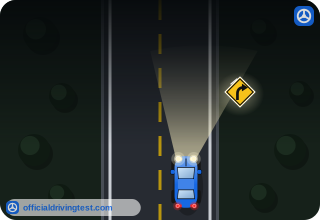
- Only reflective road signs
- Dark shapes in or near the roadway
- Only brake lights of other vehicles
- The glare of oncoming vehicles
Show answer
Correct answer: Dark shapes in or near the roadway
The manual says to search well ahead of your headlight beams, looking for dark shapes in or near the roadway.
Source: Maine Driver’s License Manual (Rev 4/24), page 11-1 · Open this page in the manual (Manual page 11-1)
-
Why should you glance to the right and left at night?
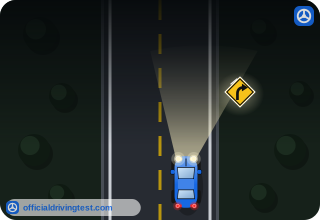
- To count the vehicles that are behind you on the road
- To read the road signs on both sides of the road
- To keep your eyes from tiring on a long drive
- To check the pavement edges and possible hazards to the sides
Show answer
Correct answer: To check the pavement edges and possible hazards to the sides
Glancing right and left lets you check the pavement edges and possible hazards to the sides.
Source: Maine Driver’s License Manual (Rev 4/24), page 11-1 · Open this page in the manual (Manual page 11-1)
-
Why should you slow down and increase your following distance on gravel or dirt roads?
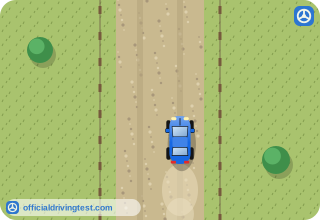
- Dust cuts down how far your headlights can reach
- There is less traction, so a skid may occur when stopping
- They are always narrower than paved roads
- Stones cannot be seen at higher speeds
Show answer
Correct answer: There is less traction, so a skid may occur when stopping
Gravel and dirt have less traction and may cause a skid when stopping.
Source: Maine Driver’s License Manual (Rev 4/24), page 11-3 · Open this page in the manual (Manual page 11-3)
-
Rural roads are narrower and may have what instead of shoulders?
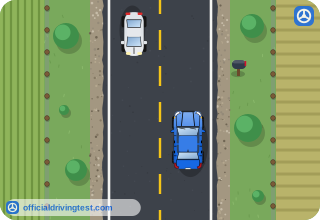
- Curbs or sidewalks
- Wide gravel lanes
- Guardrails
- Ditches or drop offs
Show answer
Correct answer: Ditches or drop offs
Rural roads are narrower and may have ditches or drop offs instead of shoulders.
Source: Maine Driver’s License Manual (Rev 4/24), page 11-3 · Open this page in the manual (Manual page 11-3)
-
On a narrow rural road, where should you place your vehicle, and what should you look for?
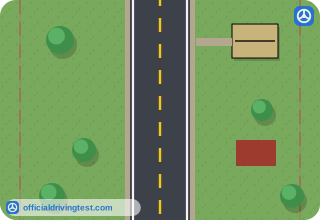
- Center it in your lane; watch for oncoming traffic crowding it
- Keep near the right edge and watch for deer on the shoulder
- Keep near the center line and watch for bicycles ahead
- Straddle the shoulder and watch for farm vehicles
Show answer
Correct answer: Center it in your lane; watch for oncoming traffic crowding it
You should slow down and center your vehicle in your lane, watching for oncoming traffic that may be in or crowding your lane.
Source: Maine Driver’s License Manual (Rev 4/24), page 11-3 · Open this page in the manual (Manual page 11-3)
-
What should you keep when crossing open bridge gratings or steel bridges?
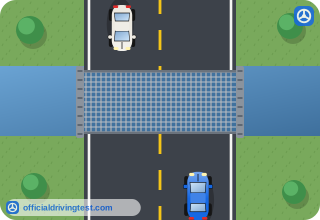
- A loose hold on the steering wheel
- A firm grip on the steering wheel
- One hand free for signaling
- Your foot resting on the brake
Show answer
Correct answer: A firm grip on the steering wheel
The manual says to reduce your speed, increase your following distance, and keep a firm grip on the steering wheel on these bridges.
Source: Maine Driver’s License Manual (Rev 4/24), page 11-3 · Open this page in the manual (Manual page 11-3)
-
Wooded areas, crops next to the road and steep hills can block your view on rural roads. What should you do there?
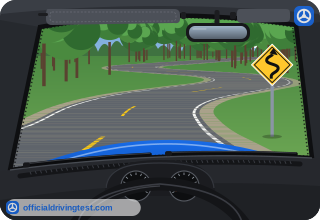
- Speed up to clear the area quickly
- Use your horn constantly
- Move toward the center of the road
- Slow down and be ready to stop
Show answer
Correct answer: Slow down and be ready to stop
In areas where your view is limited you should slow down and be ready to stop.
Source: Maine Driver’s License Manual (Rev 4/24), page 11-3 · Open this page in the manual (Manual page 11-3)
-
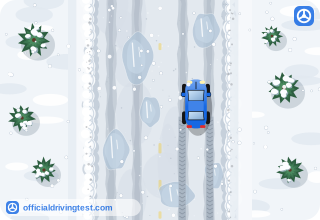
How can you find out how slippery the road is in winter?
- Brake hard once at a safe speed to test the road
- Steer sharply from side to side
- Try the brakes occasionally while driving slowly
- Accelerate quickly and then ease off
Show answer
Correct answer: Try the brakes occasionally while driving slowly
The manual says to try the brakes occasionally while driving slowly to determine how slippery the road is.
Source: Maine Driver’s License Manual (Rev 4/24), page 11-4 · Open this page in the manual (Manual page 11-4)
-
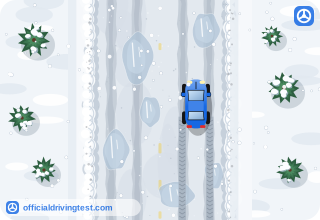
On snow or ice, how does the distance needed to stop compare with dry pavement?
- Twice as much
- Two to five times as much
- Half again as much
- Three to twelve times as much
Show answer
Correct answer: Three to twelve times as much
On snow or ice it takes three to twelve times as much distance to stop as on dry pavement.
Source: Maine Driver’s License Manual (Rev 4/24), page 11-5 · Open this page in the manual (Manual page 11-5)
-
What should you do when approaching hills and curves on slippery roads?
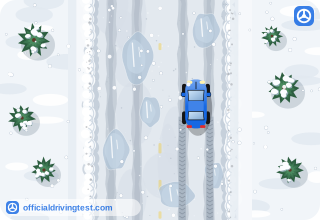
- Slow down and make turns gradually
- Keep your speed and brake in the curve
- Speed up on hills to keep traction
- Turn quickly to avoid sliding
Show answer
Correct answer: Slow down and make turns gradually
You should slow down when approaching hills and curves and make turns gradually.
Source: Maine Driver’s License Manual (Rev 4/24), page 11-5 · Open this page in the manual (Manual page 11-5)
-
What is the best rule during foggy conditions?
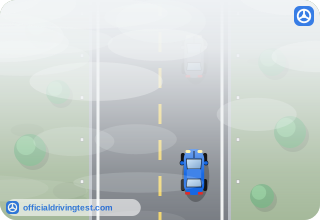
- Drive with your high beams on
- Avoid driving
- Stay close behind the vehicle ahead
- Drive at the posted speed limit
Show answer
Correct answer: Avoid driving
The best rule during foggy conditions is to avoid driving.
Source: Maine Driver’s License Manual (Rev 4/24), page 11-6 · Open this page in the manual (Manual page 11-6)
-
In fog, you should always be prepared to stop your vehicle within:
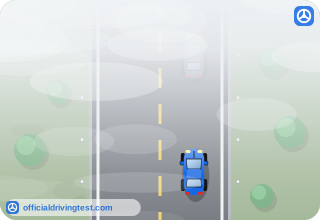
- The reach of your high beams
- The distance to the next road sign
- Twice your usual following distance
- The limits of your vision
Show answer
Correct answer: The limits of your vision
In fog you should reduce your speed and be prepared to stop within the limits of your vision.
Source: Maine Driver’s License Manual (Rev 4/24), page 11-6 · Open this page in the manual (Manual page 11-6)
-
In fog, what can help guide you?

- Road edge markings
- The center of the road only
- Your high beams
- The headlights of oncoming vehicles
Show answer
Correct answer: Road edge markings
The manual says to look for road edge markings to help guide you in fog.
Source: Maine Driver’s License Manual (Rev 4/24), page 11-6 · Open this page in the manual (Manual page 11-6)
-
If fog becomes so thick that you can barely see, you should:
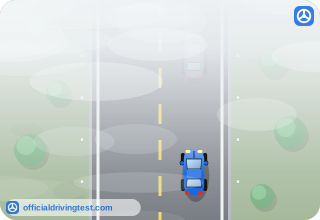
- Creep along at 5 or 10 miles an hour
- Stop in your lane and leave your brake lights on
- Pull off the road and stop, using your emergency flashers
- Turn on your high beams and keep going
Show answer
Correct answer: Pull off the road and stop, using your emergency flashers
You should pull off the road and stop with your emergency flashers, and wait until visibility improves.
Source: Maine Driver’s License Manual (Rev 4/24), page 11-6 · Open this page in the manual (Manual page 11-6)
-
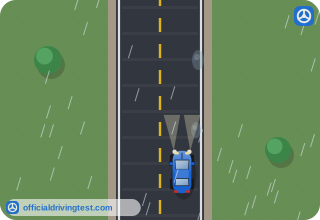
What should you always do when roads are wet?
- Increase your speed to clear the water
- Reduce your speed
- Use your high beams
- Follow the vehicle ahead closely
Show answer
Correct answer: Reduce your speed
Wet roads can be as dangerous as icy roads, so you should always reduce your speed.
Source: Maine Driver’s License Manual (Rev 4/24), page 11-6 · Open this page in the manual (Manual page 11-6)
-
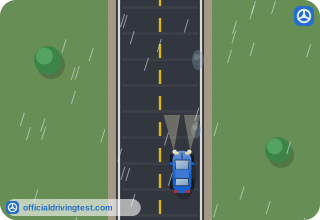
On wet roads, when may you skid?
- When signaling a turn
- When driving slowly in a straight line
- When using your wipers
- When turning sharply
Show answer
Correct answer: When turning sharply
On wet roads you need more distance for stopping and you may skid when turning sharply.
Source: Maine Driver’s License Manual (Rev 4/24), page 11-6 · Open this page in the manual (Manual page 11-6)
-
When are roads more dangerous during rain?
- At the start of a light rain
- After a full day of heavy rain
- Once the rain has stopped
- When the rain is at its heaviest
Show answer
Correct answer: At the start of a light rain
At the start of a light rain, road oil and water mix to form a greasy film on the road.
Source: Maine Driver’s License Manual (Rev 4/24), page 11-6 · Open this page in the manual (Manual page 11-6)
-
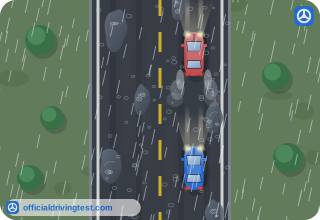
In rain, when should you begin braking?
- Late, with one hard stop to avoid skidding
- Well in advance so other drivers know your plans
- At the last moment to avoid a skid
- Only by shifting to a lower gear
Show answer
Correct answer: Well in advance so other drivers know your plans
You should signal all turns and begin braking well in advance so other drivers know what you are planning to do.
Source: Maine Driver’s License Manual (Rev 4/24), page 11-6 · Open this page in the manual (Manual page 11-6)
-
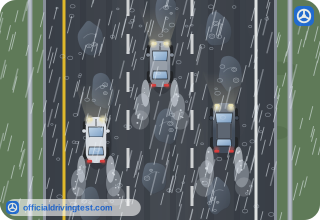
What happens as your speed increases on wet roads and your tires can no longer "wipe" the road well?
- They hold the road better as they get warm
- They grip the road better
- They wipe the road more quickly
- They start to ride up on a film of water
Show answer
Correct answer: They start to ride up on a film of water
The tires start to ride up on a film of water just as a water skier does, which is hydroplaning.
Source: Maine Driver’s License Manual (Rev 4/24), page 11-6 · Open this page in the manual (Manual page 11-6)
-
In most cars, hydroplaning may begin at speeds as low as:
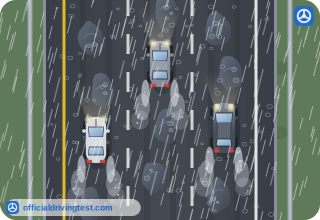
- 30 to 40 MPH
- 10 to 20 MPH
- 20 to 25 MPH
- 45 to 55 MPH
Show answer
Correct answer: 30 to 40 MPH
In most cars hydroplaning may begin at speeds as low as 30 to 40 MPH.
Source: Maine Driver’s License Manual (Rev 4/24), page 11-6 · Open this page in the manual (Manual page 11-6)
-
In a bad rainstorm, at what speed may the tires lose all contact with the road?
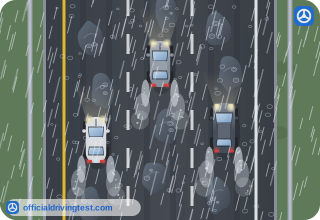
- 20 to 30 MPH
- 35 to 45 MPH
- 50 to 60 MPH
- 70 to 80 MPH
Show answer
Correct answer: 50 to 60 MPH
In a bad rainstorm the tires may lose all contact with the road at 50 to 60 MPH.
Source: Maine Driver’s License Manual (Rev 4/24), page 11-6 · Open this page in the manual (Manual page 11-6)
-
Which action helps reduce the chances of hydroplaning?
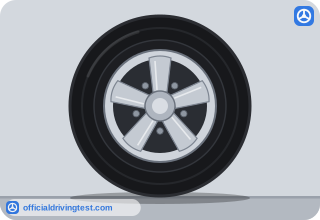
- Driving with slightly underinflated tires
- Replacing tires as soon as they become worn
- Using your high beams in rain
- Speeding up through standing water
Show answer
Correct answer: Replacing tires as soon as they become worn
To reduce the chances of hydroplaning you should slow down during rainstorms, replace worn tires and keep tires properly inflated.
Source: Maine Driver’s License Manual (Rev 4/24), page 11-6 · Open this page in the manual (Manual page 11-6)
-
Why is it good practice to drive slower at night?
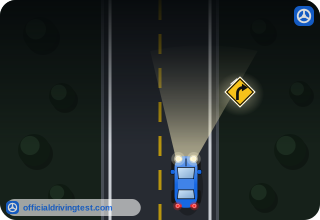
- Overall visibility is much more restricted
- Other drivers are less careful after dark
- Headlights are not required at night
- Speed limits are lower at night
Show answer
Correct answer: Overall visibility is much more restricted
The manual says it is good practice to drive slower at night because overall visibility is much more restricted due to the darkness.
Source: Maine Driver’s License Manual (Rev 4/24), page 11-7 · Open this page in the manual (Manual page 11-7)