Maine: Speed and following distance — Part 2 Practice Test
Managing speed, Maine speed limits, stopping distances, space cushions, night driving and road conditions. — Part 2
Independent educational site · not affiliated with any government agency or DMV
Ready? Test yourself
- Instant feedback with an explanation
- Every answer cites its source in the manual
- Your best score is saved on this device
Questions are original and based on the official manual "Maine Driver’s License Manual" (Rev 4/24), Maine Bureau of Motor Vehicles.
All 32 questions in this practice test
Take the test above first, then use this list to study. Tap “Show answer” to see the correct answer and explanation.
Show the questions and answersHide the questions
-
On packed snow, how much does the manual say to slow down?
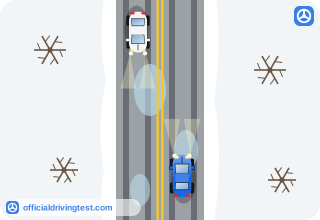
- By one quarter of your speed
- To half speed
- To one third of your speed
- By 20 to 30 mph
Show answer
Correct answer: To half speed
The manual's guideline for packed snow is to slow down to half speed.
Source: Maine Driver’s License Manual (Rev 4/24), page 8-6 · Open this page in the manual (Manual page 8-6)
-
On ice, how much does the manual say to slow down?

- Slow to a crawl
- Slow down by 10 to 15 mph
- Slow to about 20 mph
- Slow to two thirds of your speed
Show answer
Correct answer: Slow to a crawl
The manual's guideline for ice is to slow to a crawl.
Source: Maine Driver’s License Manual (Rev 4/24), page 8-6 · Open this page in the manual (Manual page 8-6)
-
Which of these may make a road slippery?
- Bright sun on the pavement
- A smooth, dry asphalt road
- Wet leaves
- Cold, dry air
Show answer
Correct answer: Wet leaves
The manual says falling or drifting snow, wet leaves or gravel on the road may make it slippery.
Source: Maine Driver’s License Manual (Rev 4/24), page 8-6 · Open this page in the manual (Manual page 8-6)
-
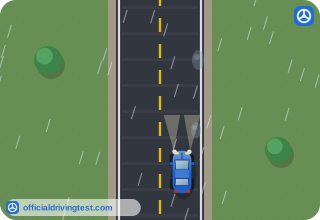
What does the manual say about road surfaces when they are wet?
- All are equally slippery
- Some are more slippery than others
- Asphalt is always more slippery than any other surface
- Only gravel roads are slippery
Show answer
Correct answer: Some are more slippery than others
The manual says some road surfaces are more slippery than others when wet.
Source: Maine Driver’s License Manual (Rev 4/24), page 8-6 · Open this page in the manual (Manual page 8-6)
-
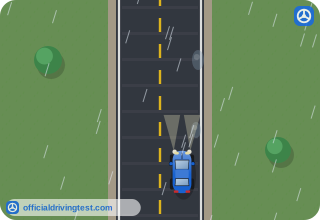
Why can pavement be very slippery for the first few minutes when it starts to rain?
- Rain freezes on contact with the cold pavement surface
- Water builds up on the surface faster than it can drain
- Tires heat up and grip less on wet pavement
- Heat has caused oil in the asphalt to come to the surface
Show answer
Correct answer: Heat has caused oil in the asphalt to come to the surface
Heat causes oil in the asphalt to come to the surface, and oil from other vehicles may also be on the road.
Source: Maine Driver’s License Manual (Rev 4/24), page 8-6 · Open this page in the manual (Manual page 8-6)
-
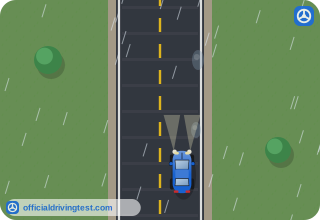
Rain makes the road slippery until what happens?
- The pavement is fully dry
- The temperature rises
- The rain turns to snow
- The oil is washed away
Show answer
Correct answer: The oil is washed away
Rain makes the road slippery until the oil on the surface is washed away.
Source: Maine Driver’s License Manual (Rev 4/24), page 8-6 · Open this page in the manual (Manual page 8-6)
-
On cold, wet days, which road surfaces tend to freeze first and dry out last?
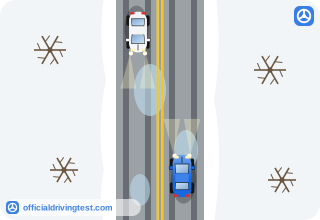
- Bridges and overpasses
- Tunnels and underpasses
- Roads lined with trees
- Hilltop intersections
Show answer
Correct answer: Bridges and overpasses
Bridges and overpasses can hide spots of ice on cold, wet days. They tend to freeze first and dry out last.
Source: Maine Driver’s License Manual (Rev 4/24), page 8-7 · Open this page in the manual (Manual page 8-7)
-
Compared with road ice at colder temperatures, how slippery is road ice when the temperature is near freezing?

- Less slippery, because the ice is packed hard
- Equally slippery at every temperature
- More slippery, because the ice is wet (slushy)
- Not slippery until the ice has dried
Show answer
Correct answer: More slippery, because the ice is wet (slushy)
Near freezing, road ice is wet (slushy), which makes it more slippery than ice at colder temperatures.
Source: Maine Driver’s License Manual (Rev 4/24), page 8-7 · Open this page in the manual (Manual page 8-7)
-
What is hydroplaning?
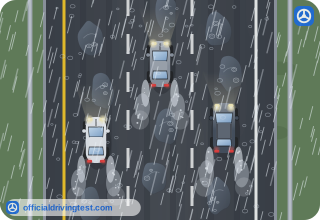
- Tires losing air pressure on a wet road
- Tires riding up on a film of water instead of gripping the road
- The brakes locking after driving through water
- Water splashing onto the windshield and blocking your view
Show answer
Correct answer: Tires riding up on a film of water instead of gripping the road
As you go faster, tires cannot wipe the road well and start to ride up on a film of water, like water skis. This is called hydroplaning.
Source: Maine Driver’s License Manual (Rev 4/24), page 8-7 · Open this page in the manual (Manual page 8-7)
-
What is the best way to keep from hydroplaning?
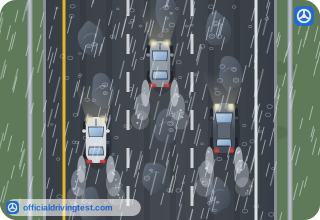
- Brake firmly and steadily as soon as the road becomes wet and shiny
- Drive in the center of the road so water drains to the sides of the car
- Switch to low beams and keep a steady speed on wet roads
- Keep your tires in good condition and your speed down on wet roads
Show answer
Correct answer: Keep your tires in good condition and your speed down on wet roads
The best way to keep from hydroplaning is to be sure your tires are in good condition and to keep your speed down when the road is wet.
Source: Maine Driver’s License Manual (Rev 4/24), page 8-7 · Open this page in the manual (Manual page 8-7)
-
How do balding tires compare with good tires when it comes to losing contact with a wet road?
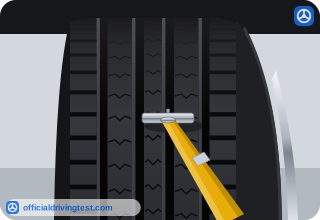
- They lose contact only at higher speeds
- They lose contact at much lower speeds
- They lose contact at the same speeds
- They never lose contact in light rain
Show answer
Correct answer: They lose contact at much lower speeds
Balding tires lose contact with the road at much lower speeds than good tires, so a slight change of direction or a gust of wind could throw the car into a skid.
Source: Maine Driver’s License Manual (Rev 4/24), page 8-7 · Open this page in the manual (Manual page 8-7)
-
What is total stopping distance?
- The distance from the time you realize you must stop until your vehicle is completely stopped
- The distance your vehicle travels after you press the brake pedal until it stops
- The distance your vehicle travels while you move your foot from the gas to the brake
- The distance needed to stop on dry pavement with good brakes
Show answer
Correct answer: The distance from the time you realize you must stop until your vehicle is completely stopped
Total stopping distance runs from the moment you realize you must stop until the vehicle is completely stopped.
Source: Maine Driver’s License Manual (Rev 4/24), page 8-7 · Open this page in the manual (Manual page 8-7)
-
In stopping distance, what is perception time?
- The time it takes your vehicle to come to a complete stop after braking begins
- The time it takes your eyes to adjust to darkness
- The time it takes you to recognize you must stop
- The time it takes the brake lights of the car ahead to come on
Show answer
Correct answer: The time it takes you to recognize you must stop
Perception time is the time it takes you to recognize that you must stop.
Source: Maine Driver’s License Manual (Rev 4/24), page 8-7 · Open this page in the manual (Manual page 8-7)
-
What is the average perception time for an alert driver?
- ¼ to ½ second
- 1½ to 2 seconds
- 3 to 5 seconds
- ¾ to 1 second
Show answer
Correct answer: ¾ to 1 second
The manual gives ¾ to 1 second as the average perception time for an alert driver.
Source: Maine Driver’s License Manual (Rev 4/24), page 8-7 · Open this page in the manual (Manual page 8-7)
-
In stopping distance, what is your reaction time?
- The time it takes to move your foot from the gas to the brake pedal and begin braking
- The time it takes you to recognize that you must stop and look for a way out
- The time it takes your vehicle to stop completely once the brakes are applied
- The time a driver needs to check the mirrors before slowing down
Show answer
Correct answer: The time it takes to move your foot from the gas to the brake pedal and begin braking
Reaction time is the time it takes to react, move your foot from the gas to the brake pedal and begin braking.
Source: Maine Driver’s License Manual (Rev 4/24), page 8-7 · Open this page in the manual (Manual page 8-7)
-
What is the average reaction time of the average driver?
- ½ to ¾ second
- 1½ to 2 seconds
- ¾ to 1 second
- 3 to 4 seconds
Show answer
Correct answer: ¾ to 1 second
The average driver has a reaction time of ¾ to 1 second.
Source: Maine Driver’s License Manual (Rev 4/24), page 8-7 · Open this page in the manual (Manual page 8-7)
-
In stopping distance, what is braking distance?
- The distance your vehicle travels while you recognize the need to stop
- The distance it takes to stop your vehicle
- The distance your vehicle travels while your foot moves to the brake pedal
- The distance you can see ahead with your headlights on
Show answer
Correct answer: The distance it takes to stop your vehicle
Braking distance is the distance it takes to stop your vehicle once braking has begun.
Source: Maine Driver’s License Manual (Rev 4/24), page 8-7 · Open this page in the manual (Manual page 8-7)
-
How does your speed affect your total stopping distance?
- The faster you travel, the shorter the distance needed to stop
- Speed does not change stopping distance on dry pavement
- The faster you travel, the more time and distance it takes to stop
- Speed affects only the braking distance, not the reaction distance
Show answer
Correct answer: The faster you travel, the more time and distance it takes to stop
The faster you are traveling, the more time and distance it takes to stop.
Source: Maine Driver’s License Manual (Rev 4/24), page 8-7 · Open this page in the manual (Manual page 8-7)
-
What does a posted speed limit tell you?
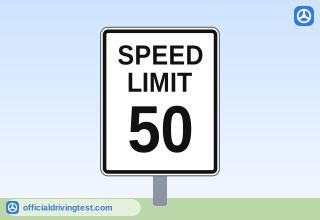
- The speed at which you must drive
- You cannot go faster than the speed shown
- The speed that is safe in all weather
- The minimum speed you must keep to avoid a ticket
Show answer
Correct answer: You cannot go faster than the speed shown
Posted speed limits do not tell you what speed you must drive. They only say you cannot go faster than the speed shown.
Source: Maine Driver’s License Manual (Rev 4/24), page 8-7 · Open this page in the manual (Manual page 8-7)
-
What must you do when road and weather conditions make the posted speed unsafe?
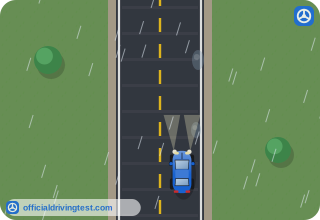
- Keep to the posted speed and use your headlights
- Stay with the speed of the traffic around you
- Speed up to leave the area of poor conditions quickly
- Slow down below the posted speed
Show answer
Correct answer: Slow down below the posted speed
If road and weather conditions make the posted speed unsafe, you must slow down.
Source: Maine Driver’s License Manual (Rev 4/24), page 8-7 · Open this page in the manual (Manual page 8-7)
-
What are posted speed limits based on?
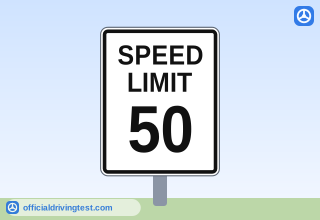
- Road condition, how far you can see, and what typical traffic is like
- The posted limit of the nearest highway and the time of day
- The size of the nearest town and the number of traffic signals
- The make and weight of the vehicles that use the road
Show answer
Correct answer: Road condition, how far you can see, and what typical traffic is like
Posted limits are based on the condition of the road, how far you can see, and what typical traffic is like.
Source: Maine Driver’s License Manual (Rev 4/24), page 8-7 · Open this page in the manual (Manual page 8-7)
-
Unless posted otherwise, what is the maximum speed in Maine outside any business, residential or built-up area?
- 45 mph
- 35 mph
- 40 mph
- 50 mph
Show answer
Correct answer: 45 mph
Unless posted otherwise, the maximum speed outside any business, residential or built-up area of Maine is 45 miles per hour.
Source: Maine Driver’s License Manual (Rev 4/24), page 8-7 · Open this page in the manual (Manual page 8-7)
-
Unless posted otherwise, what is the maximum speed in Maine in a business district, residential district or built-up area?
- 20 mph
- 30 mph
- 25 mph
- 35 mph
Show answer
Correct answer: 25 mph
Unless posted otherwise, the maximum speed in a business district, residential district or built-up area is 25 miles per hour.
Source: Maine Driver’s License Manual (Rev 4/24), page 8-7 · Open this page in the manual (Manual page 8-7)
-
Unless posted otherwise, what is the maximum speed when passing a school during recess?
- 10 mph
- 15 mph
- 20 mph
- 30 mph
Show answer
Correct answer: 15 mph
Maine sets a maximum of 15 miles per hour when passing a school during recess, unless posted otherwise.
Source: Maine Driver’s License Manual (Rev 4/24), page 8-7 · Open this page in the manual (Manual page 8-7)
-
What is the fine for exceeding the posted speed limit in a school zone?
- Three times the usual fine
- The same as the usual fine
- Fifty percent more than the usual fine
- Twice the usual fine
Show answer
Correct answer: Twice the usual fine
A fine twice that of the usual fine is imposed for exceeding the posted speed limit in a school zone.
Source: Maine Driver’s License Manual (Rev 4/24), page 8-8 · Open this page in the manual (Manual page 8-8)
-
What should you do when you are in doubt about when a school recess or school opening and closing period is?
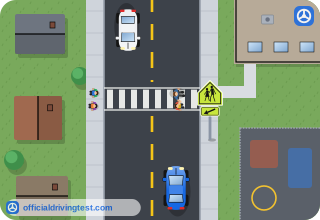
- Drive at the usual limit for that road
- Use extreme care
- Keep your speed and watch for a crossing guard
- Wait for a school bus to pass before continuing
Show answer
Correct answer: Use extreme care
The manual says it is difficult to know just when these periods are, so when in doubt, use extreme care.
Source: Maine Driver’s License Manual (Rev 4/24), page 8-8 · Open this page in the manual (Manual page 8-8)
-
What does the manual say about exceeding the posted speed limit?
- It is allowed when traffic is light
- It is allowed on expressways only
- It is allowed when you are passing another vehicle
- It is illegal
Show answer
Correct answer: It is illegal
It is illegal to exceed the posted speed limit.
Source: Maine Driver’s License Manual (Rev 4/24), page 8-8 · Open this page in the manual (Manual page 8-8)
-
Which of these is not allowed on a Maine highway?
- Racing on the highway
- Driving below the speed limit when reduced speed is necessary for safety
- Slowing down when conditions make the posted speed unsafe
- Following the lower limit posted in a school zone
Show answer
Correct answer: Racing on the highway
Racing on the highway and driving recklessly are not allowed.
Source: Maine Driver’s License Manual (Rev 4/24), page 8-8 · Open this page in the manual (Manual page 8-8)
-
Under Maine law, when may you drive so slowly that you interfere with the normal and reasonable movement of traffic?
- When you are driving in the right-hand lane
- When you are unfamiliar with the road
- Only where reduced speed is necessary for safety
- When you are towing a trailer
Show answer
Correct answer: Only where reduced speed is necessary for safety
Maine law says you must not drive so slowly that you interfere with normal and reasonable traffic movement, except where reduced speed is necessary for safety.
Source: Maine Driver’s License Manual (Rev 4/24), page 8-8 · Open this page in the manual (Manual page 8-8)
-
What may some highways have in addition to maximum speed limits?
- Higher limits for out-of-state drivers
- Lower limits for new drivers
- Different limits for each day of the week
- Minimum posted speed limits
Show answer
Correct answer: Minimum posted speed limits
The manual says some highways may have minimum posted speed limits.
Source: Maine Driver’s License Manual (Rev 4/24), page 8-8 · Open this page in the manual (Manual page 8-8)
-
At any time, how much rubber of your four tires together touches the road?
- One square foot
- One square yard
- Four square feet
- Half a square foot
Show answer
Correct answer: One square foot
The four tires together have only one square foot of rubber on the surface of the road.
Source: Maine Driver’s License Manual (Rev 4/24), page 8-8 · Open this page in the manual (Manual page 8-8)
-
Why do new drivers have more "out of control" accidents than experienced drivers?
- They drive faster than experienced drivers
- They use worn tires more often
- Many do not pay attention to road conditions
- They wear safety belts less often
Show answer
Correct answer: Many do not pay attention to road conditions
Many new drivers do not pay attention to road conditions, which is why they have more "out of control" accidents.
Source: Maine Driver’s License Manual (Rev 4/24), page 8-8 · Open this page in the manual (Manual page 8-8)