Maine: Sharing the road — Part 4 Practice Test
Bicycles and the three-foot passing rule, motorcycles and mopeds, trucks and buses and their No-Zones, school buses, slow-moving vehicles and wildlife. — Part 4
Independent educational site · not affiliated with any government agency or DMV
Ready? Test yourself
- Instant feedback with an explanation
- Every answer cites its source in the manual
- Your best score is saved on this device
Questions are original and based on the official manual "Maine Driver’s License Manual" (Rev 4/24), Maine Bureau of Motor Vehicles.
All 34 questions in this practice test
Take the test above first, then use this list to study. Tap “Show answer” to see the correct answer and explanation.
Show the questions and answersHide the questions
-
What should a bicyclist allow in the rain when using the brakes?
- The same distance as on dry roads
- Less distance because the brakes are cooler
- No distance if the bike has lights
- Extra stopping distance
Show answer
Correct answer: Extra stopping distance
In the rain, a bicyclist should allow extra stopping distance when using the brakes.
Source: Maine Driver’s License Manual (Rev 4/24), page 10-4 · Open this page in the manual (Manual page 10-4)
-
What should you do about the lane when sharing the road with a motorcycle?
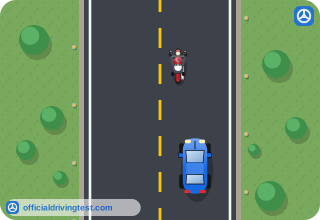
- Give the motorcycle a full lane and do not try to share it
- Share the lane if you keep to one side of the lane
- Share the lane only on wide roads with light traffic
- Share the lane when traffic is moving slowly or stopped
Show answer
Correct answer: Give the motorcycle a full lane and do not try to share it
Motorcycles need space to react to other traffic, so give motorcycles a full lane and do not attempt to share it.
Source: Maine Driver’s License Manual (Rev 4/24), page 10-5 · Open this page in the manual (Manual page 10-5)
-
Why should you always check your mirrors and blind spots for motorcycles?
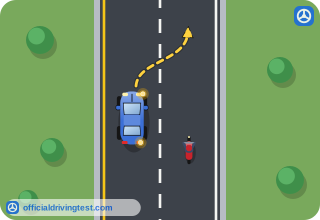
- They always travel faster than cars
- They cannot use their turn signals
- They are smaller and more difficult to see
- They are not allowed to pass vehicles
Show answer
Correct answer: They are smaller and more difficult to see
Motorcycles are smaller so more difficult to see, so check your mirrors and blind spots for them.
Source: Maine Driver’s License Manual (Rev 4/24), page 10-5 · Open this page in the manual (Manual page 10-5)
-
Before turning left, where should you look carefully for motorcycles?
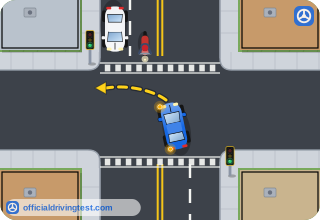
- Only behind you
- To the front and sides
- Only straight ahead
- To the rear and right side only
Show answer
Correct answer: To the front and sides
Before turning left be alert for motorcycles and look carefully to the front and sides.
Source: Maine Driver’s License Manual (Rev 4/24), page 10-5 · Open this page in the manual (Manual page 10-5)
-
Why should you not believe a motorcycle is turning just because its turn signal is flashing?
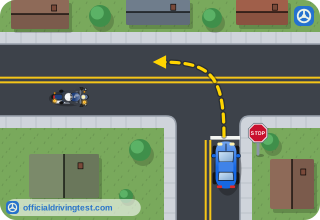
- Motorcycle riders are not required to use turn signals
- Its signal flashes every time the rider uses the brakes
- Its signal is too dim to be seen during the daytime
- Its signal may not self-cancel, so the rider may have forgotten it
Show answer
Correct answer: Its signal may not self-cancel, so the rider may have forgotten it
Turn signals on a motorcycle may not self-cancel, so the rider may have forgotten the signal is on.
Source: Maine Driver’s License Manual (Rev 4/24), page 10-5 · Open this page in the manual (Manual page 10-5)
-
What should you do when following a motorcycle and the road is wet?
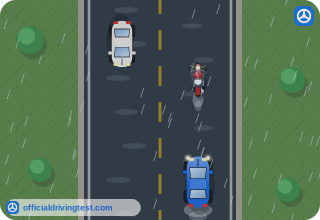
- Increase the following distance
- Decrease the following distance to stay in view
- Keep the same following distance as on dry roads
- Pass the motorcycle as soon as you can
Show answer
Correct answer: Increase the following distance
When following a motorcycle on a wet road, increase the following distance.
Source: Maine Driver’s License Manual (Rev 4/24), page 10-5 · Open this page in the manual (Manual page 10-5)
-
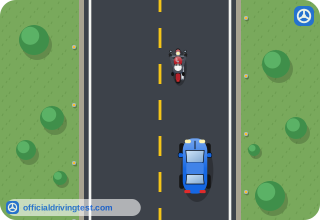
Which of these may cause a motorcyclist to change speed or direction suddenly?
- Wide, empty lanes
- Smooth, dry pavement
- Grooved paving
- Overhead road signs
Show answer
Correct answer: Grooved paving
Motorcyclists may change speed or direction because of pavement seams, railroad crossings and grooved paving.
Source: Maine Driver’s License Manual (Rev 4/24), page 10-5 · Open this page in the manual (Manual page 10-5)
-
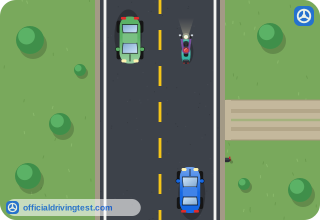
How do the speeds of scooters and mopeds compare with those of motorcycles?
- They travel at about the same speeds
- They travel at much lower speeds
- They travel at much higher speeds
- They travel slightly faster in cities
Show answer
Correct answer: They travel at much lower speeds
Scooters and mopeds travel at much lower speeds than motorcycles.
Source: Maine Driver’s License Manual (Rev 4/24), page 10-5 · Open this page in the manual (Manual page 10-5)
-
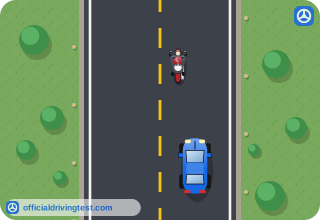
How much space should you give a motorcycle?
- Less than a car, because it is smaller
- Half a lane
- Twice as much as a car
- As much as you would give a car
Show answer
Correct answer: As much as you would give a car
Motorcycles have as much right to the road as cars, so give them as much space as you would give a car.
Source: Maine Driver’s License Manual (Rev 4/24), page 10-5 · Open this page in the manual (Manual page 10-5)
-
Why does a motorcyclist move from side to side quickly within a lane?
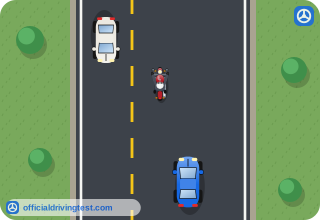
- To see and be seen, and to avoid objects on the road
- To cool the engine when riding at low speeds
- To show other drivers where they are able to pass
- To avoid having to use the turn signals
Show answer
Correct answer: To see and be seen, and to avoid objects on the road
The motorcyclist moves from side to side quickly to see and be seen, and to avoid objects on the road.
Source: Maine Driver’s License Manual (Rev 4/24), page 10-5 · Open this page in the manual (Manual page 10-5)
-
Why do drivers turning left in front of an oncoming motorcycle cause many accidents?
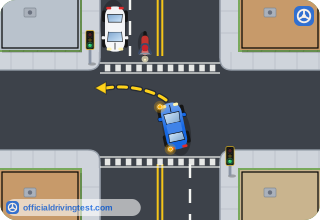
- They assume the motorcycle will also turn left ahead of them
- They think the motorcycle is going faster than it really is
- They fail to see the rider or think it is going slower than it is
- They believe that motorcycles must always yield to them
Show answer
Correct answer: They fail to see the rider or think it is going slower than it is
Drivers turning left in front of an oncoming motorcycle fail to see the motorcyclist, or they think the motorcycle is going slower than it really is.
Source: Maine Driver’s License Manual (Rev 4/24), page 10-5 · Open this page in the manual (Manual page 10-5)
-
What should you do before turning left when a motorcyclist is oncoming?
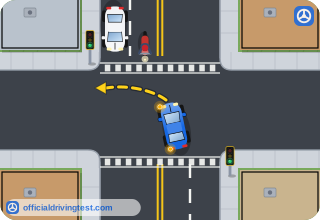
- Turn quickly ahead of the motorcycle
- Wait for the motorcyclist to pass
- Flash your headlights and turn
- Turn if the motorcycle is signaling
Show answer
Correct answer: Wait for the motorcyclist to pass
Wait for an oncoming motorcyclist to pass before turning left.
Source: Maine Driver’s License Manual (Rev 4/24), page 10-5 · Open this page in the manual (Manual page 10-5)
-
What rights and responsibilities do motorcyclists have?
- The same as other drivers
- Fewer rights than car drivers
- Rights but no responsibilities
- Only the rights listed for bicyclists
Show answer
Correct answer: The same as other drivers
Motorcyclists have the same rights and responsibilities as other drivers.
Source: Maine Driver’s License Manual (Rev 4/24), page 10-5 · Open this page in the manual (Manual page 10-5)
-
Why do bus and truck drivers face special challenges?
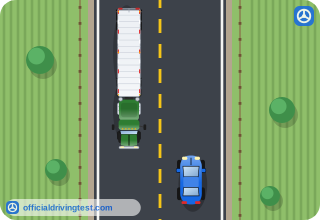
- They are not allowed on expressways
- They must always travel in the left lane
- The large size and weight of their vehicles
- Their vehicles have no mirrors
Show answer
Correct answer: The large size and weight of their vehicles
Bus and truck drivers face special challenges because of the large size and weight of their vehicles.
Source: Maine Driver’s License Manual (Rev 4/24), page 10-5 · Open this page in the manual (Manual page 10-5)
-
Compared with the blind spots of a car, how large are the blind spots of large vehicles?
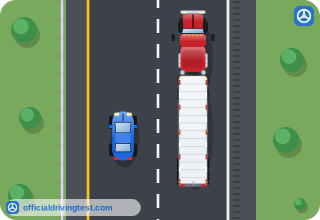
- Much larger
- About the same size
- Smaller, because they have many mirrors
- Too small to matter
Show answer
Correct answer: Much larger
Larger vehicles have much larger blind spots than cars, and some of these areas are impossible for the driver to see.
Source: Maine Driver’s License Manual (Rev 4/24), page 10-6 · Open this page in the manual (Manual page 10-6)
-
What do drivers of large vehicles rely on mostly to gather information on what is beside and behind them?
- Their passengers
- Their horns
- Their mirrors
- Their hazard flashers
Show answer
Correct answer: Their mirrors
Drivers of large vehicles rely mostly on their mirrors to see what is beside and behind them, and some areas still cannot be seen.
Source: Maine Driver’s License Manual (Rev 4/24), page 10-6 · Open this page in the manual (Manual page 10-6)
-
What is a rule about a truck or bus that is backing?
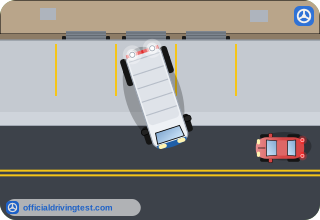
- Pass behind it quickly before it moves
- Never attempt to pass behind it
- Pass behind it only if you sound your horn
- Pass behind it only at night with your headlights on
Show answer
Correct answer: Never attempt to pass behind it
The manual says never to attempt to pass behind a truck or bus that is backing.
Source: Maine Driver’s License Manual (Rev 4/24), page 10-6 · Open this page in the manual (Manual page 10-6)
-
If you cannot see the mirrors of the large vehicle ahead of you, what does that probably mean?
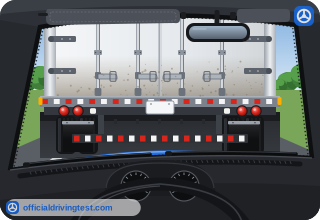
- The driver can see you in the rear window
- You are at a safe following distance
- The driver is about to pull over
- The driver probably cannot see you
Show answer
Correct answer: The driver probably cannot see you
If you cannot see the mirrors of the large vehicle ahead, the driver probably cannot see you, so you should stay out of the blind spots.
Source: Maine Driver’s License Manual (Rev 4/24), page 10-6 · Open this page in the manual (Manual page 10-6)
-
Compared with a car, how much space does a large vehicle need to speed up, stop and turn?
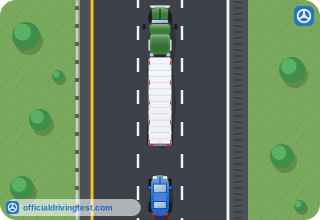
- More space
- About the same space
- Less space, because it is driven by a professional
- Less space to turn, but more to stop
Show answer
Correct answer: More space
Large vehicles take more space to speed up, stop and turn than cars.
Source: Maine Driver’s License Manual (Rev 4/24), page 10-6 · Open this page in the manual (Manual page 10-6)
-
What may happen to the speed of a large vehicle going uphill?
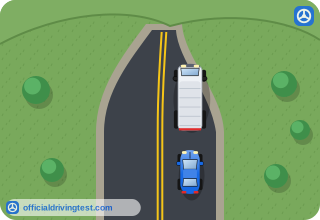
- It stays the same because of its weight
- It may increase sharply
- It may drop sharply
- It is not affected by the terrain
Show answer
Correct answer: It may drop sharply
Because of their weight, large vehicles may drop sharply in speed uphill and often gain speed quickly when starting downhill.
Source: Maine Driver’s License Manual (Rev 4/24), page 10-6 · Open this page in the manual (Manual page 10-6)
-
What should you do when a large vehicle is following you?
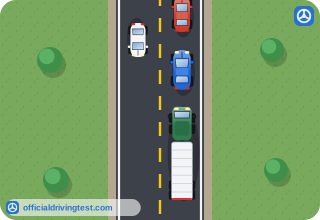
- Slow down to let it get closer behind you
- Always leave plenty of space between you and vehicles ahead
- Stay close to the vehicle ahead so the truck sees you
- Brake quickly so the truck stays well back from you
Show answer
Correct answer: Always leave plenty of space between you and vehicles ahead
Stopping distances are much greater for heavier vehicles, so you should leave plenty of space ahead to give you and the large vehicle behind time to react.
Source: Maine Driver’s License Manual (Rev 4/24), page 10-6 · Open this page in the manual (Manual page 10-6)
-
Why should you never pass or pull in front of a large vehicle that is already slowing or stopping?
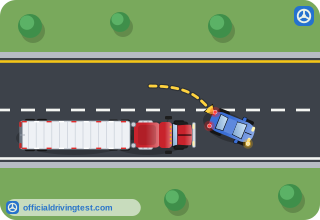
- The driver cannot hear your horn
- Large vehicles cannot use their brakes while slowing
- The driver will speed up to pass you
- The driver has based their braking ability on the space ahead
Show answer
Correct answer: The driver has based their braking ability on the space ahead
The driver of a large vehicle has based their braking ability on the space ahead, and pulling in suddenly compromises it and could cause a crash.
Source: Maine Driver’s License Manual (Rev 4/24), page 10-6 · Open this page in the manual (Manual page 10-6)
-
Before turning right, a large vehicle may first swing in which direction to clear the sidewalk or objects such as a telephone pole?
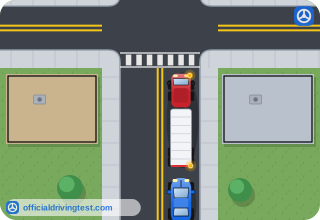
- To the left
- To the right
- Straight ahead onto the shoulder
- Backward a few feet
Show answer
Correct answer: To the left
Large vehicles will often be forced to swing to the left before turning to the right to clear the sidewalk or objects on the side of the road.
Source: Maine Driver’s License Manual (Rev 4/24), page 10-6 · Open this page in the manual (Manual page 10-6)
-
Why should you watch the directional signals of a large vehicle?
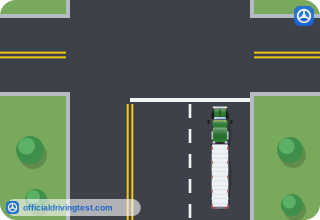
- It shows how fast the large vehicle is traveling
- It shows that the large vehicle is about to stop
- It may be the only sign it is about to turn right
- It tells you the large vehicle driver can see you
Show answer
Correct answer: It may be the only sign it is about to turn right
The signal may be the only indication that a large vehicle is about to turn right when it seems to be moving left.
Source: Maine Driver’s License Manual (Rev 4/24), page 10-6 · Open this page in the manual (Manual page 10-6)
-
What is the No-Zone?
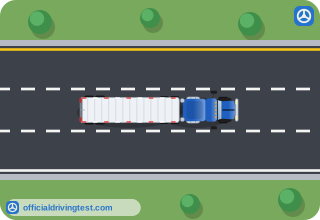
- The area in which large vehicles may not park
- The area around larger vehicles that is in the driver's blind spots
- The area in front of a school where trucks must slow down
- The lane reserved for large vehicles on highways
Show answer
Correct answer: The area around larger vehicles that is in the driver's blind spots
The No-Zone is the area around larger vehicles that is in the driver's blind spots: the sides, rear and front.
Source: Maine Driver’s License Manual (Rev 4/24), page 10-7 · Open this page in the manual (Manual page 10-7)
-
On which side is a truck's largest blind spot?
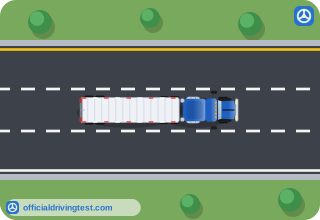
- The left side
- The front only
- The rear only
- The right side
Show answer
Correct answer: The right side
A truck's largest blind spot is on the right side, starting behind the cab and going the length of the truck.
Source: Maine Driver’s License Manual (Rev 4/24), page 10-7 · Open this page in the manual (Manual page 10-7)
-
If you cannot see a large vehicle driver's face in the side view mirror, what is true?
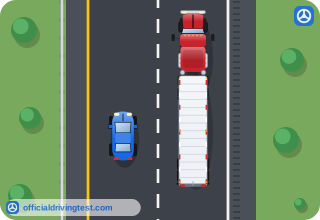
- The driver cannot see you
- The driver can see you in the rear view mirror
- The driver has seen you and will let you pass
- You are too far back to be in danger
Show answer
Correct answer: The driver cannot see you
If you cannot see a driver's face in the side view mirror, the driver cannot see you.
Source: Maine Driver’s License Manual (Rev 4/24), page 10-7 · Open this page in the manual (Manual page 10-7)
-
How long should you drive alongside a large vehicle?
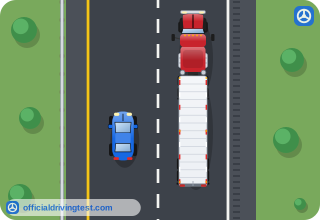
- Long enough to match its speed
- Until the driver signals you to pass
- No longer than you must
- As long as you stay in its right lane
Show answer
Correct answer: No longer than you must
You should not drive alongside a large vehicle any longer than you must, because if the driver needs to swerve or change lanes suddenly you could collide.
Source: Maine Driver’s License Manual (Rev 4/24), page 10-7 · Open this page in the manual (Manual page 10-7)
-
What should you never do in front of a moving larger vehicle?
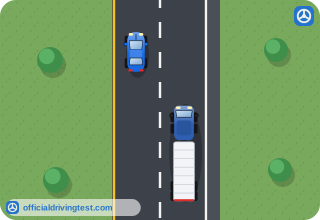
- Merge or change lanes too closely in front
- Drive in the same lane at the same speed
- Use your headlights while following it
- Signal before you change lanes in traffic
Show answer
Correct answer: Merge or change lanes too closely in front
Never merge in front of a moving larger vehicle or change lanes too closely in front of them, because larger vehicles take longer to stop than cars.
Source: Maine Driver’s License Manual (Rev 4/24), page 10-7 · Open this page in the manual (Manual page 10-7)
-
How far behind a large vehicle can its rear No-Zone reach?
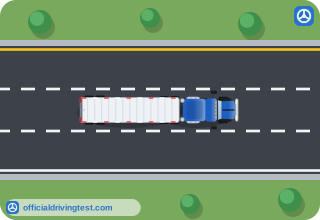
- Up to 20 feet
- Up to 50 feet
- Up to 200 feet
- Up to 75 feet
Show answer
Correct answer: Up to 200 feet
Large vehicles have huge blind spots up to 200 feet behind them.
Source: Maine Driver’s License Manual (Rev 4/24), page 10-7 · Open this page in the manual (Manual page 10-7)
-
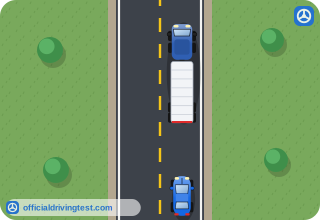
What is "drafting" behind a large vehicle?
- Passing a truck slowly while staying in its right-side blind spot
- Following a truck closely, thinking its wind drag will pull you along
- Moving back into a truck's lane right after you have passed it
- Driving beside a truck so that it blocks the wind from your car
Show answer
Correct answer: Following a truck closely, thinking its wind drag will pull you along
Drafting is following so closely behind a truck that you think the wind drag will pull your car along; the manual says it does not work and is extremely dangerous.
Source: Maine Driver’s License Manual (Rev 4/24), page 10-7 · Open this page in the manual (Manual page 10-7)
-
When you follow a large vehicle, where in your lane should you stay so the driver can see you in the side mirror?
- To the right in your lane
- Straight behind the center of the vehicle
- Half on the shoulder
- To the left in your lane
Show answer
Correct answer: To the left in your lane
The manual says to stay to the left in your lane so the driver can see you in their side mirror.
Source: Maine Driver’s License Manual (Rev 4/24), page 10-7 · Open this page in the manual (Manual page 10-7)
-
When you are stopped behind a large vehicle on a hill, what should you do?
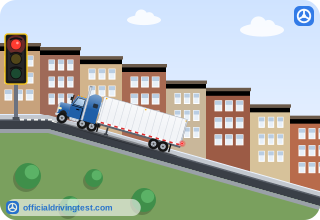
- Leave space between your car and the vehicle
- Stay as close as you can to the vehicle
- Turn off your engine and your lights
- Move into the lane beside it
Show answer
Correct answer: Leave space between your car and the vehicle
Leave space, because the large vehicle may stall or roll backwards as it pulls forward and could collide with your car.
Source: Maine Driver’s License Manual (Rev 4/24), page 10-7 · Open this page in the manual (Manual page 10-7)
-
When a large vehicle swings wide to the left to clear a curb on a right turn, how can you avoid a crash?
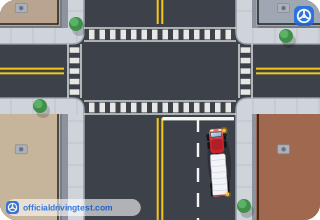
- Pass it on its right side before it turns
- Move up beside it so the driver can see you
- Wait until the larger vehicle has finished its turn
- Sound your horn until the driver stops turning
Show answer
Correct answer: Wait until the larger vehicle has finished its turn
Avoid a crash by not turning until the larger vehicle has finished its turn.
Source: Maine Driver’s License Manual (Rev 4/24), page 10-8 · Open this page in the manual (Manual page 10-8)