Maine: Sharing the road — Part 3 Practice Test
Bicycles and the three-foot passing rule, motorcycles and mopeds, trucks and buses and their No-Zones, school buses, slow-moving vehicles and wildlife. — Part 3
Independent educational site · not affiliated with any government agency or DMV
Ready? Test yourself
- Instant feedback with an explanation
- Every answer cites its source in the manual
- Your best score is saved on this device
Questions are original and based on the official manual "Maine Driver’s License Manual" (Rev 4/24), Maine Bureau of Motor Vehicles.
All 34 questions in this practice test
Take the test above first, then use this list to study. Tap “Show answer” to see the correct answer and explanation.
Show the questions and answersHide the questions
-
Which action should you avoid around bicycles?
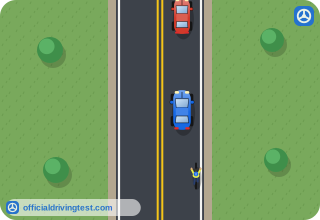
- Slowing down before you pass
- Giving extra room on wet roads
- Turning sharply in front of them
- Checking for them before you back up
Show answer
Correct answer: Turning sharply in front of them
Do not turn sharply in front of bicycles, and do not force a bicyclist off the road.
Source: Maine Driver’s License Manual (Rev 4/24), page 10-3 · Open this page in the manual (Manual page 10-3)
-
In which direction are bicyclists required to ride?
- Facing oncoming traffic
- In the direction of traffic
- Whichever direction is faster
- Against traffic when on the shoulder
Show answer
Correct answer: In the direction of traffic
Bicyclists are required to ride in the direction of traffic, although the manual says to look for them riding anywhere on the road.
Source: Maine Driver’s License Manual (Rev 4/24), page 10-3 · Open this page in the manual (Manual page 10-3)
-
Which road conditions affect bicycles much more than other vehicles?
- Dry, smooth pavement
- Bright sunshine at noon
- Painted lane lines
- A wet road, sand or gravel
Show answer
Correct answer: A wet road, sand or gravel
Be extra careful around bicyclists when the road is wet or has sand or gravel, which affect bicycles much more than other vehicles.
Source: Maine Driver’s License Manual (Rev 4/24), page 10-3 · Open this page in the manual (Manual page 10-3)
-
When must bicyclists use hand signals?
- When turning and stopping
- Only when turning left
- Only when other vehicles are behind them
- Only at night
Show answer
Correct answer: When turning and stopping
Bicyclists must use hand signals when turning and stopping.
Source: Maine Driver’s License Manual (Rev 4/24), page 10-3 · Open this page in the manual (Manual page 10-3)
-
Why might a bicyclist not be able to signal a turn?
- Bicycle riders have no need to signal other drivers
- Hand signals are meant only for motor vehicle drivers
- Conditions may require both hands on the handlebars
- Bicycle brakes need both hands at all times
Show answer
Correct answer: Conditions may require both hands on the handlebars
Bicyclists may not be able to signal if conditions require both hands on the handlebars, so drivers should look for other clues.
Source: Maine Driver’s License Manual (Rev 4/24), page 10-3 · Open this page in the manual (Manual page 10-3)
-
What do riders usually do before changing lanes or turning?
- Ring a bell to warn all other traffic
- Turn their head or look over their shoulder
- Stop at the side of the road to check
- Move to the center of the lane first
Show answer
Correct answer: Turn their head or look over their shoulder
Riders usually turn their head or look over their shoulder before changing lanes or turning.
Source: Maine Driver’s License Manual (Rev 4/24), page 10-3 · Open this page in the manual (Manual page 10-3)
-
Seen from behind, a bicyclist holds the left arm out straight to the side. What does the signal mean?
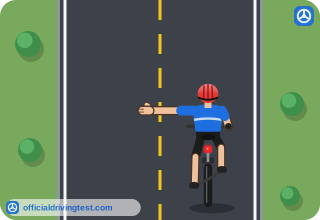
- Right turn
- Stop
- Slowing down
- Left turn
Show answer
Correct answer: Left turn
A bicyclist signals a left turn by holding the left arm out straight to the side.
Source: Maine Driver’s License Manual (Rev 4/24), page 10-3 · Open this page in the manual (Manual page 10-3)
-
Seen from behind, a bicyclist holds the left arm bent upward at the elbow with the hand raised. What does the signal mean?
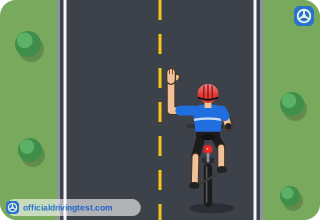
- Right turn
- Left turn
- Stop
- Passing
Show answer
Correct answer: Right turn
A bicyclist signals a right turn by holding the left arm bent upward at the elbow.
Source: Maine Driver’s License Manual (Rev 4/24), page 10-3 · Open this page in the manual (Manual page 10-3)
-
Seen from behind, a bicyclist lets the left arm hang down, bent at the elbow, with the hand low. What does the signal mean?
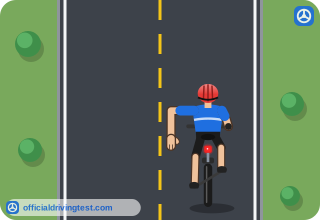
- Left turn
- Right turn
- Stop
- Speeding up
Show answer
Correct answer: Stop
A bicyclist signals a stop by holding the left arm down and bent at the elbow.
Source: Maine Driver’s License Manual (Rev 4/24), page 10-3 · Open this page in the manual (Manual page 10-3)
-
Which method is recommended for opening a vehicle door after parking on the street?
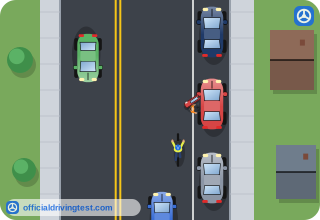
- The "Quick Release"
- The "Dutch Reach"
- The "Mirror Swing"
- The "Blind Spot Check"
Show answer
Correct answer: The "Dutch Reach"
The manual recommends the "Dutch Reach" method when opening the vehicle door.
Source: Maine Driver’s License Manual (Rev 4/24), page 10-3 · Open this page in the manual (Manual page 10-3)
-
Using the "Dutch Reach," how does the driver open the door?
- With the left hand, which makes the driver look in the mirror ahead
- With either hand, after checking the mirror and waiting a moment
- With both hands, after turning off the engine and the lights
- With the right hand, which makes the driver look over the road-side shoulder
Show answer
Correct answer: With the right hand, which makes the driver look over the road-side shoulder
The driver opens the door with the right hand, which twists the body left and forces a look over the road-side shoulder, making it easier to see oncoming bicyclists.
Source: Maine Driver’s License Manual (Rev 4/24), page 10-3 · Open this page in the manual (Manual page 10-3)
-
Where should you be extra cautious about riders when you back up?
- Near schools or residential areas
- On freeway entrance and exit ramps
- On open rural highways at night
- Near railroad crossings and tracks
Show answer
Correct answer: Near schools or residential areas
Check for bicyclists in your path before backing up, and be extra cautious near schools or residential areas where riders may be present.
Source: Maine Driver’s License Manual (Rev 4/24), page 10-3 · Open this page in the manual (Manual page 10-3)
-
Which bicyclists does the manual say are often unpredictable in their actions?
- Experienced adult bicyclists
- Riders who are wearing helmets
- Children or inexperienced adults
- Riders who use hand signals
Show answer
Correct answer: Children or inexperienced adults
Children or inexperienced adults on bicycles are often unpredictable in their actions, so drivers should expect the unexpected.
Source: Maine Driver’s License Manual (Rev 4/24), page 10-3 · Open this page in the manual (Manual page 10-3)
-
Is a license required to ride a bicycle on Maine's roadways?
- Yes, a Class C license is required
- No, but bicycle riders must obey all the rules of the road
- Yes, but only for riders under 16
- No, and bicycle riders are exempt from traffic laws
Show answer
Correct answer: No, but bicycle riders must obey all the rules of the road
A license is not required to ride a bicycle on Maine's roadways, but bicycle drivers must obey all the rules of the road.
Source: Maine Driver’s License Manual (Rev 4/24), page 10-3 · Open this page in the manual (Manual page 10-3)
-
What can happen to a bicycle rider who runs a stop sign or rides on the left side of the road?
- They lose points on a driver's license
- Nothing, since bicycles are not covered by traffic laws
- They must retake the written test
- They are subject to fines
Show answer
Correct answer: They are subject to fines
If a bicycle rider breaks any traffic laws, like riding on the left side of the road or running a stop sign or traffic light, they are subject to fines.
Source: Maine Driver’s License Manual (Rev 4/24), page 10-3 · Open this page in the manual (Manual page 10-3)
-
What should you do before entering traffic on a bicycle?
- Practice on your bicycle
- Register the bicycle with local police
- Ride on the busiest roads to learn them
- Take a written test at the BMV
Show answer
Correct answer: Practice on your bicycle
The manual says to be sure to practice on your bicycle before entering traffic and never ride in traffic above your skill level.
Source: Maine Driver’s License Manual (Rev 4/24), page 10-4 · Open this page in the manual (Manual page 10-4)
-
How often is a professional bicycle inspection recommended?
- Every month
- Every three months
- Every six months
- Every two years
Show answer
Correct answer: Every six months
A professional inspection is recommended every six months.
Source: Maine Driver’s License Manual (Rev 4/24), page 10-4 · Open this page in the manual (Manual page 10-4)
-
How should loads be carried on a bicycle?
- Hung from the handlebars so your hands stay free
- On a rack, in bike bags or on a bicycle trailer
- Held in your arms while you steer with one hand
- In a heavy back pack worn on both shoulders
Show answer
Correct answer: On a rack, in bike bags or on a bicycle trailer
Secure loads on a rack, in bike bags, or on a bicycle trailer; never hang bags on the handlebars or hold them in your arms.
Source: Maine Driver’s License Manual (Rev 4/24), page 10-4 · Open this page in the manual (Manual page 10-4)
-
What kind of helmet should a bicyclist use?
- Any sports helmet that has a chin strap and a visor
- A loose-fitting helmet that is comfortable to wear
- A construction hard hat with a chin strap
- An ANSI/Snell approved helmet designed for bicycling
Show answer
Correct answer: An ANSI/Snell approved helmet designed for bicycling
Only use an ANSI/Snell approved helmet designed specifically for bicycling.
Source: Maine Driver’s License Manual (Rev 4/24), page 10-4 · Open this page in the manual (Manual page 10-4)
-
What should you do with a bicycle helmet that has sustained any impact?
- Replace it
- Keep using it if no crack is visible
- Use it only for short rides
- Wear it with the strap tighter
Show answer
Correct answer: Replace it
Once a helmet has sustained any impact it should be replaced.
Source: Maine Driver’s License Manual (Rev 4/24), page 10-4 · Open this page in the manual (Manual page 10-4)
-
A bicycle helmet should also be replaced when it reaches what age?
- One year old
- Two years old
- Five years old
- Three years old
Show answer
Correct answer: Five years old
Helmets should also be replaced if they are five years old or older or are left in a hot car.
Source: Maine Driver’s License Manual (Rev 4/24), page 10-4 · Open this page in the manual (Manual page 10-4)
-
How should a bicycle helmet be worn?
- Tilted back so that the forehead shows
- Just above the eyebrows and snug on the head
- Low over the eyes to block the sun
- Loose enough to adjust while riding
Show answer
Correct answer: Just above the eyebrows and snug on the head
Worn correctly, a helmet is set just above your eyebrows and is snug on your head so it stays in place if you shake your head.
Source: Maine Driver’s License Manual (Rev 4/24), page 10-4 · Open this page in the manual (Manual page 10-4)
-
Persons under what age riding on bicycles are required to wear helmets and sit on passenger seats on public ways?
- 12
- 14
- 18
- 16
Show answer
Correct answer: 16
All persons under 16 years of age riding on bicycles are required to wear helmets and sit on passenger seats when traversing public ways.
Source: Maine Driver’s License Manual (Rev 4/24), page 10-4 · Open this page in the manual (Manual page 10-4)
-
On which side of motorists should a bicyclist not pass?
- The right side
- The left side
- Either side
- The front side
Show answer
Correct answer: The right side
Bicyclists should ride on the right side of the road and not pass motorists on the right side.
Source: Maine Driver’s License Manual (Rev 4/24), page 10-4 · Open this page in the manual (Manual page 10-4)
-
A bicyclist approaches an intersection with a right turn lane and intends to continue straight. What should the bicyclist do?
- Stay in the right turn lane so drivers can see you
- Ride on the sidewalk to the other side of the intersection
- Not enter the right turn lane and ride with the through traffic
- Pass the motorists on the right in the turn lane
Show answer
Correct answer: Not enter the right turn lane and ride with the through traffic
A bicyclist who intends to continue straight should not enter the right turn lane but ride with the through traffic.
Source: Maine Driver’s License Manual (Rev 4/24), page 10-4 · Open this page in the manual (Manual page 10-4)
-
How far ahead should a bicyclist always scan the road for hazards?
- 10 to 20 feet
- 50 to 100 feet
- 25 to 40 feet
- 150 to 200 feet
Show answer
Correct answer: 50 to 100 feet
A bicyclist should always scan the road 50 to 100 feet ahead for hazards like drain grates, potholes, railroad tracks, puddles or road debris.
Source: Maine Driver’s License Manual (Rev 4/24), page 10-4 · Open this page in the manual (Manual page 10-4)
-
At what angle should a bicyclist cross railroad tracks?
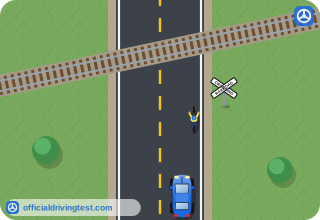
- At a shallow angle to the rails
- Parallel to the rails
- Along the rails in the lane
- At right angles
Show answer
Correct answer: At right angles
The manual says railroad tracks should be crossed at right angles.
Source: Maine Driver’s License Manual (Rev 4/24), page 10-4 · Open this page in the manual (Manual page 10-4)
-
How much room should a bicyclist give between themselves and parked vehicles to avoid opening car doors?
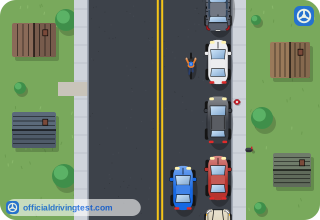
- Three or four feet
- One foot
- Six inches
- Eight to ten feet
Show answer
Correct answer: Three or four feet
A bicyclist should give three or four feet of room between themselves and parked vehicles.
Source: Maine Driver’s License Manual (Rev 4/24), page 10-4 · Open this page in the manual (Manual page 10-4)
-
What should a bicyclist always do before changing lane position?
- Ring a bell twice first
- Speed up a little
- Check over the shoulder
- Stop completely
Show answer
Correct answer: Check over the shoulder
A bicyclist should always check over the shoulder before changing lane position.
Source: Maine Driver’s License Manual (Rev 4/24), page 10-4 · Open this page in the manual (Manual page 10-4)
-
Besides turning from the left lane or left side of the travel lane, how may a bicyclist make a left turn?
- From the right edge of the road without looking behind
- In two parts: cross straight over, then pull over and turn left
- By riding along the sidewalk to the next corner ahead
- By turning left from the right turn lane
Show answer
Correct answer: In two parts: cross straight over, then pull over and turn left
A bicyclist can make a left turn in two parts by crossing straight across the intersection, pulling over to the side, and then turning left when it is safe.
Source: Maine Driver’s License Manual (Rev 4/24), page 10-4 · Open this page in the manual (Manual page 10-4)
-
What color of light must a bicycle's front light emit?
- Red
- Amber
- Green
- White
Show answer
Correct answer: White
A bicycle must have a front light that emits a white light visible from at least 200 feet to the front.
Source: Maine Driver’s License Manual (Rev 4/24), page 10-4 · Open this page in the manual (Manual page 10-4)
-
At least how far must a bicycle's front white light be visible?
- 200 feet
- 50 feet
- 100 feet
- 500 feet
Show answer
Correct answer: 200 feet
A bicycle's white front light must be visible from a distance of at least 200 feet to the front.
Source: Maine Driver’s License Manual (Rev 4/24), page 10-4 · Open this page in the manual (Manual page 10-4)
-
What must a bicycle have at the rear, visible at least 200 feet?
- A white light or a white reflector
- A green light or green reflector
- A red or amber light or reflector
- A blue light that flashes
Show answer
Correct answer: A red or amber light or reflector
A bicycle must have a red or amber light or reflector to the rear that is visible at least 200 feet to the rear.
Source: Maine Driver’s License Manual (Rev 4/24), page 10-4 · Open this page in the manual (Manual page 10-4)
-
Where is reflector material recommended on a bicycle?
- On the handlebar grips
- On the pedals
- On the seat post
- On the front fork
Show answer
Correct answer: On the pedals
Reflector material is recommended on the pedals, unless the bicyclist is wearing reflective material on the feet or ankles.
Source: Maine Driver’s License Manual (Rev 4/24), page 10-4 · Open this page in the manual (Manual page 10-4)