Maine: Sharing the road — Part 2 Practice Test
Bicycles and the three-foot passing rule, motorcycles and mopeds, trucks and buses and their No-Zones, school buses, slow-moving vehicles and wildlife. — Part 2
Independent educational site · not affiliated with any government agency or DMV
Ready? Test yourself
- Instant feedback with an explanation
- Every answer cites its source in the manual
- Your best score is saved on this device
Questions are original and based on the official manual "Maine Driver’s License Manual" (Rev 4/24), Maine Bureau of Motor Vehicles.
All 34 questions in this practice test
Take the test above first, then use this list to study. Tap “Show answer” to see the correct answer and explanation.
Show the questions and answersHide the questions
-
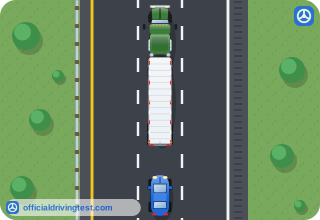
Why should you increase your following distance behind large vehicles or vehicles pulling a trailer?
- They always accelerate faster than cars
- Their drivers cannot see you well if you are too close
- Their drivers must signal earlier than cars
- They are not allowed to use their brakes on hills
Show answer
Correct answer: Their drivers cannot see you well if you are too close
Drivers of trucks, buses, vans or cars pulling campers or trailers cannot see you very well if you are too close, and they could slow down suddenly without knowing you are behind them.
Source: Maine Driver’s License Manual (Rev 4/24), page 8-12 · Open this page in the manual (Manual page 8-12)
-
When should you not pass a truck or bus on its right?
- When it is moving slower than traffic
- When it has its headlights on
- When it may be making a right-hand turn
- When it is carrying a heavy load
Show answer
Correct answer: When it may be making a right-hand turn
Trucks and buses often make wide turns, leaving an open space to their right, so do not pass them on the right if they may be making a right-hand turn.
Source: Maine Driver’s License Manual (Rev 4/24), page 8-12 · Open this page in the manual (Manual page 8-12)
-
What do large vehicles often do when climbing a hill?
- Gain speed
- Lose speed
- Keep a steady speed
- Stop and wait
Show answer
Correct answer: Lose speed
Large vehicles often lose speed when climbing a hill, and they gain substantial momentum going downhill.
Source: Maine Driver’s License Manual (Rev 4/24), page 8-12 · Open this page in the manual (Manual page 8-12)
-
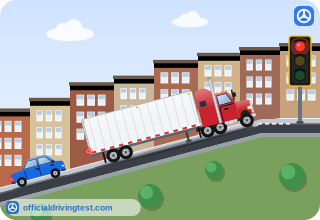
Why should you leave space in front of you when stopped behind a truck or bus at an intersection, especially on a hill?
- The driver may want to back into a parking space
- The vehicle's exhaust may block your view
- The vehicle may have to change lanes before turning
- The vehicle may roll back a bit before starting forward
Show answer
Correct answer: The vehicle may roll back a bit before starting forward
Leave space in case the truck or bus rolls back a bit before starting forward.
Source: Maine Driver’s License Manual (Rev 4/24), page 8-12 · Open this page in the manual (Manual page 8-12)
-
Which vehicles must stop at all railroad crossings, so you should expect the stops and slow down early?
- School buses and flammable-liquid tank trucks
- Delivery vans and pickup trucks with light loads
- Passenger cars and motorcycles
- Farm tractors and animal-drawn carts
Show answer
Correct answer: School buses and flammable-liquid tank trucks
School buses and tank trucks carrying flammable liquids must stop at all railroad crossings, so expect the stops and slow down early to allow plenty of room for stopping.
Source: Maine Driver’s License Manual (Rev 4/24), page 8-12 · Open this page in the manual (Manual page 8-12)
-
Why should you avoid driving alongside other vehicles on a multi-lane street?
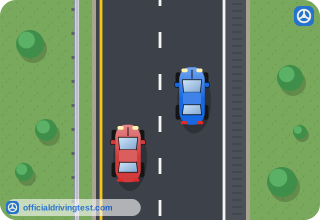
- You may be in their blind spot
- Your horn will not work as well
- Their mirrors reflect your lights
- Your car will use more fuel
Show answer
Correct answer: You may be in their blind spot
Alongside another vehicle you may be in its blind spot, which reduces the space you have to avoid a collision. Either pull ahead of the other vehicle or drop back.
Source: Maine Driver’s License Manual (Rev 4/24), page 8-13 · Open this page in the manual (Manual page 8-13)
-
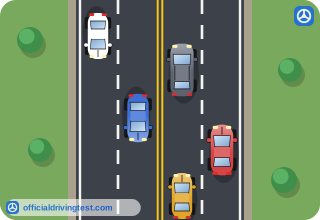
What is the danger of driving in the lane next to the center line?
- Oncoming drivers cannot see your headlights well
- Your car is more likely to hydroplane near the line
- You have no space for escape if a car swerves across
- You will be unable to signal a lane change
Show answer
Correct answer: You have no space for escape if a car swerves across
In the lane next to the center line there is no space for escape, and an oncoming vehicle could swerve across the line or turn left without signaling.
Source: Maine Driver’s License Manual (Rev 4/24), page 8-13 · Open this page in the manual (Manual page 8-13)
-
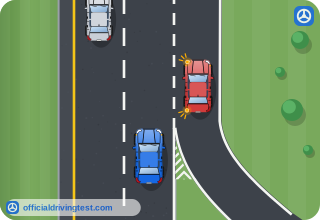
How can you make space for vehicles entering a multi-lane road?
- Speed up to stay ahead of them
- Move over a lane or slow down
- Move toward the center line and hold your speed
- Sound your horn so they wait
Show answer
Correct answer: Move over a lane or slow down
The manual says to make space for vehicles entering multi-lane roads by moving over a lane or slowing down.
Source: Maine Driver’s License Manual (Rev 4/24), page 8-13 · Open this page in the manual (Manual page 8-13)
-
Why should you keep a space between your vehicle and parked cars?
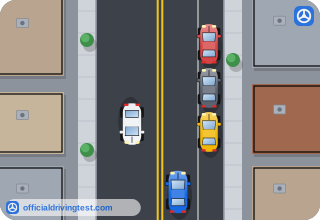
- Someone may step out or a car may pull out suddenly
- Parked cars reflect glare from your headlights
- Your side mirrors can be damaged by parked cars
- Cars parked there may leave oil on the pavement
Show answer
Correct answer: Someone may step out or a car may pull out suddenly
Someone may step out of a car or from between parked cars, or a car may start to pull out of its parking space suddenly.
Source: Maine Driver’s License Manual (Rev 4/24), page 8-13 · Open this page in the manual (Manual page 8-13)
-
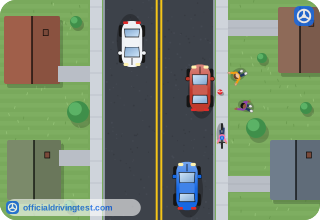
What should you do about pedestrians, children, and bicyclists?
- Sound your horn as you approach them
- Pass them at a higher speed to clear the area quickly
- Give them more space
- Leave the same space as you do for other traffic
Show answer
Correct answer: Give them more space
The manual says to give more space to pedestrians, children, and bicyclists.
Source: Maine Driver’s License Manual (Rev 4/24), page 8-13 · Open this page in the manual (Manual page 8-13)
-
When a tractor-trailer passes you, where should you position your vehicle in your lane?
- In the center of your lane
- To the right side of your lane
- To the left side of your lane
- Partly onto the shoulder of the road
Show answer
Correct answer: To the right side of your lane
When you are passed by a tractor-trailer, move to the right side of your lane and give yourself space from the tractor-trailer as it passes.
Source: Maine Driver’s License Manual (Rev 4/24), page 8-13 · Open this page in the manual (Manual page 8-13)
-
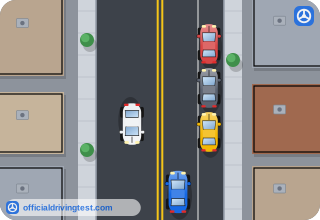
Parked cars are on your right and oncoming cars are on your left. What should you do?
- Stay close to the parked cars
- Hold the center line to keep clear
- Stop and wait until both sides are clear
- Steer a middle course between them
Show answer
Correct answer: Steer a middle course between them
When there are dangers on both sides, steer a middle course between the oncoming cars and the parked cars: split the difference.
Source: Maine Driver’s License Manual (Rev 4/24), page 8-14 · Open this page in the manual (Manual page 8-14)
-
An oncoming car is to your left and a bicyclist is to your right. What should you do?
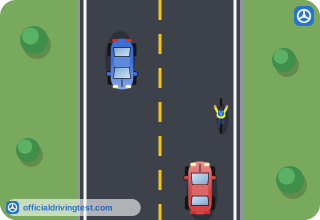
- Slow down, let the car pass, then move left to pass the bicyclist
- Speed up and pass the bicyclist before the car reaches you
- Drive between the car and the bicyclist at a steady pace
- Sound your horn and pass the bicyclist at the same moment
Show answer
Correct answer: Slow down, let the car pass, then move left to pass the bicyclist
Take the two dangers one at a time: slow down, let the oncoming car pass, and then move left to allow plenty of room as you pass the bicyclist.
Source: Maine Driver’s License Manual (Rev 4/24), page 8-14 · Open this page in the manual (Manual page 8-14)
-
When you pass a bicyclist after an oncoming car has gone by, how much room should you allow?
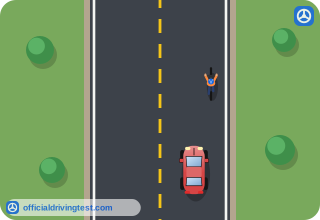
- One foot
- Five feet
- Three feet
- Six feet
Show answer
Correct answer: Three feet
After the oncoming car passes, you move to the left to allow plenty of room, three feet, as you pass the bicyclist.
Source: Maine Driver’s License Manual (Rev 4/24), page 8-14 · Open this page in the manual (Manual page 8-14)
-
If you are driving beside and slightly behind another vehicle for a long period, what should you do to be seen?
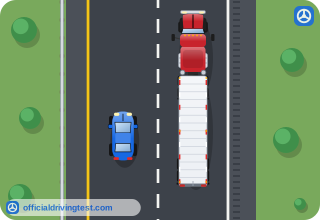
- Stay beside it so the driver can see you
- Sound your horn until the driver notices you
- Move to the center line of the road
- Either speed up or drop back to clear that lane
Show answer
Correct answer: Either speed up or drop back to clear that lane
Avoid driving on either side and slightly to the rear of another vehicle for long; either speed up or drop back to clear that lane so you can be seen.
Source: Maine Driver’s License Manual (Rev 4/24), page 8-19 · Open this page in the manual (Manual page 8-19)
-
When passing another vehicle, how should you get through the other driver's blind spot?
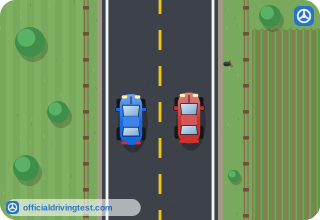
- As quickly as you can
- Slowly, so the driver has time to see you
- By staying alongside for a moment
- At the same speed as the other vehicle
Show answer
Correct answer: As quickly as you can
When passing another vehicle, get through the other driver's blind spot as quickly as you can.
Source: Maine Driver’s License Manual (Rev 4/24), page 8-19 · Open this page in the manual (Manual page 8-19)
-
How are bicycles treated under the rules of the road in Maine?
- As pedestrians who must share the sidewalk with walkers
- As vehicles with the same rights and responsibilities as drivers
- As equipment that does not have to obey traffic signals
- As a separate group with their own special traffic laws
Show answer
Correct answer: As vehicles with the same rights and responsibilities as drivers
Bicycles are considered vehicles, and bicyclists must follow the same rules of the road as other vehicles.
Source: Maine Driver’s License Manual (Rev 4/24), page 10-1 · Open this page in the manual (Manual page 10-1)
-
How do bicycles differ from motor vehicles as road users, according to the manual?
- They are more visible but make more noise
- They are less visible but have a protective casing
- They are quieter and easier to predict
- They are less visible, quieter and have no protective casing
Show answer
Correct answer: They are less visible, quieter and have no protective casing
Bicycles are less visible, quieter, and do not have a protective vehicle casing around them, so drivers must look harder and drive more cautiously.
Source: Maine Driver’s License Manual (Rev 4/24), page 10-2 · Open this page in the manual (Manual page 10-2)
-
What describes a skillful bicycle rider?
- Predictable and holds a steady line
- Swerves without notice to avoid cars
- Rides without a light at night
- Ignores signals when traffic is light
Show answer
Correct answer: Predictable and holds a steady line
A skillful rider is predictable and holds a steady line, while an unskillful rider may swerve without notice.
Source: Maine Driver’s License Manual (Rev 4/24), page 10-2 · Open this page in the manual (Manual page 10-2)
-
How should you treat bicyclists at intersections?
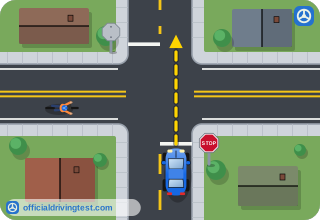
- Expect them to get off and walk across the road first
- Expect them to yield to every motor vehicle they meet
- Yield to them as you do for pedestrians and other vehicles
- Sound your horn and drive through ahead of the bicyclist
Show answer
Correct answer: Yield to them as you do for pedestrians and other vehicles
Drivers must yield to bicyclists at intersections, just like they do for pedestrians and other vehicles.
Source: Maine Driver’s License Manual (Rev 4/24), page 10-2 · Open this page in the manual (Manual page 10-2)
-
What must you do when a bicycle path or bike lane crosses the road?
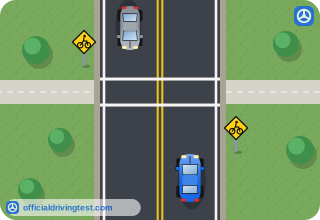
- Speed up to cross before bicyclists arrive
- Yield the right-of-way
- Sound your horn and continue
- Proceed if you reached the crossing first
Show answer
Correct answer: Yield the right-of-way
Drivers must yield the right-of-way when a bicycle path or bike lane crosses the road.
Source: Maine Driver’s License Manual (Rev 4/24), page 10-2 · Open this page in the manual (Manual page 10-2)
-
When may you stop, park or drive in a bicycle lane?
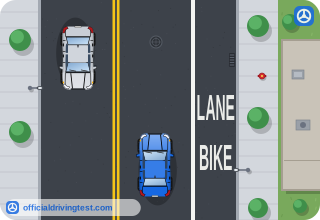
- When no bicyclists are in sight of the lane
- When you need to pass a slow-moving vehicle
- When you are waiting for a parking space
- When entering or leaving an alley or driveway
Show answer
Correct answer: When entering or leaving an alley or driveway
Do not stop, park, or drive in a bicycle lane unless you are entering or leaving an alley or driveway.
Source: Maine Driver’s License Manual (Rev 4/24), page 10-2 · Open this page in the manual (Manual page 10-2)
-
A cyclist is about to cross an intersection where you plan to turn. What should you do?
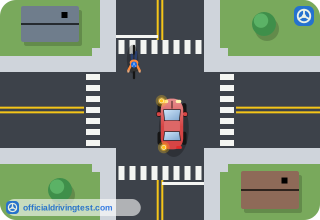
- Turn quickly ahead of the cyclist before they cross
- Sound your horn and turn closely behind the cyclist
- Slow down and let the cyclist clear the intersection first
- Speed up so the cyclist stays behind your vehicle
Show answer
Correct answer: Slow down and let the cyclist clear the intersection first
Slow down and let a cyclist clear an intersection before you make a turn.
Source: Maine Driver’s License Manual (Rev 4/24), page 10-2 · Open this page in the manual (Manual page 10-2)
-
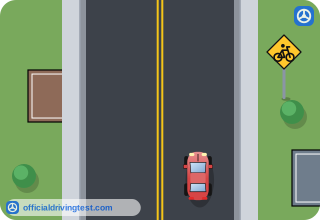
Where should bicyclists operate on the roadway?
- In the center of the lane at all times of the day or night
- On the right portion of the way, as far to the right as practical
- On the left side of the road, facing the traffic ahead
- On the sidewalk whenever one is available to them
Show answer
Correct answer: On the right portion of the way, as far to the right as practical
Bicyclists should operate on the right portion of the way as far to the right as practical, except when it is unsafe to do so as determined by the bicyclist.
Source: Maine Driver’s License Manual (Rev 4/24), page 10-2 · Open this page in the manual (Manual page 10-2)
-
What does it mean when a bicyclist "commands the lane"?
- Riding on the shoulder so that cars can pass them
- Stopping to let all the traffic go by first
- Riding on the sidewalk next to the lane
- Riding toward the center, or to the left if turning
Show answer
Correct answer: Riding toward the center, or to the left if turning
A bicyclist may "command the lane" by riding toward the center or to the left if turning, when that is the safest place to ride.
Source: Maine Driver’s License Manual (Rev 4/24), page 10-2 · Open this page in the manual (Manual page 10-2)
-
How fast can experienced bicyclists easily travel, according to the manual?
- Over 30 mph
- No more than 12 mph
- No more than 20 mph
- About 25 mph at most
Show answer
Correct answer: Over 30 mph
Bicyclists may be moving faster than you realize, since experienced bicyclists can easily travel over 30 mph.
Source: Maine Driver’s License Manual (Rev 4/24), page 10-2 · Open this page in the manual (Manual page 10-2)
-
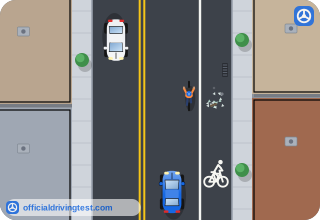
What should you do when you see potholes, debris and drain grates that are hazardous to cyclists?
- Pass quickly before they reach the hazard
- Sound your horn to warn them
- Give the cyclists adequate space to maneuver
- Follow closely behind them
Show answer
Correct answer: Give the cyclists adequate space to maneuver
Drivers should recognize hazards to cyclists, such as potholes, debris, and drain grates, and give them adequate space to maneuver.
Source: Maine Driver’s License Manual (Rev 4/24), page 10-2 · Open this page in the manual (Manual page 10-2)
-
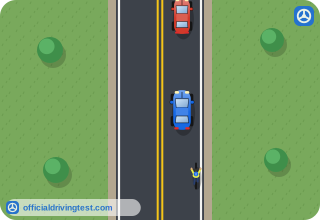
Why should you avoid slowing or stopping your vehicle suddenly near a bicycle?
- Bicycles have no brakes that work in traffic
- You can stop more quickly than a bicycle and could cause a crash
- A sudden stop would make the bicyclist pass you on the right
- Bicyclists cannot see brake lights during the day
Show answer
Correct answer: You can stop more quickly than a bicycle and could cause a crash
The manual says you can stop more quickly than a bicycle, so stopping quickly could cause a crash.
Source: Maine Driver’s License Manual (Rev 4/24), page 10-2 · Open this page in the manual (Manual page 10-2)
-
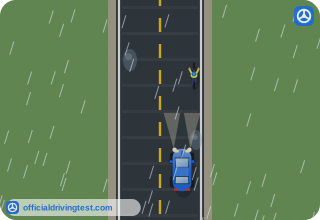
What should you do around bicyclists in inclement weather?
- Treat them as you would in dry weather
- Pass them quickly to get out of the weather
- Stay close behind to protect them
- Give them extra trailing and passing room
Show answer
Correct answer: Give them extra trailing and passing room
In inclement weather, give bicyclists extra trailing and passing room, just as you would other motorists.
Source: Maine Driver’s License Manual (Rev 4/24), page 10-2 · Open this page in the manual (Manual page 10-2)
-
When should you especially reduce your speed when passing bicyclists?
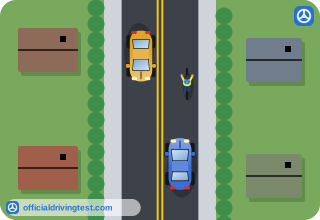
- If the roadway is narrow
- If the roadway is wide
- If the bicyclist wears a helmet
- If it is daylight
Show answer
Correct answer: If the roadway is narrow
Drivers should reduce speed when passing bicyclists, especially if the roadway is narrow.
Source: Maine Driver’s License Manual (Rev 4/24), page 10-2 · Open this page in the manual (Manual page 10-2)
-
When a road is too narrow for cars and bikes to ride safely side by side, what should bicycles do?
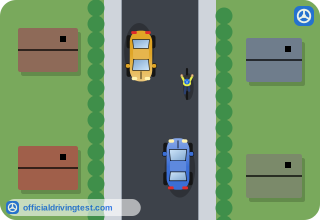
- Ride on the left edge of the road, facing oncoming cars
- Move onto the sidewalk until all of the cars have passed
- Take the travel lane by riding in or near the center of the lane
- Stop and wait until the road is clear of all cars
Show answer
Correct answer: Take the travel lane by riding in or near the center of the lane
When a road is too narrow for cars and bikes to ride safely side by side, bicycles should "take the travel lane," riding in or near the center of the lane.
Source: Maine Driver’s License Manual (Rev 4/24), page 10-2 · Open this page in the manual (Manual page 10-2)
-
When may a driver near a person operating a bicycle make a right turn?
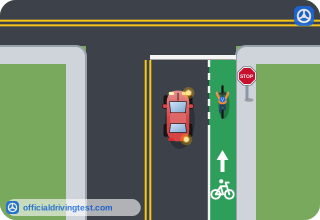
- Only after sounding the horn to warn the bicyclist that you are turning
- Only if the turn is reasonably safe and does not interfere with the bicycle
- Whenever the driver signals well before the turn is made
- Only when the bicyclist is stopped at the intersection ahead
Show answer
Correct answer: Only if the turn is reasonably safe and does not interfere with the bicycle
A driver near a bicycle may not make a right turn unless it can be made with reasonable safety and without interfering with the safe and legal operation of the bicycle.
Source: Maine Driver’s License Manual (Rev 4/24), page 10-3 · Open this page in the manual (Manual page 10-3)
-
When should you use your horn close to bicycles?
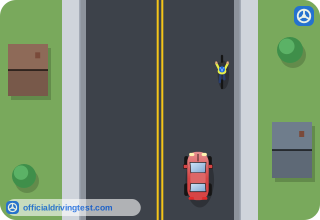
- To let them know you are about to pass
- Whenever you approach them from behind
- When a bicyclist is riding on the sidewalk
- Only if there is a chance of a crash
Show answer
Correct answer: Only if there is a chance of a crash
Do not use your horn close to bicycles unless there is a chance of a crash, because the horn could startle them and cause them to steer into your path.
Source: Maine Driver’s License Manual (Rev 4/24), page 10-3 · Open this page in the manual (Manual page 10-3)
-
What should you watch out for when you see children riding bikes on the sidewalk?
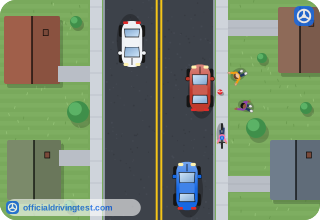
- They may suddenly ride onto the road
- They will stop at every driveway
- They will signal before leaving the sidewalk
- They will stay on the sidewalk
Show answer
Correct answer: They may suddenly ride onto the road
Children riding bikes on the sidewalk may suddenly ride onto the road.
Source: Maine Driver’s License Manual (Rev 4/24), page 10-3 · Open this page in the manual (Manual page 10-3)