Louisiana: Parking rules
Parking on hills, parallel and angle parking, where Louisiana law forbids parking, accessible spaces and preventing car theft. Split into 4 shorter tests so you're not stuck in one long quiz.
Independent educational site · not affiliated with any government agency or DMV
Choose a part
Parking rules — Part 1
Questions in this part include: “Where is angle parking often used?”
StartParking rules — Part 2
Questions in this part include: “When parking along the roadway, where should you park your vehicle?”
StartParking rules — Part 3
Questions in this part include: “According to R.S. 32:143, in which of these places is it against the law to park?”
StartParking rules — Part 4
Questions in this part include: “What should you do with your doors to help prevent automobile theft?”
StartAll 67 Parking rules questions with answers
Choose a part above to take a practice test, or study every question and answer here.
Show the questions and answersHide the questions
-
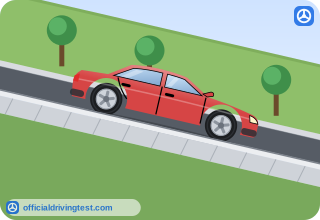
You park facing downhill next to a curb. How should you turn your wheels?
- Away from the curb
- Toward the curb
- Straight ahead
- Parallel to the road
Show answer
Correct answer: Toward the curb
When facing downhill with a curb, you turn your wheels toward the curb and shift into reverse or park.
Source: Class D & E Driver’s Guide (Revised August 2025 (DPSMV2052 R08/25)), page 68 · Open this page in the manual (Manual page 68)
-
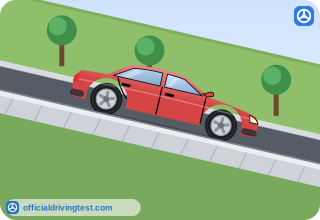
You park facing downhill next to a curb. Which gear should you shift into?
- Low gear or neutral
- Neutral only
- Drive
- Reverse or park
Show answer
Correct answer: Reverse or park
When facing downhill with a curb, you shift into reverse or park.
Source: Class D & E Driver’s Guide (Revised August 2025 (DPSMV2052 R08/25)), page 68 · Open this page in the manual (Manual page 68)
-
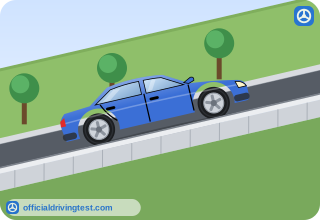
You park facing uphill next to a curb. How should you turn your wheels?
- Away from the curb
- Toward the curb
- Straight ahead
- Toward the center of the road
Show answer
Correct answer: Away from the curb
When facing uphill with a curb, you turn your wheels away from the curb and shift into low gear or park.
Source: Class D & E Driver’s Guide (Revised August 2025 (DPSMV2052 R08/25)), page 68 · Open this page in the manual (Manual page 68)
-
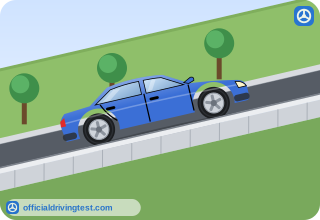
You park facing uphill next to a curb. Which gear should you shift into?
- Reverse or neutral
- Neutral only
- Low gear or park
- Reverse only
Show answer
Correct answer: Low gear or park
When facing uphill with a curb, you shift into low gear or park.
Source: Class D & E Driver’s Guide (Revised August 2025 (DPSMV2052 R08/25)), page 68 · Open this page in the manual (Manual page 68)
-
You park on a hill where there is no curb. How should you turn your wheels?
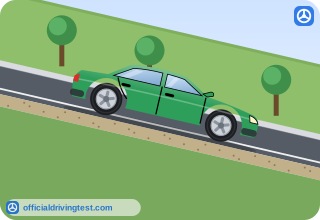
- Away from the edge of the road, whether facing uphill or downhill
- Toward the edge of the road facing downhill and away from it facing uphill
- Straight ahead so the car stays on the road
- Toward the edge of the road, whether facing uphill or downhill
Show answer
Correct answer: Toward the edge of the road, whether facing uphill or downhill
With no curb, you turn your wheels toward the edge of the road whether you face uphill or downhill.
Source: Class D & E Driver’s Guide (Revised August 2025 (DPSMV2052 R08/25)), page 68 · Open this page in the manual (Manual page 68)
-
How should you drive into an angle parking space?
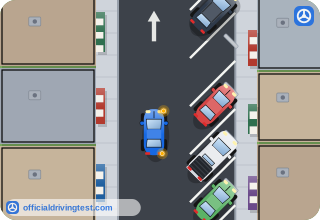
- Forward, staying close to the line on the left side of the space
- Forward into the space, with equal space on each side between the lines
- Forward, stopping with your front wheels on the line
- Forward, leaving extra room on the side next to the curb
Show answer
Correct answer: Forward into the space, with equal space on each side between the lines
The manual says to drive forward into an angle parking space with equal space on each side between lines.
Source: Class D & E Driver’s Guide (Revised August 2025 (DPSMV2052 R08/25)), page 68 · Open this page in the manual (Manual page 68)
-
Where is angle parking often used?
- On interstate shoulders and freeway ramps
- Only on narrow residential streets with no curbs
- In parking lots, shopping centers, and sometimes at curbs
- Only in front of fire stations and driveways
Show answer
Correct answer: In parking lots, shopping centers, and sometimes at curbs
The manual says angle parking is often used in parking lots, shopping centers, and sometimes at curbs.
Source: Class D & E Driver’s Guide (Revised August 2025 (DPSMV2052 R08/25)), page 68 · Open this page in the manual (Manual page 68)
-
When you enter an angle parking space, where should you watch for traffic?
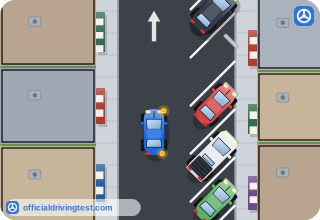
- Both ahead and behind
- Only ahead
- Only behind
- Only toward the side where the space is
Show answer
Correct answer: Both ahead and behind
The manual says to watch for traffic both ahead and behind when entering an angle parking space.
Source: Class D & E Driver’s Guide (Revised August 2025 (DPSMV2052 R08/25)), page 68 · Open this page in the manual (Manual page 68)
-
When entering an angle parking space, what should you make sure about the rear of your car?
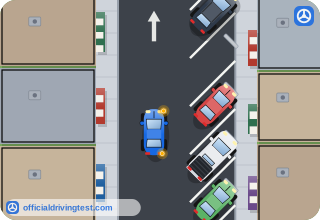
- That it will clear any parked car
- That it points toward the curb
- That it is closer to the left line than to the right line
- That it sits farther out than the cars beside you
Show answer
Correct answer: That it will clear any parked car
The manual says to make sure the rear of your car will clear any parked car when entering an angle space.
Source: Class D & E Driver’s Guide (Revised August 2025 (DPSMV2052 R08/25)), page 68 · Open this page in the manual (Manual page 68)
-
How do you steer into an angle parking space?
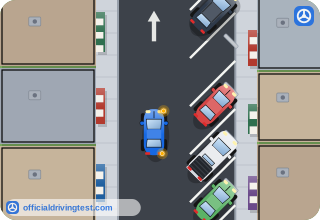
- Gradually in a wide curve, keeping the wheels turned until you stop
- Straight in, keeping the wheels turned left
- Sharply into the space, then straighten the wheels to center the car
- Slowly in reverse, turning the wheels toward the curb
Show answer
Correct answer: Sharply into the space, then straighten the wheels to center the car
The manual says to steer sharply into the parking space, then straighten the wheels, centering the car.
Source: Class D & E Driver’s Guide (Revised August 2025 (DPSMV2052 R08/25)), page 68 · Open this page in the manual (Manual page 68)
-
After you center your car in an angle parking space, what should you do?
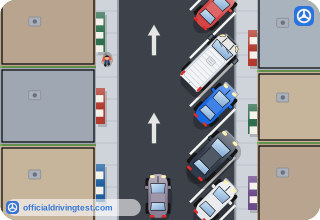
- Shift to neutral and leave the parking brake off
- Shift to park or reverse and apply the parking brake
- Shift to drive and turn off the engine
- Shift to low gear and release the brake
Show answer
Correct answer: Shift to park or reverse and apply the parking brake
The manual says to shift to park or reverse and apply the parking brake once you are in an angle space.
Source: Class D & E Driver’s Guide (Revised August 2025 (DPSMV2052 R08/25)), page 68 · Open this page in the manual (Manual page 68)
-
What should you do first before backing out of an angle parking space?
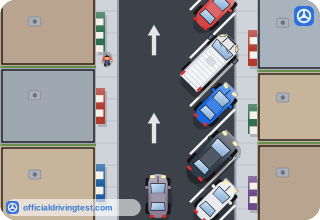
- Honk the horn twice and then back out
- Turn the wheels sharply left while the car is stopped
- Shift to drive and pull forward slightly
- Walk around the car to make sure nothing is blocking the space
Show answer
Correct answer: Walk around the car to make sure nothing is blocking the space
The manual says to walk around to make sure nothing is blocking the space before backing out of an angle parking space.
Source: Class D & E Driver’s Guide (Revised August 2025 (DPSMV2052 R08/25)), page 69 · Open this page in the manual (Manual page 69)
-
Why should you move your car back slowly when backing out of an angle parking space?
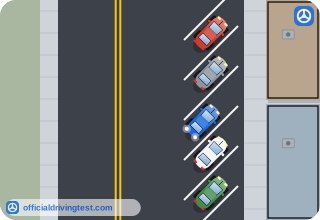
- Reverse gear is hard on the transmission
- Parked cars may roll into your path
- It is hard to see oncoming traffic
- Your front wheels turn the opposite way in reverse
Show answer
Correct answer: It is hard to see oncoming traffic
The manual says to move back slowly because it is hard to see oncoming traffic.
Source: Class D & E Driver’s Guide (Revised August 2025 (DPSMV2052 R08/25)), page 69 · Open this page in the manual (Manual page 69)
-
While backing out of an angle parking space, you can see past the tops of the cars parked next to you. What should you do?
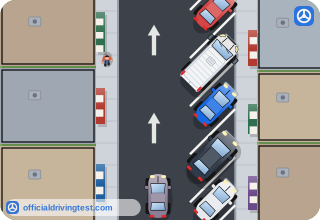
- Stop and look again, back and to each side for other drivers
- Speed up to clear the space quickly
- Keep backing without stopping because the way is clear
- Turn off the engine and wait for traffic to pass
Show answer
Correct answer: Stop and look again, back and to each side for other drivers
The manual says that when you can see past the tops of the cars next to you, you stop and look again, back and to each side.
Source: Class D & E Driver’s Guide (Revised August 2025 (DPSMV2052 R08/25)), page 69 · Open this page in the manual (Manual page 69)
-
When you back out of an angle parking space, which way does the front of your car swing?
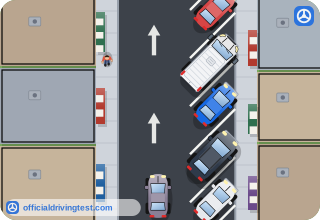
- The same way as the direction of your turn
- Straight toward the car parked beside you
- It does not swing when you back slowly
- Opposite to the direction of your turn
Show answer
Correct answer: Opposite to the direction of your turn
The manual tells you to remember that the front of your car will swing opposite to the direction of your turn.
Source: Class D & E Driver’s Guide (Revised August 2025 (DPSMV2052 R08/25)), page 69 · Open this page in the manual (Manual page 69)
-
Backing out of an angle parking space, how long do you back slowly while turning?
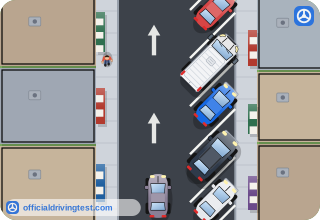
- Until your right front wheel reaches the curb on the right side of the lane
- Until your left front wheel passes the rear bumper of the car parked on your left
- Until your front bumper is even with the car parked on your right side
- Until your rear wheels touch the painted line at the back of the space
Show answer
Correct answer: Until your left front wheel passes the rear bumper of the car parked on your left
The manual says to back slowly while turning until your left front wheel passes the rear bumper of the car parked on your left.
Source: Class D & E Driver’s Guide (Revised August 2025 (DPSMV2052 R08/25)), page 69 · Open this page in the manual (Manual page 69)
-
When exiting a perpendicular or angle parking space, in which direction do you signal?
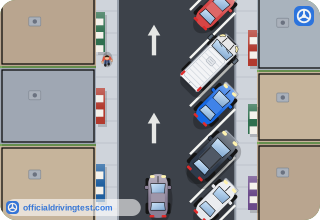
- Always to the right
- In the direction you are turning
- Toward the car parked beside you
- You do not signal until you are in the lane
Show answer
Correct answer: In the direction you are turning
The manual says to shift to reverse and signal in the direction you are turning when exiting the space.
Source: Class D & E Driver’s Guide (Revised August 2025 (DPSMV2052 R08/25)), page 69 · Open this page in the manual (Manual page 69)
-
When exiting a perpendicular or angle parking space, how far straight back do you move before turning?
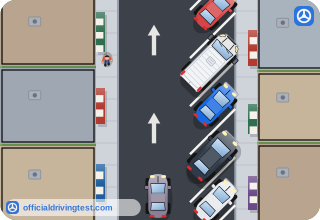
- Until your rear bumper reaches the center of the lane
- Until your car is halfway into the lane
- Until your rear wheels are past the painted line
- Until your front bumper clears the vehicle parked beside you
Show answer
Correct answer: Until your front bumper clears the vehicle parked beside you
You move straight back until your front bumper clears the vehicle parked beside you, on the side opposite to your turn.
Source: Class D & E Driver’s Guide (Revised August 2025 (DPSMV2052 R08/25)), page 69 · Open this page in the manual (Manual page 69)
-
When exiting a perpendicular or angle parking space, which way do you turn the steering wheel sharply?
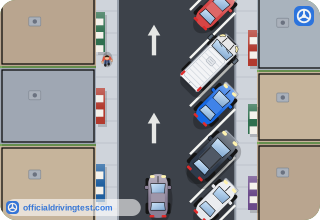
- In the direction that the rear of your vehicle should move
- In the direction that the front of your vehicle should move
- Toward the vehicle parked beside you
- Straight, keeping the wheels centered
Show answer
Correct answer: In the direction that the rear of your vehicle should move
The manual says to turn the steering wheel sharply in the direction that the rear of your vehicle should move.
Source: Class D & E Driver’s Guide (Revised August 2025 (DPSMV2052 R08/25)), page 69 · Open this page in the manual (Manual page 69)
-
When you clear a perpendicular or angle parking space and center in your lane, what do you do?
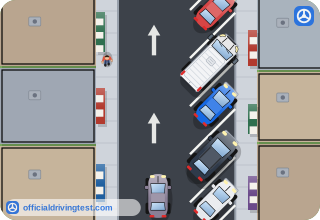
- Keep reversing until you reach the curb
- Shift to neutral and wait for traffic
- Stop and shift to drive
- Accelerate in reverse until the wheels are straight
Show answer
Correct answer: Stop and shift to drive
The manual says that when the vehicle clears the parking area and centers in the lane, you stop and shift to drive.
Source: Class D & E Driver’s Guide (Revised August 2025 (DPSMV2052 R08/25)), page 69 · Open this page in the manual (Manual page 69)
-
For a perpendicular parking spot, which method does the manual call safer when it is possible?
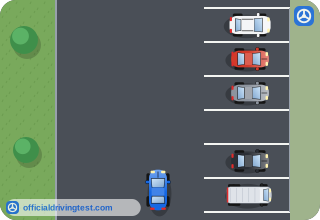
- Parking with the front wheels turned toward the curb
- Parking beside the other car with equal space on each side
- Entering the spot with the left turn signal on
- Backing into the spot or pulling through
Show answer
Correct answer: Backing into the spot or pulling through
The manual says that, when possible, it is preferable to back into a perpendicular parking spot or pull through, a safer method that prevents crashes with other vehicles or pedestrians.
Source: Class D & E Driver’s Guide (Revised August 2025 (DPSMV2052 R08/25)), page 69 · Open this page in the manual (Manual page 69)
-
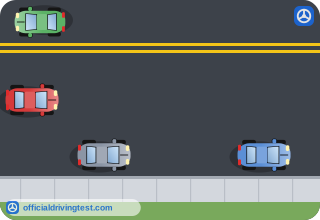
When you start to parallel park, how far from the front car should you stop beside it?
- About 6 inches
- About 18 inches
- About 3 feet
- About 5 feet
Show answer
Correct answer: About 18 inches
The manual says to signal and stop parallel to the front car, about 18 inches from it.
Source: Class D & E Driver’s Guide (Revised August 2025 (DPSMV2052 R08/25)), page 69 · Open this page in the manual (Manual page 69)
-
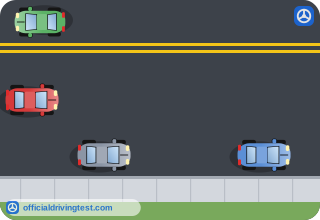
When you first stop beside the front car to parallel park, what should be even?
- Your rear wheels and its front wheels
- Your headlights and its taillights
- The rear bumpers of the two cars
- Your door handles and its trunk
Show answer
Correct answer: The rear bumpers of the two cars
The manual says to stop parallel to the front car with rear bumpers even.
Source: Class D & E Driver’s Guide (Revised August 2025 (DPSMV2052 R08/25)), page 69 · Open this page in the manual (Manual page 69)
-
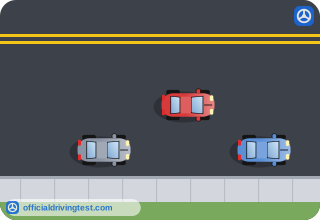
When backing into a parallel parking space, you turn the steering wheel sharply to the right until your car is at about what angle with the street?
- 45 degrees
- 15 degrees
- 30 degrees
- 90 degrees
Show answer
Correct answer: 45 degrees
The manual says to back slowly, turning sharply right until your car is about a 45-degree angle with the street.
Source: Class D & E Driver’s Guide (Revised August 2025 (DPSMV2052 R08/25)), page 69 · Open this page in the manual (Manual page 69)
-
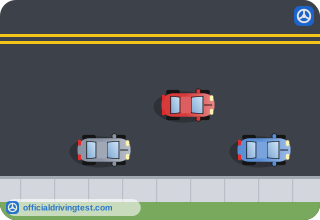
While parallel parking, your front bumper is even with the other car’s back bumper. Which way do you turn the wheels sharply and rapidly?
- To the left
- To the right
- Straight ahead
- You hold the wheel where it is
Show answer
Correct answer: To the left
When the front bumper is even with the other car’s back bumper, you turn the wheels sharply and rapidly to the left.
Source: Class D & E Driver’s Guide (Revised August 2025 (DPSMV2052 R08/25)), page 69 · Open this page in the manual (Manual page 69)
-
Unless the street is otherwise marked, how close should your front and rear bumpers be to the other vehicles when you are parallel parked?
- Not closer than six inches
- Not closer than one foot
- Not closer than two feet
- Not closer than five feet
Show answer
Correct answer: Not closer than two feet
The manual says front and rear bumpers should not be closer than two feet from the other vehicles in the parked position, unless the street is otherwise marked.
Source: Class D & E Driver’s Guide (Revised August 2025 (DPSMV2052 R08/25)), page 69 · Open this page in the manual (Manual page 69)
-
When parking along the roadway, where should you park your vehicle?
- In the middle of the lane, with the hazard flashers on
- As far from traffic as possible, and as close to a curb as possible
- Far enough from the curb to leave room to open the doors
- As close to traffic as possible, so the curb stays clear
Show answer
Correct answer: As far from traffic as possible, and as close to a curb as possible
The manual says to park as far away from traffic as possible and, if there is a curb, as close to it as possible.
Source: Class D & E Driver’s Guide (Revised August 2025 (DPSMV2052 R08/25)), page 69 · Open this page in the manual (Manual page 69)
-
What should you do when you park and leave a vehicle unattended?
- Leave the motor running, lock the doors, and set the brake
- Stop the motor, leave the key in the ignition, and turn on the hazard flashers
- Remove the key and leave the brake off so the car can be moved
- Stop the motor, remove the key, lock the ignition, and set the brake
Show answer
Correct answer: Stop the motor, remove the key, lock the ignition, and set the brake
The manual says that when you park and leave a vehicle unattended you stop the motor, remove the key, lock the ignition, and set the brake.
Source: Class D & E Driver’s Guide (Revised August 2025 (DPSMV2052 R08/25)), page 70 · Open this page in the manual (Manual page 70)
-
According to R.S. 32:143, within how many feet of a fire hydrant is it against the law to park?
- 5 feet
- 10 feet
- 15 feet
- 25 feet
Show answer
Correct answer: 15 feet
R.S. 32:143 makes it against the law to park within 15 feet of a fire hydrant.
Source: Class D & E Driver’s Guide (Revised August 2025 (DPSMV2052 R08/25)), page 70 · Open this page in the manual (Manual page 70)
-
According to R.S. 32:143, within how many feet of a railroad crossing is it against the law to park?
- 25 feet
- 30 feet
- 100 feet
- 50 feet
Show answer
Correct answer: 50 feet
R.S. 32:143 makes it against the law to park within 50 feet of a railroad crossing.
Source: Class D & E Driver’s Guide (Revised August 2025 (DPSMV2052 R08/25)), page 70 · Open this page in the manual (Manual page 70)
-
According to R.S. 32:143, within how many feet of a crosswalk at an intersection is it against the law to park?
- 5 feet
- 20 feet
- 10 feet
- 30 feet
Show answer
Correct answer: 20 feet
R.S. 32:143 makes it against the law to park within 20 feet of a crosswalk at an intersection.
Source: Class D & E Driver’s Guide (Revised August 2025 (DPSMV2052 R08/25)), page 70 · Open this page in the manual (Manual page 70)
-
According to R.S. 32:143, within how many feet of a fire station driveway on the same side of the street is it against the law to park?
- 10 feet
- 30 feet
- 20 feet
- 50 feet
Show answer
Correct answer: 20 feet
R.S. 32:143 makes it against the law to park within 20 feet of a fire station driveway on the same side of the street.
Source: Class D & E Driver’s Guide (Revised August 2025 (DPSMV2052 R08/25)), page 70 · Open this page in the manual (Manual page 70)
-
According to R.S. 32:143, within how many feet of a fire station driveway on the other side of the street is it against the law to park?
- 75 feet
- 25 feet
- 50 feet
- 100 feet
Show answer
Correct answer: 75 feet
R.S. 32:143 makes it against the law to park within 75 feet of the fire station driveway on the other side of the street.
Source: Class D & E Driver’s Guide (Revised August 2025 (DPSMV2052 R08/25)), page 70 · Open this page in the manual (Manual page 70)
-
According to R.S. 32:143, within how many feet of a stop sign at the side of a roadway is it against the law to park?
- 20 feet
- 5 feet
- 10 feet
- 30 feet
Show answer
Correct answer: 20 feet
R.S. 32:143 makes it against the law to park within 20 feet of a traffic signal, flashing beacon, stop sign, yield sign or traffic control signal at the side of a roadway.
Source: Class D & E Driver’s Guide (Revised August 2025 (DPSMV2052 R08/25)), page 70 · Open this page in the manual (Manual page 70)
-
According to R.S. 32:143, in which of these places is it against the law to park?
- In a marked space at a shopping center
- Parallel to the curb on a residential street
- In a biking lane
- In an angle space in a parking lot
Show answer
Correct answer: In a biking lane
R.S. 32:143 lists a biking lane among the places where it is against the law to park.
Source: Class D & E Driver’s Guide (Revised August 2025 (DPSMV2052 R08/25)), page 70 · Open this page in the manual (Manual page 70)
-
What is parking beside a parallel parked vehicle called, and is it allowed under R.S. 32:143?
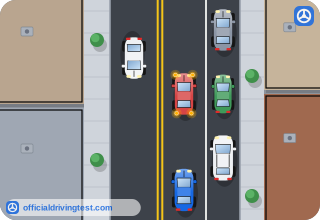
- Double parking, and it is allowed for short stops
- Double parking, and it is against the law
- Side parking, and it is allowed if you stay in the vehicle
- Side parking, and it is against the law only on bridges
Show answer
Correct answer: Double parking, and it is against the law
R.S. 32:143 makes it against the law to park beside a parallel parked vehicle, which the manual calls double parking.
Source: Class D & E Driver’s Guide (Revised August 2025 (DPSMV2052 R08/25)), page 70 · Open this page in the manual (Manual page 70)
-
According to R.S. 32:143, which of these is true about parking on a bridge, overpass or in a tunnel?
- It is allowed if you stay with the vehicle
- It is allowed if the hazard flashers are on
- It is allowed for up to 15 minutes
- It is against the law
Show answer
Correct answer: It is against the law
R.S. 32:143 makes it against the law to park on a bridge, overpass or in any tunnel.
Source: Class D & E Driver’s Guide (Revised August 2025 (DPSMV2052 R08/25)), page 70 · Open this page in the manual (Manual page 70)
-
Under R.S. 32:143, when is it against the law to park in a construction area?
- Only when workers are present
- Only after dark
- If you will block traffic
- Only when the area is fenced off
Show answer
Correct answer: If you will block traffic
R.S. 32:143 makes it against the law to park in a construction area if you will block traffic.
Source: Class D & E Driver’s Guide (Revised August 2025 (DPSMV2052 R08/25)), page 70 · Open this page in the manual (Manual page 70)
-
According to R.S. 32:143, when may you park in a space marked for the disabled?
- Only if you have a handicap license plate, sticker, or tag
- If you stay inside the vehicle while you wait for someone
- If you are there for less than 15 minutes during the day
- If no other parking spaces are open anywhere nearby
Show answer
Correct answer: Only if you have a handicap license plate, sticker, or tag
R.S. 32:143 makes it against the law to park in a space marked for the disabled unless you have a handicap license plate, sticker, or tag.
Source: Class D & E Driver’s Guide (Revised August 2025 (DPSMV2052 R08/25)), page 70 · Open this page in the manual (Manual page 70)
-
According to R.S. 32:143, which of these is against the law?
- Parking in a marked space in a parking lot
- Parking at a curb with no signs, 100 feet from any intersection
- Stopping at a safety zone only to drop off a passenger
- Parking between a safety zone and the adjacent curb
Show answer
Correct answer: Parking between a safety zone and the adjacent curb
R.S. 32:143 makes it against the law to park between a safety zone and the adjacent curb.
Source: Class D & E Driver’s Guide (Revised August 2025 (DPSMV2052 R08/25)), page 70 · Open this page in the manual (Manual page 70)
-
What does a white painted curb indicate?
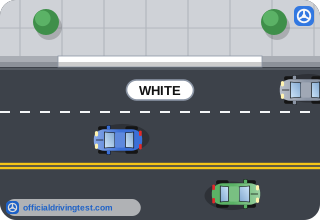
- A loading zone
- Only short stops are permitted
- Fire zone restrictions
- An accessibility restriction
Show answer
Correct answer: Only short stops are permitted
The manual says a white painted curb indicates that only short stops are permitted.
Source: Class D & E Driver’s Guide (Revised August 2025 (DPSMV2052 R08/25)), page 70 · Open this page in the manual (Manual page 70)
-
What does a yellow painted curb indicate?
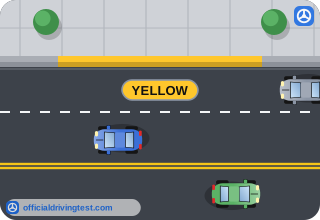
- Only short stops are permitted
- A loading zone or some other restriction
- Parking is free for all drivers
- Parking is reserved for visitors only
Show answer
Correct answer: A loading zone or some other restriction
The manual says a yellow painted curb indicates a loading zone or some other restriction.
Source: Class D & E Driver’s Guide (Revised August 2025 (DPSMV2052 R08/25)), page 70 · Open this page in the manual (Manual page 70)
-
What does a red painted curb indicate?
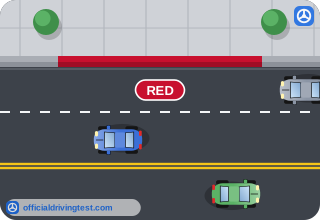
- A loading zone
- Only short stops are permitted
- Parking is allowed after dark
- Fire zone restrictions
Show answer
Correct answer: Fire zone restrictions
The manual says a red painted curb indicates fire zone restrictions.
Source: Class D & E Driver’s Guide (Revised August 2025 (DPSMV2052 R08/25)), page 70 · Open this page in the manual (Manual page 70)
-
What does a blue painted curb indicate?
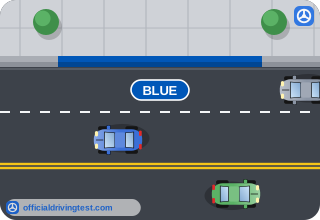
- An accessibility restriction
- Fire zone restrictions
- A loading zone
- Only short stops are permitted
Show answer
Correct answer: An accessibility restriction
The manual says a blue painted curb indicates an accessibility restriction.
Source: Class D & E Driver’s Guide (Revised August 2025 (DPSMV2052 R08/25)), page 70 · Open this page in the manual (Manual page 70)
-
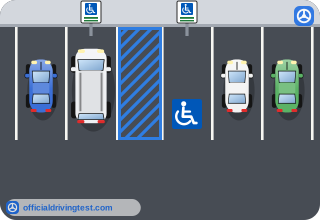
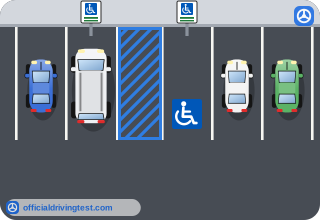
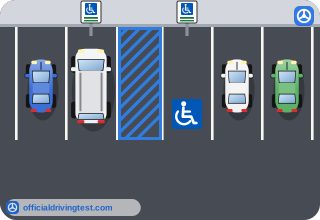
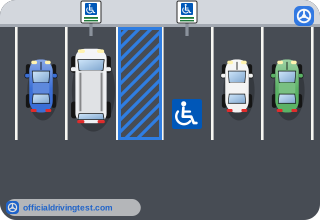
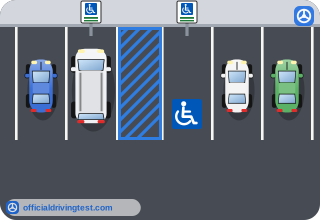
What is the area marked by blue lines with blue diagonal stripes beside some accessible parking spaces called?
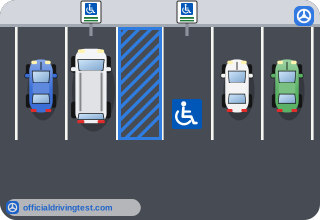
- The loading bay
- The safety zone
- The access aisle
- The transfer lane
Show answer
Correct answer: The access aisle
Some accessible parking spaces have a side area marked by blue lines with blue diagonal stripes, which is the access aisle.
Source: Class D & E Driver’s Guide (Revised August 2025 (DPSMV2052 R08/25)), page 70 · Open this page in the manual (Manual page 70)
-
What is the purpose of the access aisle beside an accessible parking space?
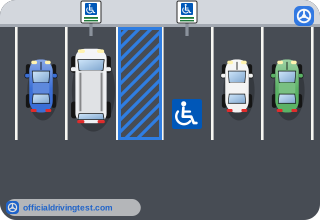
- To give drivers extra room to park wide vehicles such as trucks
- To provide a short-term waiting area for drivers who stop briefly
- To mark where a vehicle must stop to let pedestrians cross
- To allow safe loading and unloading of equipment and provide safe access
Show answer
Correct answer: To allow safe loading and unloading of equipment and provide safe access
The access aisle allows safe loading and unloading of equipment and provides safe access for individuals with disabilities.
Source: Class D & E Driver’s Guide (Revised August 2025 (DPSMV2052 R08/25)), page 70 · Open this page in the manual (Manual page 70)
-
Which of these is a parking violation concerning accessibility?
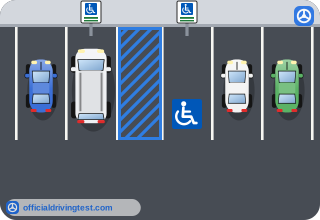
- Parking in an accessible space with the proper documentation
- Blocking the access aisle used for loading and unloading
- Using a standard space while a person with a disability waits for a companion
- Parking within the lines of a standard space beside an access aisle
Show answer
Correct answer: Blocking the access aisle used for loading and unloading
The manual lists parking in an accessible area without proper documentation and blocking the access aisle as parking violations concerning accessibility.
Source: Class D & E Driver’s Guide (Revised August 2025 (DPSMV2052 R08/25)), page 71 · Open this page in the manual (Manual page 71)
-
What can happen to an unauthorized vehicle parked in accessible parking or an access aisle?
- It receives a written warning only
- Its registration is suspended on the spot
- It can be towed, with the associated costs charged to the violator
- Its driver must take a driver improvement course before driving again
Show answer
Correct answer: It can be towed, with the associated costs charged to the violator
The manual says violators are subject to substantial consequences, including towing and associated costs.
Source: Class D & E Driver’s Guide (Revised August 2025 (DPSMV2052 R08/25)), page 71 · Open this page in the manual (Manual page 71)
-
When does the manual say to consider using a standard parking area instead of an accessible space?
- When the person with a disability will sit idle waiting for a companion
- When the accessible spaces are close to the building entrance
- When you are carrying packages to the vehicle
- When the standard spaces are empty
Show answer
Correct answer: When the person with a disability will sit idle waiting for a companion
The manual says to consider a standard parking area when the person with a disability is going to sit idle while waiting for a companion in the building.
Source: Class D & E Driver’s Guide (Revised August 2025 (DPSMV2052 R08/25)), page 71 · Open this page in the manual (Manual page 71)
-
When should you not use an accessible space that has an access aisle?
- When you do not need the extra space for loading and unloading
- When the lot has more than one accessible space
- When the aisle is on the left side of the space
- When another vehicle with a permit is parked in the next space nearby
Show answer
Correct answer: When you do not need the extra space for loading and unloading
The manual says not to use an accessible space with an access aisle if you do not need the extra space for loading and unloading.
Source: Class D & E Driver’s Guide (Revised August 2025 (DPSMV2052 R08/25)), page 71 · Open this page in the manual (Manual page 71)
-
What should you not leave in an access aisle?
- Only parked cars; carts and motorcycles are fine
- Anything, as long as the aisle is not fully blocked
- Shopping carts, motorized shopping carts or motorcycles
- Only trash; carts and motorcycles are fine
Show answer
Correct answer: Shopping carts, motorized shopping carts or motorcycles
The manual says not to block the intended purpose of the access aisle by leaving shopping carts, motorized shopping carts or motorcycles in it.
Source: Class D & E Driver’s Guide (Revised August 2025 (DPSMV2052 R08/25)), page 71 · Open this page in the manual (Manual page 71)
-
What counts as blocking an access aisle?
- Only physically blocking the entrance to the access aisle
- Blocking its intended use, not only physically blocking the entrance
- Only parking a vehicle inside the access aisle itself
- Only leaving an object in the access aisle overnight
Show answer
Correct answer: Blocking its intended use, not only physically blocking the entrance
The manual says blocking is not only physically blocking the entrance to the access aisle; blocking its intended use is also considered blocking.
Source: Class D & E Driver’s Guide (Revised August 2025 (DPSMV2052 R08/25)), page 71 · Open this page in the manual (Manual page 71)
-
Why should you park correctly within the designated lines of an accessible space?
- So the parking attendant can easily see your permit from the entrance
- So your vehicle is not towed from the aisle after dark when the lot closes
- So the space can be reserved for the next visitor
- So others have enough room to get in and out and to load or unload equipment
Show answer
Correct answer: So others have enough room to get in and out and to load or unload equipment
The manual says to park within the designated lines to ensure others enough room to get in and out of the vehicle and to load or unload equipment.
Source: Class D & E Driver’s Guide (Revised August 2025 (DPSMV2052 R08/25)), page 71 · Open this page in the manual (Manual page 71)
-
What do the international symbols for parking for persons with disabilities mean?
- A parking space is for loading and unloading only
- A parking space is free for any driver who makes a short stop
- A parking space is especially reserved for a person who has a disability
- A parking space is for emergency vehicles
Show answer
Correct answer: A parking space is especially reserved for a person who has a disability
The manual says these symbols mean a parking space is especially reserved for a person who has a disability.
Source: Class D & E Driver’s Guide (Revised August 2025 (DPSMV2052 R08/25)), page 71 · Open this page in the manual (Manual page 71)
-
What is the result of using a space marked with the international symbol for parking for persons with disabilities without proper authorization?
- A fine
- A written warning only
- A 30-day license suspension
- A mandatory driver improvement course
Show answer
Correct answer: A fine
The manual says that using one of these spaces without proper authorization will result in a fine.
Source: Class D & E Driver’s Guide (Revised August 2025 (DPSMV2052 R08/25)), page 71 · Open this page in the manual (Manual page 71)
-
What should you do with your doors to help prevent automobile theft?
- Leave them unlocked in a familiar area
- Lock only the driver's door
- Lock them only at night
- Lock them
Show answer
Correct answer: Lock them
The manual's "Park Smart" tips say to lock your doors.
Source: Class D & E Driver’s Guide (Revised August 2025 (DPSMV2052 R08/25)), page 99 · Open this page in the manual (Manual page 99)
-
What should you do with your windows to help prevent automobile theft?
- Leave them open a few inches
- Close them
- Close them only at night
- Close only the driver's window
Show answer
Correct answer: Close them
The manual's "Park Smart" tips say to close windows.
Source: Class D & E Driver’s Guide (Revised August 2025 (DPSMV2052 R08/25)), page 99 · Open this page in the manual (Manual page 99)
-
In what kind of area does the manual say to park to help prevent automobile theft?
- A secluded area away from traffic
- An area behind a building
- A well-lighted area
- An area with no other cars
Show answer
Correct answer: A well-lighted area
The manual's "Park Smart" tips say to park in well-lighted areas.
Source: Class D & E Driver’s Guide (Revised August 2025 (DPSMV2052 R08/25)), page 99 · Open this page in the manual (Manual page 99)
-
Where should you put valuables to help prevent automobile theft?
- In the trunk
- On the dashboard
- On the back seat
- On the passenger seat
Show answer
Correct answer: In the trunk
The manual's "Park Smart" tips say to put valuables in the trunk.
Source: Class D & E Driver’s Guide (Revised August 2025 (DPSMV2052 R08/25)), page 99 · Open this page in the manual (Manual page 99)
-
Which device does the manual recommend using to help prevent automobile theft?
- Vehicle immobilizers
- Extra mirrors
- Window-tinting film
- Remote engine starters
Show answer
Correct answer: Vehicle immobilizers
The manual's "Park Smart" tips include using vehicle immobilizers.
Source: Class D & E Driver’s Guide (Revised August 2025 (DPSMV2052 R08/25)), page 99 · Open this page in the manual (Manual page 99)
-
Besides vehicle immobilizers, what does the manual recommend using to help prevent automobile theft?
- Spare key holders
- Extra door locks
- Tinted windows
- Theft deterrents
Show answer
Correct answer: Theft deterrents
The manual's "Park Smart" tips include using theft deterrents.
Source: Class D & E Driver’s Guide (Revised August 2025 (DPSMV2052 R08/25)), page 99 · Open this page in the manual (Manual page 99)
-
What does the manual say about leaving your keys in the ignition while pumping gas, running into a convenience store, or warming up your car?
- It is fine if the doors are locked
- Don't do it
- It is fine if the stop is brief
- It is fine if you can see the car
Show answer
Correct answer: Don't do it
The manual's "Park Smart" tips say not to leave your keys in the ignition in these situations.
Source: Class D & E Driver’s Guide (Revised August 2025 (DPSMV2052 R08/25)), page 99 · Open this page in the manual (Manual page 99)
-
What does the manual say to do about personal possessions such as a purse, laptop or cell phone in your car?
- Leave them on the seat if the doors are locked
- Keep them on the dashboard so you can watch them
- Do not leave them where they can be seen
- Leave them in view so thieves see nothing is hidden
Show answer
Correct answer: Do not leave them where they can be seen
The manual's "Park Smart" tips say not to leave personal possessions in your car where they can be seen.
Source: Class D & E Driver’s Guide (Revised August 2025 (DPSMV2052 R08/25)), page 99 · Open this page in the manual (Manual page 99)
-
What does the manual say about hiding a key in or on your car?
- It is safe if the key is in a magnetic box
- It is recommended in case you are locked out
- You should not do it
- It is allowed only when the car has an immobilizer
Show answer
Correct answer: You should not do it
The manual's "Park Smart" tips say not to hide a key in or on your car.
Source: Class D & E Driver’s Guide (Revised August 2025 (DPSMV2052 R08/25)), page 99 · Open this page in the manual (Manual page 99)
-
What does the manual say about hiding a firearm in your vehicle?
- You should not do it
- It is safe if the firearm is under the seat
- It is recommended if the doors are locked
- It is allowed only when the firearm is in the trunk
Show answer
Correct answer: You should not do it
The manual's "Park Smart" tips say not to hide a firearm in your vehicle.
Source: Class D & E Driver’s Guide (Revised August 2025 (DPSMV2052 R08/25)), page 99 · Open this page in the manual (Manual page 99)
-
Whom does the auto theft awareness education program of the Louisiana Automobile Theft and Insurance Fraud Prevention Authority (LATIFPA) aim to educate?
- Drivers over 65 years of age
- Insurance agents and producers
- Police officers in training
- Middle and high school students
Show answer
Correct answer: Middle and high school students
The manual says LATIFPA's program is designed to educate middle and high school students in Louisiana about the consequences of auto theft.
Source: Class D & E Driver’s Guide (Revised August 2025 (DPSMV2052 R08/25)), page 99 · Open this page in the manual (Manual page 99)
-
Under Louisiana law, what must a person do before letting a motor vehicle stand unattended?
- Stop the motor, lock the ignition, remove the key and set the brake
- Stop the motor, leave the key in the ignition and set the brake firmly
- Turn on the flashers, remove the key and lock the doors only, leaving the motor idling
- Stop the motor, leave the lights on and lock the doors of the vehicle
Show answer
Correct answer: Stop the motor, lock the ignition, remove the key and set the brake
No person driving or in charge of a motor vehicle may let it stand unattended without stopping the motor, locking the ignition, removing the key and effectively setting the brake.
Source: Class D & E Driver’s Guide (Revised August 2025 (DPSMV2052 R08/25)), page 121 · Open this page in the manual (Manual page 121)