Louisiana: Parking rules — Part 1 Practice Test
Questions in this part include: “Where is angle parking often used?”
Independent educational site · not affiliated with any government agency or DMV
Ready? Test yourself
- Instant feedback with an explanation
- Every answer cites its source in the manual
- Your best score is saved on this device
Questions are original and based on the official manual "Class D & E Driver’s Guide" (Revised August 2025 (DPSMV2052 R08/25)), Louisiana Office of Motor Vehicles.
All 17 questions in this practice test
Take the test above first, then use this list to study. Tap “Show answer” to see the correct answer and explanation.
Show the questions and answersHide the questions
-
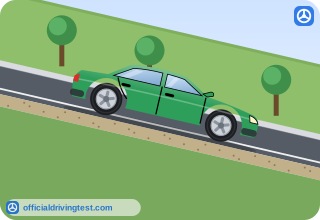
You park facing downhill next to a curb. How should you turn your wheels?
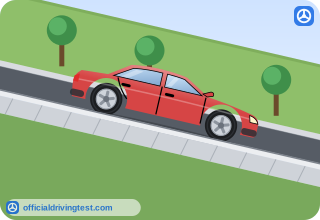
- Away from the curb
- Toward the curb
- Straight ahead
- Parallel to the road
Show answer
Correct answer: Toward the curb
When facing downhill with a curb, you turn your wheels toward the curb and shift into reverse or park.
Source: Class D & E Driver’s Guide (Revised August 2025 (DPSMV2052 R08/25)), page 68 · Open this page in the manual (Manual page 68)
-
You park facing downhill next to a curb. Which gear should you shift into?
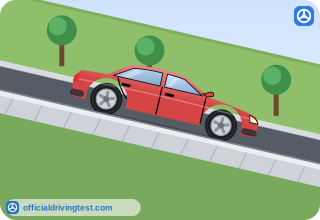
- Low gear or neutral
- Neutral only
- Drive
- Reverse or park
Show answer
Correct answer: Reverse or park
When facing downhill with a curb, you shift into reverse or park.
Source: Class D & E Driver’s Guide (Revised August 2025 (DPSMV2052 R08/25)), page 68 · Open this page in the manual (Manual page 68)
-
You park facing uphill next to a curb. How should you turn your wheels?
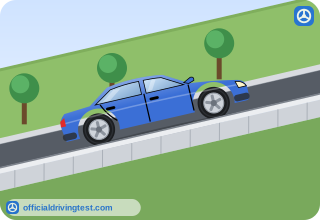
- Away from the curb
- Toward the curb
- Straight ahead
- Toward the center of the road
Show answer
Correct answer: Away from the curb
When facing uphill with a curb, you turn your wheels away from the curb and shift into low gear or park.
Source: Class D & E Driver’s Guide (Revised August 2025 (DPSMV2052 R08/25)), page 68 · Open this page in the manual (Manual page 68)
-
You park facing uphill next to a curb. Which gear should you shift into?
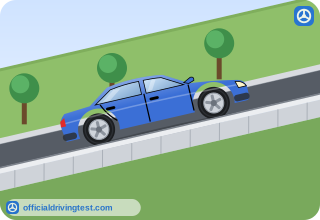
- Reverse or neutral
- Neutral only
- Low gear or park
- Reverse only
Show answer
Correct answer: Low gear or park
When facing uphill with a curb, you shift into low gear or park.
Source: Class D & E Driver’s Guide (Revised August 2025 (DPSMV2052 R08/25)), page 68 · Open this page in the manual (Manual page 68)
-
You park on a hill where there is no curb. How should you turn your wheels?
- Away from the edge of the road, whether facing uphill or downhill
- Toward the edge of the road facing downhill and away from it facing uphill
- Straight ahead so the car stays on the road
- Toward the edge of the road, whether facing uphill or downhill
Show answer
Correct answer: Toward the edge of the road, whether facing uphill or downhill
With no curb, you turn your wheels toward the edge of the road whether you face uphill or downhill.
Source: Class D & E Driver’s Guide (Revised August 2025 (DPSMV2052 R08/25)), page 68 · Open this page in the manual (Manual page 68)
-
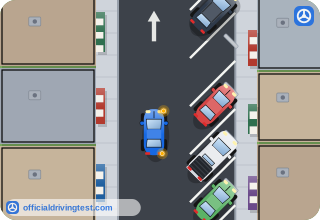
How should you drive into an angle parking space?
- Forward, staying close to the line on the left side of the space
- Forward into the space, with equal space on each side between the lines
- Forward, stopping with your front wheels on the line
- Forward, leaving extra room on the side next to the curb
Show answer
Correct answer: Forward into the space, with equal space on each side between the lines
The manual says to drive forward into an angle parking space with equal space on each side between lines.
Source: Class D & E Driver’s Guide (Revised August 2025 (DPSMV2052 R08/25)), page 68 · Open this page in the manual (Manual page 68)
-
Where is angle parking often used?
- On interstate shoulders and freeway ramps
- Only on narrow residential streets with no curbs
- In parking lots, shopping centers, and sometimes at curbs
- Only in front of fire stations and driveways
Show answer
Correct answer: In parking lots, shopping centers, and sometimes at curbs
The manual says angle parking is often used in parking lots, shopping centers, and sometimes at curbs.
Source: Class D & E Driver’s Guide (Revised August 2025 (DPSMV2052 R08/25)), page 68 · Open this page in the manual (Manual page 68)
-
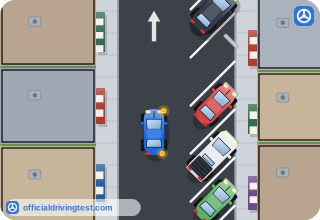
When you enter an angle parking space, where should you watch for traffic?
- Both ahead and behind
- Only ahead
- Only behind
- Only toward the side where the space is
Show answer
Correct answer: Both ahead and behind
The manual says to watch for traffic both ahead and behind when entering an angle parking space.
Source: Class D & E Driver’s Guide (Revised August 2025 (DPSMV2052 R08/25)), page 68 · Open this page in the manual (Manual page 68)
-
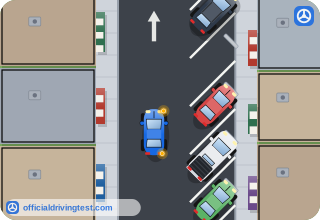
When entering an angle parking space, what should you make sure about the rear of your car?
- That it will clear any parked car
- That it points toward the curb
- That it is closer to the left line than to the right line
- That it sits farther out than the cars beside you
Show answer
Correct answer: That it will clear any parked car
The manual says to make sure the rear of your car will clear any parked car when entering an angle space.
Source: Class D & E Driver’s Guide (Revised August 2025 (DPSMV2052 R08/25)), page 68 · Open this page in the manual (Manual page 68)
-
How do you steer into an angle parking space?
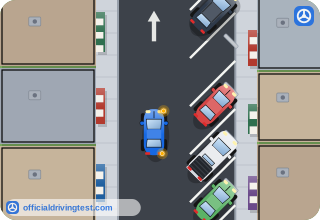
- Gradually in a wide curve, keeping the wheels turned until you stop
- Straight in, keeping the wheels turned left
- Sharply into the space, then straighten the wheels to center the car
- Slowly in reverse, turning the wheels toward the curb
Show answer
Correct answer: Sharply into the space, then straighten the wheels to center the car
The manual says to steer sharply into the parking space, then straighten the wheels, centering the car.
Source: Class D & E Driver’s Guide (Revised August 2025 (DPSMV2052 R08/25)), page 68 · Open this page in the manual (Manual page 68)
-
After you center your car in an angle parking space, what should you do?
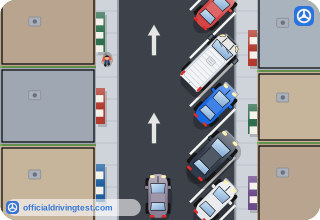
- Shift to neutral and leave the parking brake off
- Shift to park or reverse and apply the parking brake
- Shift to drive and turn off the engine
- Shift to low gear and release the brake
Show answer
Correct answer: Shift to park or reverse and apply the parking brake
The manual says to shift to park or reverse and apply the parking brake once you are in an angle space.
Source: Class D & E Driver’s Guide (Revised August 2025 (DPSMV2052 R08/25)), page 68 · Open this page in the manual (Manual page 68)
-
What should you do first before backing out of an angle parking space?
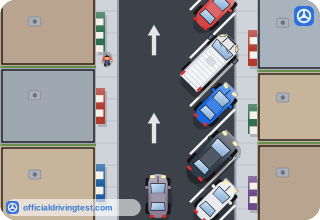
- Honk the horn twice and then back out
- Turn the wheels sharply left while the car is stopped
- Shift to drive and pull forward slightly
- Walk around the car to make sure nothing is blocking the space
Show answer
Correct answer: Walk around the car to make sure nothing is blocking the space
The manual says to walk around to make sure nothing is blocking the space before backing out of an angle parking space.
Source: Class D & E Driver’s Guide (Revised August 2025 (DPSMV2052 R08/25)), page 69 · Open this page in the manual (Manual page 69)
-
Why should you move your car back slowly when backing out of an angle parking space?
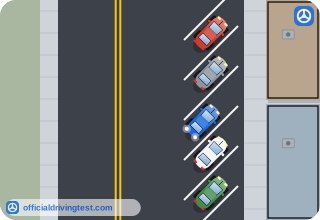
- Reverse gear is hard on the transmission
- Parked cars may roll into your path
- It is hard to see oncoming traffic
- Your front wheels turn the opposite way in reverse
Show answer
Correct answer: It is hard to see oncoming traffic
The manual says to move back slowly because it is hard to see oncoming traffic.
Source: Class D & E Driver’s Guide (Revised August 2025 (DPSMV2052 R08/25)), page 69 · Open this page in the manual (Manual page 69)
-
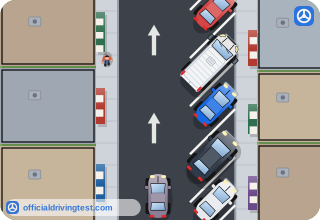
While backing out of an angle parking space, you can see past the tops of the cars parked next to you. What should you do?
- Stop and look again, back and to each side for other drivers
- Speed up to clear the space quickly
- Keep backing without stopping because the way is clear
- Turn off the engine and wait for traffic to pass
Show answer
Correct answer: Stop and look again, back and to each side for other drivers
The manual says that when you can see past the tops of the cars next to you, you stop and look again, back and to each side.
Source: Class D & E Driver’s Guide (Revised August 2025 (DPSMV2052 R08/25)), page 69 · Open this page in the manual (Manual page 69)
-
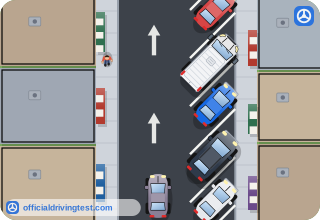
When you back out of an angle parking space, which way does the front of your car swing?
- The same way as the direction of your turn
- Straight toward the car parked beside you
- It does not swing when you back slowly
- Opposite to the direction of your turn
Show answer
Correct answer: Opposite to the direction of your turn
The manual tells you to remember that the front of your car will swing opposite to the direction of your turn.
Source: Class D & E Driver’s Guide (Revised August 2025 (DPSMV2052 R08/25)), page 69 · Open this page in the manual (Manual page 69)
-
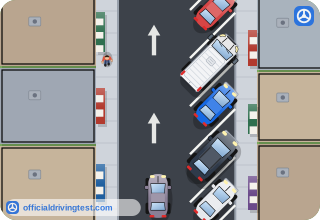
Backing out of an angle parking space, how long do you back slowly while turning?
- Until your right front wheel reaches the curb on the right side of the lane
- Until your left front wheel passes the rear bumper of the car parked on your left
- Until your front bumper is even with the car parked on your right side
- Until your rear wheels touch the painted line at the back of the space
Show answer
Correct answer: Until your left front wheel passes the rear bumper of the car parked on your left
The manual says to back slowly while turning until your left front wheel passes the rear bumper of the car parked on your left.
Source: Class D & E Driver’s Guide (Revised August 2025 (DPSMV2052 R08/25)), page 69 · Open this page in the manual (Manual page 69)
-
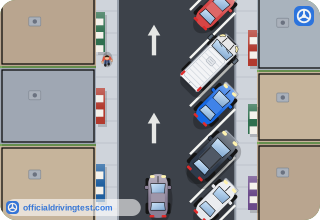
When exiting a perpendicular or angle parking space, in which direction do you signal?
- Always to the right
- In the direction you are turning
- Toward the car parked beside you
- You do not signal until you are in the lane
Show answer
Correct answer: In the direction you are turning
The manual says to shift to reverse and signal in the direction you are turning when exiting the space.
Source: Class D & E Driver’s Guide (Revised August 2025 (DPSMV2052 R08/25)), page 69 · Open this page in the manual (Manual page 69)