Louisiana: Parking rules — Part 3 Practice Test
Questions in this part include: “According to R.S. 32:143, in which of these places is it against the law to park?” · “According to R.S. 32:143, when may you park in a space marked for the disabled?”
Independent educational site · not affiliated with any government agency or DMV
Ready? Test yourself
- Instant feedback with an explanation
- Every answer cites its source in the manual
- Your best score is saved on this device
Questions are original and based on the official manual "Class D & E Driver’s Guide" (Revised August 2025 (DPSMV2052 R08/25)), Louisiana Office of Motor Vehicles.
All 17 questions in this practice test
Take the test above first, then use this list to study. Tap “Show answer” to see the correct answer and explanation.
Show the questions and answersHide the questions
-
According to R.S. 32:143, in which of these places is it against the law to park?
- In a marked space at a shopping center
- Parallel to the curb on a residential street
- In a biking lane
- In an angle space in a parking lot
Show answer
Correct answer: In a biking lane
R.S. 32:143 lists a biking lane among the places where it is against the law to park.
Source: Class D & E Driver’s Guide (Revised August 2025 (DPSMV2052 R08/25)), page 70 · Open this page in the manual (Manual page 70)
-
What is parking beside a parallel parked vehicle called, and is it allowed under R.S. 32:143?
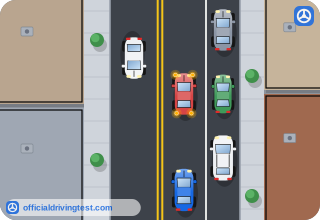
- Double parking, and it is allowed for short stops
- Double parking, and it is against the law
- Side parking, and it is allowed if you stay in the vehicle
- Side parking, and it is against the law only on bridges
Show answer
Correct answer: Double parking, and it is against the law
R.S. 32:143 makes it against the law to park beside a parallel parked vehicle, which the manual calls double parking.
Source: Class D & E Driver’s Guide (Revised August 2025 (DPSMV2052 R08/25)), page 70 · Open this page in the manual (Manual page 70)
-
According to R.S. 32:143, which of these is true about parking on a bridge, overpass or in a tunnel?
- It is allowed if you stay with the vehicle
- It is allowed if the hazard flashers are on
- It is allowed for up to 15 minutes
- It is against the law
Show answer
Correct answer: It is against the law
R.S. 32:143 makes it against the law to park on a bridge, overpass or in any tunnel.
Source: Class D & E Driver’s Guide (Revised August 2025 (DPSMV2052 R08/25)), page 70 · Open this page in the manual (Manual page 70)
-
Under R.S. 32:143, when is it against the law to park in a construction area?
- Only when workers are present
- Only after dark
- If you will block traffic
- Only when the area is fenced off
Show answer
Correct answer: If you will block traffic
R.S. 32:143 makes it against the law to park in a construction area if you will block traffic.
Source: Class D & E Driver’s Guide (Revised August 2025 (DPSMV2052 R08/25)), page 70 · Open this page in the manual (Manual page 70)
-
According to R.S. 32:143, when may you park in a space marked for the disabled?
- Only if you have a handicap license plate, sticker, or tag
- If you stay inside the vehicle while you wait for someone
- If you are there for less than 15 minutes during the day
- If no other parking spaces are open anywhere nearby
Show answer
Correct answer: Only if you have a handicap license plate, sticker, or tag
R.S. 32:143 makes it against the law to park in a space marked for the disabled unless you have a handicap license plate, sticker, or tag.
Source: Class D & E Driver’s Guide (Revised August 2025 (DPSMV2052 R08/25)), page 70 · Open this page in the manual (Manual page 70)
-
According to R.S. 32:143, which of these is against the law?
- Parking in a marked space in a parking lot
- Parking at a curb with no signs, 100 feet from any intersection
- Stopping at a safety zone only to drop off a passenger
- Parking between a safety zone and the adjacent curb
Show answer
Correct answer: Parking between a safety zone and the adjacent curb
R.S. 32:143 makes it against the law to park between a safety zone and the adjacent curb.
Source: Class D & E Driver’s Guide (Revised August 2025 (DPSMV2052 R08/25)), page 70 · Open this page in the manual (Manual page 70)
-
What does a white painted curb indicate?
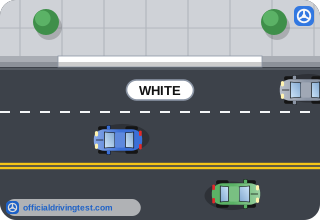
- A loading zone
- Only short stops are permitted
- Fire zone restrictions
- An accessibility restriction
Show answer
Correct answer: Only short stops are permitted
The manual says a white painted curb indicates that only short stops are permitted.
Source: Class D & E Driver’s Guide (Revised August 2025 (DPSMV2052 R08/25)), page 70 · Open this page in the manual (Manual page 70)
-
What does a yellow painted curb indicate?
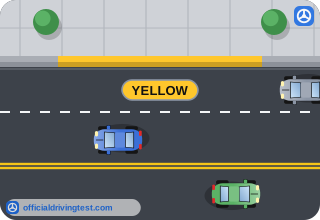
- Only short stops are permitted
- A loading zone or some other restriction
- Parking is free for all drivers
- Parking is reserved for visitors only
Show answer
Correct answer: A loading zone or some other restriction
The manual says a yellow painted curb indicates a loading zone or some other restriction.
Source: Class D & E Driver’s Guide (Revised August 2025 (DPSMV2052 R08/25)), page 70 · Open this page in the manual (Manual page 70)
-
What does a red painted curb indicate?
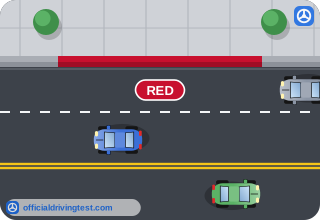
- A loading zone
- Only short stops are permitted
- Parking is allowed after dark
- Fire zone restrictions
Show answer
Correct answer: Fire zone restrictions
The manual says a red painted curb indicates fire zone restrictions.
Source: Class D & E Driver’s Guide (Revised August 2025 (DPSMV2052 R08/25)), page 70 · Open this page in the manual (Manual page 70)
-
What does a blue painted curb indicate?
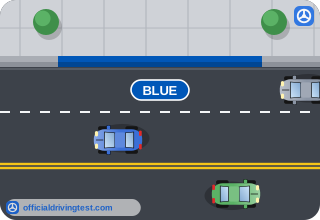
- An accessibility restriction
- Fire zone restrictions
- A loading zone
- Only short stops are permitted
Show answer
Correct answer: An accessibility restriction
The manual says a blue painted curb indicates an accessibility restriction.
Source: Class D & E Driver’s Guide (Revised August 2025 (DPSMV2052 R08/25)), page 70 · Open this page in the manual (Manual page 70)
-
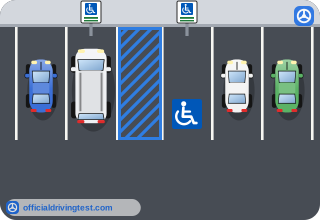
What is the area marked by blue lines with blue diagonal stripes beside some accessible parking spaces called?
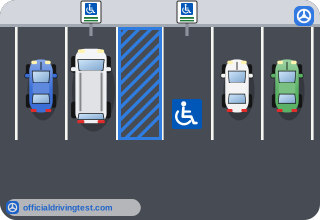
- The loading bay
- The safety zone
- The access aisle
- The transfer lane
Show answer
Correct answer: The access aisle
Some accessible parking spaces have a side area marked by blue lines with blue diagonal stripes, which is the access aisle.
Source: Class D & E Driver’s Guide (Revised August 2025 (DPSMV2052 R08/25)), page 70 · Open this page in the manual (Manual page 70)
-
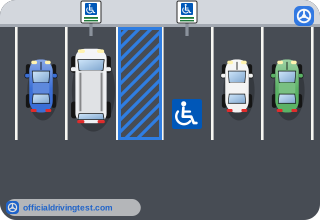
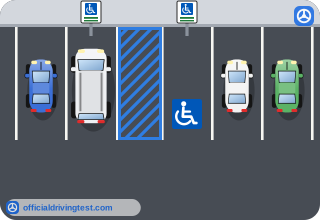
What is the purpose of the access aisle beside an accessible parking space?
- To give drivers extra room to park wide vehicles such as trucks
- To provide a short-term waiting area for drivers who stop briefly
- To mark where a vehicle must stop to let pedestrians cross
- To allow safe loading and unloading of equipment and provide safe access
Show answer
Correct answer: To allow safe loading and unloading of equipment and provide safe access
The access aisle allows safe loading and unloading of equipment and provides safe access for individuals with disabilities.
Source: Class D & E Driver’s Guide (Revised August 2025 (DPSMV2052 R08/25)), page 70 · Open this page in the manual (Manual page 70)
-
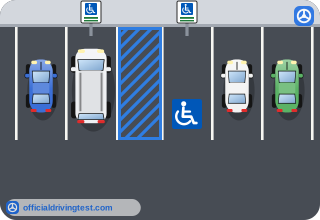
Which of these is a parking violation concerning accessibility?
- Parking in an accessible space with the proper documentation
- Blocking the access aisle used for loading and unloading
- Using a standard space while a person with a disability waits for a companion
- Parking within the lines of a standard space beside an access aisle
Show answer
Correct answer: Blocking the access aisle used for loading and unloading
The manual lists parking in an accessible area without proper documentation and blocking the access aisle as parking violations concerning accessibility.
Source: Class D & E Driver’s Guide (Revised August 2025 (DPSMV2052 R08/25)), page 71 · Open this page in the manual (Manual page 71)
-
What can happen to an unauthorized vehicle parked in accessible parking or an access aisle?
- It receives a written warning only
- Its registration is suspended on the spot
- It can be towed, with the associated costs charged to the violator
- Its driver must take a driver improvement course before driving again
Show answer
Correct answer: It can be towed, with the associated costs charged to the violator
The manual says violators are subject to substantial consequences, including towing and associated costs.
Source: Class D & E Driver’s Guide (Revised August 2025 (DPSMV2052 R08/25)), page 71 · Open this page in the manual (Manual page 71)
-
When does the manual say to consider using a standard parking area instead of an accessible space?
- When the person with a disability will sit idle waiting for a companion
- When the accessible spaces are close to the building entrance
- When you are carrying packages to the vehicle
- When the standard spaces are empty
Show answer
Correct answer: When the person with a disability will sit idle waiting for a companion
The manual says to consider a standard parking area when the person with a disability is going to sit idle while waiting for a companion in the building.
Source: Class D & E Driver’s Guide (Revised August 2025 (DPSMV2052 R08/25)), page 71 · Open this page in the manual (Manual page 71)
-
When should you not use an accessible space that has an access aisle?
- When you do not need the extra space for loading and unloading
- When the lot has more than one accessible space
- When the aisle is on the left side of the space
- When another vehicle with a permit is parked in the next space nearby
Show answer
Correct answer: When you do not need the extra space for loading and unloading
The manual says not to use an accessible space with an access aisle if you do not need the extra space for loading and unloading.
Source: Class D & E Driver’s Guide (Revised August 2025 (DPSMV2052 R08/25)), page 71 · Open this page in the manual (Manual page 71)
-
What should you not leave in an access aisle?
- Only parked cars; carts and motorcycles are fine
- Anything, as long as the aisle is not fully blocked
- Shopping carts, motorized shopping carts or motorcycles
- Only trash; carts and motorcycles are fine
Show answer
Correct answer: Shopping carts, motorized shopping carts or motorcycles
The manual says not to block the intended purpose of the access aisle by leaving shopping carts, motorized shopping carts or motorcycles in it.
Source: Class D & E Driver’s Guide (Revised August 2025 (DPSMV2052 R08/25)), page 71 · Open this page in the manual (Manual page 71)