Louisiana: Parking rules — Part 2 Practice Test
Questions in this part include: “When parking along the roadway, where should you park your vehicle?” · “According to R.S. 32:143, within how many feet of a railroad crossing is it against the law to park?”
Independent educational site · not affiliated with any government agency or DMV
Ready? Test yourself
- Instant feedback with an explanation
- Every answer cites its source in the manual
- Your best score is saved on this device
Questions are original and based on the official manual "Class D & E Driver’s Guide" (Revised August 2025 (DPSMV2052 R08/25)), Louisiana Office of Motor Vehicles.
All 17 questions in this practice test
Take the test above first, then use this list to study. Tap “Show answer” to see the correct answer and explanation.
Show the questions and answersHide the questions
-
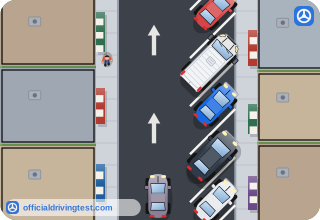
When exiting a perpendicular or angle parking space, how far straight back do you move before turning?
- Until your rear bumper reaches the center of the lane
- Until your car is halfway into the lane
- Until your rear wheels are past the painted line
- Until your front bumper clears the vehicle parked beside you
Show answer
Correct answer: Until your front bumper clears the vehicle parked beside you
You move straight back until your front bumper clears the vehicle parked beside you, on the side opposite to your turn.
Source: Class D & E Driver’s Guide (Revised August 2025 (DPSMV2052 R08/25)), page 69 · Open this page in the manual (Manual page 69)
-
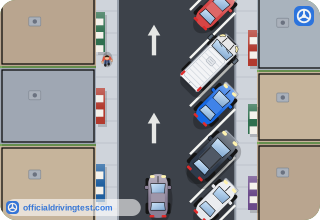
When exiting a perpendicular or angle parking space, which way do you turn the steering wheel sharply?
- In the direction that the rear of your vehicle should move
- In the direction that the front of your vehicle should move
- Toward the vehicle parked beside you
- Straight, keeping the wheels centered
Show answer
Correct answer: In the direction that the rear of your vehicle should move
The manual says to turn the steering wheel sharply in the direction that the rear of your vehicle should move.
Source: Class D & E Driver’s Guide (Revised August 2025 (DPSMV2052 R08/25)), page 69 · Open this page in the manual (Manual page 69)
-
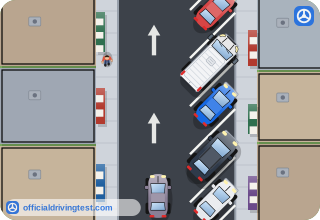
When you clear a perpendicular or angle parking space and center in your lane, what do you do?
- Keep reversing until you reach the curb
- Shift to neutral and wait for traffic
- Stop and shift to drive
- Accelerate in reverse until the wheels are straight
Show answer
Correct answer: Stop and shift to drive
The manual says that when the vehicle clears the parking area and centers in the lane, you stop and shift to drive.
Source: Class D & E Driver’s Guide (Revised August 2025 (DPSMV2052 R08/25)), page 69 · Open this page in the manual (Manual page 69)
-
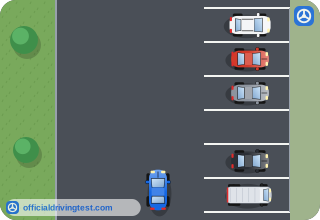
For a perpendicular parking spot, which method does the manual call safer when it is possible?
- Parking with the front wheels turned toward the curb
- Parking beside the other car with equal space on each side
- Entering the spot with the left turn signal on
- Backing into the spot or pulling through
Show answer
Correct answer: Backing into the spot or pulling through
The manual says that, when possible, it is preferable to back into a perpendicular parking spot or pull through, a safer method that prevents crashes with other vehicles or pedestrians.
Source: Class D & E Driver’s Guide (Revised August 2025 (DPSMV2052 R08/25)), page 69 · Open this page in the manual (Manual page 69)
-
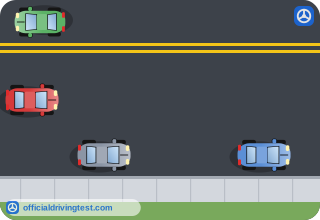
When you start to parallel park, how far from the front car should you stop beside it?
- About 6 inches
- About 18 inches
- About 3 feet
- About 5 feet
Show answer
Correct answer: About 18 inches
The manual says to signal and stop parallel to the front car, about 18 inches from it.
Source: Class D & E Driver’s Guide (Revised August 2025 (DPSMV2052 R08/25)), page 69 · Open this page in the manual (Manual page 69)
-
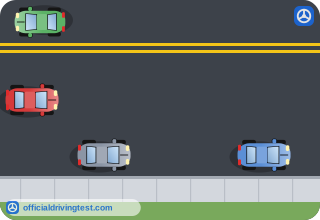
When you first stop beside the front car to parallel park, what should be even?
- Your rear wheels and its front wheels
- Your headlights and its taillights
- The rear bumpers of the two cars
- Your door handles and its trunk
Show answer
Correct answer: The rear bumpers of the two cars
The manual says to stop parallel to the front car with rear bumpers even.
Source: Class D & E Driver’s Guide (Revised August 2025 (DPSMV2052 R08/25)), page 69 · Open this page in the manual (Manual page 69)
-
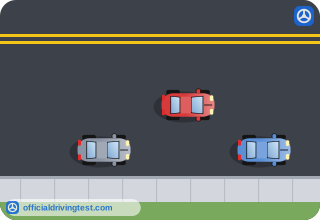
When backing into a parallel parking space, you turn the steering wheel sharply to the right until your car is at about what angle with the street?
- 45 degrees
- 15 degrees
- 30 degrees
- 90 degrees
Show answer
Correct answer: 45 degrees
The manual says to back slowly, turning sharply right until your car is about a 45-degree angle with the street.
Source: Class D & E Driver’s Guide (Revised August 2025 (DPSMV2052 R08/25)), page 69 · Open this page in the manual (Manual page 69)
-
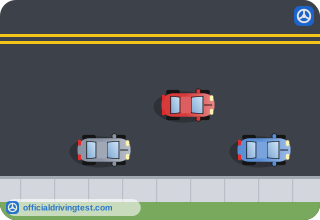
While parallel parking, your front bumper is even with the other car’s back bumper. Which way do you turn the wheels sharply and rapidly?
- To the left
- To the right
- Straight ahead
- You hold the wheel where it is
Show answer
Correct answer: To the left
When the front bumper is even with the other car’s back bumper, you turn the wheels sharply and rapidly to the left.
Source: Class D & E Driver’s Guide (Revised August 2025 (DPSMV2052 R08/25)), page 69 · Open this page in the manual (Manual page 69)
-
Unless the street is otherwise marked, how close should your front and rear bumpers be to the other vehicles when you are parallel parked?
- Not closer than six inches
- Not closer than one foot
- Not closer than two feet
- Not closer than five feet
Show answer
Correct answer: Not closer than two feet
The manual says front and rear bumpers should not be closer than two feet from the other vehicles in the parked position, unless the street is otherwise marked.
Source: Class D & E Driver’s Guide (Revised August 2025 (DPSMV2052 R08/25)), page 69 · Open this page in the manual (Manual page 69)
-
When parking along the roadway, where should you park your vehicle?
- In the middle of the lane, with the hazard flashers on
- As far from traffic as possible, and as close to a curb as possible
- Far enough from the curb to leave room to open the doors
- As close to traffic as possible, so the curb stays clear
Show answer
Correct answer: As far from traffic as possible, and as close to a curb as possible
The manual says to park as far away from traffic as possible and, if there is a curb, as close to it as possible.
Source: Class D & E Driver’s Guide (Revised August 2025 (DPSMV2052 R08/25)), page 69 · Open this page in the manual (Manual page 69)
-
What should you do when you park and leave a vehicle unattended?
- Leave the motor running, lock the doors, and set the brake
- Stop the motor, leave the key in the ignition, and turn on the hazard flashers
- Remove the key and leave the brake off so the car can be moved
- Stop the motor, remove the key, lock the ignition, and set the brake
Show answer
Correct answer: Stop the motor, remove the key, lock the ignition, and set the brake
The manual says that when you park and leave a vehicle unattended you stop the motor, remove the key, lock the ignition, and set the brake.
Source: Class D & E Driver’s Guide (Revised August 2025 (DPSMV2052 R08/25)), page 70 · Open this page in the manual (Manual page 70)
-
According to R.S. 32:143, within how many feet of a fire hydrant is it against the law to park?
- 5 feet
- 10 feet
- 15 feet
- 25 feet
Show answer
Correct answer: 15 feet
R.S. 32:143 makes it against the law to park within 15 feet of a fire hydrant.
Source: Class D & E Driver’s Guide (Revised August 2025 (DPSMV2052 R08/25)), page 70 · Open this page in the manual (Manual page 70)
-
According to R.S. 32:143, within how many feet of a railroad crossing is it against the law to park?
- 25 feet
- 30 feet
- 100 feet
- 50 feet
Show answer
Correct answer: 50 feet
R.S. 32:143 makes it against the law to park within 50 feet of a railroad crossing.
Source: Class D & E Driver’s Guide (Revised August 2025 (DPSMV2052 R08/25)), page 70 · Open this page in the manual (Manual page 70)
-
According to R.S. 32:143, within how many feet of a crosswalk at an intersection is it against the law to park?
- 5 feet
- 20 feet
- 10 feet
- 30 feet
Show answer
Correct answer: 20 feet
R.S. 32:143 makes it against the law to park within 20 feet of a crosswalk at an intersection.
Source: Class D & E Driver’s Guide (Revised August 2025 (DPSMV2052 R08/25)), page 70 · Open this page in the manual (Manual page 70)
-
According to R.S. 32:143, within how many feet of a fire station driveway on the same side of the street is it against the law to park?
- 10 feet
- 30 feet
- 20 feet
- 50 feet
Show answer
Correct answer: 20 feet
R.S. 32:143 makes it against the law to park within 20 feet of a fire station driveway on the same side of the street.
Source: Class D & E Driver’s Guide (Revised August 2025 (DPSMV2052 R08/25)), page 70 · Open this page in the manual (Manual page 70)
-
According to R.S. 32:143, within how many feet of a fire station driveway on the other side of the street is it against the law to park?
- 75 feet
- 25 feet
- 50 feet
- 100 feet
Show answer
Correct answer: 75 feet
R.S. 32:143 makes it against the law to park within 75 feet of the fire station driveway on the other side of the street.
Source: Class D & E Driver’s Guide (Revised August 2025 (DPSMV2052 R08/25)), page 70 · Open this page in the manual (Manual page 70)
-
According to R.S. 32:143, within how many feet of a stop sign at the side of a roadway is it against the law to park?
- 20 feet
- 5 feet
- 10 feet
- 30 feet
Show answer
Correct answer: 20 feet
R.S. 32:143 makes it against the law to park within 20 feet of a traffic signal, flashing beacon, stop sign, yield sign or traffic control signal at the side of a roadway.
Source: Class D & E Driver’s Guide (Revised August 2025 (DPSMV2052 R08/25)), page 70 · Open this page in the manual (Manual page 70)