Kentucky: Speed and following distance
Kentucky speed limits, scanning ahead, stopping distance, the four-second following distance, space around your vehicle, night and rural driving. Split into 3 shorter tests so you're not stuck in one long quiz.
Independent educational site · not affiliated with any government agency or DMV
Choose a part
Speed and following distance — Part 1
Questions in this part include: “What does the manual advise about starts, stops, and speed to reduce driving pollution?”
StartSpeed and following distance — Part 2
Questions in this part include: “What does total stopping distance mean?”
StartSpeed and following distance — Part 3
Questions in this part include: “What may narrow rural roads have instead of shoulders?”
StartAll 56 Speed and following distance questions with answers
Choose a part above to take a practice test, or study every question and answer here.
Show the questions and answersHide the questions
-
What does the manual advise about starts, stops, and speed to reduce driving pollution?
- Accelerate quickly to clear intersections sooner and save time
- Brake late and hard so you can keep a steady speed on the road
- Drive faster than traffic to shorten the length of each trip
- Avoid quick starts and stops and drive smoothly at moderate speeds
Show answer
Correct answer: Avoid quick starts and stops and drive smoothly at moderate speeds
The manual says to avoid quick starts and stops and to drive smoothly and at moderate speeds.
Source: Kentucky Driver Manual (Updated July 23, 2026), page 21 · Open this page in the manual (Manual page 21)
-
According to the manual, smooth driving allows you to do what?
- Use less distance between yourself and other drivers and save time
- Keep more distance between yourself and other drivers and improve fuel economy
- Keep a higher speed than other drivers and reach your destination sooner
- Reduce the distance you need to follow other drivers and avoid signaling
Show answer
Correct answer: Keep more distance between yourself and other drivers and improve fuel economy
Smooth driving lets you keep more distance between yourself and other drivers and helps improve fuel economy.
Source: Kentucky Driver Manual (Updated July 23, 2026), page 46 · Open this page in the manual (Manual page 46)
-
Ideally, how far ahead of your car should you try to look to see what is occurring?
- 20 to 30 seconds in front of your car
- 2 to 3 seconds in front of your car
- 5 to 8 seconds in front of your car
- 10 to 15 seconds in front of your car
Show answer
Correct answer: 20 to 30 seconds in front of your car
The manual says you should ideally look at what is occurring 20 to 30 seconds in front of your car. Looking well ahead gives you time to adjust and plan your driving movements.
Source: Kentucky Driver Manual (Updated July 23, 2026), page 49 · Open this page in the manual (Manual page 49)
-
How should you use your eyes while searching for possible problems around your vehicle?
- Keep your eyes fixed on the car directly ahead
- Keep your eyes on the road just past your hood
- Avoid staring and keep your eyes moving
- Keep your eyes on the mirrors most of the time
Show answer
Correct answer: Avoid staring and keep your eyes moving
The manual tells drivers to avoid staring and to keep their eyes moving and searching for possible problems.
Source: Kentucky Driver Manual (Updated July 23, 2026), page 49 · Open this page in the manual (Manual page 49)
-
Searching around your vehicle gives you time to change what?
- Your seat position or mirror settings
- Your speed or roadway position
- Your route or your destination
- Your license class or restrictions
Show answer
Correct answer: Your speed or roadway position
Searching helps you see situations that could cause a problem and gives you time to change speed or roadway position.
Source: Kentucky Driver Manual (Updated July 23, 2026), page 49 · Open this page in the manual (Manual page 49)
-
Which of these can limit how far ahead you are able to see?
- Driving on a highway instead of in a city
- Using your mirrors to check traffic behind
- Searching ahead for possible problems
- Following too close to a larger vehicle
Show answer
Correct answer: Following too close to a larger vehicle
The manual lists following too close to a larger vehicle as a situation that can limit how far you can see. You should adjust your speed and road position so you can see.
Source: Kentucky Driver Manual (Updated July 23, 2026), page 49 · Open this page in the manual (Manual page 49)
-
How often should you make a habit of glancing at your speedometer?
- About once every 10 minutes
- About once every half hour
- About once every 10 seconds
- About once a minute
Show answer
Correct answer: About once a minute
The manual says to glance at the speedometer about once a minute to be sure you are driving at a safe and legal speed.
Source: Kentucky Driver Manual (Updated July 23, 2026), page 49 · Open this page in the manual (Manual page 49)
-
When the speed limit is not posted, what is the speed limit on interstate highways and parkways in Kentucky?
- 45 mph
- 65 mph
- 55 mph
- 60 mph
Show answer
Correct answer: 65 mph
Kentucky sets 65 miles per hour as the speed limit on interstate highways and parkways when no limit is posted.
Source: Kentucky Driver Manual (Updated July 23, 2026), page 49 · Open this page in the manual (Manual page 49)
-
When the speed limit is not posted, what is the speed limit on all other state highways in Kentucky?
- 55 mph
- 45 mph
- 50 mph
- 60 mph
Show answer
Correct answer: 55 mph
Fifty-five miles per hour is the unposted speed limit on all other state highways.
Source: Kentucky Driver Manual (Updated July 23, 2026), page 49 · Open this page in the manual (Manual page 49)
-
When the speed limit is not posted, what is the speed limit in a business or residential district in Kentucky?
- 20 mph
- 30 mph
- 35 mph
- 45 mph
Show answer
Correct answer: 35 mph
Thirty-five miles per hour is the unposted speed limit in a business or residential district.
Source: Kentucky Driver Manual (Updated July 23, 2026), page 49 · Open this page in the manual (Manual page 49)
-
What is the speed limit in an off-street parking facility offered for public use, whether publicly or privately owned?
- 10 mph
- 15 mph
- 20 mph
- 25 mph
Show answer
Correct answer: 15 mph
The speed limit in an off-street parking facility offered for public use is fifteen miles per hour.
Source: Kentucky Driver Manual (Updated July 23, 2026), page 49 · Open this page in the manual (Manual page 49)
-
Who may increase the speed limit of specific highways to seventy miles per hour?
- The governor of Kentucky
- The commissioner of the State Police
- The judge-executive of each county
- The secretary of transportation
Show answer
Correct answer: The secretary of transportation
The manual says the secretary of transportation may increase the speed limit of specific highways to seventy miles per hour.
Source: Kentucky Driver Manual (Updated July 23, 2026), page 49 · Open this page in the manual (Manual page 49)
-
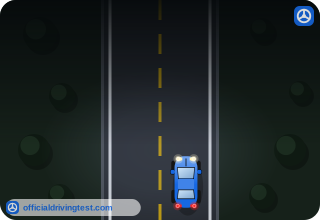
At night, how fast should you never drive?
- So fast that you cannot read the signs located beside the road ahead of you
- So fast that you cannot keep up with the vehicles around you
- So fast that you cannot stop within the distance you can see with your headlights
- So fast that you cannot see the taillights of every other car
Show answer
Correct answer: So fast that you cannot stop within the distance you can see with your headlights
You must be closer to an object to see it at night than during the day. The manual says never to drive so fast that you cannot stop within the distance you can see with your headlights.
Source: Kentucky Driver Manual (Updated July 23, 2026), page 50 · Open this page in the manual (Manual page 50)
-
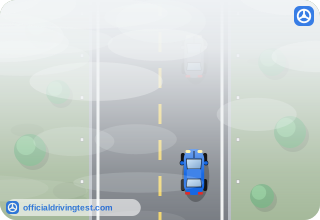
In a heavy rain, snowstorm, or thick fog you may not be able to see more than 100 feet ahead. When you cannot see any farther, what is the fastest you can safely drive?
- 25 miles per hour
- 15 miles per hour
- 30 miles per hour
- 40 miles per hour
Show answer
Correct answer: 25 miles per hour
When you cannot see farther than 100 feet, the manual says you cannot safely drive faster than 25 miles per hour.
Source: Kentucky Driver Manual (Updated July 23, 2026), page 50 · Open this page in the manual (Manual page 50)
-
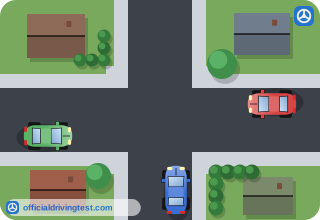
Trees, bushes, parked cars, signs, and buildings at an intersection can block your view of vehicles coming from the side. How should you approach the intersection?
- At the speed limit so you can clear the intersection quickly
- With caution and slowly enough to be able to stop if a vehicle pulls out suddenly
- At a steady speed while sounding your horn as a warning
- Slowly, but only when you can see another vehicle that is approaching
Show answer
Correct answer: With caution and slowly enough to be able to stop if a vehicle pulls out suddenly
The manual says to approach these areas with caution and slowly enough to be able to stop if a vehicle pulls out suddenly.
Source: Kentucky Driver Manual (Updated July 23, 2026), page 50 · Open this page in the manual (Manual page 50)
-
When you come to a hill or curve, why should you adjust your speed?
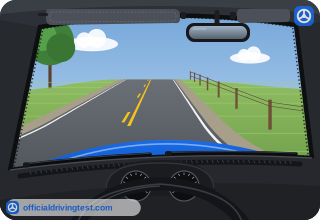
- So you can stop if a stalled car or slow-moving vehicle is in your lane
- So you can pass slower vehicles safely on the hill or on the curve
- So you can keep the same speed as the vehicle ahead
- So you can avoid using your headlights on the curve
Show answer
Correct answer: So you can stop if a stalled car or slow-moving vehicle is in your lane
On a hill or curve you may not see a stalled car or slow-moving vehicle until you are close. The manual says to adjust your speed so you can stop for it.
Source: Kentucky Driver Manual (Updated July 23, 2026), page 50 · Open this page in the manual (Manual page 50)
-
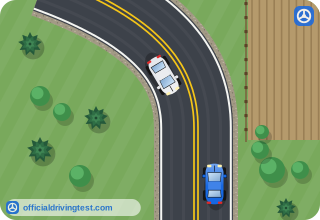
What is a safe speed for entering a curve?
- A speed that allows you to brake hard once you are in the curve
- A speed that allows you to coast through with no acceleration
- A speed that allows slight and constant acceleration through the curve
- A speed that allows you to pass slower vehicles in the curve
Show answer
Correct answer: A speed that allows slight and constant acceleration through the curve
The manual defines a safe curve speed as one that allows you to apply slight and constant acceleration through the curve.
Source: Kentucky Driver Manual (Updated July 23, 2026), page 50 · Open this page in the manual (Manual page 50)
-
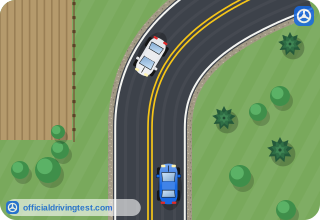
What could happen if you brake hard after you have entered a curve?
- The vehicle will always straighten out of the curve
- The vehicle tires could lose traction
- The brakes will lock until the vehicle has stopped
- The vehicle will slow down more safely than before
Show answer
Correct answer: The vehicle tires could lose traction
The manual warns that hard braking after entry to a curve could cause the vehicle tires to lose traction.
Source: Kentucky Driver Manual (Updated July 23, 2026), page 50 · Open this page in the manual (Manual page 50)
-
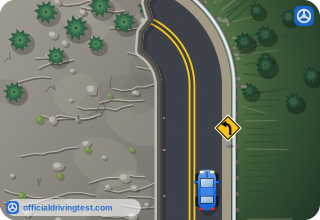
When should you reduce your speed even more before a curve?
- When the road surface is dry and clear
- When you are the only vehicle on the road
- When the curve is on a straight highway
- When you cannot see the end of the curve
Show answer
Correct answer: When you cannot see the end of the curve
The manual says to reduce speed more when traction is poor, when following other vehicles, and when you cannot see the end of the curve.
Source: Kentucky Driver Manual (Updated July 23, 2026), page 50 · Open this page in the manual (Manual page 50)
-
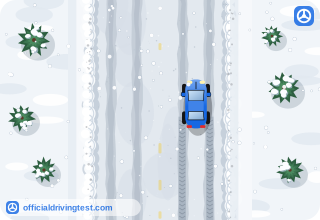
When should you reduce your speed on a roadway that may become slippery?
- Only after the road is completely covered with ice
- Only after your tires begin to slide on the road
- At the first sign of rain, snow, sleet, or ice
- Only after you see other vehicles slowing down
Show answer
Correct answer: At the first sign of rain, snow, sleet, or ice
The manual says to reduce speed at the first sign of rain, snow, sleet, or ice.
Source: Kentucky Driver Manual (Updated July 23, 2026), page 50 · Open this page in the manual (Manual page 50)
-
How does a slippery roadway affect stopping and turning?
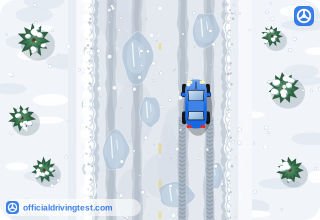
- It takes longer to stop and is harder to turn without skidding
- It takes the same distance to stop but is harder to turn
- It takes a shorter distance to stop but is harder to turn
- It is easier to turn but it takes longer to stop
Show answer
Correct answer: It takes longer to stop and is harder to turn without skidding
When the roadway is slippery your tires do not grip as well. The manual says it takes longer to stop and is harder to turn without skidding.
Source: Kentucky Driver Manual (Updated July 23, 2026), page 50 · Open this page in the manual (Manual page 50)
-
What does total stopping distance mean?
- The distance your vehicle travels from the time you first touch the brake pedal until it stops
- The distance the vehicle ahead travels from the time its brake lights come on
- The distance you can see ahead of your vehicle in ideal conditions
- The distance your vehicle travels, in ideal conditions, from when you realize you must stop until it stops
Show answer
Correct answer: The distance your vehicle travels, in ideal conditions, from when you realize you must stop until it stops
The manual defines total stopping distance as the distance traveled, in ideal conditions, from the time you realize you must stop until the vehicle stops.
Source: Kentucky Driver Manual (Updated July 23, 2026), page 50 · Open this page in the manual (Manual page 50)
-
How does your speed affect your stopping distance?
- The faster you are traveling, the less time you need to stop
- Speed changes your stopping time but not your stopping distance
- The faster you are traveling, the more time and distance are needed to stop
- Speed has no effect when your brakes are in good condition
Show answer
Correct answer: The faster you are traveling, the more time and distance are needed to stop
Speed is one of the things that affect stopping distance: the faster you travel, the more time and distance you need to stop.
Source: Kentucky Driver Manual (Updated July 23, 2026), page 50 · Open this page in the manual (Manual page 50)
-
What is the average perception time for an alert driver?
- ¾ second to 1 second
- 1½ to 2 seconds
- 2½ to 3 seconds
- 3 to 4 seconds
Show answer
Correct answer: ¾ second to 1 second
The manual gives ¾ second to 1 second as the average perception time for an alert driver.
Source: Kentucky Driver Manual (Updated July 23, 2026), page 50 · Open this page in the manual (Manual page 50)
-
What is perception time?
- The time and distance it takes for your brakes to stop the vehicle
- The time and distance it takes you to look in your mirrors
- The time and distance it takes you to move your foot to the brake
- The time and distance it takes you to recognize you must stop
Show answer
Correct answer: The time and distance it takes you to recognize you must stop
Perception time is the time and distance it takes you to recognize that you must stop.
Source: Kentucky Driver Manual (Updated July 23, 2026), page 50 · Open this page in the manual (Manual page 50)
-
What is reaction time?
- The time and distance it takes to recognize that you must stop
- The time and distance it takes to move your foot from the gas pedal and begin applying the brakes
- The time and distance it takes your brakes to slow down and then stop your vehicle
- The time and distance it takes to check your mirrors and signal
Show answer
Correct answer: The time and distance it takes to move your foot from the gas pedal and begin applying the brakes
Reaction time is the time and distance it takes you to move your foot from the gas pedal and begin applying the brakes.
Source: Kentucky Driver Manual (Updated July 23, 2026), page 51 · Open this page in the manual (Manual page 51)
-
What is the reaction time of the average driver?
- ¾ second to 1 second
- ½ second to ¾ second
- 1½ to 2 seconds
- 2 to 3 seconds
Show answer
Correct answer: ¾ second to 1 second
The manual gives ¾ second to 1 second as the average driver reaction time.
Source: Kentucky Driver Manual (Updated July 23, 2026), page 51 · Open this page in the manual (Manual page 51)
-
At 50 mph on dry pavement with good brakes, about how many feet can braking distance take?
- About 75 feet
- About 105 feet
- About 158 feet
- About 225 feet
Show answer
Correct answer: About 158 feet
The manual says that at 50 mph on dry pavement with good brakes, braking distance can take about 158 feet.
Source: Kentucky Driver Manual (Updated July 23, 2026), page 51 · Open this page in the manual (Manual page 51)
-
What minimum following distance should you always try to keep between your car and the vehicle in front?
- 2 seconds
- 3 seconds
- 4 seconds
- 6 seconds
Show answer
Correct answer: 4 seconds
The manual says you should always try to keep a minimum following distance of 4 seconds between your car and the vehicle in front.
Source: Kentucky Driver Manual (Updated July 23, 2026), page 51 · Open this page in the manual (Manual page 51)
-
It is against the law to follow another vehicle more closely than what?
- Is reasonable and prudent
- Is shown on a posted sign
- One car length for each 10 mph
- 100 feet at any speed
Show answer
Correct answer: Is reasonable and prudent
The manual says it is against the law to follow another vehicle more closely than is reasonable and prudent.
Source: Kentucky Driver Manual (Updated July 23, 2026), page 51 · Open this page in the manual (Manual page 51)
-
How do you determine your following distance?
- Measure the number of car lengths between your car and the vehicle ahead
- Count the seconds that the brake lights of the vehicle ahead stay on while it is slowing down on the road
- Count the signs and poles that you pass while following the vehicle ahead
- Count the seconds it takes you to reach the point where the rear of the vehicle ahead passed a stationary object
Show answer
Correct answer: Count the seconds it takes you to reach the point where the rear of the vehicle ahead passed a stationary object
You watch when the rear of the vehicle ahead passes a sign, pole, or other stationary point, and then count the seconds it takes you to reach the same point.
Source: Kentucky Driver Manual (Updated July 23, 2026), page 51 · Open this page in the manual (Manual page 51)
-
Why should you allow extra space when following motorcycles?
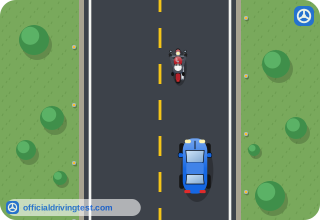
- Motorcyclists are required to stop at every railroad crossing
- Motorcyclists can turn and change lanes much quicker than other vehicles
- Motorcyclists are not allowed to use turn signals
- Motorcyclists always travel faster than the speed limit
Show answer
Correct answer: Motorcyclists can turn and change lanes much quicker than other vehicles
The manual says to increase your following distance behind motorcycles because motorcyclists can turn and change lanes much quicker than other vehicles.
Source: Kentucky Driver Manual (Updated July 23, 2026), page 51 · Open this page in the manual (Manual page 51)
-
What should you do with your following distance when you follow a large vehicle such as a truck, bus, or recreational vehicle?
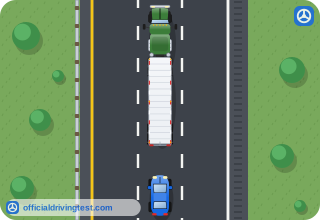
- Increase it
- Decrease it to see around the vehicle
- Keep it the same as for a car
- Keep it at two seconds or less
Show answer
Correct answer: Increase it
The manual lists following large vehicles such as trucks, buses, recreational vehicles, and vehicles pulling a trailer as a time to increase your following distance.
Source: Kentucky Driver Manual (Updated July 23, 2026), page 51 · Open this page in the manual (Manual page 51)
-
What should you do with your following distance at night, in fog, or in bad weather?
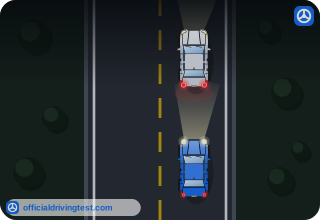
- Decrease it to see the road better
- Keep it the same as in daylight
- Increase it
- Keep it as short as possible
Show answer
Correct answer: Increase it
The manual lists night, fog, and bad weather among the situations when you need more space in front of your vehicle.
Source: Kentucky Driver Manual (Updated July 23, 2026), page 51 · Open this page in the manual (Manual page 51)
-
Which of these vehicles is required to stop at railroad crossings, so you should increase your following distance behind it?
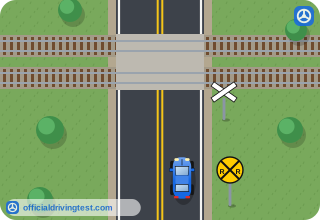
- A passenger sedan
- A school bus
- A pickup truck
- A taxi
Show answer
Correct answer: A school bus
The manual lists vehicles required to stop at railroad crossings, such as transit buses, school buses, and vehicles carrying hazardous materials, as a time to increase your following distance.
Source: Kentucky Driver Manual (Updated July 23, 2026), page 51 · Open this page in the manual (Manual page 51)
-
A driver behind you wants to pass. What should you do to help?
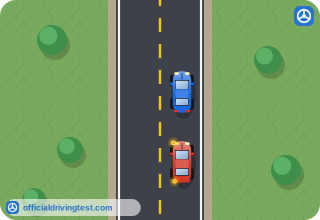
- Speed up to stay ahead of the driver
- Move onto the shoulder and stop
- Brake sharply to warn the driver
- Ease up on the accelerator
Show answer
Correct answer: Ease up on the accelerator
The manual says to ease up on the accelerator to assist a driver behind you who wants to pass. You may have to slow down to allow enough space in front for the driver to move in.
Source: Kentucky Driver Manual (Updated July 23, 2026), page 51 · Open this page in the manual (Manual page 51)
-
Which action helps keep the driver behind you at a safe following distance?
- Slowing down quickly just before you turn
- Signaling only at the moment you begin to turn
- Keeping a steady speed and signaling in advance
- Speeding up when a vehicle follows closely
Show answer
Correct answer: Keeping a steady speed and signaling in advance
The manual says you can help keep the driver behind you at a safe distance by keeping a steady speed, signaling in advance, and keeping more space to the front before reducing speed or turning.
Source: Kentucky Driver Manual (Updated July 23, 2026), page 53 · Open this page in the manual (Manual page 53)
-
You are following another vehicle. When are you following too closely?
- When you pass the stationary point before counting to one thousand four
- When you pass the stationary point after counting to one thousand five
- When you pass the stationary point after counting to one thousand six
- When you pass the stationary point exactly at one thousand four
Show answer
Correct answer: When you pass the stationary point before counting to one thousand four
Counting “one thousand one” through “one thousand four” gives four seconds. If you reach the stationary point sooner than that, you are following too closely.
Source: Kentucky Driver Manual (Updated July 23, 2026), page 51 · Open this page in the manual (Manual page 51)
-
By how much should you increase your following distance for night driving conditions?
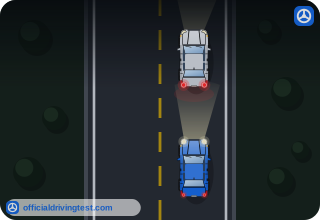
- At least one additional second
- Nothing, because headlights make up for it
- At least five additional seconds
- Half a second at most
Show answer
Correct answer: At least one additional second
The manual says to add at least one additional second of following distance for night driving conditions.
Source: Kentucky Driver Manual (Updated July 23, 2026), page 68 · Open this page in the manual (Manual page 68)
-
By how much should you increase your following distance for driving on unfamiliar roadways at night?
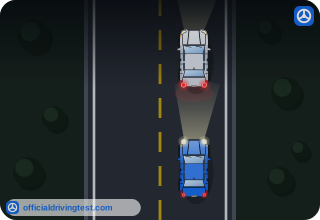
- At least two additional seconds
- At least six additional seconds
- No extra time if you use high beams
- Half a second more than in daylight
Show answer
Correct answer: At least two additional seconds
On unfamiliar roadways at night the manual says to add at least two additional seconds of following distance.
Source: Kentucky Driver Manual (Updated July 23, 2026), page 68 · Open this page in the manual (Manual page 68)
-
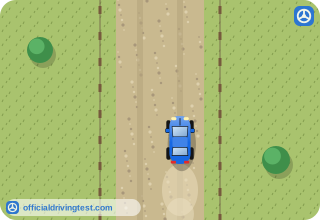
What should you do on gravel or dirt roads, where traction can be reduced?
- Keep your normal speed and brake firmly to stop
- Increase your speed to stay on top of the loose surface
- Move to the edge of the road to improve traction
- Reduce your speed and increase your following distance
Show answer
Correct answer: Reduce your speed and increase your following distance
Traction is reduced on gravel or dirt roads, so you should reduce speed, increase following distance, and realize you may skid when stopping.
Source: Kentucky Driver Manual (Updated July 23, 2026), page 69 · Open this page in the manual (Manual page 69)
-
What may narrow rural roads have instead of shoulders?
- Guardrails
- Ditches or drop offs
- Paved turnout lanes
- Wide gravel strips
Show answer
Correct answer: Ditches or drop offs
Rural roads are generally narrower and may have ditches or drop offs instead of shoulders.
Source: Kentucky Driver Manual (Updated July 23, 2026), page 69 · Open this page in the manual (Manual page 69)
-
Where should you position your vehicle on a narrow rural road?
- Near the center line
- Near the right edge
- Centered in your lane
- Straddling the center line
Show answer
Correct answer: Centered in your lane
On narrow rural roads you should reduce speed, center your vehicle in your lane, and watch for oncoming traffic that may attempt to share it.
Source: Kentucky Driver Manual (Updated July 23, 2026), page 69 · Open this page in the manual (Manual page 69)
-
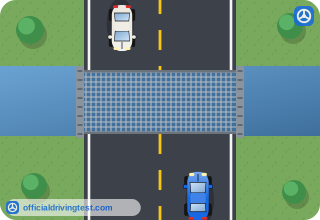
What should you do with the steering wheel on open bridge gratings or steel bridges, which can reduce traction?
- Maintain a firm grip
- Hold it loosely with one hand
- Turn it back and forth to find traction
- Let the vehicle steer itself
Show answer
Correct answer: Maintain a firm grip
Open bridge gratings and steel bridges can reduce traction, so you should reduce speed, increase following distance, and maintain a firm grip on the steering wheel.
Source: Kentucky Driver Manual (Updated July 23, 2026), page 70 · Open this page in the manual (Manual page 70)
-
What can create blind corners and limit how far you can see on rural roads?
- Gravel surfaces, ditches, and single-lane bridges
- Fog, rain, and snow only
- Wooded areas, crops, and steep hills
- Narrow lanes and rough pavement
Show answer
Correct answer: Wooded areas, crops, and steep hills
Blind corners created by wooded areas, crops growing in fields, and steep hills can limit how far you can see.
Source: Kentucky Driver Manual (Updated July 23, 2026), page 70 · Open this page in the manual (Manual page 70)
-
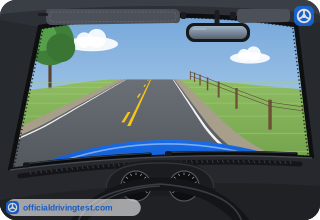
What should you do in rural areas of reduced vision?
- Sound your horn and keep your speed
- Reduce your speed and be prepared to stop
- Move to the center of the road
- Speed up to get through quickly
Show answer
Correct answer: Reduce your speed and be prepared to stop
In areas with reduced vision you should always reduce your speed and be prepared to stop.
Source: Kentucky Driver Manual (Updated July 23, 2026), page 70 · Open this page in the manual (Manual page 70)
-
What percent of a trailer's cargo weight should go in the front, nearest the towing vehicle?
- 50 percent
- 70 percent
- 80 percent
- 60 percent
Show answer
Correct answer: 60 percent
Sixty percent of the cargo weight should go in the front of the trailer and 40 percent in the back.
Source: Kentucky Driver Manual (Updated July 23, 2026), page 70 · Open this page in the manual (Manual page 70)
-
What is the maximum recommended speed for most vehicle-trailer combinations?
- 35 mph
- 45 mph
- 50 mph
- 55 mph
Show answer
Correct answer: 55 mph
The manual gives 55 mph as the maximum recommended speed for most vehicle-trailer combinations.
Source: Kentucky Driver Manual (Updated July 23, 2026), page 71 · Open this page in the manual (Manual page 71)
-
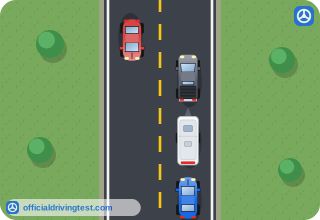
While towing a trailer, what speed must you never exceed?
- The speed of traffic around you
- Your normal speed when not towing
- The speed of the vehicle ahead
- The posted speed limit
Show answer
Correct answer: The posted speed limit
When towing, you must never exceed the posted speed limit.
Source: Kentucky Driver Manual (Updated July 23, 2026), page 71 · Open this page in the manual (Manual page 71)
-
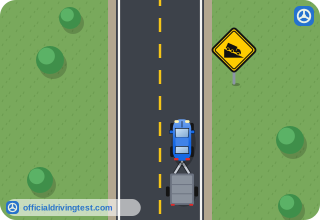
When going down a grade with a trailer, when should you slow down?
- After you reach the steepest part
- Before starting down the hill
- When the trailer begins to sway
- Once the vehicle starts to pick up speed
Show answer
Correct answer: Before starting down the hill
You should slow down before starting down the hill when towing.
Source: Kentucky Driver Manual (Updated July 23, 2026), page 71 · Open this page in the manual (Manual page 71)
-
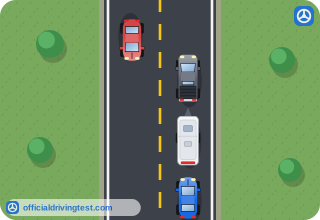
What does a vehicle-trailer combination require compared with a vehicle without a trailer?
- Less distance to stop
- The same distance to stop
- More distance to stop
- More distance to stop only when the road is wet
Show answer
Correct answer: More distance to stop
A vehicle-trailer combination requires more distance to stop, so extra space should be allowed ahead.
Source: Kentucky Driver Manual (Updated July 23, 2026), page 71 · Open this page in the manual (Manual page 71)
-
When towing a trailer in rain, snow, or fog, what should you do about the space between you and the vehicle ahead?
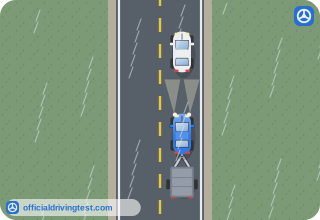
- Allow even more space
- Keep the same space as in dry weather
- Reduce the space so you can see the vehicle ahead
- Allow less space because you are driving slower
Show answer
Correct answer: Allow even more space
When towing in rain, snow, or fog, you should allow even more space between your vehicle and the vehicle ahead.
Source: Kentucky Driver Manual (Updated July 23, 2026), page 71 · Open this page in the manual (Manual page 71)
-
When towing, your vehicle will require more distance to do what?
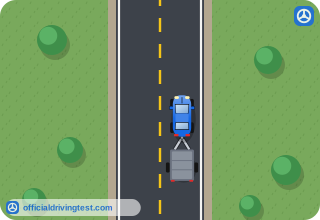
- Pass on hills or curves
- Accelerate on a flat road
- Start the engine in cold weather
- Signal before turning
Show answer
Correct answer: Pass on hills or curves
When towing, your vehicle needs more distance to pass on hills or curves.
Source: Kentucky Driver Manual (Updated July 23, 2026), page 71 · Open this page in the manual (Manual page 71)
-
When making a turn while towing a trailer, what should you remember about the trailer?
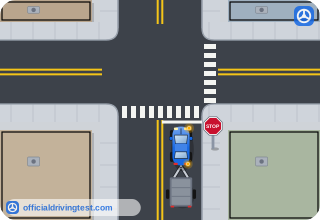
- It follows exactly in the path of the car
- It turns more sharply than the car
- It does not follow directly behind the car
- It needs less room than the car to turn
Show answer
Correct answer: It does not follow directly behind the car
The trailer does not follow directly behind the car and may require extra room to turn safely.
Source: Kentucky Driver Manual (Updated July 23, 2026), page 71 · Open this page in the manual (Manual page 71)
-
When driving a long distance with a trailer, what should you not attempt to do?
- Drive “straight through”
- Stop at a rest area
- Drive in daylight
- Recheck the hitch at fuel stops
Show answer
Correct answer: Drive “straight through”
On a long trip you plan a rest stop so you can drive in daylight while rested and alert, rather than driving straight through.
Source: Kentucky Driver Manual (Updated July 23, 2026), page 71 · Open this page in the manual (Manual page 71)
-
If you are unsure how to hook up, load, or drive with a trailer, what does the manual advise?
- Seek advice from a trailer professional
- Practice on a busy highway
- Ask another driver on the road
- Rely on the trailer’s instruction sticker
Show answer
Correct answer: Seek advice from a trailer professional
Anyone unsure how to properly hook up, load, or drive with a trailer should seek advice from a trailer professional.
Source: Kentucky Driver Manual (Updated July 23, 2026), page 71 · Open this page in the manual (Manual page 71)