Kentucky: Speed and following distance — Part 3 Practice Test
Questions in this part include: “What may narrow rural roads have instead of shoulders?” · “What percent of a trailer's cargo weight should go in the front, nearest the towing vehicle?”
Independent educational site · not affiliated with any government agency or DMV
Ready? Test yourself
- Instant feedback with an explanation
- Every answer cites its source in the manual
- Your best score is saved on this device
Questions are original and based on the official manual "Kentucky Driver Manual" (Updated July 23, 2026), Kentucky State Police.
All 18 questions in this practice test
Take the test above first, then use this list to study. Tap “Show answer” to see the correct answer and explanation.
Show the questions and answersHide the questions
-
By how much should you increase your following distance for night driving conditions?
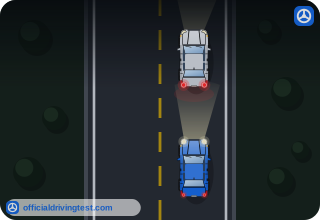
- At least one additional second
- Nothing, because headlights make up for it
- At least five additional seconds
- Half a second at most
Show answer
Correct answer: At least one additional second
The manual says to add at least one additional second of following distance for night driving conditions.
Source: Kentucky Driver Manual (Updated July 23, 2026), page 68 · Open this page in the manual (Manual page 68)
-
By how much should you increase your following distance for driving on unfamiliar roadways at night?
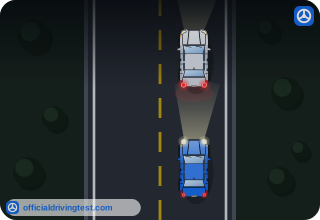
- At least two additional seconds
- At least six additional seconds
- No extra time if you use high beams
- Half a second more than in daylight
Show answer
Correct answer: At least two additional seconds
On unfamiliar roadways at night the manual says to add at least two additional seconds of following distance.
Source: Kentucky Driver Manual (Updated July 23, 2026), page 68 · Open this page in the manual (Manual page 68)
-
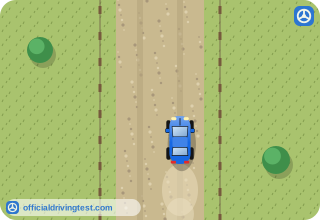
What should you do on gravel or dirt roads, where traction can be reduced?
- Keep your normal speed and brake firmly to stop
- Increase your speed to stay on top of the loose surface
- Move to the edge of the road to improve traction
- Reduce your speed and increase your following distance
Show answer
Correct answer: Reduce your speed and increase your following distance
Traction is reduced on gravel or dirt roads, so you should reduce speed, increase following distance, and realize you may skid when stopping.
Source: Kentucky Driver Manual (Updated July 23, 2026), page 69 · Open this page in the manual (Manual page 69)
-
What may narrow rural roads have instead of shoulders?
- Guardrails
- Ditches or drop offs
- Paved turnout lanes
- Wide gravel strips
Show answer
Correct answer: Ditches or drop offs
Rural roads are generally narrower and may have ditches or drop offs instead of shoulders.
Source: Kentucky Driver Manual (Updated July 23, 2026), page 69 · Open this page in the manual (Manual page 69)
-
Where should you position your vehicle on a narrow rural road?
- Near the center line
- Near the right edge
- Centered in your lane
- Straddling the center line
Show answer
Correct answer: Centered in your lane
On narrow rural roads you should reduce speed, center your vehicle in your lane, and watch for oncoming traffic that may attempt to share it.
Source: Kentucky Driver Manual (Updated July 23, 2026), page 69 · Open this page in the manual (Manual page 69)
-
What should you do with the steering wheel on open bridge gratings or steel bridges, which can reduce traction?
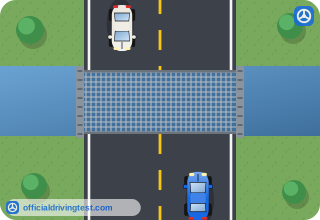
- Maintain a firm grip
- Hold it loosely with one hand
- Turn it back and forth to find traction
- Let the vehicle steer itself
Show answer
Correct answer: Maintain a firm grip
Open bridge gratings and steel bridges can reduce traction, so you should reduce speed, increase following distance, and maintain a firm grip on the steering wheel.
Source: Kentucky Driver Manual (Updated July 23, 2026), page 70 · Open this page in the manual (Manual page 70)
-
What can create blind corners and limit how far you can see on rural roads?
- Gravel surfaces, ditches, and single-lane bridges
- Fog, rain, and snow only
- Wooded areas, crops, and steep hills
- Narrow lanes and rough pavement
Show answer
Correct answer: Wooded areas, crops, and steep hills
Blind corners created by wooded areas, crops growing in fields, and steep hills can limit how far you can see.
Source: Kentucky Driver Manual (Updated July 23, 2026), page 70 · Open this page in the manual (Manual page 70)
-
What should you do in rural areas of reduced vision?
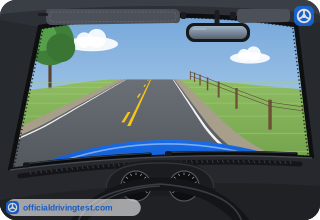
- Sound your horn and keep your speed
- Reduce your speed and be prepared to stop
- Move to the center of the road
- Speed up to get through quickly
Show answer
Correct answer: Reduce your speed and be prepared to stop
In areas with reduced vision you should always reduce your speed and be prepared to stop.
Source: Kentucky Driver Manual (Updated July 23, 2026), page 70 · Open this page in the manual (Manual page 70)
-
What percent of a trailer's cargo weight should go in the front, nearest the towing vehicle?
- 50 percent
- 70 percent
- 80 percent
- 60 percent
Show answer
Correct answer: 60 percent
Sixty percent of the cargo weight should go in the front of the trailer and 40 percent in the back.
Source: Kentucky Driver Manual (Updated July 23, 2026), page 70 · Open this page in the manual (Manual page 70)
-
What is the maximum recommended speed for most vehicle-trailer combinations?
- 35 mph
- 45 mph
- 50 mph
- 55 mph
Show answer
Correct answer: 55 mph
The manual gives 55 mph as the maximum recommended speed for most vehicle-trailer combinations.
Source: Kentucky Driver Manual (Updated July 23, 2026), page 71 · Open this page in the manual (Manual page 71)
-
While towing a trailer, what speed must you never exceed?
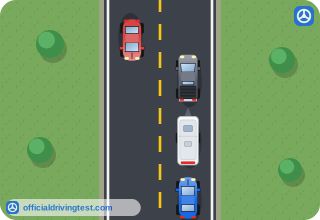
- The speed of traffic around you
- Your normal speed when not towing
- The speed of the vehicle ahead
- The posted speed limit
Show answer
Correct answer: The posted speed limit
When towing, you must never exceed the posted speed limit.
Source: Kentucky Driver Manual (Updated July 23, 2026), page 71 · Open this page in the manual (Manual page 71)
-
When going down a grade with a trailer, when should you slow down?
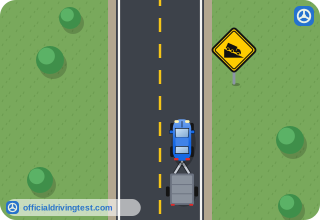
- After you reach the steepest part
- Before starting down the hill
- When the trailer begins to sway
- Once the vehicle starts to pick up speed
Show answer
Correct answer: Before starting down the hill
You should slow down before starting down the hill when towing.
Source: Kentucky Driver Manual (Updated July 23, 2026), page 71 · Open this page in the manual (Manual page 71)
-
What does a vehicle-trailer combination require compared with a vehicle without a trailer?
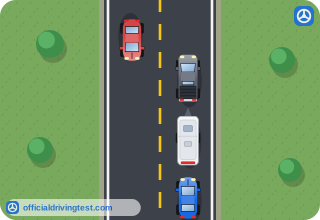
- Less distance to stop
- The same distance to stop
- More distance to stop
- More distance to stop only when the road is wet
Show answer
Correct answer: More distance to stop
A vehicle-trailer combination requires more distance to stop, so extra space should be allowed ahead.
Source: Kentucky Driver Manual (Updated July 23, 2026), page 71 · Open this page in the manual (Manual page 71)
-
When towing a trailer in rain, snow, or fog, what should you do about the space between you and the vehicle ahead?
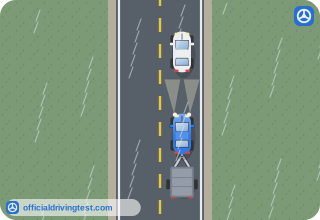
- Allow even more space
- Keep the same space as in dry weather
- Reduce the space so you can see the vehicle ahead
- Allow less space because you are driving slower
Show answer
Correct answer: Allow even more space
When towing in rain, snow, or fog, you should allow even more space between your vehicle and the vehicle ahead.
Source: Kentucky Driver Manual (Updated July 23, 2026), page 71 · Open this page in the manual (Manual page 71)
-
When towing, your vehicle will require more distance to do what?
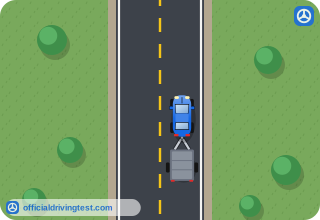
- Pass on hills or curves
- Accelerate on a flat road
- Start the engine in cold weather
- Signal before turning
Show answer
Correct answer: Pass on hills or curves
When towing, your vehicle needs more distance to pass on hills or curves.
Source: Kentucky Driver Manual (Updated July 23, 2026), page 71 · Open this page in the manual (Manual page 71)
-
When making a turn while towing a trailer, what should you remember about the trailer?
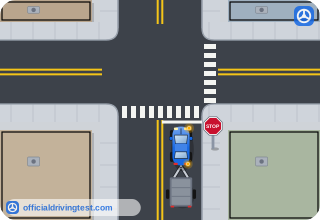
- It follows exactly in the path of the car
- It turns more sharply than the car
- It does not follow directly behind the car
- It needs less room than the car to turn
Show answer
Correct answer: It does not follow directly behind the car
The trailer does not follow directly behind the car and may require extra room to turn safely.
Source: Kentucky Driver Manual (Updated July 23, 2026), page 71 · Open this page in the manual (Manual page 71)
-
When driving a long distance with a trailer, what should you not attempt to do?
- Drive “straight through”
- Stop at a rest area
- Drive in daylight
- Recheck the hitch at fuel stops
Show answer
Correct answer: Drive “straight through”
On a long trip you plan a rest stop so you can drive in daylight while rested and alert, rather than driving straight through.
Source: Kentucky Driver Manual (Updated July 23, 2026), page 71 · Open this page in the manual (Manual page 71)
-
If you are unsure how to hook up, load, or drive with a trailer, what does the manual advise?
- Seek advice from a trailer professional
- Practice on a busy highway
- Ask another driver on the road
- Rely on the trailer’s instruction sticker
Show answer
Correct answer: Seek advice from a trailer professional
Anyone unsure how to properly hook up, load, or drive with a trailer should seek advice from a trailer professional.
Source: Kentucky Driver Manual (Updated July 23, 2026), page 71 · Open this page in the manual (Manual page 71)