Kentucky: Speed and following distance — Part 2 Practice Test
Questions in this part include: “What does total stopping distance mean?” · “At 50 mph on dry pavement with good brakes, about how many feet can braking distance take?”
Independent educational site · not affiliated with any government agency or DMV
Ready? Test yourself
- Instant feedback with an explanation
- Every answer cites its source in the manual
- Your best score is saved on this device
Questions are original and based on the official manual "Kentucky Driver Manual" (Updated July 23, 2026), Kentucky State Police.
All 19 questions in this practice test
Take the test above first, then use this list to study. Tap “Show answer” to see the correct answer and explanation.
Show the questions and answersHide the questions
-
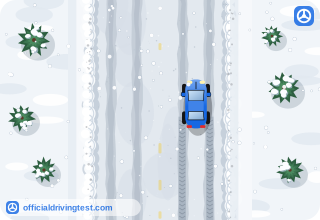
When should you reduce your speed on a roadway that may become slippery?
- Only after the road is completely covered with ice
- Only after your tires begin to slide on the road
- At the first sign of rain, snow, sleet, or ice
- Only after you see other vehicles slowing down
Show answer
Correct answer: At the first sign of rain, snow, sleet, or ice
The manual says to reduce speed at the first sign of rain, snow, sleet, or ice.
Source: Kentucky Driver Manual (Updated July 23, 2026), page 50 · Open this page in the manual (Manual page 50)
-
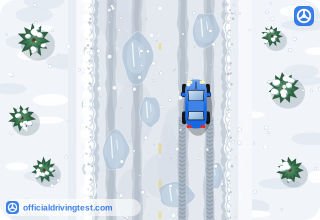
How does a slippery roadway affect stopping and turning?
- It takes longer to stop and is harder to turn without skidding
- It takes the same distance to stop but is harder to turn
- It takes a shorter distance to stop but is harder to turn
- It is easier to turn but it takes longer to stop
Show answer
Correct answer: It takes longer to stop and is harder to turn without skidding
When the roadway is slippery your tires do not grip as well. The manual says it takes longer to stop and is harder to turn without skidding.
Source: Kentucky Driver Manual (Updated July 23, 2026), page 50 · Open this page in the manual (Manual page 50)
-
What does total stopping distance mean?
- The distance your vehicle travels from the time you first touch the brake pedal until it stops
- The distance the vehicle ahead travels from the time its brake lights come on
- The distance you can see ahead of your vehicle in ideal conditions
- The distance your vehicle travels, in ideal conditions, from when you realize you must stop until it stops
Show answer
Correct answer: The distance your vehicle travels, in ideal conditions, from when you realize you must stop until it stops
The manual defines total stopping distance as the distance traveled, in ideal conditions, from the time you realize you must stop until the vehicle stops.
Source: Kentucky Driver Manual (Updated July 23, 2026), page 50 · Open this page in the manual (Manual page 50)
-
How does your speed affect your stopping distance?
- The faster you are traveling, the less time you need to stop
- Speed changes your stopping time but not your stopping distance
- The faster you are traveling, the more time and distance are needed to stop
- Speed has no effect when your brakes are in good condition
Show answer
Correct answer: The faster you are traveling, the more time and distance are needed to stop
Speed is one of the things that affect stopping distance: the faster you travel, the more time and distance you need to stop.
Source: Kentucky Driver Manual (Updated July 23, 2026), page 50 · Open this page in the manual (Manual page 50)
-
What is the average perception time for an alert driver?
- ¾ second to 1 second
- 1½ to 2 seconds
- 2½ to 3 seconds
- 3 to 4 seconds
Show answer
Correct answer: ¾ second to 1 second
The manual gives ¾ second to 1 second as the average perception time for an alert driver.
Source: Kentucky Driver Manual (Updated July 23, 2026), page 50 · Open this page in the manual (Manual page 50)
-
What is perception time?
- The time and distance it takes for your brakes to stop the vehicle
- The time and distance it takes you to look in your mirrors
- The time and distance it takes you to move your foot to the brake
- The time and distance it takes you to recognize you must stop
Show answer
Correct answer: The time and distance it takes you to recognize you must stop
Perception time is the time and distance it takes you to recognize that you must stop.
Source: Kentucky Driver Manual (Updated July 23, 2026), page 50 · Open this page in the manual (Manual page 50)
-
What is reaction time?
- The time and distance it takes to recognize that you must stop
- The time and distance it takes to move your foot from the gas pedal and begin applying the brakes
- The time and distance it takes your brakes to slow down and then stop your vehicle
- The time and distance it takes to check your mirrors and signal
Show answer
Correct answer: The time and distance it takes to move your foot from the gas pedal and begin applying the brakes
Reaction time is the time and distance it takes you to move your foot from the gas pedal and begin applying the brakes.
Source: Kentucky Driver Manual (Updated July 23, 2026), page 51 · Open this page in the manual (Manual page 51)
-
What is the reaction time of the average driver?
- ¾ second to 1 second
- ½ second to ¾ second
- 1½ to 2 seconds
- 2 to 3 seconds
Show answer
Correct answer: ¾ second to 1 second
The manual gives ¾ second to 1 second as the average driver reaction time.
Source: Kentucky Driver Manual (Updated July 23, 2026), page 51 · Open this page in the manual (Manual page 51)
-
At 50 mph on dry pavement with good brakes, about how many feet can braking distance take?
- About 75 feet
- About 105 feet
- About 158 feet
- About 225 feet
Show answer
Correct answer: About 158 feet
The manual says that at 50 mph on dry pavement with good brakes, braking distance can take about 158 feet.
Source: Kentucky Driver Manual (Updated July 23, 2026), page 51 · Open this page in the manual (Manual page 51)
-
What minimum following distance should you always try to keep between your car and the vehicle in front?
- 2 seconds
- 3 seconds
- 4 seconds
- 6 seconds
Show answer
Correct answer: 4 seconds
The manual says you should always try to keep a minimum following distance of 4 seconds between your car and the vehicle in front.
Source: Kentucky Driver Manual (Updated July 23, 2026), page 51 · Open this page in the manual (Manual page 51)
-
It is against the law to follow another vehicle more closely than what?
- Is reasonable and prudent
- Is shown on a posted sign
- One car length for each 10 mph
- 100 feet at any speed
Show answer
Correct answer: Is reasonable and prudent
The manual says it is against the law to follow another vehicle more closely than is reasonable and prudent.
Source: Kentucky Driver Manual (Updated July 23, 2026), page 51 · Open this page in the manual (Manual page 51)
-
How do you determine your following distance?
- Measure the number of car lengths between your car and the vehicle ahead
- Count the seconds that the brake lights of the vehicle ahead stay on while it is slowing down on the road
- Count the signs and poles that you pass while following the vehicle ahead
- Count the seconds it takes you to reach the point where the rear of the vehicle ahead passed a stationary object
Show answer
Correct answer: Count the seconds it takes you to reach the point where the rear of the vehicle ahead passed a stationary object
You watch when the rear of the vehicle ahead passes a sign, pole, or other stationary point, and then count the seconds it takes you to reach the same point.
Source: Kentucky Driver Manual (Updated July 23, 2026), page 51 · Open this page in the manual (Manual page 51)
-
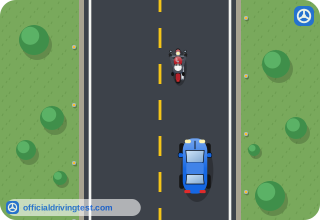
Why should you allow extra space when following motorcycles?
- Motorcyclists are required to stop at every railroad crossing
- Motorcyclists can turn and change lanes much quicker than other vehicles
- Motorcyclists are not allowed to use turn signals
- Motorcyclists always travel faster than the speed limit
Show answer
Correct answer: Motorcyclists can turn and change lanes much quicker than other vehicles
The manual says to increase your following distance behind motorcycles because motorcyclists can turn and change lanes much quicker than other vehicles.
Source: Kentucky Driver Manual (Updated July 23, 2026), page 51 · Open this page in the manual (Manual page 51)
-
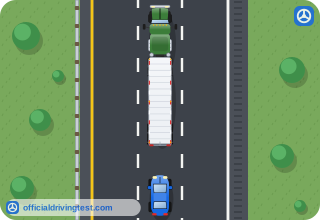
What should you do with your following distance when you follow a large vehicle such as a truck, bus, or recreational vehicle?
- Increase it
- Decrease it to see around the vehicle
- Keep it the same as for a car
- Keep it at two seconds or less
Show answer
Correct answer: Increase it
The manual lists following large vehicles such as trucks, buses, recreational vehicles, and vehicles pulling a trailer as a time to increase your following distance.
Source: Kentucky Driver Manual (Updated July 23, 2026), page 51 · Open this page in the manual (Manual page 51)
-
What should you do with your following distance at night, in fog, or in bad weather?
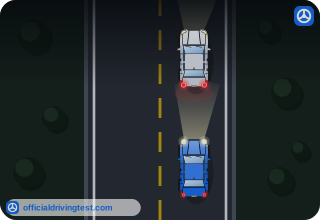
- Decrease it to see the road better
- Keep it the same as in daylight
- Increase it
- Keep it as short as possible
Show answer
Correct answer: Increase it
The manual lists night, fog, and bad weather among the situations when you need more space in front of your vehicle.
Source: Kentucky Driver Manual (Updated July 23, 2026), page 51 · Open this page in the manual (Manual page 51)
-
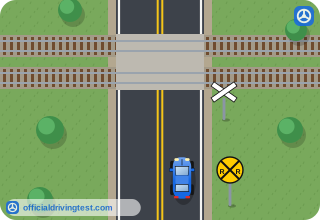
Which of these vehicles is required to stop at railroad crossings, so you should increase your following distance behind it?
- A passenger sedan
- A school bus
- A pickup truck
- A taxi
Show answer
Correct answer: A school bus
The manual lists vehicles required to stop at railroad crossings, such as transit buses, school buses, and vehicles carrying hazardous materials, as a time to increase your following distance.
Source: Kentucky Driver Manual (Updated July 23, 2026), page 51 · Open this page in the manual (Manual page 51)
-
A driver behind you wants to pass. What should you do to help?
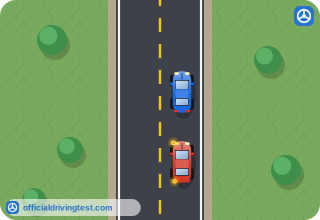
- Speed up to stay ahead of the driver
- Move onto the shoulder and stop
- Brake sharply to warn the driver
- Ease up on the accelerator
Show answer
Correct answer: Ease up on the accelerator
The manual says to ease up on the accelerator to assist a driver behind you who wants to pass. You may have to slow down to allow enough space in front for the driver to move in.
Source: Kentucky Driver Manual (Updated July 23, 2026), page 51 · Open this page in the manual (Manual page 51)
-
Which action helps keep the driver behind you at a safe following distance?
- Slowing down quickly just before you turn
- Signaling only at the moment you begin to turn
- Keeping a steady speed and signaling in advance
- Speeding up when a vehicle follows closely
Show answer
Correct answer: Keeping a steady speed and signaling in advance
The manual says you can help keep the driver behind you at a safe distance by keeping a steady speed, signaling in advance, and keeping more space to the front before reducing speed or turning.
Source: Kentucky Driver Manual (Updated July 23, 2026), page 53 · Open this page in the manual (Manual page 53)
-
You are following another vehicle. When are you following too closely?
- When you pass the stationary point before counting to one thousand four
- When you pass the stationary point after counting to one thousand five
- When you pass the stationary point after counting to one thousand six
- When you pass the stationary point exactly at one thousand four
Show answer
Correct answer: When you pass the stationary point before counting to one thousand four
Counting “one thousand one” through “one thousand four” gives four seconds. If you reach the stationary point sooner than that, you are following too closely.
Source: Kentucky Driver Manual (Updated July 23, 2026), page 51 · Open this page in the manual (Manual page 51)