Kentucky: Speed and following distance — Part 1 Practice Test
Questions in this part include: “What does the manual advise about starts, stops, and speed to reduce driving pollution?” · “How often should you make a habit of glancing at your speedometer?”
Independent educational site · not affiliated with any government agency or DMV
Ready? Test yourself
- Instant feedback with an explanation
- Every answer cites its source in the manual
- Your best score is saved on this device
Questions are original and based on the official manual "Kentucky Driver Manual" (Updated July 23, 2026), Kentucky State Police.
All 19 questions in this practice test
Take the test above first, then use this list to study. Tap “Show answer” to see the correct answer and explanation.
Show the questions and answersHide the questions
-
What does the manual advise about starts, stops, and speed to reduce driving pollution?
- Accelerate quickly to clear intersections sooner and save time
- Brake late and hard so you can keep a steady speed on the road
- Drive faster than traffic to shorten the length of each trip
- Avoid quick starts and stops and drive smoothly at moderate speeds
Show answer
Correct answer: Avoid quick starts and stops and drive smoothly at moderate speeds
The manual says to avoid quick starts and stops and to drive smoothly and at moderate speeds.
Source: Kentucky Driver Manual (Updated July 23, 2026), page 21 · Open this page in the manual (Manual page 21)
-
According to the manual, smooth driving allows you to do what?
- Use less distance between yourself and other drivers and save time
- Keep more distance between yourself and other drivers and improve fuel economy
- Keep a higher speed than other drivers and reach your destination sooner
- Reduce the distance you need to follow other drivers and avoid signaling
Show answer
Correct answer: Keep more distance between yourself and other drivers and improve fuel economy
Smooth driving lets you keep more distance between yourself and other drivers and helps improve fuel economy.
Source: Kentucky Driver Manual (Updated July 23, 2026), page 46 · Open this page in the manual (Manual page 46)
-
Ideally, how far ahead of your car should you try to look to see what is occurring?
- 20 to 30 seconds in front of your car
- 2 to 3 seconds in front of your car
- 5 to 8 seconds in front of your car
- 10 to 15 seconds in front of your car
Show answer
Correct answer: 20 to 30 seconds in front of your car
The manual says you should ideally look at what is occurring 20 to 30 seconds in front of your car. Looking well ahead gives you time to adjust and plan your driving movements.
Source: Kentucky Driver Manual (Updated July 23, 2026), page 49 · Open this page in the manual (Manual page 49)
-
How should you use your eyes while searching for possible problems around your vehicle?
- Keep your eyes fixed on the car directly ahead
- Keep your eyes on the road just past your hood
- Avoid staring and keep your eyes moving
- Keep your eyes on the mirrors most of the time
Show answer
Correct answer: Avoid staring and keep your eyes moving
The manual tells drivers to avoid staring and to keep their eyes moving and searching for possible problems.
Source: Kentucky Driver Manual (Updated July 23, 2026), page 49 · Open this page in the manual (Manual page 49)
-
Searching around your vehicle gives you time to change what?
- Your seat position or mirror settings
- Your speed or roadway position
- Your route or your destination
- Your license class or restrictions
Show answer
Correct answer: Your speed or roadway position
Searching helps you see situations that could cause a problem and gives you time to change speed or roadway position.
Source: Kentucky Driver Manual (Updated July 23, 2026), page 49 · Open this page in the manual (Manual page 49)
-
Which of these can limit how far ahead you are able to see?
- Driving on a highway instead of in a city
- Using your mirrors to check traffic behind
- Searching ahead for possible problems
- Following too close to a larger vehicle
Show answer
Correct answer: Following too close to a larger vehicle
The manual lists following too close to a larger vehicle as a situation that can limit how far you can see. You should adjust your speed and road position so you can see.
Source: Kentucky Driver Manual (Updated July 23, 2026), page 49 · Open this page in the manual (Manual page 49)
-
How often should you make a habit of glancing at your speedometer?
- About once every 10 minutes
- About once every half hour
- About once every 10 seconds
- About once a minute
Show answer
Correct answer: About once a minute
The manual says to glance at the speedometer about once a minute to be sure you are driving at a safe and legal speed.
Source: Kentucky Driver Manual (Updated July 23, 2026), page 49 · Open this page in the manual (Manual page 49)
-
When the speed limit is not posted, what is the speed limit on interstate highways and parkways in Kentucky?
- 45 mph
- 65 mph
- 55 mph
- 60 mph
Show answer
Correct answer: 65 mph
Kentucky sets 65 miles per hour as the speed limit on interstate highways and parkways when no limit is posted.
Source: Kentucky Driver Manual (Updated July 23, 2026), page 49 · Open this page in the manual (Manual page 49)
-
When the speed limit is not posted, what is the speed limit on all other state highways in Kentucky?
- 55 mph
- 45 mph
- 50 mph
- 60 mph
Show answer
Correct answer: 55 mph
Fifty-five miles per hour is the unposted speed limit on all other state highways.
Source: Kentucky Driver Manual (Updated July 23, 2026), page 49 · Open this page in the manual (Manual page 49)
-
When the speed limit is not posted, what is the speed limit in a business or residential district in Kentucky?
- 20 mph
- 30 mph
- 35 mph
- 45 mph
Show answer
Correct answer: 35 mph
Thirty-five miles per hour is the unposted speed limit in a business or residential district.
Source: Kentucky Driver Manual (Updated July 23, 2026), page 49 · Open this page in the manual (Manual page 49)
-
What is the speed limit in an off-street parking facility offered for public use, whether publicly or privately owned?
- 10 mph
- 15 mph
- 20 mph
- 25 mph
Show answer
Correct answer: 15 mph
The speed limit in an off-street parking facility offered for public use is fifteen miles per hour.
Source: Kentucky Driver Manual (Updated July 23, 2026), page 49 · Open this page in the manual (Manual page 49)
-
Who may increase the speed limit of specific highways to seventy miles per hour?
- The governor of Kentucky
- The commissioner of the State Police
- The judge-executive of each county
- The secretary of transportation
Show answer
Correct answer: The secretary of transportation
The manual says the secretary of transportation may increase the speed limit of specific highways to seventy miles per hour.
Source: Kentucky Driver Manual (Updated July 23, 2026), page 49 · Open this page in the manual (Manual page 49)
-
At night, how fast should you never drive?
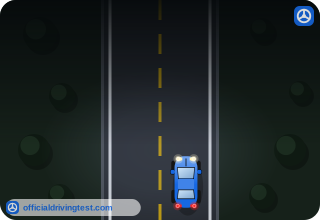
- So fast that you cannot read the signs located beside the road ahead of you
- So fast that you cannot keep up with the vehicles around you
- So fast that you cannot stop within the distance you can see with your headlights
- So fast that you cannot see the taillights of every other car
Show answer
Correct answer: So fast that you cannot stop within the distance you can see with your headlights
You must be closer to an object to see it at night than during the day. The manual says never to drive so fast that you cannot stop within the distance you can see with your headlights.
Source: Kentucky Driver Manual (Updated July 23, 2026), page 50 · Open this page in the manual (Manual page 50)
-
In a heavy rain, snowstorm, or thick fog you may not be able to see more than 100 feet ahead. When you cannot see any farther, what is the fastest you can safely drive?
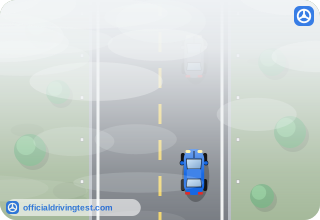
- 25 miles per hour
- 15 miles per hour
- 30 miles per hour
- 40 miles per hour
Show answer
Correct answer: 25 miles per hour
When you cannot see farther than 100 feet, the manual says you cannot safely drive faster than 25 miles per hour.
Source: Kentucky Driver Manual (Updated July 23, 2026), page 50 · Open this page in the manual (Manual page 50)
-
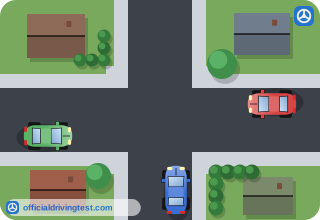
Trees, bushes, parked cars, signs, and buildings at an intersection can block your view of vehicles coming from the side. How should you approach the intersection?
- At the speed limit so you can clear the intersection quickly
- With caution and slowly enough to be able to stop if a vehicle pulls out suddenly
- At a steady speed while sounding your horn as a warning
- Slowly, but only when you can see another vehicle that is approaching
Show answer
Correct answer: With caution and slowly enough to be able to stop if a vehicle pulls out suddenly
The manual says to approach these areas with caution and slowly enough to be able to stop if a vehicle pulls out suddenly.
Source: Kentucky Driver Manual (Updated July 23, 2026), page 50 · Open this page in the manual (Manual page 50)
-
When you come to a hill or curve, why should you adjust your speed?
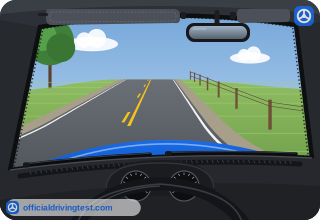
- So you can stop if a stalled car or slow-moving vehicle is in your lane
- So you can pass slower vehicles safely on the hill or on the curve
- So you can keep the same speed as the vehicle ahead
- So you can avoid using your headlights on the curve
Show answer
Correct answer: So you can stop if a stalled car or slow-moving vehicle is in your lane
On a hill or curve you may not see a stalled car or slow-moving vehicle until you are close. The manual says to adjust your speed so you can stop for it.
Source: Kentucky Driver Manual (Updated July 23, 2026), page 50 · Open this page in the manual (Manual page 50)
-
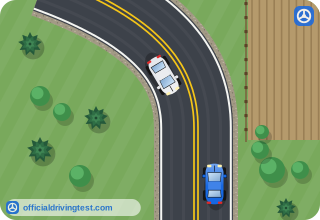
What is a safe speed for entering a curve?
- A speed that allows you to brake hard once you are in the curve
- A speed that allows you to coast through with no acceleration
- A speed that allows slight and constant acceleration through the curve
- A speed that allows you to pass slower vehicles in the curve
Show answer
Correct answer: A speed that allows slight and constant acceleration through the curve
The manual defines a safe curve speed as one that allows you to apply slight and constant acceleration through the curve.
Source: Kentucky Driver Manual (Updated July 23, 2026), page 50 · Open this page in the manual (Manual page 50)
-
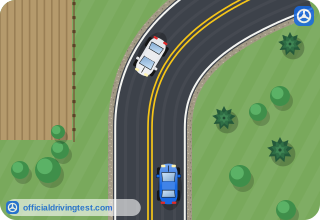
What could happen if you brake hard after you have entered a curve?
- The vehicle will always straighten out of the curve
- The vehicle tires could lose traction
- The brakes will lock until the vehicle has stopped
- The vehicle will slow down more safely than before
Show answer
Correct answer: The vehicle tires could lose traction
The manual warns that hard braking after entry to a curve could cause the vehicle tires to lose traction.
Source: Kentucky Driver Manual (Updated July 23, 2026), page 50 · Open this page in the manual (Manual page 50)
-
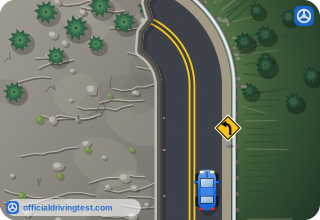
When should you reduce your speed even more before a curve?
- When the road surface is dry and clear
- When you are the only vehicle on the road
- When the curve is on a straight highway
- When you cannot see the end of the curve
Show answer
Correct answer: When you cannot see the end of the curve
The manual says to reduce speed more when traction is poor, when following other vehicles, and when you cannot see the end of the curve.
Source: Kentucky Driver Manual (Updated July 23, 2026), page 50 · Open this page in the manual (Manual page 50)