Kentucky: Emergencies
Skids, brake failure, tire blowouts, a stuck accelerator, running off the pavement, collisions, what to do at a crash scene and reporting it. Split into 5 shorter tests so you're not stuck in one long quiz.
Independent educational site · not affiliated with any government agency or DMV
Choose a part
Emergencies — Part 1
Questions in this part include: “What is hydroplaning?”
StartEmergencies — Part 2
Questions in this part include: “When may it be necessary to accelerate to avoid a crash?”
StartEmergencies — Part 3
Questions in this part include: “What information about the vehicles should you record after a collision?”
StartEmergencies — Part 4
Questions in this part include: “Which of these is an example of reasonable assistance after a collision?”
StartEmergencies — Part 5
Questions in this part include: “What must be done about a stuck accelerator pedal before you drive again?”
StartAll 84 Emergencies questions with answers
Choose a part above to take a practice test, or study every question and answer here.
Show the questions and answersHide the questions
-
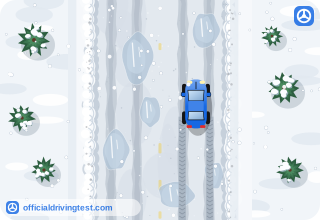
What should you do when your vehicle is equipped with anti-lock brakes and the road is slippery?
- Pump the brakes gently
- Release the brakes completely
- Tap the brakes in short, hard stabs
- Apply steady pressure to the brakes
Show answer
Correct answer: Apply steady pressure to the brakes
The manual says to pump the brakes gently unless the vehicle has anti-lock brakes, in which case you apply steady pressure to the brakes.
Source: Kentucky Driver Manual (Updated July 23, 2026), page 50 · Open this page in the manual (Manual page 50)
-
What is hydroplaning?
- The rear tires lock up and begin to slide on the dry roadway pavement
- The steering tires ride up on pooled water and do not contact the roadway surface
- The tires overheat and lose air on a hot road
- The wheels spin because the tires are worn smooth
Show answer
Correct answer: The steering tires ride up on pooled water and do not contact the roadway surface
Hydroplaning occurs when the steering tires start to ride up on pooled water, like the action of water skis. The tires are not contacting the actual roadway surface.
Source: Kentucky Driver Manual (Updated July 23, 2026), page 50 · Open this page in the manual (Manual page 50)
-
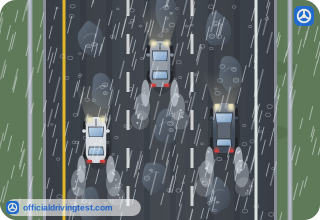
What is the best way to avoid traction loss from hydroplaning?
- Slow down in the rain or when the road has pooled water
- Brake as hard as you can when you see water
- Drive in the center of the lane to avoid puddles
- Keep your speed steady until the tires lose grip
Show answer
Correct answer: Slow down in the rain or when the road has pooled water
The manual says the best way to avoid traction loss from hydroplaning is to slow down in the rain or when the road is wet with pooled water or puddles.
Source: Kentucky Driver Manual (Updated July 23, 2026), page 50 · Open this page in the manual (Manual page 50)
-
Which tire condition helps you avoid traction loss from hydroplaning?
- Slightly low air pressure for a wider grip
- Smooth tread that touches more of the road
- Proper inflation and good tire tread
- Extra air pressure for faster water runoff
Show answer
Correct answer: Proper inflation and good tire tread
The manual says it is helpful to drive with properly-inflated tires with good tire tread.
Source: Kentucky Driver Manual (Updated July 23, 2026), page 50 · Open this page in the manual (Manual page 50)
-
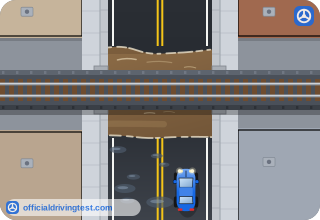
What should you do if you see a flooded roadway?
- Drive through slowly in a low gear
- Find another route to get to your destination
- Follow the vehicle ahead through the water
- Wait in the water until the level drops
Show answer
Correct answer: Find another route to get to your destination
The manual says not to drive through large bodies of standing water on a road. If a roadway is flooded, find another route.
Source: Kentucky Driver Manual (Updated July 23, 2026), page 50 · Open this page in the manual (Manual page 50)
-
Which three options does a driver have to avoid a crash or reduce its impact?
- Braking, honking, or signaling
- Steering, reversing, or flashing the lights
- Braking, steering, or accelerating
- Accelerating, honking, or stopping on the shoulder
Show answer
Correct answer: Braking, steering, or accelerating
The manual says the three options to avoid a crash or reduce its impact are braking, steering, or accelerating.
Source: Kentucky Driver Manual (Updated July 23, 2026), page 55 · Open this page in the manual (Manual page 55)
-
What is the first reaction for most drivers to avoid a crash?
- To stop the vehicle
- To steer around the problem
- To accelerate away from it
- To sound the horn
Show answer
Correct answer: To stop the vehicle
The first reaction for most drivers who want to avoid a crash is to stop the vehicle.
Source: Kentucky Driver Manual (Updated July 23, 2026), page 55 · Open this page in the manual (Manual page 55)
-
What does ABS (anti-lock braking system) allow you to do?
- Stop without pressing the brake pedal hard or for long
- Accelerate faster while braking on slippery pavement
- Skip checking the owner’s manual about braking
- Stop your vehicle without skidding and keep steering control
Show answer
Correct answer: Stop your vehicle without skidding and keep steering control
ABS lets you stop without skidding and keep steering control.
Source: Kentucky Driver Manual (Updated July 23, 2026), page 55 · Open this page in the manual (Manual page 55)
-
If your vehicle has ABS and you must stop in an emergency, how should you use the brake pedal?
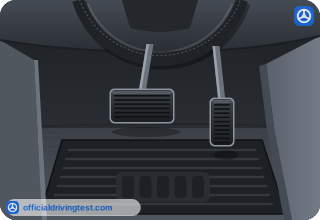
- Pump the pedal repeatedly until the vehicle stops
- Press as hard as you can and keep applying pressure
- Press lightly and release when the pedal vibrates
- Tap the pedal quickly and steer around the problem
Show answer
Correct answer: Press as hard as you can and keep applying pressure
With ABS you press the brake pedal as hard as you can and keep applying pressure, because ABS works only while you keep the pressure on.
Source: Kentucky Driver Manual (Updated July 23, 2026), page 55 · Open this page in the manual (Manual page 55)
-
While braking with ABS, you feel the brake pedal vibrate and hear a clicking noise. What does the manual say about this?
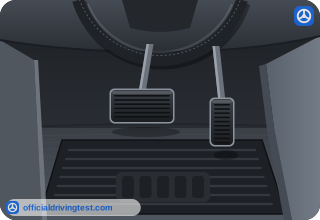
- The brakes are failing
- This is normal
- The ABS has switched itself off
- You should release the pedal at once
Show answer
Correct answer: This is normal
A vibrating pedal and a clicking noise are normal when ABS is working.
Source: Kentucky Driver Manual (Updated July 23, 2026), page 55 · Open this page in the manual (Manual page 55)
-
If your vehicle is not equipped with ABS, where does the manual tell you to look for the proper braking procedure?
- The Kentucky State Police
- The parking brake instructions
- A driver education school
- Your vehicle’s owner’s manual
Show answer
Correct answer: Your vehicle’s owner’s manual
The manual says to refer to the vehicle’s owner’s manual for the proper braking procedure when there is no ABS.
Source: Kentucky Driver Manual (Updated July 23, 2026), page 55 · Open this page in the manual (Manual page 55)
-
What is it called when you quickly steer around a problem to avoid a crash?
- Swerving
- Fishtailing
- Hydroplaning
- Lane splitting
Show answer
Correct answer: Swerving
Quickly steering around a problem is sometimes called swerving.
Source: Kentucky Driver Manual (Updated July 23, 2026), page 55 · Open this page in the manual (Manual page 55)
-
When quickly steering around a problem, what grip should you have on the steering wheel?
- A light grip with one hand
- A firm grip with the left hand only
- A good grip with both hands
- A loose grip so the wheel can turn freely
Show answer
Correct answer: A good grip with both hands
The manual says to make sure you have a good grip with both hands on the steering wheel.
Source: Kentucky Driver Manual (Updated July 23, 2026), page 55 · Open this page in the manual (Manual page 55)
-
When steering around a problem, which way should you steer?
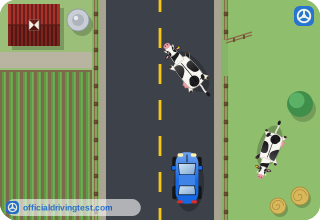
- In the direction opposite to where you want to go
- Toward the shoulder, whether or not other traffic is there
- Straight ahead, using only the brakes to avoid the problem
- In the direction you want to go, while trying to avoid other traffic
Show answer
Correct answer: In the direction you want to go, while trying to avoid other traffic
You steer in the direction you want to go but try to avoid other traffic.
Source: Kentucky Driver Manual (Updated July 23, 2026), page 55 · Open this page in the manual (Manual page 55)
-
After you have cleared the problem while swerving, what should you do with the steering?
- Keep steering the same way until the vehicle stops
- Steer in the opposite direction to straighten the vehicle
- Release the wheel and let the vehicle straighten itself
- Turn the wheel sharply again in the same direction
Show answer
Correct answer: Steer in the opposite direction to straighten the vehicle
After clearing the problem you steer in the opposite direction to straighten out, gain control, and start slowing.
Source: Kentucky Driver Manual (Updated July 23, 2026), page 55 · Open this page in the manual (Manual page 55)
-
When may you take one hand off the steering wheel?
- To use it for some other driving task
- Whenever the road ahead is straight
- When you are driving slowly in traffic
- When you have a good grip with the other hand
Show answer
Correct answer: To use it for some other driving task
Both hands should stay on the steering wheel at all times except to use one hand for some other driving task.
Source: Kentucky Driver Manual (Updated July 23, 2026), page 55 · Open this page in the manual (Manual page 55)
-
If an animal runs in front of your vehicle, what does the manual say you should do?
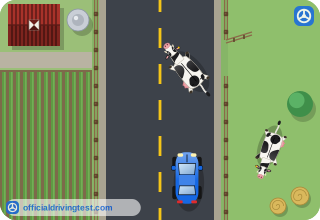
- Accelerate and drive past it quickly
- Hold your speed and sound the horn
- Brake and steer to miss the animal
- Brake hard and keep going straight
Show answer
Correct answer: Brake and steer to miss the animal
Using braking and steering together is a good way to avoid obstacles such as animals.
Source: Kentucky Driver Manual (Updated July 23, 2026), page 55 · Open this page in the manual (Manual page 55)
-
When may it be necessary to accelerate to avoid a crash?
- When another vehicle is about to hit you from behind or the side
- When a pedestrian suddenly steps into the road ahead of your vehicle
- When an animal runs in front of your vehicle on a rural road
- When you are approaching a stopped vehicle on a freeway
Show answer
Correct answer: When another vehicle is about to hit you from behind or the side
Accelerating may be necessary when another vehicle is about to hit you from behind or the side.
Source: Kentucky Driver Manual (Updated July 23, 2026), page 55 · Open this page in the manual (Manual page 55)
-
Which of these can cause a skid?
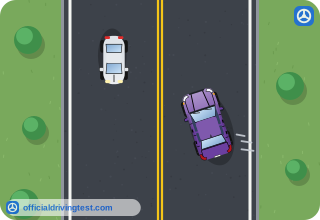
- Driving below the speed limit
- Using the parking brake gently
- Stopping too suddenly
- Keeping both hands on the wheel
Show answer
Correct answer: Stopping too suddenly
Skids are caused by traveling too fast for conditions, stopping too suddenly, or tires that can no longer grip the roadway.
Source: Kentucky Driver Manual (Updated July 23, 2026), page 55 · Open this page in the manual (Manual page 55)
-
How much control of your vehicle do you have when you begin to skid?
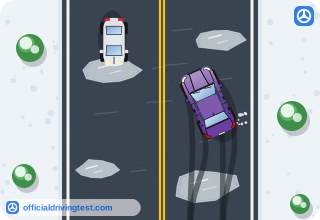
- Full control
- Little control
- Control of steering only
- Control of braking only
Show answer
Correct answer: Little control
When you begin to skid you have little control of your vehicle.
Source: Kentucky Driver Manual (Updated July 23, 2026), page 55 · Open this page in the manual (Manual page 55)
-
Which actions by a driver without skid-recovery skills make a skid worse?
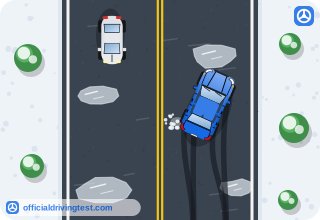
- Turning on the emergency flashers and sounding the horn
- Shifting to neutral and turning off the engine
- Moving to the shoulder and stopping the vehicle slowly
- Panicking, stomping on the brake, and overcorrecting
Show answer
Correct answer: Panicking, stomping on the brake, and overcorrecting
Drivers who panic, stomp on the brake, and overcorrect the steering only make a skid worse.
Source: Kentucky Driver Manual (Updated July 23, 2026), page 55 · Open this page in the manual (Manual page 55)
-
If your vehicle begins to skid, what does the manual say to do?
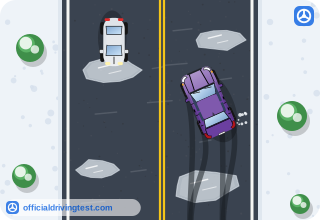
- Accelerate hard and look at the front of your vehicle
- Shift to neutral and look at the pavement beside you
- Release the brake or accelerator and look where you want to go
- Turn the wheel away from the skid and look behind you
Show answer
Correct answer: Release the brake or accelerator and look where you want to go
To regain control of a skid you release the brake or accelerator and look where you want to go.
Source: Kentucky Driver Manual (Updated July 23, 2026), page 56 · Open this page in the manual (Manual page 56)
-
If you are skidding in a straight line and your vehicle has anti-lock brakes, what should you do with the brake?
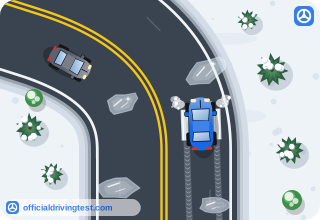
- Apply consistent pressure to slow the vehicle
- Pump the brake gently to slow the vehicle
- Leave the brake alone and use only the accelerator
- Stomp on it and turn the wheel sharply
Show answer
Correct answer: Apply consistent pressure to slow the vehicle
With anti-lock brakes in a straight-line skid you apply consistent pressure to the brake to slow the vehicle.
Source: Kentucky Driver Manual (Updated July 23, 2026), page 56 · Open this page in the manual (Manual page 56)
-
If your vehicle does not have anti-lock brakes and begins to skid, how should you slow it?
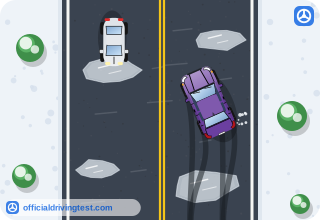
- By braking as hard as possible
- By applying steady full pressure to the pedal
- By turning off the engine
- By pumping the brakes gently
Show answer
Correct answer: By pumping the brakes gently
Without anti-lock you do not brake hard, because that locks the wheels and makes the skid worse; you pump the brakes gently instead.
Source: Kentucky Driver Manual (Updated July 23, 2026), page 56 · Open this page in the manual (Manual page 56)
-
If your vehicle begins to skid sideways, which way should you turn the wheel?
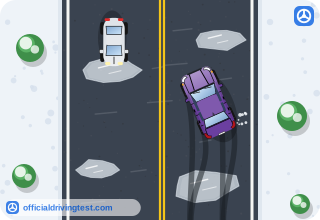
- Away from the direction the back is skidding
- In the direction the back of the vehicle is skidding
- Toward the nearest edge of the road
- Straight ahead and hold it still
Show answer
Correct answer: In the direction the back of the vehicle is skidding
Turning the wheel in the direction the back is skidding lets the front of the vehicle line up with the back.
Source: Kentucky Driver Manual (Updated July 23, 2026), page 56 · Open this page in the manual (Manual page 56)
-
As soon as the vehicle begins to straighten out of a skid, what should you do with the steering wheel?
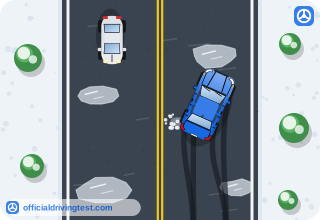
- Hold it in the same position until the vehicle comes to a stop
- Turn it back to prevent skidding in the opposite direction
- Turn it further in the same direction to complete the correction
- Let go of it so the vehicle can straighten out by itself
Show answer
Correct answer: Turn it back to prevent skidding in the opposite direction
As the vehicle straightens you turn the wheel back so it does not skid in the opposite direction.
Source: Kentucky Driver Manual (Updated July 23, 2026), page 56 · Open this page in the manual (Manual page 56)
-
Which vehicle control is the most important to use during a skid?
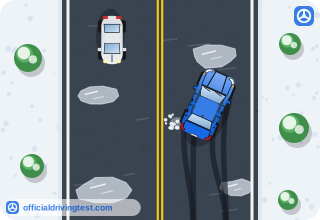
- The brake pedal
- The accelerator
- The parking brake
- The steering wheel
Show answer
Correct answer: The steering wheel
The manual calls the steering wheel the most important vehicle control to use during a skid.
Source: Kentucky Driver Manual (Updated July 23, 2026), page 56 · Open this page in the manual (Manual page 56)
-
How long should you continue to correct your steering during a skid?
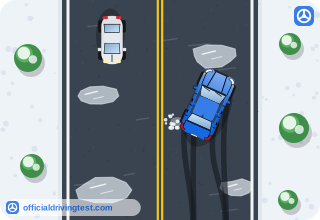
- Left and right, until you recover completely from the skid
- Once, then hold the wheel straight until you stop
- Until you have released the brake pedal
- Until the vehicle has slowed below 25 miles per hour
Show answer
Correct answer: Left and right, until you recover completely from the skid
You keep correcting the steering, left and right, until you have recovered completely from the skid.
Source: Kentucky Driver Manual (Updated July 23, 2026), page 56 · Open this page in the manual (Manual page 56)
-
If your vehicle leaves the paved road, what does the manual say to do?
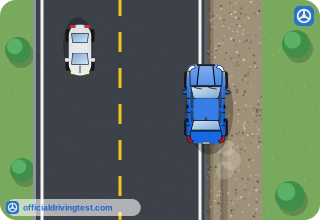
- Brake hard right away and stop on the roadside
- Speed up so you can return to the pavement quickly
- Slow down gradually and turn quickly back onto the pavement
- Hold the wheel straight and keep driving beside the road
Show answer
Correct answer: Slow down gradually and turn quickly back onto the pavement
You slow down gradually, when safe to do so, and turn quickly back onto the pavement, avoiding panic steering.
Source: Kentucky Driver Manual (Updated July 23, 2026), page 56 · Open this page in the manual (Manual page 56)
-
If you are involved in a collision, where should you stop your vehicle?
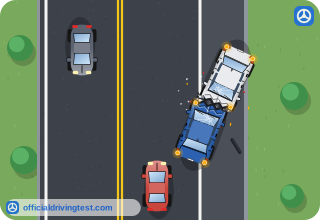
- At the next exit or the next safe parking area
- At your destination, then call the police
- On the opposite side of the road from the scene
- At or near the collision scene
Show answer
Correct answer: At or near the collision scene
The manual says to stop your vehicle at or near the collision scene.
Source: Kentucky Driver Manual (Updated July 23, 2026), page 56 · Open this page in the manual (Manual page 56)
-
After a collision, how long should you remain with your vehicle?
- Until the other driver has driven away from the collision scene
- Until the officer arrives and has questioned everyone involved
- Until you have exchanged insurance information with every driver
- For at least thirty minutes after the collision has occurred
Show answer
Correct answer: Until the officer arrives and has questioned everyone involved
You remain with the vehicle until the law enforcement officer arrives and has questioned everyone involved.
Source: Kentucky Driver Manual (Updated July 23, 2026), page 56 · Open this page in the manual (Manual page 56)
-
According to Kentucky law, what should you do with the damaged vehicles after a non-injury accident?
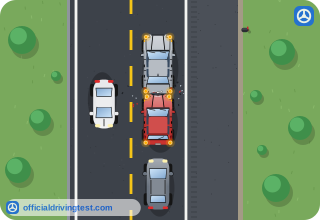
- Move them to the shoulder of the roadway
- Leave them where they stopped until police arrive
- Move them to the nearest parking lot
- Leave them in the lane and turn on the emergency flashers
Show answer
Correct answer: Move them to the shoulder of the roadway
Kentucky law says that in a non-injury accident the damaged vehicles are moved to the shoulder of the roadway.
Source: Kentucky Driver Manual (Updated July 23, 2026), page 56 · Open this page in the manual (Manual page 56)
-
Whose names and addresses should you get after a collision?
- Only the other drivers involved
- Only people who were injured
- All people involved in the collision and any witnesses
- The other driver and the officer who responds
Show answer
Correct answer: All people involved in the collision and any witnesses
You get the names and addresses of all people involved in the collision and any witnesses.
Source: Kentucky Driver Manual (Updated July 23, 2026), page 56 · Open this page in the manual (Manual page 56)
-
Which of these should you record about any other operator after a collision?
- Driver license number
- Home telephone number
- Employer’s name
- Date of birth
Show answer
Correct answer: Driver license number
The manual lists the other operator’s name, address, and driver license number to record.
Source: Kentucky Driver Manual (Updated July 23, 2026), page 56 · Open this page in the manual (Manual page 56)
-
What information about the vehicles should you record after a collision?
- Color, mileage, purchase price, and lienholder
- Registration date, tire size, color, and mileage
- License plate number, VIN, make, model, and year
- Odometer reading, fuel level, color, and year of purchase
Show answer
Correct answer: License plate number, VIN, make, model, and year
You record the license plate number, VIN, make, model, and year of all vehicles involved.
Source: Kentucky Driver Manual (Updated July 23, 2026), page 56 · Open this page in the manual (Manual page 56)
-
What information should you record about the insurance for each vehicle?
- Policy premium and renewal date
- Company name and telephone number
- Coverage limits and agent’s address
- Policy number and starting date
Show answer
Correct answer: Company name and telephone number
You record the insurance company name and telephone number for each vehicle.
Source: Kentucky Driver Manual (Updated July 23, 2026), page 56 · Open this page in the manual (Manual page 56)
-
How should you record any damage to the vehicles after a collision?
- By asking the other driver to write an estimate
- By describing the damage to the first officer who arrives
- By having a tow truck driver sign a damage form
- By making a list of damages and taking photographs
Show answer
Correct answer: By making a list of damages and taking photographs
You record damage by making a list of damages and taking photographs.
Source: Kentucky Driver Manual (Updated July 23, 2026), page 56 · Open this page in the manual (Manual page 56)
-
What does the manual say to record about what happened in a collision?
- Only what happened in the minutes after the collision
- Only what the other driver says happened afterward
- Exactly what happened immediately before and after the collision
- What the witnesses believe caused it, not what you saw
Show answer
Correct answer: Exactly what happened immediately before and after the collision
You record exactly what happened immediately before and after the collision.
Source: Kentucky Driver Manual (Updated July 23, 2026), page 56 · Open this page in the manual (Manual page 56)
-
If a collision involves a parked vehicle and you cannot find its owner, what should you do?
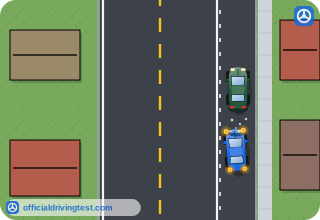
- Leave a note where it can be seen
- Wait beside the parked vehicle until the owner returns
- Drive away and tell the police the next day
- Move the parked vehicle to the shoulder yourself
Show answer
Correct answer: Leave a note where it can be seen
You first try to locate the owner, and if you cannot, you leave a note where it can be seen.
Source: Kentucky Driver Manual (Updated July 23, 2026), page 56 · Open this page in the manual (Manual page 56)
-
Which of these should the note you leave on a parked vehicle include?
- Your insurance policy number
- Your date of birth
- Your home telephone number
- Date and time of the collision
Show answer
Correct answer: Date and time of the collision
The note should hold your name, address, driver license number, license plate number, and the date and time of the collision.
Source: Kentucky Driver Manual (Updated July 23, 2026), page 56 · Open this page in the manual (Manual page 56)
-
A collision with property damage exceeding what amount, with no law enforcement investigation, requires you to file a written report?
- $250
- $500
- $1,000
- $2,500
Show answer
Correct answer: $500
A written report is required for property damage exceeding $500 when no law enforcement officer investigates.
Source: Kentucky Driver Manual (Updated July 23, 2026), page 56 · Open this page in the manual (Manual page 56)
-
Within how many days of the collision must the written report be filed when property damage exceeds the stated amount and no officer investigated?
- Three days
- Ten days
- Thirty days
- Sixty days
Show answer
Correct answer: Ten days
The written report must be filed within ten (10) days of the collision.
Source: Kentucky Driver Manual (Updated July 23, 2026), page 56 · Open this page in the manual (Manual page 56)
-
With which agency must a written report of such a collision be filed?
- Kentucky Transportation Cabinet
- The county clerk’s office
- Your insurance company
- Kentucky State Police
Show answer
Correct answer: Kentucky State Police
The written report of the accident is filed with the Kentucky State Police.
Source: Kentucky Driver Manual (Updated July 23, 2026), page 56 · Open this page in the manual (Manual page 56)
-
When should you not complete a civilian collision report?
- When an officer investigated the collision
- When no one was injured in the collision
- When the other driver has insurance coverage
- When only one vehicle was involved
Show answer
Correct answer: When an officer investigated the collision
The manual says not to complete a civilian collision report if a law enforcement officer investigated the collision.
Source: Kentucky Driver Manual (Updated July 23, 2026), page 57 · Open this page in the manual (Manual page 57)
-
If possible, whom should you call to help collision victims?
- Only your insurance company
- A tow truck company and your insurance company
- Emergency medical personnel and law enforcement
- A family member and then law enforcement
Show answer
Correct answer: Emergency medical personnel and law enforcement
The manual says to call emergency medical personnel and notify law enforcement if possible.
Source: Kentucky Driver Manual (Updated July 23, 2026), page 57 · Open this page in the manual (Manual page 57)
-
When calling for help after a collision, what should you clearly and correctly state?
- The names of every witness
- Your driver license number
- The cause of the collision
- The place of the accident
Show answer
Correct answer: The place of the accident
You state the place of the accident clearly so emergency personnel and law enforcement can locate you easily.
Source: Kentucky Driver Manual (Updated July 23, 2026), page 57 · Open this page in the manual (Manual page 57)
-
When should you attempt to remove an individual from a collision?
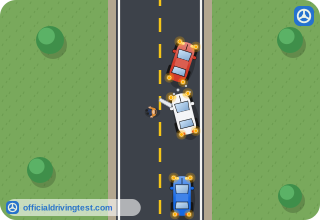
- Whenever the person asks you to
- Only in life-threatening emergencies
- As soon as you reach the scene
- Only after the vehicle has been moved to the shoulder
Show answer
Correct answer: Only in life-threatening emergencies
Only in life-threatening emergencies should you try to remove a person from a collision.
Source: Kentucky Driver Manual (Updated July 23, 2026), page 57 · Open this page in the manual (Manual page 57)
-
If possible, what should you do rather than attempting to remove an injured person from a collision?
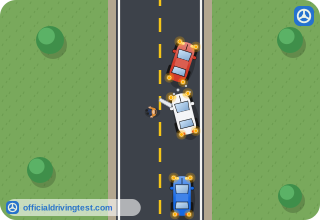
- Wait for an Emergency Medical Technician or ambulance
- Leave the scene to look for a doctor nearby
- Help the person walk to the shoulder of the roadway
- Move the person to a safer place near the roadside
Show answer
Correct answer: Wait for an Emergency Medical Technician or ambulance
If possible you wait for an Emergency Medical Technician or ambulance instead of removing the person.
Source: Kentucky Driver Manual (Updated July 23, 2026), page 57 · Open this page in the manual (Manual page 57)
-
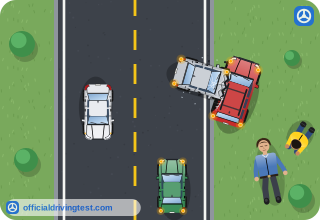
How can you keep a collision victim warm?
- By moving them into your vehicle with the heater on
- By having them stand up and walk to the shoulder
- By covering them with a blanket or coat if necessary
- By lighting a flare beside them
Show answer
Correct answer: By covering them with a blanket or coat if necessary
The manual says to keep the victim warm by covering them with a blanket or coat if necessary.
Source: Kentucky Driver Manual (Updated July 23, 2026), page 57 · Open this page in the manual (Manual page 57)
-
What must the operator of any vehicle involved in a collision do immediately, according to Kentucky law?
- Stop and ascertain the extent of injury or damage
- Move to a safe place and call the insurance company
- Exchange phone numbers and continue driving if damage is minor
- Report to the Transportation Cabinet in person
Show answer
Correct answer: Stop and ascertain the extent of injury or damage
Kentucky law requires the operator to immediately stop and ascertain the extent of any injury or damage and render reasonable assistance.
Source: Kentucky Driver Manual (Updated July 23, 2026), page 57 · Open this page in the manual (Manual page 57)
-
What kind of assistance does Kentucky law require the operator of a vehicle involved in a collision to render?
- Financial assistance
- Towing assistance
- Reasonable assistance
- Legal assistance
Show answer
Correct answer: Reasonable assistance
The operator must stop, ascertain the extent of any injury or damage, and render reasonable assistance.
Source: Kentucky Driver Manual (Updated July 23, 2026), page 57 · Open this page in the manual (Manual page 57)
-
Which of these is an example of reasonable assistance after a collision?
- Paying for the medical treatment of any injured person at the scene
- Arranging for an injured person to be carried to medical treatment
- Giving the injured person your insurance policy and driving away
- Staying at the scene only if someone asks you to remain
Show answer
Correct answer: Arranging for an injured person to be carried to medical treatment
Reasonable assistance may include carrying, or arranging for the carrying of, an injured person to receive medical treatment if it is apparent it is necessary or if requested.
Source: Kentucky Driver Manual (Updated July 23, 2026), page 57 · Open this page in the manual (Manual page 57)
-
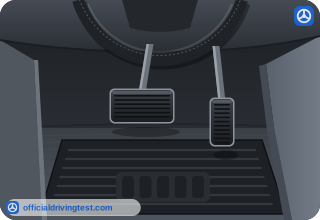
If your brakes stop working while driving, what should you try first?
- Shift into park
- Shift into reverse to slow the vehicle
- Pump the accelerator to slow the vehicle
- Slowly use the parking brake
Show answer
Correct answer: Slowly use the parking brake
The first step after brake failure is to use the parking brake, slowly.
Source: Kentucky Driver Manual (Updated July 23, 2026), page 57 · Open this page in the manual (Manual page 57)
-
Why should you pull or push the parking brake slowly when your brakes fail?
- So the brake fluid has time to flow back to the pedal
- So you do not lock the rear wheels and cause a skid
- So the engine does not stall while the car slows down
- So the parking brake cable does not wear out quickly
Show answer
Correct answer: So you do not lock the rear wheels and cause a skid
Applying the parking brake slowly keeps the rear wheels from locking and causing a skid.
Source: Kentucky Driver Manual (Updated July 23, 2026), page 57 · Open this page in the manual (Manual page 57)
-
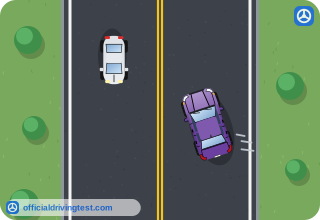
When using the parking brake after brake failure, what should you be ready to do if the vehicle starts to skid?
- Pull the brake harder
- Release the brake
- Shift into reverse
- Press the accelerator
Show answer
Correct answer: Release the brake
You should be ready to release the parking brake if the vehicle does start to skid.
Source: Kentucky Driver Manual (Updated July 23, 2026), page 57 · Open this page in the manual (Manual page 57)
-
If using the parking brake does not work when your brakes fail, what should you do?
- Shift into reverse and slow to a stop in the roadway
- Keep driving to the nearest repair shop at low speed
- Pump the accelerator and keep going to the next exit
- Turn off the engine and look for a safe place to stop
Show answer
Correct answer: Turn off the engine and look for a safe place to stop
If the parking brake does not work, you turn off the engine and look for a safe place to slow to a stop.
Source: Kentucky Driver Manual (Updated July 23, 2026), page 57 · Open this page in the manual (Manual page 57)
-
After your brakes fail and you stop, where must the vehicle be?
- Off the roadway
- In the right lane
- In the left lane
- On the center line
Show answer
Correct answer: Off the roadway
The manual says to make sure the vehicle is off the roadway and not to keep driving without working brakes.
Source: Kentucky Driver Manual (Updated July 23, 2026), page 57 · Open this page in the manual (Manual page 57)
-
What is a tire blowout?
- A slow leak that lowers tire pressure over several days
- A worn tread that makes the tire lose grip
- A rapid deflation of air from the tire
- A tire that has been overinflated for a long time
Show answer
Correct answer: A rapid deflation of air from the tire
The manual defines a tire blowout as a rapid deflation of air from the tire.
Source: Kentucky Driver Manual (Updated July 23, 2026), page 57 · Open this page in the manual (Manual page 57)
-
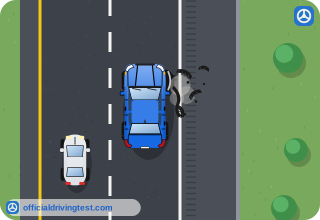
What happens when a front tire blows out?
- The vehicle wobbles and shakes but does not pull
- The vehicle pulls sharply away from the blowout
- The vehicle speeds up until the driver brakes
- The vehicle pulls sharply in the direction of the blowout
Show answer
Correct answer: The vehicle pulls sharply in the direction of the blowout
If a front tire blows out, the vehicle pulls sharply in the direction of the blowout.
Source: Kentucky Driver Manual (Updated July 23, 2026), page 57 · Open this page in the manual (Manual page 57)
-
What happens when a rear tire blows out?
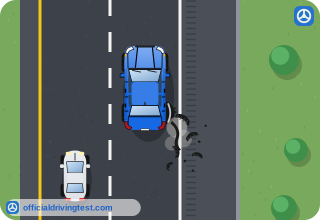
- It pulls sharply toward the side of the blowout
- It wobbles, shakes, and pulls some toward the blowout
- It pulls sharply away from the blowout side
- It drifts straight ahead with no change in handling
Show answer
Correct answer: It wobbles, shakes, and pulls some toward the blowout
If a rear tire blows out, the vehicle wobbles, shakes, and pulls some in the direction of the blowout.
Source: Kentucky Driver Manual (Updated July 23, 2026), page 57 · Open this page in the manual (Manual page 57)
-
If a tire blows out or suddenly goes flat, what should you do with the steering wheel?
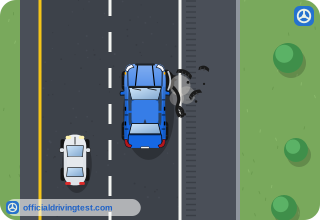
- Grip it firmly and keep the vehicle going straight
- Turn it sharply toward the shoulder right away
- Hold it loosely and let the vehicle follow the tire
- Turn it away from the side of the blowout
Show answer
Correct answer: Grip it firmly and keep the vehicle going straight
After a blowout you grip the steering wheel firmly and keep the vehicle going straight.
Source: Kentucky Driver Manual (Updated July 23, 2026), page 57 · Open this page in the manual (Manual page 57)
-
After a tire blowout, what should you do about your speed?
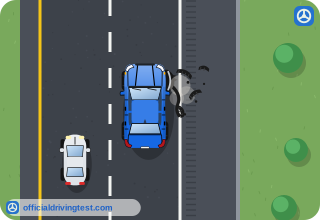
- Brake as hard as you can to stop the vehicle quickly
- Accelerate gently so the vehicle keeps its straight path
- Slow down gradually by taking your foot off the accelerator
- Hold your speed steady until you reach the next exit ramp
Show answer
Correct answer: Slow down gradually by taking your foot off the accelerator
You slow down gradually and take your foot off the accelerator pedal.
Source: Kentucky Driver Manual (Updated July 23, 2026), page 57 · Open this page in the manual (Manual page 57)
-
After a tire blowout, how should you use the brakes?
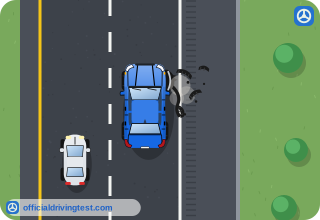
- Avoid braking, or brake gently only if necessary
- Brake firmly to bring the vehicle to a stop as soon as possible
- Brake hard once, then release and steer
- Pump the brakes quickly several times
Show answer
Correct answer: Avoid braking, or brake gently only if necessary
The manual says not to brake, but to let the vehicle slow by itself or brake gently if necessary.
Source: Kentucky Driver Manual (Updated July 23, 2026), page 57 · Open this page in the manual (Manual page 57)
-
After a tire blowout, where should you stop if at all possible?
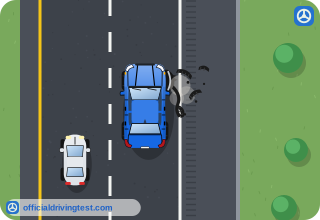
- In the nearest traffic lane, with emergency flashers on
- In the middle of the road so other drivers can see you
- Off the road, in a safe place, with emergency flashers on
- On the left shoulder, with the emergency flashers off
Show answer
Correct answer: Off the road, in a safe place, with emergency flashers on
You should not stop on the road if at all possible; you pull off in a safe place and turn on the emergency flashers.
Source: Kentucky Driver Manual (Updated July 23, 2026), page 58 · Open this page in the manual (Manual page 58)
-
If the engine shuts off while you are driving, what should you know about the steering wheel?
- It locks in place until you shift into neutral
- It may be difficult to turn, but you can turn it
- It turns more easily than usual
- It can be turned only after you brake hard
Show answer
Correct answer: It may be difficult to turn, but you can turn it
When the engine shuts off, the steering wheel may be difficult to turn, but you can still turn it.
Source: Kentucky Driver Manual (Updated July 23, 2026), page 58 · Open this page in the manual (Manual page 58)
-
If the engine shuts off while you are driving, how should you brake?
- Hard, in one motion, to stop quickly
- By pumping the pedal rapidly
- Not at all, until the vehicle stops by itself
- With steady pressure on the pedal, not hard
Show answer
Correct answer: With steady pressure on the pedal, not hard
After a power failure you do not brake hard; you brake with steady pressure, slow down, and pull off the roadway.
Source: Kentucky Driver Manual (Updated July 23, 2026), page 58 · Open this page in the manual (Manual page 58)
-
If the engine shuts off and you cannot restart it, what should you do?
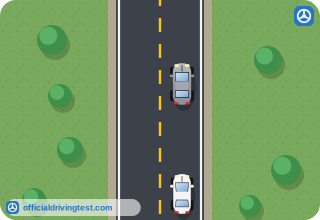
- Keep trying to restart it while rolling in the lane
- Leave the vehicle in the lane and walk to find help
- Raise the hood, turn on the flashers, and call for help
- Coast to a stop and wait for another driver to pass
Show answer
Correct answer: Raise the hood, turn on the flashers, and call for help
If restarting is unsuccessful, you raise the hood, turn on the emergency flashers, and call for help.
Source: Kentucky Driver Manual (Updated July 23, 2026), page 58 · Open this page in the manual (Manual page 58)
-
If your vehicle is accelerating out of control, which gear should you shift to?
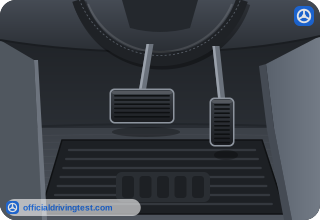
- Neutral
- Park
- Reverse
- Low
Show answer
Correct answer: Neutral
For a stuck accelerator the manual says to shift to neutral and search for an escape path.
Source: Kentucky Driver Manual (Updated July 23, 2026), page 58 · Open this page in the manual (Manual page 58)
-
If your vehicle is accelerating out of control, what should you do with the engine?
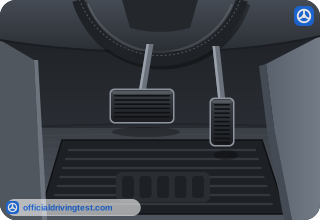
- Keep it running
- Rev it higher
- Keep it idling
- Turn it off
Show answer
Correct answer: Turn it off
The first step for a vehicle accelerating out of control is to turn off the engine.
Source: Kentucky Driver Manual (Updated July 23, 2026), page 58 · Open this page in the manual (Manual page 58)
-
With a stuck accelerator, how should you steer and brake?
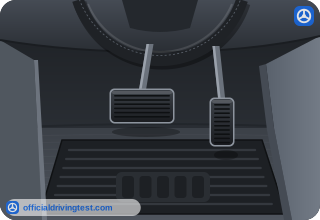
- Steer sharply, brake hard, and stop in the lane
- Steer smoothly, brake gently, and pull off the roadway
- Steer straight, do not brake, and coast to a stop
- Steer sharply, brake gently, and stop where you are
Show answer
Correct answer: Steer smoothly, brake gently, and pull off the roadway
You steer smoothly, brake gently, and pull off the roadway.
Source: Kentucky Driver Manual (Updated July 23, 2026), page 58 · Open this page in the manual (Manual page 58)
-
What must be done about a stuck accelerator pedal before you drive again?
- It can be left as is once the engine restarts
- It must be repaired at a service center
- It should be tested on a quiet road first
- It only needs repair if the problem happens twice
Show answer
Correct answer: It must be repaired at a service center
The pedal must be repaired at a service center before driving again.
Source: Kentucky Driver Manual (Updated July 23, 2026), page 58 · Open this page in the manual (Manual page 58)
-
Why do crashes often occur involving a disabled vehicle?
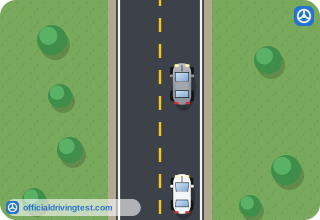
- The driver of the disabled vehicle is not wearing a seat belt
- Disabled vehicles are usually parked on the left side
- Drivers following it are not using their headlights
- A driver does not see it until it is too late to stop
Show answer
Correct answer: A driver does not see it until it is too late to stop
Crashes often occur because a driver does not see a disabled vehicle until it is too late to stop.
Source: Kentucky Driver Manual (Updated July 23, 2026), page 58 · Open this page in the manual (Manual page 58)
-
When your vehicle breaks down on the highway, where should you pull if possible?
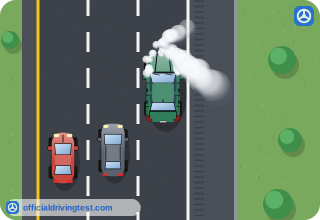
- Completely off the road, to the right side
- Onto the left shoulder, facing traffic
- Just over a hill so others see your lights
- Into the right lane, as far right as you can
Show answer
Correct answer: Completely off the road, to the right side
You pull completely off the road, to the right side of the road if possible.
Source: Kentucky Driver Manual (Updated July 23, 2026), page 58 · Open this page in the manual (Manual page 58)
-
If you cannot get completely off the roadway, what should you try to do?
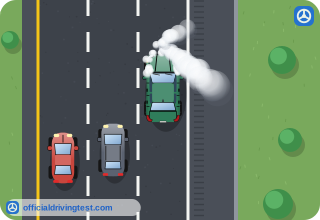
- Stop in the middle of the lane so others slow down
- Keep driving until you reach a repair shop
- Stop where your vehicle can be seen from a distance
- Stop right in front of a curve to stay visible
Show answer
Correct answer: Stop where your vehicle can be seen from a distance
If you cannot get off the roadway, you try to stop where your vehicle can be seen from a distance.
Source: Kentucky Driver Manual (Updated July 23, 2026), page 58 · Open this page in the manual (Manual page 58)
-
Which place does the manual say you should NOT stop a disabled vehicle?
- On a straight section where drivers can see you from far away
- Completely off the road on the right side
- Off the road at a place visible from a long way back
- Just over a hill or just around a curve
Show answer
Correct answer: Just over a hill or just around a curve
The manual says not to stop just over a hill or just around a curve.
Source: Kentucky Driver Manual (Updated July 23, 2026), page 58 · Open this page in the manual (Manual page 58)
-
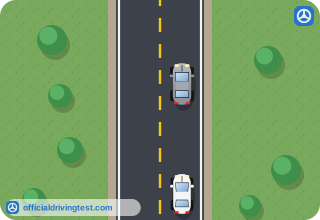
When your vehicle breaks down, why should you turn on your emergency flashers?
- To show that you are about to pull into traffic
- To show that your vehicle is disabled
- To signal that you want other drivers to pass
- To save the battery while the engine is off
Show answer
Correct answer: To show that your vehicle is disabled
Emergency flashers show other drivers that your vehicle is disabled.
Source: Kentucky Driver Manual (Updated July 23, 2026), page 58 · Open this page in the manual (Manual page 58)
-
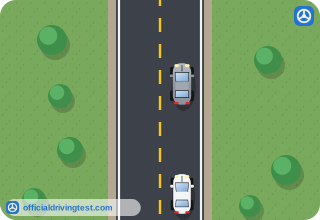
When your vehicle breaks down, what does lifting the hood show other drivers?
- That you need assistance
- That the engine has overheated
- That the battery has died
- That a tire has blown out
Show answer
Correct answer: That you need assistance
Lifting the hood shows other drivers you need assistance.
Source: Kentucky Driver Manual (Updated July 23, 2026), page 58 · Open this page in the manual (Manual page 58)
-
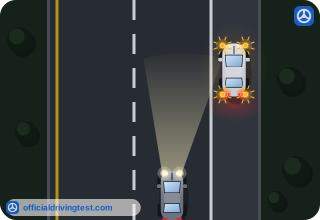
How far behind a disabled vehicle should you place emergency flares?
- About 50 to 100 feet
- About 400 to 500 feet
- About 200 to 300 feet
- About 600 to 700 feet
Show answer
Correct answer: About 200 to 300 feet
Flares are placed about 200 to 300 feet behind the vehicle to give other drivers time to change lanes.
Source: Kentucky Driver Manual (Updated July 23, 2026), page 58 · Open this page in the manual (Manual page 58)
-
If available, what should you use to notify authorities that a vehicle has broken down?
- A cell phone or other device
- Your horn and headlights
- Your emergency flashers
- Your parking lights
Show answer
Correct answer: A cell phone or other device
The manual says to use your cell phone or other device, if available, to notify authorities of a breakdown.
Source: Kentucky Driver Manual (Updated July 23, 2026), page 58 · Open this page in the manual (Manual page 58)
-
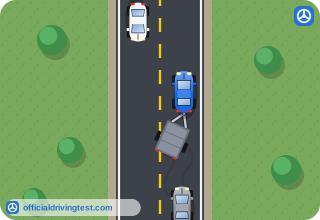
What should you do if your trailer begins to sway or whip?
- Apply the brakes firmly and steer toward the shoulder
- Increase speed slightly to pull the trailer straight
- Steer straight and slow gradually without braking
- Turn the wheel sharply in the direction of the sway
Show answer
Correct answer: Steer straight and slow gradually without braking
When a trailer sways or whips you steer straight and reduce speed gradually without applying the brakes, and never increase speed.
Source: Kentucky Driver Manual (Updated July 23, 2026), page 71 · Open this page in the manual (Manual page 71)
-
After a trailer begins to sway or whip, when should you stop?
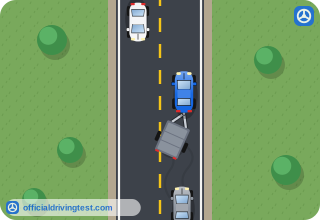
- As soon as you can safely get completely off the roadway
- Only after you reach the next rest area
- Only when the swaying becomes worse
- After you have driven another mile at reduced speed
Show answer
Correct answer: As soon as you can safely get completely off the roadway
After a trailer sways you should stop as soon as you can safely get completely off the roadway.
Source: Kentucky Driver Manual (Updated July 23, 2026), page 71 · Open this page in the manual (Manual page 71)
-
After stopping a swaying trailer, what should you check first?
- That the cargo is loaded heavier in the front
- The air pressure in each of the trailer tires
- That the safety chains are attached
- That the trailer lights work
Show answer
Correct answer: That the cargo is loaded heavier in the front
The manual says to check the cargo first to be sure the trailer is loaded heavier in front, and to reload if necessary.
Source: Kentucky Driver Manual (Updated July 23, 2026), page 71 · Open this page in the manual (Manual page 71)
-
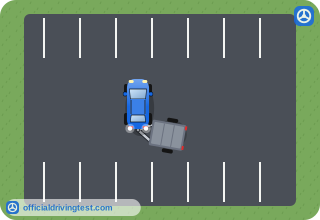
If the trailer starts to jackknife while you are backing up, what should you do?
- Back up faster to straighten it
- Turn the wheel sharply the other way and keep backing
- Set the parking brake and get out
- Stop and pull ahead to straighten out, then start again
Show answer
Correct answer: Stop and pull ahead to straighten out, then start again
If the trailer starts to jackknife, you stop, pull ahead to straighten out, and then start again.
Source: Kentucky Driver Manual (Updated July 23, 2026), page 71 · Open this page in the manual (Manual page 71)
-
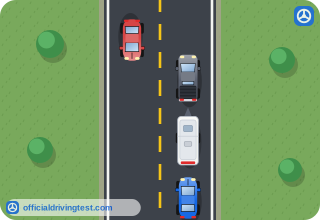
If, while driving with a trailer, you hear an unusual noise or suspect trouble, what should you do?
- Slow down and keep driving to the next exit
- Continue until the next fuel stop
- Stop at a safe place off the roadway to check
- Speed up to see if the noise goes away
Show answer
Correct answer: Stop at a safe place off the roadway to check
You should stop at a safe place off the roadway to check on the problem.
Source: Kentucky Driver Manual (Updated July 23, 2026), page 71 · Open this page in the manual (Manual page 71)