Kentucky: Emergencies — Part 5 Practice Test
Questions in this part include: “What must be done about a stuck accelerator pedal before you drive again?” · “If available, what should you use to notify authorities that a vehicle has broken down?”
Independent educational site · not affiliated with any government agency or DMV
Ready? Test yourself
- Instant feedback with an explanation
- Every answer cites its source in the manual
- Your best score is saved on this device
Questions are original and based on the official manual "Kentucky Driver Manual" (Updated July 23, 2026), Kentucky State Police.
All 16 questions in this practice test
Take the test above first, then use this list to study. Tap “Show answer” to see the correct answer and explanation.
Show the questions and answersHide the questions
-
If your vehicle is accelerating out of control, what should you do with the engine?
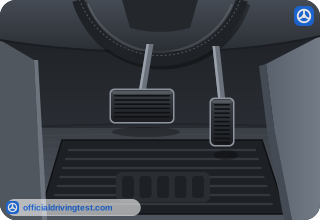
- Keep it running
- Rev it higher
- Keep it idling
- Turn it off
Show answer
Correct answer: Turn it off
The first step for a vehicle accelerating out of control is to turn off the engine.
Source: Kentucky Driver Manual (Updated July 23, 2026), page 58 · Open this page in the manual (Manual page 58)
-
With a stuck accelerator, how should you steer and brake?
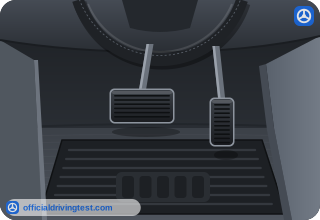
- Steer sharply, brake hard, and stop in the lane
- Steer smoothly, brake gently, and pull off the roadway
- Steer straight, do not brake, and coast to a stop
- Steer sharply, brake gently, and stop where you are
Show answer
Correct answer: Steer smoothly, brake gently, and pull off the roadway
You steer smoothly, brake gently, and pull off the roadway.
Source: Kentucky Driver Manual (Updated July 23, 2026), page 58 · Open this page in the manual (Manual page 58)
-
What must be done about a stuck accelerator pedal before you drive again?
- It can be left as is once the engine restarts
- It must be repaired at a service center
- It should be tested on a quiet road first
- It only needs repair if the problem happens twice
Show answer
Correct answer: It must be repaired at a service center
The pedal must be repaired at a service center before driving again.
Source: Kentucky Driver Manual (Updated July 23, 2026), page 58 · Open this page in the manual (Manual page 58)
-
Why do crashes often occur involving a disabled vehicle?
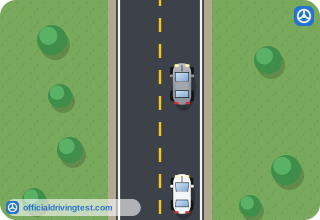
- The driver of the disabled vehicle is not wearing a seat belt
- Disabled vehicles are usually parked on the left side
- Drivers following it are not using their headlights
- A driver does not see it until it is too late to stop
Show answer
Correct answer: A driver does not see it until it is too late to stop
Crashes often occur because a driver does not see a disabled vehicle until it is too late to stop.
Source: Kentucky Driver Manual (Updated July 23, 2026), page 58 · Open this page in the manual (Manual page 58)
-
When your vehicle breaks down on the highway, where should you pull if possible?
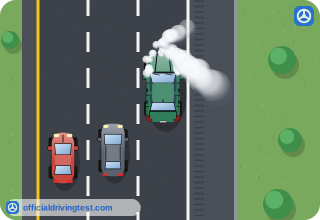
- Completely off the road, to the right side
- Onto the left shoulder, facing traffic
- Just over a hill so others see your lights
- Into the right lane, as far right as you can
Show answer
Correct answer: Completely off the road, to the right side
You pull completely off the road, to the right side of the road if possible.
Source: Kentucky Driver Manual (Updated July 23, 2026), page 58 · Open this page in the manual (Manual page 58)
-
If you cannot get completely off the roadway, what should you try to do?
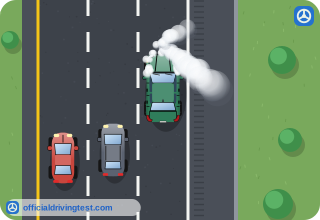
- Stop in the middle of the lane so others slow down
- Keep driving until you reach a repair shop
- Stop where your vehicle can be seen from a distance
- Stop right in front of a curve to stay visible
Show answer
Correct answer: Stop where your vehicle can be seen from a distance
If you cannot get off the roadway, you try to stop where your vehicle can be seen from a distance.
Source: Kentucky Driver Manual (Updated July 23, 2026), page 58 · Open this page in the manual (Manual page 58)
-
Which place does the manual say you should NOT stop a disabled vehicle?
- On a straight section where drivers can see you from far away
- Completely off the road on the right side
- Off the road at a place visible from a long way back
- Just over a hill or just around a curve
Show answer
Correct answer: Just over a hill or just around a curve
The manual says not to stop just over a hill or just around a curve.
Source: Kentucky Driver Manual (Updated July 23, 2026), page 58 · Open this page in the manual (Manual page 58)
-
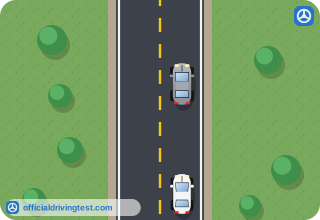
When your vehicle breaks down, why should you turn on your emergency flashers?
- To show that you are about to pull into traffic
- To show that your vehicle is disabled
- To signal that you want other drivers to pass
- To save the battery while the engine is off
Show answer
Correct answer: To show that your vehicle is disabled
Emergency flashers show other drivers that your vehicle is disabled.
Source: Kentucky Driver Manual (Updated July 23, 2026), page 58 · Open this page in the manual (Manual page 58)
-
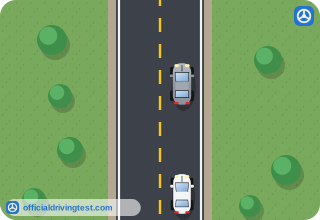
When your vehicle breaks down, what does lifting the hood show other drivers?
- That you need assistance
- That the engine has overheated
- That the battery has died
- That a tire has blown out
Show answer
Correct answer: That you need assistance
Lifting the hood shows other drivers you need assistance.
Source: Kentucky Driver Manual (Updated July 23, 2026), page 58 · Open this page in the manual (Manual page 58)
-
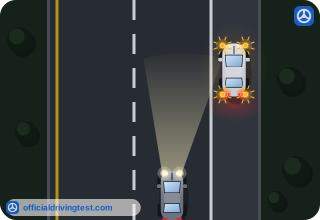
How far behind a disabled vehicle should you place emergency flares?
- About 50 to 100 feet
- About 400 to 500 feet
- About 200 to 300 feet
- About 600 to 700 feet
Show answer
Correct answer: About 200 to 300 feet
Flares are placed about 200 to 300 feet behind the vehicle to give other drivers time to change lanes.
Source: Kentucky Driver Manual (Updated July 23, 2026), page 58 · Open this page in the manual (Manual page 58)
-
If available, what should you use to notify authorities that a vehicle has broken down?
- A cell phone or other device
- Your horn and headlights
- Your emergency flashers
- Your parking lights
Show answer
Correct answer: A cell phone or other device
The manual says to use your cell phone or other device, if available, to notify authorities of a breakdown.
Source: Kentucky Driver Manual (Updated July 23, 2026), page 58 · Open this page in the manual (Manual page 58)
-
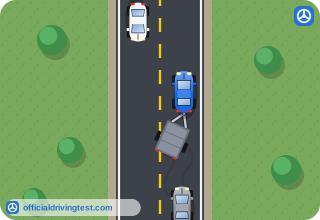
What should you do if your trailer begins to sway or whip?
- Apply the brakes firmly and steer toward the shoulder
- Increase speed slightly to pull the trailer straight
- Steer straight and slow gradually without braking
- Turn the wheel sharply in the direction of the sway
Show answer
Correct answer: Steer straight and slow gradually without braking
When a trailer sways or whips you steer straight and reduce speed gradually without applying the brakes, and never increase speed.
Source: Kentucky Driver Manual (Updated July 23, 2026), page 71 · Open this page in the manual (Manual page 71)
-
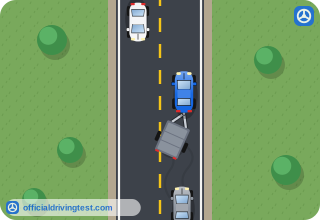
After a trailer begins to sway or whip, when should you stop?
- As soon as you can safely get completely off the roadway
- Only after you reach the next rest area
- Only when the swaying becomes worse
- After you have driven another mile at reduced speed
Show answer
Correct answer: As soon as you can safely get completely off the roadway
After a trailer sways you should stop as soon as you can safely get completely off the roadway.
Source: Kentucky Driver Manual (Updated July 23, 2026), page 71 · Open this page in the manual (Manual page 71)
-
After stopping a swaying trailer, what should you check first?
- That the cargo is loaded heavier in the front
- The air pressure in each of the trailer tires
- That the safety chains are attached
- That the trailer lights work
Show answer
Correct answer: That the cargo is loaded heavier in the front
The manual says to check the cargo first to be sure the trailer is loaded heavier in front, and to reload if necessary.
Source: Kentucky Driver Manual (Updated July 23, 2026), page 71 · Open this page in the manual (Manual page 71)
-
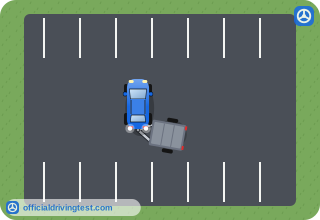
If the trailer starts to jackknife while you are backing up, what should you do?
- Back up faster to straighten it
- Turn the wheel sharply the other way and keep backing
- Set the parking brake and get out
- Stop and pull ahead to straighten out, then start again
Show answer
Correct answer: Stop and pull ahead to straighten out, then start again
If the trailer starts to jackknife, you stop, pull ahead to straighten out, and then start again.
Source: Kentucky Driver Manual (Updated July 23, 2026), page 71 · Open this page in the manual (Manual page 71)
-
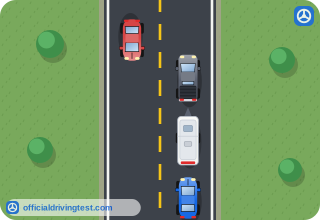
If, while driving with a trailer, you hear an unusual noise or suspect trouble, what should you do?
- Slow down and keep driving to the next exit
- Continue until the next fuel stop
- Stop at a safe place off the roadway to check
- Speed up to see if the noise goes away
Show answer
Correct answer: Stop at a safe place off the roadway to check
You should stop at a safe place off the roadway to check on the problem.
Source: Kentucky Driver Manual (Updated July 23, 2026), page 71 · Open this page in the manual (Manual page 71)