Kentucky: Emergencies — Part 1 Practice Test
Questions in this part include: “What is hydroplaning?” · “If your vehicle is not equipped with ABS, where does the manual tell you to look for the proper braking procedure?”
Independent educational site · not affiliated with any government agency or DMV
Ready? Test yourself
- Instant feedback with an explanation
- Every answer cites its source in the manual
- Your best score is saved on this device
Questions are original and based on the official manual "Kentucky Driver Manual" (Updated July 23, 2026), Kentucky State Police.
All 17 questions in this practice test
Take the test above first, then use this list to study. Tap “Show answer” to see the correct answer and explanation.
Show the questions and answersHide the questions
-
What should you do when your vehicle is equipped with anti-lock brakes and the road is slippery?

- Pump the brakes gently
- Release the brakes completely
- Tap the brakes in short, hard stabs
- Apply steady pressure to the brakes
Show answer
Correct answer: Apply steady pressure to the brakes
The manual says to pump the brakes gently unless the vehicle has anti-lock brakes, in which case you apply steady pressure to the brakes.
Source: Kentucky Driver Manual (Updated July 23, 2026), page 50 · Open this page in the manual (Manual page 50)
-
What is hydroplaning?
- The rear tires lock up and begin to slide on the dry roadway pavement
- The steering tires ride up on pooled water and do not contact the roadway surface
- The tires overheat and lose air on a hot road
- The wheels spin because the tires are worn smooth
Show answer
Correct answer: The steering tires ride up on pooled water and do not contact the roadway surface
Hydroplaning occurs when the steering tires start to ride up on pooled water, like the action of water skis. The tires are not contacting the actual roadway surface.
Source: Kentucky Driver Manual (Updated July 23, 2026), page 50 · Open this page in the manual (Manual page 50)
-
What is the best way to avoid traction loss from hydroplaning?
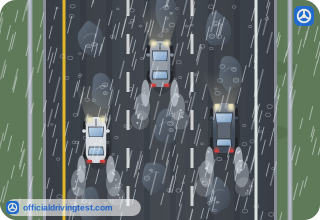
- Slow down in the rain or when the road has pooled water
- Brake as hard as you can when you see water
- Drive in the center of the lane to avoid puddles
- Keep your speed steady until the tires lose grip
Show answer
Correct answer: Slow down in the rain or when the road has pooled water
The manual says the best way to avoid traction loss from hydroplaning is to slow down in the rain or when the road is wet with pooled water or puddles.
Source: Kentucky Driver Manual (Updated July 23, 2026), page 50 · Open this page in the manual (Manual page 50)
-
Which tire condition helps you avoid traction loss from hydroplaning?
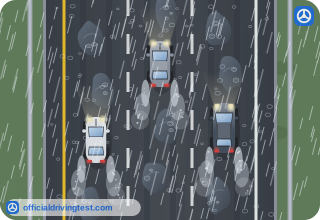
- Slightly low air pressure for a wider grip
- Smooth tread that touches more of the road
- Proper inflation and good tire tread
- Extra air pressure for faster water runoff
Show answer
Correct answer: Proper inflation and good tire tread
The manual says it is helpful to drive with properly-inflated tires with good tire tread.
Source: Kentucky Driver Manual (Updated July 23, 2026), page 50 · Open this page in the manual (Manual page 50)
-
What should you do if you see a flooded roadway?
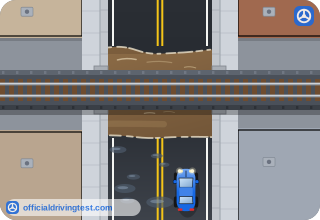
- Drive through slowly in a low gear
- Find another route to get to your destination
- Follow the vehicle ahead through the water
- Wait in the water until the level drops
Show answer
Correct answer: Find another route to get to your destination
The manual says not to drive through large bodies of standing water on a road. If a roadway is flooded, find another route.
Source: Kentucky Driver Manual (Updated July 23, 2026), page 50 · Open this page in the manual (Manual page 50)
-
Which three options does a driver have to avoid a crash or reduce its impact?
- Braking, honking, or signaling
- Steering, reversing, or flashing the lights
- Braking, steering, or accelerating
- Accelerating, honking, or stopping on the shoulder
Show answer
Correct answer: Braking, steering, or accelerating
The manual says the three options to avoid a crash or reduce its impact are braking, steering, or accelerating.
Source: Kentucky Driver Manual (Updated July 23, 2026), page 55 · Open this page in the manual (Manual page 55)
-
What is the first reaction for most drivers to avoid a crash?
- To stop the vehicle
- To steer around the problem
- To accelerate away from it
- To sound the horn
Show answer
Correct answer: To stop the vehicle
The first reaction for most drivers who want to avoid a crash is to stop the vehicle.
Source: Kentucky Driver Manual (Updated July 23, 2026), page 55 · Open this page in the manual (Manual page 55)
-
What does ABS (anti-lock braking system) allow you to do?
- Stop without pressing the brake pedal hard or for long
- Accelerate faster while braking on slippery pavement
- Skip checking the owner’s manual about braking
- Stop your vehicle without skidding and keep steering control
Show answer
Correct answer: Stop your vehicle without skidding and keep steering control
ABS lets you stop without skidding and keep steering control.
Source: Kentucky Driver Manual (Updated July 23, 2026), page 55 · Open this page in the manual (Manual page 55)
-
If your vehicle has ABS and you must stop in an emergency, how should you use the brake pedal?
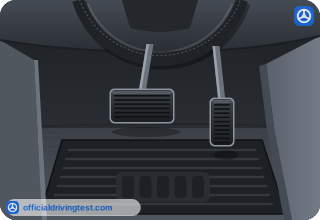
- Pump the pedal repeatedly until the vehicle stops
- Press as hard as you can and keep applying pressure
- Press lightly and release when the pedal vibrates
- Tap the pedal quickly and steer around the problem
Show answer
Correct answer: Press as hard as you can and keep applying pressure
With ABS you press the brake pedal as hard as you can and keep applying pressure, because ABS works only while you keep the pressure on.
Source: Kentucky Driver Manual (Updated July 23, 2026), page 55 · Open this page in the manual (Manual page 55)
-
While braking with ABS, you feel the brake pedal vibrate and hear a clicking noise. What does the manual say about this?
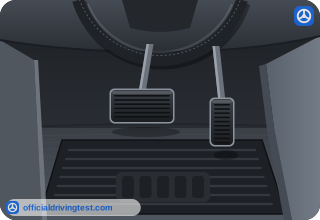
- The brakes are failing
- This is normal
- The ABS has switched itself off
- You should release the pedal at once
Show answer
Correct answer: This is normal
A vibrating pedal and a clicking noise are normal when ABS is working.
Source: Kentucky Driver Manual (Updated July 23, 2026), page 55 · Open this page in the manual (Manual page 55)
-
If your vehicle is not equipped with ABS, where does the manual tell you to look for the proper braking procedure?
- The Kentucky State Police
- The parking brake instructions
- A driver education school
- Your vehicle’s owner’s manual
Show answer
Correct answer: Your vehicle’s owner’s manual
The manual says to refer to the vehicle’s owner’s manual for the proper braking procedure when there is no ABS.
Source: Kentucky Driver Manual (Updated July 23, 2026), page 55 · Open this page in the manual (Manual page 55)
-
What is it called when you quickly steer around a problem to avoid a crash?
- Swerving
- Fishtailing
- Hydroplaning
- Lane splitting
Show answer
Correct answer: Swerving
Quickly steering around a problem is sometimes called swerving.
Source: Kentucky Driver Manual (Updated July 23, 2026), page 55 · Open this page in the manual (Manual page 55)
-
When quickly steering around a problem, what grip should you have on the steering wheel?
- A light grip with one hand
- A firm grip with the left hand only
- A good grip with both hands
- A loose grip so the wheel can turn freely
Show answer
Correct answer: A good grip with both hands
The manual says to make sure you have a good grip with both hands on the steering wheel.
Source: Kentucky Driver Manual (Updated July 23, 2026), page 55 · Open this page in the manual (Manual page 55)
-
When steering around a problem, which way should you steer?
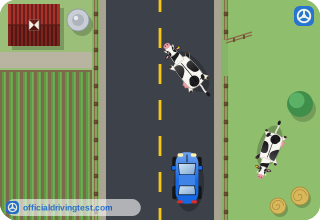
- In the direction opposite to where you want to go
- Toward the shoulder, whether or not other traffic is there
- Straight ahead, using only the brakes to avoid the problem
- In the direction you want to go, while trying to avoid other traffic
Show answer
Correct answer: In the direction you want to go, while trying to avoid other traffic
You steer in the direction you want to go but try to avoid other traffic.
Source: Kentucky Driver Manual (Updated July 23, 2026), page 55 · Open this page in the manual (Manual page 55)
-
After you have cleared the problem while swerving, what should you do with the steering?
- Keep steering the same way until the vehicle stops
- Steer in the opposite direction to straighten the vehicle
- Release the wheel and let the vehicle straighten itself
- Turn the wheel sharply again in the same direction
Show answer
Correct answer: Steer in the opposite direction to straighten the vehicle
After clearing the problem you steer in the opposite direction to straighten out, gain control, and start slowing.
Source: Kentucky Driver Manual (Updated July 23, 2026), page 55 · Open this page in the manual (Manual page 55)
-
When may you take one hand off the steering wheel?
- To use it for some other driving task
- Whenever the road ahead is straight
- When you are driving slowly in traffic
- When you have a good grip with the other hand
Show answer
Correct answer: To use it for some other driving task
Both hands should stay on the steering wheel at all times except to use one hand for some other driving task.
Source: Kentucky Driver Manual (Updated July 23, 2026), page 55 · Open this page in the manual (Manual page 55)
-
If an animal runs in front of your vehicle, what does the manual say you should do?
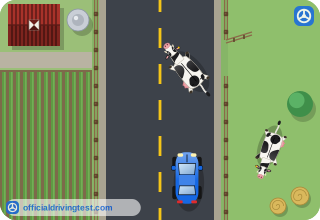
- Accelerate and drive past it quickly
- Hold your speed and sound the horn
- Brake and steer to miss the animal
- Brake hard and keep going straight
Show answer
Correct answer: Brake and steer to miss the animal
Using braking and steering together is a good way to avoid obstacles such as animals.
Source: Kentucky Driver Manual (Updated July 23, 2026), page 55 · Open this page in the manual (Manual page 55)