Kentucky: Emergencies — Part 2 Practice Test
Questions in this part include: “When may it be necessary to accelerate to avoid a crash?” · “Whose names and addresses should you get after a collision?”
Independent educational site · not affiliated with any government agency or DMV
Ready? Test yourself
- Instant feedback with an explanation
- Every answer cites its source in the manual
- Your best score is saved on this device
Questions are original and based on the official manual "Kentucky Driver Manual" (Updated July 23, 2026), Kentucky State Police.
All 17 questions in this practice test
Take the test above first, then use this list to study. Tap “Show answer” to see the correct answer and explanation.
Show the questions and answersHide the questions
-
When may it be necessary to accelerate to avoid a crash?
- When another vehicle is about to hit you from behind or the side
- When a pedestrian suddenly steps into the road ahead of your vehicle
- When an animal runs in front of your vehicle on a rural road
- When you are approaching a stopped vehicle on a freeway
Show answer
Correct answer: When another vehicle is about to hit you from behind or the side
Accelerating may be necessary when another vehicle is about to hit you from behind or the side.
Source: Kentucky Driver Manual (Updated July 23, 2026), page 55 · Open this page in the manual (Manual page 55)
-
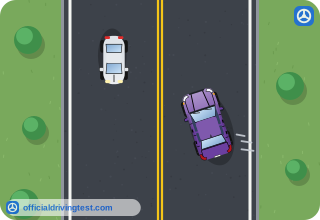
Which of these can cause a skid?
- Driving below the speed limit
- Using the parking brake gently
- Stopping too suddenly
- Keeping both hands on the wheel
Show answer
Correct answer: Stopping too suddenly
Skids are caused by traveling too fast for conditions, stopping too suddenly, or tires that can no longer grip the roadway.
Source: Kentucky Driver Manual (Updated July 23, 2026), page 55 · Open this page in the manual (Manual page 55)
-
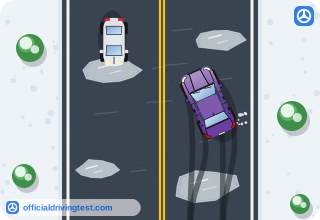
How much control of your vehicle do you have when you begin to skid?
- Full control
- Little control
- Control of steering only
- Control of braking only
Show answer
Correct answer: Little control
When you begin to skid you have little control of your vehicle.
Source: Kentucky Driver Manual (Updated July 23, 2026), page 55 · Open this page in the manual (Manual page 55)
-
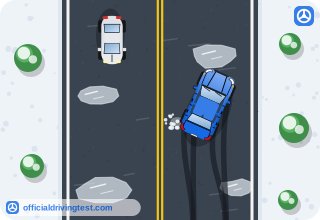
Which actions by a driver without skid-recovery skills make a skid worse?
- Turning on the emergency flashers and sounding the horn
- Shifting to neutral and turning off the engine
- Moving to the shoulder and stopping the vehicle slowly
- Panicking, stomping on the brake, and overcorrecting
Show answer
Correct answer: Panicking, stomping on the brake, and overcorrecting
Drivers who panic, stomp on the brake, and overcorrect the steering only make a skid worse.
Source: Kentucky Driver Manual (Updated July 23, 2026), page 55 · Open this page in the manual (Manual page 55)
-
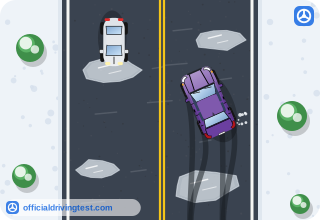
If your vehicle begins to skid, what does the manual say to do?
- Accelerate hard and look at the front of your vehicle
- Shift to neutral and look at the pavement beside you
- Release the brake or accelerator and look where you want to go
- Turn the wheel away from the skid and look behind you
Show answer
Correct answer: Release the brake or accelerator and look where you want to go
To regain control of a skid you release the brake or accelerator and look where you want to go.
Source: Kentucky Driver Manual (Updated July 23, 2026), page 56 · Open this page in the manual (Manual page 56)
-
If you are skidding in a straight line and your vehicle has anti-lock brakes, what should you do with the brake?

- Apply consistent pressure to slow the vehicle
- Pump the brake gently to slow the vehicle
- Leave the brake alone and use only the accelerator
- Stomp on it and turn the wheel sharply
Show answer
Correct answer: Apply consistent pressure to slow the vehicle
With anti-lock brakes in a straight-line skid you apply consistent pressure to the brake to slow the vehicle.
Source: Kentucky Driver Manual (Updated July 23, 2026), page 56 · Open this page in the manual (Manual page 56)
-
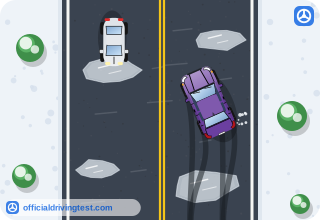
If your vehicle does not have anti-lock brakes and begins to skid, how should you slow it?
- By braking as hard as possible
- By applying steady full pressure to the pedal
- By turning off the engine
- By pumping the brakes gently
Show answer
Correct answer: By pumping the brakes gently
Without anti-lock you do not brake hard, because that locks the wheels and makes the skid worse; you pump the brakes gently instead.
Source: Kentucky Driver Manual (Updated July 23, 2026), page 56 · Open this page in the manual (Manual page 56)
-
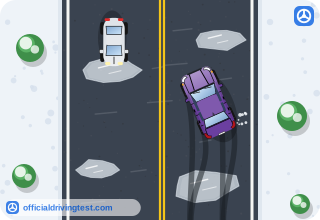
If your vehicle begins to skid sideways, which way should you turn the wheel?
- Away from the direction the back is skidding
- In the direction the back of the vehicle is skidding
- Toward the nearest edge of the road
- Straight ahead and hold it still
Show answer
Correct answer: In the direction the back of the vehicle is skidding
Turning the wheel in the direction the back is skidding lets the front of the vehicle line up with the back.
Source: Kentucky Driver Manual (Updated July 23, 2026), page 56 · Open this page in the manual (Manual page 56)
-
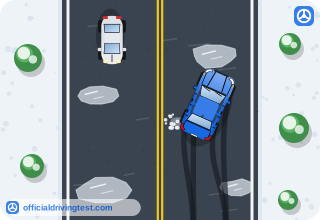
As soon as the vehicle begins to straighten out of a skid, what should you do with the steering wheel?
- Hold it in the same position until the vehicle comes to a stop
- Turn it back to prevent skidding in the opposite direction
- Turn it further in the same direction to complete the correction
- Let go of it so the vehicle can straighten out by itself
Show answer
Correct answer: Turn it back to prevent skidding in the opposite direction
As the vehicle straightens you turn the wheel back so it does not skid in the opposite direction.
Source: Kentucky Driver Manual (Updated July 23, 2026), page 56 · Open this page in the manual (Manual page 56)
-
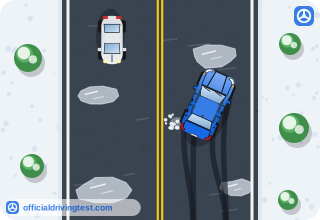
Which vehicle control is the most important to use during a skid?
- The brake pedal
- The accelerator
- The parking brake
- The steering wheel
Show answer
Correct answer: The steering wheel
The manual calls the steering wheel the most important vehicle control to use during a skid.
Source: Kentucky Driver Manual (Updated July 23, 2026), page 56 · Open this page in the manual (Manual page 56)
-
How long should you continue to correct your steering during a skid?
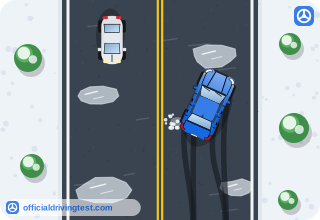
- Left and right, until you recover completely from the skid
- Once, then hold the wheel straight until you stop
- Until you have released the brake pedal
- Until the vehicle has slowed below 25 miles per hour
Show answer
Correct answer: Left and right, until you recover completely from the skid
You keep correcting the steering, left and right, until you have recovered completely from the skid.
Source: Kentucky Driver Manual (Updated July 23, 2026), page 56 · Open this page in the manual (Manual page 56)
-
If your vehicle leaves the paved road, what does the manual say to do?
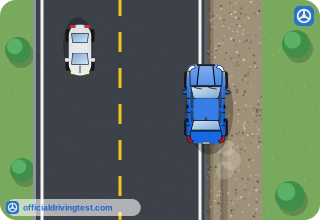
- Brake hard right away and stop on the roadside
- Speed up so you can return to the pavement quickly
- Slow down gradually and turn quickly back onto the pavement
- Hold the wheel straight and keep driving beside the road
Show answer
Correct answer: Slow down gradually and turn quickly back onto the pavement
You slow down gradually, when safe to do so, and turn quickly back onto the pavement, avoiding panic steering.
Source: Kentucky Driver Manual (Updated July 23, 2026), page 56 · Open this page in the manual (Manual page 56)
-
If you are involved in a collision, where should you stop your vehicle?
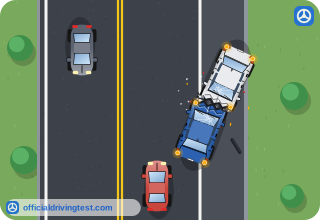
- At the next exit or the next safe parking area
- At your destination, then call the police
- On the opposite side of the road from the scene
- At or near the collision scene
Show answer
Correct answer: At or near the collision scene
The manual says to stop your vehicle at or near the collision scene.
Source: Kentucky Driver Manual (Updated July 23, 2026), page 56 · Open this page in the manual (Manual page 56)
-
After a collision, how long should you remain with your vehicle?
- Until the other driver has driven away from the collision scene
- Until the officer arrives and has questioned everyone involved
- Until you have exchanged insurance information with every driver
- For at least thirty minutes after the collision has occurred
Show answer
Correct answer: Until the officer arrives and has questioned everyone involved
You remain with the vehicle until the law enforcement officer arrives and has questioned everyone involved.
Source: Kentucky Driver Manual (Updated July 23, 2026), page 56 · Open this page in the manual (Manual page 56)
-
According to Kentucky law, what should you do with the damaged vehicles after a non-injury accident?
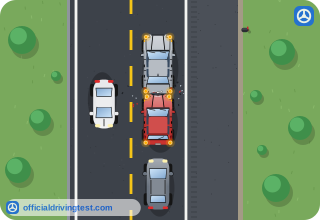
- Move them to the shoulder of the roadway
- Leave them where they stopped until police arrive
- Move them to the nearest parking lot
- Leave them in the lane and turn on the emergency flashers
Show answer
Correct answer: Move them to the shoulder of the roadway
Kentucky law says that in a non-injury accident the damaged vehicles are moved to the shoulder of the roadway.
Source: Kentucky Driver Manual (Updated July 23, 2026), page 56 · Open this page in the manual (Manual page 56)
-
Whose names and addresses should you get after a collision?
- Only the other drivers involved
- Only people who were injured
- All people involved in the collision and any witnesses
- The other driver and the officer who responds
Show answer
Correct answer: All people involved in the collision and any witnesses
You get the names and addresses of all people involved in the collision and any witnesses.
Source: Kentucky Driver Manual (Updated July 23, 2026), page 56 · Open this page in the manual (Manual page 56)
-
Which of these should you record about any other operator after a collision?
- Driver license number
- Home telephone number
- Employer’s name
- Date of birth
Show answer
Correct answer: Driver license number
The manual lists the other operator’s name, address, and driver license number to record.
Source: Kentucky Driver Manual (Updated July 23, 2026), page 56 · Open this page in the manual (Manual page 56)