Kansas: Emergency vehicles and work zones
Yielding to emergency vehicles, police traffic stops, work zones, flaggers and orange work zone signs. Split into 3 shorter tests so you're not stuck in one long quiz.
Independent educational site · not affiliated with any government agency or DMV
Choose a part
Emergency vehicles and work zones — Part 1
Questions in this part include: “What color are work zone signs?”
StartEmergency vehicles and work zones — Part 2
Questions in this part include: “Even when an emergency vehicle driver is exempt from some traffic laws, what must that driver still do?”
StartEmergency vehicles and work zones — Part 3
Questions in this part include: “What is a work zone?”
StartAll 49 Emergency vehicles and work zones questions with answers
Choose a part above to take a practice test, or study every question and answer here.
Show the questions and answersHide the questions
-
What must you do when an emergency vehicle coming toward you or from behind is displaying flashing red lights or sounding a siren?
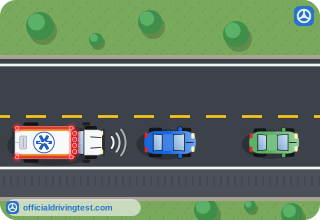
- Pull to the left side of the road and stop as soon as it is safe
- Speed up to clear the intersection, then pull over and stop
- Stop where you are, even in the middle of an intersection
- Drive to the right at once and stop, keeping intersections clear
Show answer
Correct answer: Drive to the right at once and stop, keeping intersections clear
You must immediately drive to the right and stop without blocking any intersection.
Source: Kansas Driving Handbook (Revised February 2022), page 18
-
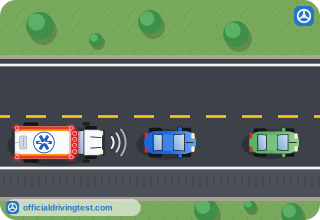
When do emergency vehicles such as police cars, fire engines and ambulances have the right-of-way?
- Only when both a red light and a siren are used together
- Only on divided highways and on one-way streets
- When they show a red light in front or sound a siren or bell
- Only when they are traveling faster than the posted limit
Show answer
Correct answer: When they show a red light in front or sound a siren or bell
Emergency vehicles have the right-of-way when displaying a red light in front or when they signal with a siren or bell.
Source: Kansas Driving Handbook (Revised February 2022), page 18
-
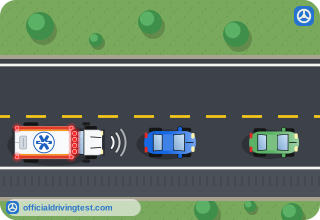
After an emergency vehicle has passed you, what does the manual say you must NEVER do?
- Follow such vehicles
- Move to the right
- Use your turn signal
- Wait at the curb
Show answer
Correct answer: Follow such vehicles
After drivers pull right and stop for emergency vehicles, the manual says never to follow such vehicles.
Source: Kansas Driving Handbook (Revised February 2022), page 18
-
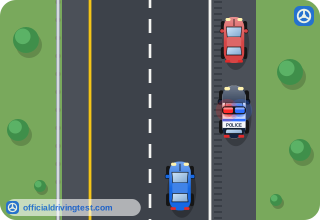
What must you do when approaching from the rear a stationary emergency vehicle that is using flashing warning lights, on a street or highway with two or more lanes in each direction?
- Stop behind the emergency vehicle and wait until it has left
- Stay in your lane, speed up and pass the stopped vehicle quickly
- Move into the lane next to the emergency vehicle and stop
- Proceed with due caution and move to a lane not next to the stopped vehicle
Show answer
Correct answer: Proceed with due caution and move to a lane not next to the stopped vehicle
You must proceed with due caution and move to a lane that is not next to the stopped emergency vehicle.
Source: Kansas Driving Handbook (Revised February 2022), page 18
-
If you cannot change lanes when approaching a stationary emergency vehicle using flashing warning lights, what must you do?
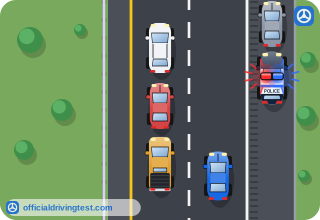
- Stop behind the emergency vehicle
- Reduce speed and proceed with due caution
- Keep your speed and sound your horn
- Move onto the shoulder and pass
Show answer
Correct answer: Reduce speed and proceed with due caution
If it is not possible to change lanes, the driver must reduce speed and proceed with due caution.
Source: Kansas Driving Handbook (Revised February 2022), page 18
-
What must you do when you encounter construction vehicles and workers that are actually engaged in work on the roadway?
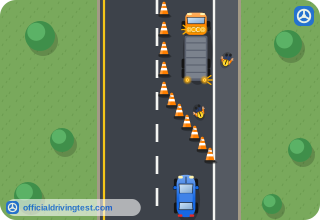
- Slow down and keep driving in the lane right next to the workers
- Stop and wait until the work on the roadway is finished
- Yield, and move into a lane that is not next to the construction vehicles
- Sound your horn and drive past the work area quickly
Show answer
Correct answer: Yield, and move into a lane that is not next to the construction vehicles
You must yield to construction vehicles and workers actually engaged in work and move into a lane that is not next to them.
Source: Kansas Driving Handbook (Revised February 2022), page 18
-
What color are work zone signs?
- Yellow with black letters or symbols
- Orange with black letters or symbols
- Fluorescent pink with black letters
- Red with white letters
Show answer
Correct answer: Orange with black letters or symbols
Work zone signs are generally diamond or rectangular shaped and orange with black letters or symbols.
Source: Kansas Driving Handbook (Revised February 2022), page 38
-
Which of these do work zone signs warn you about?
- An animal crossing the road ahead
- A railroad crossing on the road ahead
- A school zone on the road ahead
- Poor or suddenly changing road surfaces
Show answer
Correct answer: Poor or suddenly changing road surfaces
Work zone signs warn of workers ahead, reduced speed, detours, slow moving construction equipment and poor or suddenly changing road surfaces.
Source: Kansas Driving Handbook (Revised February 2022), page 38
-
An orange diamond-shaped sign shows a black figure shoveling. What does it warn of?
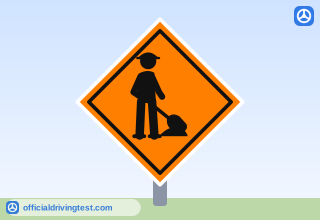
- Workers ahead
- A detour ahead
- Tar ahead
- A one lane road ahead
Show answer
Correct answer: Workers ahead
An orange diamond showing a shoveling figure is the Workers Ahead work zone sign.
Source: Kansas Driving Handbook (Revised February 2022), page 38
-
An orange diamond-shaped sign shows a black human figure with one arm held out. What does it warn of?
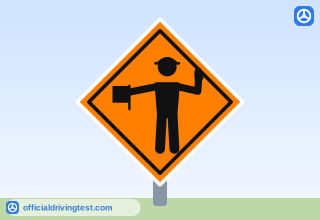
- A survey crew ahead
- Road construction ahead
- A flagger ahead
- A detour ahead
Show answer
Correct answer: A flagger ahead
An orange diamond showing a human figure with an outstretched arm is the Flagger Ahead work zone sign.
Source: Kansas Driving Handbook (Revised February 2022), page 38
-
A person in a work zone holds a sign or flag to tell traffic which way to go, slow down or stop. What must you do?
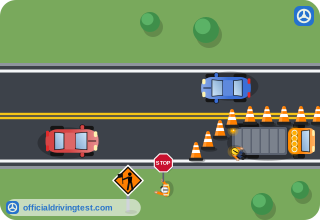
- Follow their instructions
- Follow them only if no cones are present
- Follow the posted signs instead of the person
- Follow them only if other drivers do
Show answer
Correct answer: Follow their instructions
Traffic in a work zone may be controlled by a person with a sign or flag, and drivers must follow those instructions.
Source: Kansas Driving Handbook (Revised February 2022), page 39
-
What are drums, cones and tubes (panels) used for in work zones?
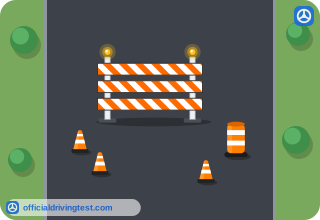
- To show where workers may park their vehicles
- To mark where the speed limit changes
- To keep traffic out of hazardous work zones
- To show which way a detour turns
Show answer
Correct answer: To keep traffic out of hazardous work zones
Barriers such as drums, cones and tubes are used to keep traffic out of hazardous work zones and, with signs and markings, guide drivers through safely.
Source: Kansas Driving Handbook (Revised February 2022), page 39
-
You reach a temporary traffic signal in a work zone and there is a white line on the road. Where should you stop for a red signal?
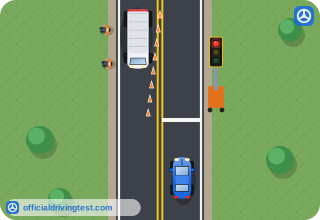
- Just past the signal
- At the white line
- At the nearest cone
- Once the front of your vehicle is level with the signal
Show answer
Correct answer: At the white line
At a temporary traffic signal in a work zone, you stop at the white line if one is present.
Source: Kansas Driving Handbook (Revised February 2022), page 39
-
What happens to fines for speeding in a work zone?
- They are tripled
- They are the same as elsewhere
- They are waived for a first offense
- They are doubled
Show answer
Correct answer: They are doubled
The manual states that fines for speeding in a work zone are doubled.
Source: Kansas Driving Handbook (Revised February 2022), page 39
-
How should you drive when you approach and pass through a work zone?
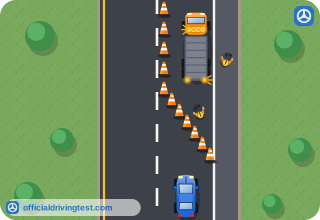
- Reduce your speed and be prepared to stop suddenly
- Keep your speed and move to the left lane
- Speed up to clear the work zone quickly
- Slow down only if workers are within sight
Show answer
Correct answer: Reduce your speed and be prepared to stop suddenly
Drivers are asked to give workers a "brake" by reducing speed and being ready to stop suddenly.
Source: Kansas Driving Handbook (Revised February 2022), page 39
-
Which of these does the manual tell you NOT to do in a work zone?
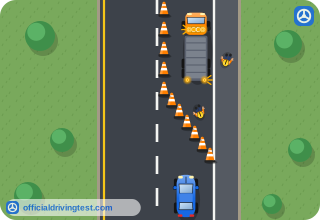
- Reduce your speed
- Be prepared to stop suddenly
- Tailgate
- Follow a flagger’s instructions
Show answer
Correct answer: Tailgate
The manual tells drivers not to tailgate in work zones.
Source: Kansas Driving Handbook (Revised February 2022), page 39
-
Under emergency conditions, which of these may a driver of an emergency vehicle do?
- Go through a red light or stop sign after slowing down
- Drive through a crosswalk without regard to pedestrians
- Ignore every traffic law once the siren is on
- Pass other vehicles with the lights and siren turned off
Show answer
Correct answer: Go through a red light or stop sign after slowing down
Under emergency conditions, drivers of emergency vehicles may be exempt from traffic control laws, for example going through a red light or stop sign after slowing down.
Source: Kansas Driving Handbook (Revised February 2022), page 84
-
Even when an emergency vehicle driver is exempt from some traffic laws, what must that driver still do?
- Keep to the posted speed limit at all times, with no exceptions
- Stop at every intersection before entering it, even on green
- Drive with regard for the safety of other roadway users
- Stay in the right lane for the whole length of the trip
Show answer
Correct answer: Drive with regard for the safety of other roadway users
Drivers of emergency vehicles must drive with regard for the safety of other roadway users.
Source: Kansas Driving Handbook (Revised February 2022), page 84
-
Which of these is named as an example of an emergency vehicle?
- A mail delivery truck
- A blood delivery vehicle
- A taxi
- A garbage truck
Show answer
Correct answer: A blood delivery vehicle
Emergency vehicles include fire department equipment, police vehicles, ambulances and specialty-equipped vehicles such as blood delivery vehicles, river rescue vehicles and hazmat response vehicles.
Source: Kansas Driving Handbook (Revised February 2022), page 84
-
What should you do when you hear a siren or see a vehicle approaching with flashing lights?
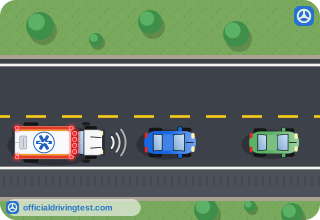
- Keep your speed and stay in your lane until the vehicle has passed
- Move into the right lane and drive slowly until the vehicle has passed
- Speed up to get out of the way of the emergency vehicle behind you
- Move to the right, pull over to the curb or edge of the road, and stop
Show answer
Correct answer: Move to the right, pull over to the curb or edge of the road, and stop
You must move to the right, pull over to the curb or edge of the road, and stop for an approaching siren or flashing lights.
Source: Kansas Driving Handbook (Revised February 2022), page 85
-
How should you position your vehicle when you pull over for an emergency vehicle?
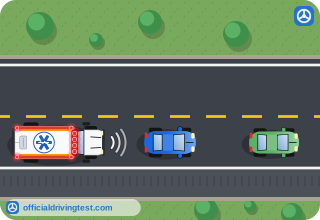
- Parallel and as near to the curb as possible
- At an angle, with the front wheels turned toward the road
- Straddling the lane line so the vehicle can pass on either side
- At least one lane away from the curb
Show answer
Correct answer: Parallel and as near to the curb as possible
Position yourself parallel and as near to the curb as possible when you pull over for an emergency vehicle.
Source: Kansas Driving Handbook (Revised February 2022), page 85
-
When you pull over for an emergency vehicle, what must you always do about intersections?
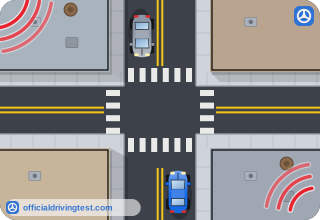
- Stop in them to see both directions
- Stop in the middle of them to block cross traffic
- Keep them clear
- Pull over at the nearest one
Show answer
Correct answer: Keep them clear
When pulling over for an emergency vehicle you must always keep intersections clear.
Source: Kansas Driving Handbook (Revised February 2022), page 85
-
An emergency vehicle is leaving or returning to its garage with its emergency lights still flashing. What must you do?
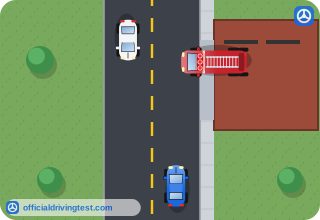
- Pass it carefully on the left
- Slow down but keep moving beside it
- Continue if no siren is sounding
- Stop until it is safely out of your path
Show answer
Correct answer: Stop until it is safely out of your path
If an emergency vehicle is leaving or returning to its garage and the emergency lights are still flashing, you must stop until it is safely out of your path.
Source: Kansas Driving Handbook (Revised February 2022), page 85
-
During an emergency, whose direction must you obey at the scene?
- Law enforcement or emergency services personnel
- Any other driver who stopped there first
- Only the traffic signals and signs at the scene
- Bystanders who are helping at the scene
Show answer
Correct answer: Law enforcement or emergency services personnel
During an emergency you must obey the direction of law enforcement or emergency services personnel on the scene.
Source: Kansas Driving Handbook (Revised February 2022), page 85
-
If law enforcement pulls you over, where should you stop?
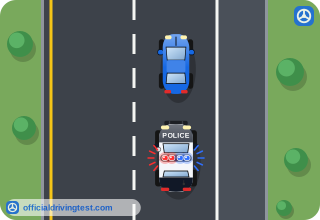
- In your current lane so that the officer can see you from behind
- On the left side of the roadway, as close to the center as possible
- On the right side of the roadway, as far out of the way of traffic as possible
- In the next intersection, where the officer can easily find you
Show answer
Correct answer: On the right side of the roadway, as far out of the way of traffic as possible
When pulled over, move to the right side of the roadway and position your vehicle as far out of the way of traffic as possible, where it is safe for you and the officer.
Source: Kansas Driving Handbook (Revised February 2022), page 85
-
When you are pulled over by law enforcement, what should you turn off?
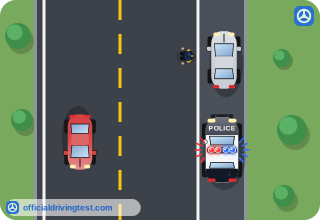
- Your headlights and hazard flashers so you do not distract the officer
- Your engine, radio and any device that might interfere with communicating
- Your seat belt, so you can reach your documents more easily
- Only your engine, while the radio stays on to keep you calm
Show answer
Correct answer: Your engine, radio and any device that might interfere with communicating
Turn off your engine, radio, CD player or any other device that might interfere with communicating with the officer.
Source: Kansas Driving Handbook (Revised February 2022), page 85
-
At night during a traffic stop, which lights should you turn on so that the officer can see inside your vehicle?
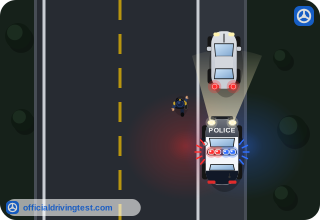
- Your high beam headlights
- Your fog lights
- Your parking lights only
- Your interior lights
Show answer
Correct answer: Your interior lights
Turn on your hazard flashers and, if it is night, your interior lights to help the officer see that everything is in order inside the vehicle.
Source: Kansas Driving Handbook (Revised February 2022), page 85
-
What should you do with your window when an officer has pulled you over?
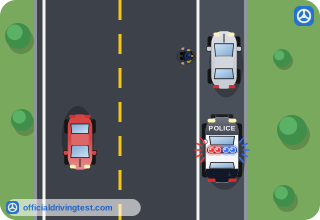
- Roll it down so you and the officer can communicate
- Keep it closed and speak through the door instead
- Keep it closed and hold your license against the glass
- Open it only after the officer asks you to step out
Show answer
Correct answer: Roll it down so you and the officer can communicate
Roll down your window so that you and the officer can communicate.
Source: Kansas Driving Handbook (Revised February 2022), page 85
-
During a traffic stop, what should you do with your safety belt?
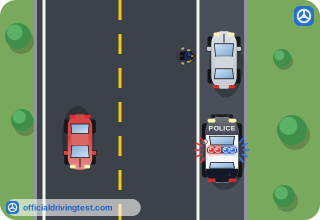
- Unfasten it so that you can reach your documents more easily
- Unfasten it and ask your passengers to unfasten theirs
- Keep it fastened and ask your passengers to do the same
- Unfasten it only after the officer reaches your window
Show answer
Correct answer: Keep it fastened and ask your passengers to do the same
Remain calm and keep your safety belt fastened, and ask your passengers to do so as well.
Source: Kansas Driving Handbook (Revised February 2022), page 85
-
During a traffic stop, where should you keep your hands?
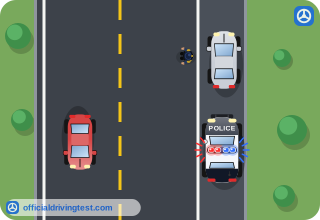
- On the top of the dashboard
- On the steering wheel
- Behind your head
- Out of the window
Show answer
Correct answer: On the steering wheel
Keep your hands on the steering wheel and limit movements so the officer does not think you are hiding or searching for something.
Source: Kansas Driving Handbook (Revised February 2022), page 85
-
An officer asks for your license, proof of insurance or registration. How should you reach for them?
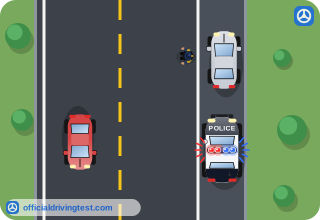
- Quickly, using both hands so that the officer can see them at once
- With both hands off the wheel while you are turned toward the officer
- After getting out of the vehicle to open the glove box yourself
- Slowly, with one hand on the wheel, after telling the officer where they are
Show answer
Correct answer: Slowly, with one hand on the wheel, after telling the officer where they are
Tell the officer where the documents are located and reach for them slowly with one hand on the wheel.
Source: Kansas Driving Handbook (Revised February 2022), page 85
-
During a traffic stop, when should you get out of your vehicle?
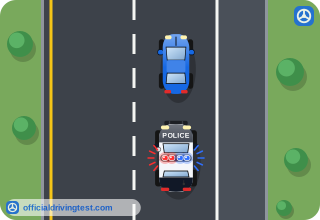
- Only when the officer requests it
- As soon as the officer's vehicle stops behind you
- Whenever you need to find your documents
- When you see the officer walking up in your mirror
Show answer
Correct answer: Only when the officer requests it
Remain in the vehicle unless requested to get out.
Source: Kansas Driving Handbook (Revised February 2022), page 85
-
How do the consequences of running from law enforcement compare with the initial traffic citation?
- They are about the same as the citation
- They are less severe if you stop soon afterward
- They are more severe than the initial citation
- They are limited to a warning if no one is hurt
Show answer
Correct answer: They are more severe than the initial citation
Running from law enforcement is very dangerous, and the consequences are more severe than the initial traffic citation.
Source: Kansas Driving Handbook (Revised February 2022), page 85
-
What does state law require when you approach a stationary emergency vehicle displaying flashing lights, traveling in the same direction?
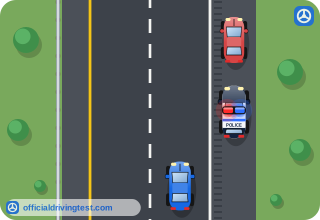
- Stop at least 500 feet behind it until the lights go off
- Vacate the closest lane if safe and possible, or slow to a safe speed
- Speed up and pass it as quickly as possible in the same lane
- Move to the left shoulder and wait until it has left
Show answer
Correct answer: Vacate the closest lane if safe and possible, or slow to a safe speed
Under the move-over law you must vacate the lane closest to the stationary emergency vehicle if safe and possible, or slow to a speed safe for road, weather and traffic conditions.
Source: Kansas Driving Handbook (Revised February 2022), page 85
-
Which of these stationary vehicles with flashing lights is included in the move-over law?
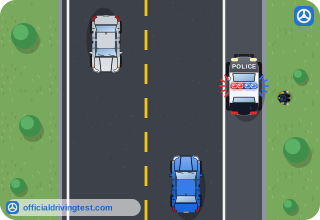
- Mail delivery vehicles
- Any vehicle with its hazard lights on
- Parked school buses
- Towing and recovery vehicles
Show answer
Correct answer: Towing and recovery vehicles
The move-over law applies to a stationary emergency vehicle displaying flashing lights, including towing and recovery vehicles.
Source: Kansas Driving Handbook (Revised February 2022), page 85
-
What is a work zone?
- A stretch of road where the speed limit is lowered for every driver all year
- An area of road where police officers direct all of the traffic
- A stretch of road closed to traffic while workers are on a break
- An area of roadwork that may involve lane closures, detours and moving equipment
Show answer
Correct answer: An area of roadwork that may involve lane closures, detours and moving equipment
A work zone is an area where roadwork takes place and may involve lane closures, detours and moving equipment.
Source: Kansas Driving Handbook (Revised February 2022), page 91
-
In which season are work zones most common?
- Winter
- Summer
- Spring
- Fall
Show answer
Correct answer: Summer
Work zones can exist at any time of the year but most commonly in the summer.
Source: Kansas Driving Handbook (Revised February 2022), page 91
-
What colors do temporary signs in work zones have?
- An orange background with black letters or symbols
- A yellow background with black letters or symbols
- A green background with white letters
- A white background with red letters
Show answer
Correct answer: An orange background with black letters or symbols
All temporary signs in work zones have an orange background and black letters or symbols.
Source: Kansas Driving Handbook (Revised February 2022), page 91
-
Besides what to do, what do temporary work zone signs tell you?
- Who is paying for the work and when it will be finished
- Which lane the workers will close next and for how long
- How soon you will reach the work zone and the speed limit through it
- How many workers are in the work zone and what they are doing
Show answer
Correct answer: How soon you will reach the work zone and the speed limit through it
Temporary signs tell you what to do, how soon you will encounter the work zone and the speed limit through it.
Source: Kansas Driving Handbook (Revised February 2022), page 91
-
What speed limit should you obey in a work zone that has no reduced speed limit signs?
- Half of the normal posted speed limit
- The normal posted speed limit
- 10 mph below the normal posted speed limit
- Whatever speed the traffic around you is traveling
Show answer
Correct answer: The normal posted speed limit
If there are no reduced speed limit signs, you should obey the normal posted speed limit.
Source: Kansas Driving Handbook (Revised February 2022), page 91
-
In a work zone, how should you be prepared to react to the traffic around you?
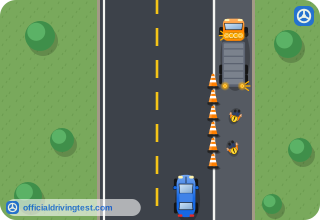
- By keeping your speed and passing slower vehicles before the lane narrows
- By following the vehicle ahead more closely to keep traffic moving
- By ignoring flaggers when no workers are in sight
- By reducing speed, obeying signs and flaggers and increasing following distance
Show answer
Correct answer: By reducing speed, obeying signs and flaggers and increasing following distance
In a work zone you should reduce your speed, obey signs and flaggers and increase your following distance.
Source: Kansas Driving Handbook (Revised February 2022), page 92
-
Why should you keep paying attention to work zone signs even when the work is long term or widespread?
- The posted speed limit in a long-term zone goes up every day
- Workers are always present in a work zone that lasts a long time
- The signs in a long-term work zone are replaced every week
- Traffic patterns can change daily, such as lane shifts or lane closures
Show answer
Correct answer: Traffic patterns can change daily, such as lane shifts or lane closures
Traffic patterns in work zones can change daily, including lane shifts or alternating lane closures.
Source: Kansas Driving Handbook (Revised February 2022), page 92
-
When should you merge as you approach a work zone?
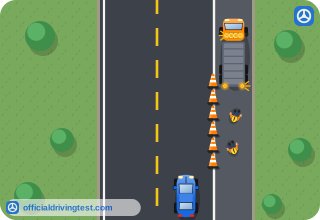
- At the last moment, where the lane ends
- As soon as possible, at the first notice of the work zone
- Only when a vehicle slows to let you in
- Only after you have passed the last warning sign
Show answer
Correct answer: As soon as possible, at the first notice of the work zone
Moving to the appropriate lane at first notice of an approaching work zone helps maintain traffic flow and posted speeds.
Source: Kansas Driving Handbook (Revised February 2022), page 92
-
When must you use extreme caution while driving through a work zone at night?
- Only when workers are visible
- Only when a lane is closed
- Whether workers are present or not
- Only when flashing lights are on
Show answer
Correct answer: Whether workers are present or not
You should use extreme caution when driving through a work zone at night whether workers are present or not.
Source: Kansas Driving Handbook (Revised February 2022), page 92
-
When possible, how should you adjust your lane position in a work zone?
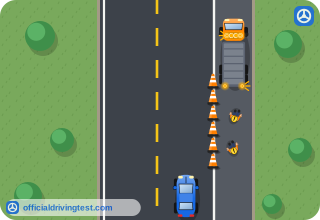
- Away from the side where workers and equipment are located
- Toward the side where workers and equipment are located
- Straddling the line between two lanes
- Directly behind the vehicle ahead, on whichever side it drives
Show answer
Correct answer: Away from the side where workers and equipment are located
You should adjust your lane position away from the side where workers and equipment are located when possible.
Source: Kansas Driving Handbook (Revised February 2022), page 92
-
Which of these is an example of a mobile work zone?
- Bridge replacement
- Line painting
- Road widening
- Building a new interchange
Show answer
Correct answer: Line painting
Work zones such as line painting, road patching and mowing are mobile.
Source: Kansas Driving Handbook (Revised February 2022), page 92
-
In a mobile work zone, how long should you keep observing the posted signs?
- Until you can no longer see any workers on the road
- Until you pass the first warning sign of the work zone
- Until the speed limit sign changes back to normal
- Until you see the sign that says "End Road Work"
Show answer
Correct answer: Until you see the sign that says "End Road Work"
Workers may still be out there even if you do not see them right after the warning sign; keep observing signs until "End Road Work."
Source: Kansas Driving Handbook (Revised February 2022), page 92
-
How should you plan for a trip that may take you through work zones?
- Expect delays, plan for them and leave early
- Plan to speed through the zone to stay on schedule
- Leave late because work zones are cleared at night
- Assume there are no delays if you do not see any workers
Show answer
Correct answer: Expect delays, plan for them and leave early
You should expect delays, plan for them and leave early to reach your destination on time.
Source: Kansas Driving Handbook (Revised February 2022), page 92
-
What can you do to avoid a work zone altogether?
- Drive through only after dark
- Follow a large vehicle through the zone
- Use an alternate route when you can
- Travel at a higher speed to get through quickly
Show answer
Correct answer: Use an alternate route when you can
When you can, avoid work zones altogether by using alternate routes.
Source: Kansas Driving Handbook (Revised February 2022), page 92