Kansas: Emergency vehicles and work zones — Part 3 Practice Test
Questions in this part include: “What is a work zone?” · “Why should you keep paying attention to work zone signs even when the work is long term or widespread?”
Independent educational site · not affiliated with any government agency or DMV
Ready? Test yourself
- Instant feedback with an explanation
- Every answer cites its source in the manual
- Your best score is saved on this device
Questions are original and based on the official manual "Kansas Driving Handbook" (Revised February 2022), Kansas Department of Revenue, Division of Vehicles.
All 16 questions in this practice test
Take the test above first, then use this list to study. Tap “Show answer” to see the correct answer and explanation.
Show the questions and answersHide the questions
-
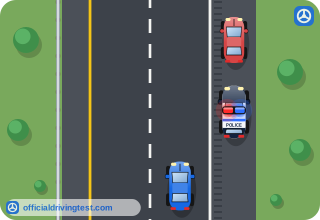
What does state law require when you approach a stationary emergency vehicle displaying flashing lights, traveling in the same direction?
- Stop at least 500 feet behind it until the lights go off
- Vacate the closest lane if safe and possible, or slow to a safe speed
- Speed up and pass it as quickly as possible in the same lane
- Move to the left shoulder and wait until it has left
Show answer
Correct answer: Vacate the closest lane if safe and possible, or slow to a safe speed
Under the move-over law you must vacate the lane closest to the stationary emergency vehicle if safe and possible, or slow to a speed safe for road, weather and traffic conditions.
Source: Kansas Driving Handbook (Revised February 2022), page 85
-
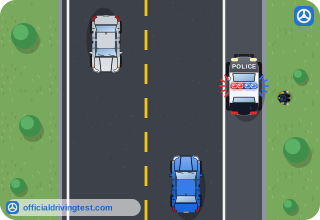
Which of these stationary vehicles with flashing lights is included in the move-over law?
- Mail delivery vehicles
- Any vehicle with its hazard lights on
- Parked school buses
- Towing and recovery vehicles
Show answer
Correct answer: Towing and recovery vehicles
The move-over law applies to a stationary emergency vehicle displaying flashing lights, including towing and recovery vehicles.
Source: Kansas Driving Handbook (Revised February 2022), page 85
-
What is a work zone?
- A stretch of road where the speed limit is lowered for every driver all year
- An area of road where police officers direct all of the traffic
- A stretch of road closed to traffic while workers are on a break
- An area of roadwork that may involve lane closures, detours and moving equipment
Show answer
Correct answer: An area of roadwork that may involve lane closures, detours and moving equipment
A work zone is an area where roadwork takes place and may involve lane closures, detours and moving equipment.
Source: Kansas Driving Handbook (Revised February 2022), page 91
-
In which season are work zones most common?
- Winter
- Summer
- Spring
- Fall
Show answer
Correct answer: Summer
Work zones can exist at any time of the year but most commonly in the summer.
Source: Kansas Driving Handbook (Revised February 2022), page 91
-
What colors do temporary signs in work zones have?
- An orange background with black letters or symbols
- A yellow background with black letters or symbols
- A green background with white letters
- A white background with red letters
Show answer
Correct answer: An orange background with black letters or symbols
All temporary signs in work zones have an orange background and black letters or symbols.
Source: Kansas Driving Handbook (Revised February 2022), page 91
-
Besides what to do, what do temporary work zone signs tell you?
- Who is paying for the work and when it will be finished
- Which lane the workers will close next and for how long
- How soon you will reach the work zone and the speed limit through it
- How many workers are in the work zone and what they are doing
Show answer
Correct answer: How soon you will reach the work zone and the speed limit through it
Temporary signs tell you what to do, how soon you will encounter the work zone and the speed limit through it.
Source: Kansas Driving Handbook (Revised February 2022), page 91
-
What speed limit should you obey in a work zone that has no reduced speed limit signs?
- Half of the normal posted speed limit
- The normal posted speed limit
- 10 mph below the normal posted speed limit
- Whatever speed the traffic around you is traveling
Show answer
Correct answer: The normal posted speed limit
If there are no reduced speed limit signs, you should obey the normal posted speed limit.
Source: Kansas Driving Handbook (Revised February 2022), page 91
-
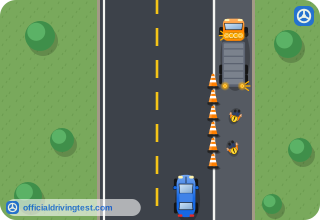
In a work zone, how should you be prepared to react to the traffic around you?
- By keeping your speed and passing slower vehicles before the lane narrows
- By following the vehicle ahead more closely to keep traffic moving
- By ignoring flaggers when no workers are in sight
- By reducing speed, obeying signs and flaggers and increasing following distance
Show answer
Correct answer: By reducing speed, obeying signs and flaggers and increasing following distance
In a work zone you should reduce your speed, obey signs and flaggers and increase your following distance.
Source: Kansas Driving Handbook (Revised February 2022), page 92
-
Why should you keep paying attention to work zone signs even when the work is long term or widespread?
- The posted speed limit in a long-term zone goes up every day
- Workers are always present in a work zone that lasts a long time
- The signs in a long-term work zone are replaced every week
- Traffic patterns can change daily, such as lane shifts or lane closures
Show answer
Correct answer: Traffic patterns can change daily, such as lane shifts or lane closures
Traffic patterns in work zones can change daily, including lane shifts or alternating lane closures.
Source: Kansas Driving Handbook (Revised February 2022), page 92
-
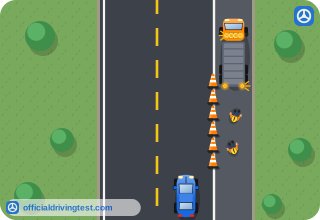
When should you merge as you approach a work zone?
- At the last moment, where the lane ends
- As soon as possible, at the first notice of the work zone
- Only when a vehicle slows to let you in
- Only after you have passed the last warning sign
Show answer
Correct answer: As soon as possible, at the first notice of the work zone
Moving to the appropriate lane at first notice of an approaching work zone helps maintain traffic flow and posted speeds.
Source: Kansas Driving Handbook (Revised February 2022), page 92
-
When must you use extreme caution while driving through a work zone at night?
- Only when workers are visible
- Only when a lane is closed
- Whether workers are present or not
- Only when flashing lights are on
Show answer
Correct answer: Whether workers are present or not
You should use extreme caution when driving through a work zone at night whether workers are present or not.
Source: Kansas Driving Handbook (Revised February 2022), page 92
-
When possible, how should you adjust your lane position in a work zone?
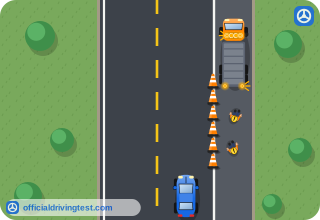
- Away from the side where workers and equipment are located
- Toward the side where workers and equipment are located
- Straddling the line between two lanes
- Directly behind the vehicle ahead, on whichever side it drives
Show answer
Correct answer: Away from the side where workers and equipment are located
You should adjust your lane position away from the side where workers and equipment are located when possible.
Source: Kansas Driving Handbook (Revised February 2022), page 92
-
Which of these is an example of a mobile work zone?
- Bridge replacement
- Line painting
- Road widening
- Building a new interchange
Show answer
Correct answer: Line painting
Work zones such as line painting, road patching and mowing are mobile.
Source: Kansas Driving Handbook (Revised February 2022), page 92
-
In a mobile work zone, how long should you keep observing the posted signs?
- Until you can no longer see any workers on the road
- Until you pass the first warning sign of the work zone
- Until the speed limit sign changes back to normal
- Until you see the sign that says "End Road Work"
Show answer
Correct answer: Until you see the sign that says "End Road Work"
Workers may still be out there even if you do not see them right after the warning sign; keep observing signs until "End Road Work."
Source: Kansas Driving Handbook (Revised February 2022), page 92
-
How should you plan for a trip that may take you through work zones?
- Expect delays, plan for them and leave early
- Plan to speed through the zone to stay on schedule
- Leave late because work zones are cleared at night
- Assume there are no delays if you do not see any workers
Show answer
Correct answer: Expect delays, plan for them and leave early
You should expect delays, plan for them and leave early to reach your destination on time.
Source: Kansas Driving Handbook (Revised February 2022), page 92
-
What can you do to avoid a work zone altogether?
- Drive through only after dark
- Follow a large vehicle through the zone
- Use an alternate route when you can
- Travel at a higher speed to get through quickly
Show answer
Correct answer: Use an alternate route when you can
When you can, avoid work zones altogether by using alternate routes.
Source: Kansas Driving Handbook (Revised February 2022), page 92